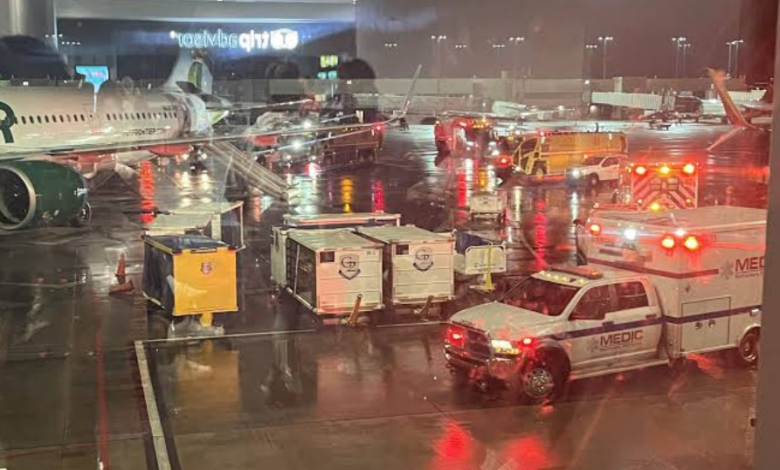
Passengers traveling through Charlotte Douglas International Airport faced an unexpected and lengthy disruption after a Frontier Airlines aircraft was damaged during preparations for a scheduled flight to New York. The incident happened while the plane remained parked at its gate, turning what was expected to be an ordinary departure into a complicated maintenance and safety response that delayed travelers for much of the day.
The aircraft involved was a Frontier Airlines Airbus A320neo assigned to flight F9 3134 from Charlotte, North Carolina, to New York’s LaGuardia Airport. The flight had been scheduled to make the relatively short journey between the two major East Coast cities on August 16, 2025. Passengers had reportedly already boarded or were completing the boarding process when the problem occurred.
During ground preparations, a large hose used to provide cooled air to the aircraft was drawn into the plane’s left engine. The hose was part of the ground equipment commonly used to keep the cabin comfortable while an aircraft is parked at a gate. It allows cooled air to circulate through the plane without requiring the aircraft to rely entirely on its own systems.
Under normal circumstances, ground crews connect and position this equipment carefully before departure. The equipment must then be disconnected, removed and secured before engines are started and the aircraft begins moving away from the gate. In this case, however, the hose came into contact with the engine and was pulled into its rotating fan area.
The event immediately brought the departure process to a halt. Airport and airline workers secured the area while maintenance personnel assessed the damage. Because the aircraft was still at the gate and had not begun its flight, crews were able to respond without the added danger of an emergency in the air.
No passengers, crew members or ground workers were reported injured. That outcome was especially important given the number of employees and pieces of equipment that may be positioned near an aircraft during boarding, baggage loading, catering, fueling and final departure preparations.
Although the incident did not result in injuries, it was serious enough to prevent the aircraft from continuing its scheduled journey. Any object entering a jet engine can damage fan blades and other internal components. Even when an engine appears to remain operational, engineers must examine it carefully before the aircraft can be considered safe to return to service.
Foreign-object damage is a significant concern throughout the aviation industry. Airports and airlines follow strict procedures designed to keep tools, debris, luggage equipment, hoses and other materials away from operating engines. A jet engine moves a large volume of air and can draw nearby objects toward its intake when running.
Once the hose entered the engine, the aircraft could no longer be used for the flight to LaGuardia. Frontier Airlines removed the plane from service and began arranging for a replacement aircraft. Passengers were required to leave the affected plane and return to the terminal while the airline worked on a new travel plan.
What followed was a delay of approximately nine hours for those booked on the flight. The replacement aircraft was not immediately available, requiring travelers to remain at Charlotte Douglas until another plane could be positioned and prepared for departure.
For passengers, such a long delay can affect far more than the flight itself. Travelers may miss connecting flights, scheduled transportation, hotel check-in times, family events, work commitments or other plans. Parents traveling with children may also need to manage meals, rest and entertainment during the extended wait.
Airline employees are often required to handle many concerns at once during this type of disruption. Gate agents must provide updates, answer questions, review connecting itineraries and assist passengers who may need to change their plans. At the same time, airline operations teams must locate an available plane and ensure that a qualified flight crew is ready to operate it.
Replacement aircraft cannot simply be moved into position without preparation. The plane must be available, inspected and properly assigned. Crews must also confirm that the aircraft has the necessary fuel, catering supplies, safety equipment and paperwork before passengers can board.
A delay lasting several hours can therefore result from a combination of factors rather than from the original incident alone. Even after the damaged aircraft is removed from the schedule, the airline must find another plane without causing major disruptions to additional flights elsewhere in its network.
Frontier eventually secured a replacement aircraft, allowing passengers to continue to New York. The flight arrived safely, and no further problems were reported. While the delay created considerable inconvenience, the decision not to use the damaged aircraft demonstrated the priority placed on safety.
Aviation procedures require that uncertainty be resolved before departure. An airline cannot assume that an engine remains safe after ingesting an object. Maintenance specialists must inspect the affected components, evaluate visible and hidden damage and determine what repairs or replacements are necessary.
The original Airbus A320neo remained out of service while engineers examined its left engine. Depending on the level of damage, an inspection may involve looking closely at fan blades, the engine casing and internal sections that cannot be fully evaluated from the outside.
Technicians may use specialized equipment to inspect areas deeper inside the engine. They must also check for fragments of the hose or other material that may have become lodged within the machinery. Even small pieces can cause further damage if the engine is operated before they are removed.
Each maintenance step must be documented. Airlines operate under strict technical standards, and aircraft can return to service only after qualified personnel approve the work. The process is designed to prevent pressure from flight schedules or passenger demand from overriding safety requirements.
The incident attracted attention partly because images and video of unusual aircraft events can circulate quickly online. Passengers watching from the terminal or sitting inside a plane may record what they see and post it on social media before airlines or airports release official statements.
Such footage can provide a striking view of an event, but it may not explain the technical causes. Investigators and maintenance experts must examine the equipment, review procedures and speak with the workers involved before determining exactly how the incident occurred.
The presence of a hose near an engine does not by itself reveal which action or failure caused it to be drawn inside. Investigators may consider whether the hose was properly positioned, whether it had been disconnected, whether communication between teams was clear and whether each stage of the departure process was completed in the correct order.
They may also review training records, equipment condition, staffing levels and the sequence in which the aircraft’s systems were activated. The goal is not only to identify responsibility but also to prevent the same event from happening again.
Ground operations involve close coordination among many workers. Pilots, gate agents, baggage handlers, maintenance personnel, pushback crews and other employees must communicate clearly as the aircraft is prepared to leave.
Before departure, teams use checklists and signals to confirm that doors are closed, baggage compartments are secured, equipment has been removed and the area around the plane is clear. If even one step is missed or misunderstood, the risk of an incident can increase.
Charlotte Douglas International Airport is one of the busiest airports in the United States, with aircraft arriving and departing throughout the day. Its gates, taxiways and ramps are active working environments where teams must operate efficiently without sacrificing attention to detail.
Busy conditions can increase the importance of clear procedures. Workers may be handling several aircraft within a limited area, and flights often operate on tight schedules. However, safety standards require ground personnel to stop operations whenever they notice a hazard or uncertainty.
In this case, activities around the Frontier plane were halted after the hose entered the engine. The aircraft stayed on the ground, passengers were removed safely and maintenance workers took control of the situation.
The incident also illustrates why delays are sometimes necessary even when travelers cannot immediately see the problem. A passenger may view a grounded aircraft from the terminal and wonder why it cannot simply depart once the visible debris has been removed.
Jet engines, however, are complex machines that operate under extreme conditions. Damage that appears small from outside may affect the engine’s performance or reliability. A thorough inspection can take hours, and repairs may require specialized parts or technicians.
Airlines generally prefer to delay or cancel a flight rather than risk operating an aircraft with an unresolved mechanical concern. Although passengers may be frustrated, a delay gives maintenance teams the time needed to make a careful decision.
The safety systems surrounding commercial aviation include multiple layers. Ground workers inspect and service the plane, flight crews complete their own checks, maintenance personnel address technical concerns and airline operations teams monitor whether the aircraft is legally and mechanically permitted to fly.
These overlapping responsibilities help catch problems before departure. The Charlotte incident was disruptive, but it remained a ground event rather than developing into an in-flight emergency.
The fact that no one was injured should not reduce the importance of examining what happened. Aviation safety improves when airlines study incidents as well as major accidents. A situation that ends without injury may still reveal a weakness in procedures, equipment placement or communication.
Safety investigations often focus on systems rather than a single person. Human errors can occur, especially in busy workplaces, so procedures should be designed to make those errors less likely and to prevent one mistake from producing a serious outcome.
For example, equipment may be marked, positioned or secured in ways that make hazards easier to notice. Checklists may require workers to confirm removal before engine activation. Communication steps may be revised so that one team cannot proceed until another team has provided clear confirmation.
Training can also be updated using lessons from real incidents. Ground employees may review how engine intake areas should be managed, how hoses must be stored and what warning signs require an immediate stop.
Airports and airlines regularly conduct safety briefings because ramp environments contain several hazards. Jet engines, moving vehicles, baggage equipment and aircraft surfaces all require workers to remain alert.
Hearing protection, high-visibility clothing and marked safety zones are among the measures used to protect employees. Procedures also limit who may enter certain areas when an engine is running or preparing to start.
The hose involved in the Charlotte incident was used for preconditioned air, which helps cool the cabin while the aircraft is parked. This service is particularly useful during hot weather, when temperatures inside a plane can rise quickly.
Using ground-supplied air can also reduce the need to operate the aircraft’s auxiliary power unit continuously. The auxiliary power unit is a smaller engine that provides electricity and air conditioning while the main engines are not operating.
Ground systems can therefore support passenger comfort and airport efficiency, but the equipment must be disconnected and cleared before departure. Large hoses can be heavy and may extend across part of the working area beneath or beside the aircraft.
The workers responsible for preparing a flight may be employed by the airline, airport or a contracted ground-handling company. Determining which organization was responsible for the equipment would form part of any internal review.
Frontier Airlines apologized to the affected travelers and praised the airport staff’s response. The airline also indicated that the circumstances would be investigated to understand what led to the event.
An internal investigation may examine video from the gate, equipment logs and statements from employees. Investigators may compare the workers’ actions with established procedures and determine whether any equipment malfunction contributed.
Airport security and surveillance cameras frequently cover gate and ramp areas. Recordings can help establish the timing of events and show where the hose was positioned before it entered the engine.
The aircraft’s own systems may also provide relevant information. Maintenance records and cockpit data can show when the engine was started and whether any warnings appeared.
The purpose of reviewing this information is to create an accurate sequence. Investigators need to understand what happened first, what actions followed and at what point the danger became apparent.
Accurate timelines are important because early descriptions of an incident may be incomplete. Passengers see events from different locations and may not know what workers were doing outside the aircraft.
One traveler may hear an unusual noise, another may see ground employees running toward the plane and another may notice that the departure time has changed. Each observation can be genuine while still representing only part of the situation.
Official findings therefore require more than social media videos or witness comments. Technical specialists must examine the aircraft and equipment while investigators gather information from all involved parties.
The delay also demonstrated the challenges low-cost and traditional airlines face when an aircraft unexpectedly becomes unavailable. Airlines plan schedules carefully, often using the same plane for several flights during one day.
When one aircraft is damaged, the disruption can spread through the schedule. A plane that was expected to fly from Charlotte to New York may have been assigned to additional routes later in the day.
Replacing it can require adjustments to other flights, aircraft swaps or crew assignments. Airlines must balance the needs of passengers on the affected flight with the risk of creating new delays elsewhere.
Charlotte Douglas is a major hub for air travel, and disruptions there can affect passengers across the country. Many travelers use the airport to connect between cities rather than as their final destination.
The Frontier flight involved a direct journey to LaGuardia, but some passengers may still have had onward arrangements after reaching New York. The nine-hour delay could have forced them to change transportation or accommodation plans.
LaGuardia also operates under busy air-traffic conditions, and flight schedules are coordinated around available departure and arrival times. A replacement flight leaving many hours late may need new approvals and updated operational planning.
Weather, traffic congestion and crew duty limits can further complicate recovery. Pilots and flight attendants may only work a certain number of hours before rest is required. If a delay becomes long enough, the airline may need to locate a replacement crew in addition to another aircraft.
Despite these difficulties, Frontier was able to operate the flight later that day. For passengers, finally boarding the replacement aircraft likely brought relief after hours of uncertainty.
Travelers affected by a major delay often seek clear information more than frequent promises. When departure times repeatedly change, frustration can grow. Airlines therefore try to provide updates even when the final solution has not yet been confirmed.
Gate employees may have limited control over how quickly a replacement aircraft arrives. They rely on information from operations teams, maintenance departments and flight crews. This can make communication difficult when circumstances are changing.
The incident serves as a reminder for passengers to monitor airline applications, airport displays and messages during delays. Travelers should also keep essential medication, identification, chargers and basic personal items in their carry-on luggage rather than in checked bags.
These precautions do not prevent delays, but they can make a long wait easier to manage. Passengers with connecting flights should speak with airline representatives as early as possible to explore alternative arrangements.
Families, elderly travelers and people with disabilities may require additional assistance when a flight is delayed for many hours. Airlines and airports should ensure that important updates are accessible and that travelers know where to request help.
The Charlotte event did not appear to cause a complete shutdown of the airport. The disruption was primarily connected to the affected Frontier flight and the gate area where the aircraft was parked.
Other airport operations were able to continue, although activity near the plane may have been temporarily restricted while workers secured equipment and examined the aircraft.
Reports describing the airport as facing flight delays should therefore be understood in the context of the incident. The most significant delay involved the passengers scheduled to travel on flight F9 3134.
The aircraft itself was identified in aviation reports as registration N365FR, an Airbus A320-251N. Aircraft registrations function somewhat like identification numbers, allowing maintenance history, operations and incidents to be connected to a specific plane.
The A320neo belongs to a widely used family of narrow-body passenger aircraft. Airlines around the world use these planes for domestic and regional routes.
The term “neo” refers to a newer engine option designed to improve fuel efficiency and reduce operating costs. Like all commercial aircraft, the plane is subject to routine inspections and maintenance standards.
An incident involving one aircraft does not mean that the aircraft type as a whole is unsafe. The Charlotte event involved external ground equipment entering the engine during gate operations rather than a reported design failure during flight.
This distinction is important when discussing aviation events. Mechanical failures, operational errors, weather problems and ground-handling incidents have different causes and require different responses.
Public reports sometimes use dramatic language when describing unusual aircraft events. Responsible coverage should explain what is confirmed without suggesting that passengers faced dangers that were not reported.
In this case, the essential facts were that the aircraft was at the gate, a ground air-conditioning hose entered the left engine, the plane was removed from service, no injuries were reported and passengers experienced a lengthy delay before traveling on another aircraft.
Claims beyond those facts should be treated cautiously unless supported by an official investigation or statement. The precise cause and responsibility cannot be determined only from images of the damaged equipment.
The aviation industry is built around learning from unexpected events. Reports may be shared within the airline or among safety organizations so that other crews can review the risks.
Even a rare event can lead to practical changes. An airline may alter where hoses are placed, require another visual inspection or revise the communication used before engine start.
Airport managers may examine whether gate design or equipment storage contributed. Contractors may introduce additional training or supervision.
The strongest safety cultures encourage workers to report hazards without fear that every mistake will automatically result in punishment. This allows organizations to identify weaknesses before they contribute to a more serious event.
At the same time, repeated violations or reckless actions must be addressed. A fair investigation distinguishes between an accidental mistake, inadequate training, equipment failure and intentional disregard for safety rules.
The Charlotte incident provides an opportunity to review all those possibilities carefully. The absence of injuries allows the organizations involved to study the event without also dealing with a medical emergency or loss of life.
Passengers may still experience stress during such situations, particularly when they hear unusual sounds or see damaged equipment. Airline staff should explain clearly that the aircraft will not depart until it has been inspected.
Knowing that another plane is being arranged can reassure travelers, even when the delay remains inconvenient. Transparent communication can prevent rumors and reduce fear.
Social media can make communication harder because unofficial claims may spread faster than verified information. Photos may be reposted with incorrect dates, flight numbers or descriptions.
Passengers and readers should check information against airline statements, airport announcements and established aviation records. They should also avoid identifying individual workers or assigning blame before an investigation is complete.
For Charlotte Douglas International Airport, the event was one of many situations that emergency and operations teams are trained to manage. Airport staff must be prepared for mechanical problems, medical emergencies, security concerns and severe weather.
Responses are designed to protect passengers while allowing unaffected parts of the airport to continue operating. Coordination between the airline and airport helped keep the incident contained to the ground.
The wider public often thinks about aviation safety mainly during takeoff and landing. Yet a significant amount of safety work takes place while the aircraft is parked.
Ground teams inspect the exterior, load baggage, service the cabin, connect power systems and prepare the plane for pushback. Every task must be completed around tight spaces and heavy machinery.
A safe flight therefore begins well before the pilots move the aircraft. The actions of ground employees are as important as those of the flight crew in preventing hazards.
The Charlotte incident emphasizes the importance of respecting engine safety zones. Jet engines create powerful suction, and objects positioned too close to the intake can be pulled inside.
Ground crews receive training on minimum distances and equipment placement. Clear markings and active supervision help reinforce those rules.
Aircraft engines also represent a danger to people, making it essential that workers never enter restricted areas while the engines are operating. In this event, no ground employee was injured, preventing what could have become a far more serious emergency.
After the replacement flight departed, the immediate disruption for passengers came to an end. The work surrounding the damaged plane, however, likely continued.
Maintenance teams needed to determine the full extent of the damage and decide whether repairs could be completed in Charlotte. If major work was required, engine specialists and replacement components may have been brought to the airport.
Aircraft downtime is expensive for an airline, but financial concerns cannot take priority over technical requirements. The plane must remain out of service until engineers confirm that it is safe.
Insurance companies, equipment contractors and airport authorities may also become involved in reviewing costs and responsibility. These matters can continue long after passengers reach their destination.
The public may never see every conclusion of an internal airline investigation. However, the most important outcome is that any lessons are turned into stronger procedures.
The event also offers a broader lesson about travel disruptions. A delay may begin with a single unexpected problem but expand because aviation systems are highly interconnected.
A damaged engine leads to an aircraft being removed from service. That creates a need for a replacement plane, new crew arrangements, revised departure approvals and updated passenger plans.
Each step requires coordination, which explains why the delay lasted far longer than the few moments in which the incident occurred.
Travelers naturally focus on the inconvenience, especially when they are given little information. Airlines can reduce frustration by explaining why a damaged aircraft cannot be quickly returned to service and what steps are being taken.
Passengers should never be pressured to accept an aircraft with an unresolved safety concern simply to preserve the schedule. Most travelers would prefer a delayed arrival over unnecessary risk.
The Charlotte incident ended without injuries, and the affected passengers ultimately continued to New York safely. That conclusion reflects the purpose of aviation safety procedures.
The plane remained on the ground, the hazard was contained and engineers were given time to inspect the damage. A replacement aircraft was used rather than attempting a rushed repair.
While the incident caused a difficult day for travelers, it also showed how the aviation system responds when routine operations go wrong. Workers stopped the departure, protected those nearby and prevented the damaged aircraft from flying.
The investigation should now focus on how the hose reached the engine and what changes can ensure that similar ground equipment remains clear in the future.
For passengers, the event will likely be remembered as an exhausting delay and an unusual view of airport operations. For Frontier Airlines and Charlotte airport personnel, it should be treated as a valuable safety warning.
Every flight depends on hundreds of tasks being performed correctly. Most of those tasks take place without passengers noticing them. When one step fails, the resulting incident reveals how important those behind-the-scenes procedures are.
Aviation remains safe not because unexpected events never happen, but because systems exist to detect problems, stop operations and learn from mistakes. The response at Charlotte prevented a damaged aircraft from leaving the gate and ensured that travelers completed their journey on another plane.
Although schedules were disrupted and passengers lost much of their day, the outcome remained far better than it might have been had the problem gone unnoticed. The incident demonstrates why caution, inspections and strict ground procedures must always take priority over an on-time departure.