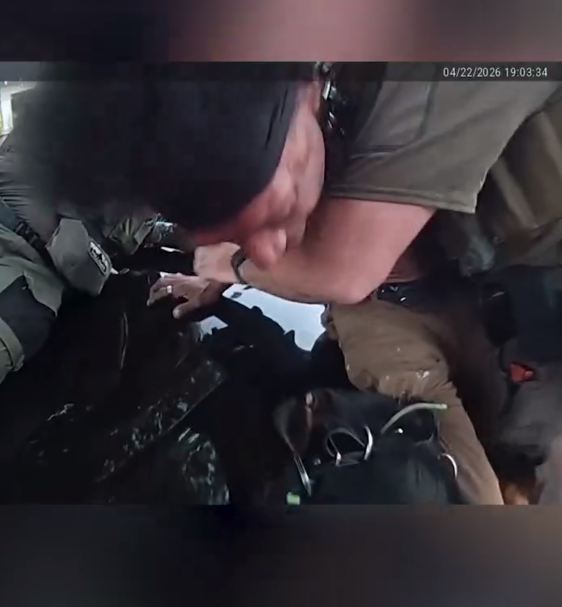
The release of body camera footage often provides a clearer and more complete understanding of events that unfold during law enforcement encounters, and in recent days, one such video from Florence, Alabama has drawn widespread attention online. The footage, which captures an unusual and intense moment during a police operation, shows a man biting a police K-9 during an arrest, an action that has sparked discussion across social media platforms and within the local community. While short clips of the incident have circulated rapidly, authorities have emphasized the importance of viewing the full footage to understand the context and sequence of events that led to the confrontation.
According to statements released by the Florence Police Department, the incident took place on April 22 during a coordinated drug operation conducted by the Lauderdale County Drug Task Force. The operation involved multiple agencies, including the Florence-Lauderdale SWAT team and the department’s K-9 unit. These types of operations are typically planned in advance and executed with a clear structure, involving specialized teams trained to handle potentially high-risk situations. Officers are tasked with maintaining control of the scene, ensuring safety, and executing search warrants in accordance with established procedures.
The situation began when officers arrived at a residence located in the 200 block of North Locus Street in Florence. Their objective was to carry out a search warrant as part of an ongoing investigation. During such operations, the environment can be tense and unpredictable, requiring officers to remain focused and vigilant. It is in these circumstances that maintaining order becomes essential, as unexpected interruptions or disruptions can increase the risk for both officers and civilians.
It was during this operation that David Culliver, a 46-year-old man from Sheffield, arrived at the scene. According to police, Culliver was not connected to the investigation that prompted the search warrant. However, his presence quickly became a focal point as he allegedly began to insert himself into the situation. The department stated that Culliver became increasingly agitated, raising his voice and directing his attention toward the officers conducting the operation.
Witness accounts and official statements suggest that Culliver’s behavior escalated rapidly. He reportedly began yelling at officers and moving into an active roadway where traffic was flowing. This action immediately introduced an additional safety concern, as standing or moving within a roadway can create dangerous conditions not only for the individual involved but also for drivers and other pedestrians. Officers on the scene reportedly instructed Culliver multiple times to move out of the roadway, emphasizing the potential danger he was placing himself in.
Despite repeated warnings, authorities say Culliver continued to disrupt the scene, stepping further into traffic and refusing to comply with commands. At this point, officers made the decision to place him under arrest, citing concerns for public safety as well as his interference with an active police operation. Arrest situations can quickly become complex, especially when individuals resist or fail to follow instructions, and officers are trained to use a range of techniques to gain control while minimizing harm.
According to the Florence Police Department, an officer initially attempted to place Culliver in handcuffs, but he resisted, pulling away and struggling against multiple officers. Resistance during an arrest introduces additional risks, often requiring officers to escalate their response in order to safely detain the individual. In such cases, the goal is to gain control as efficiently as possible while preventing injury to all parties involved.
As the struggle continued, a police K-9 was deployed to assist in the arrest. K-9 units are specifically trained to help officers in situations where a suspect is resisting or poses a risk, using controlled force to subdue individuals when necessary. The use of a K-9 is typically considered when other methods have not been successful in gaining compliance. These dogs undergo extensive training to respond to commands, maintain control, and disengage when directed by their handler.
During the attempt to apprehend Culliver, the situation took an unusual and highly concerning turn. Authorities reported that Culliver grabbed one of the K-9’s legs and bit the animal. This moment, captured on body camera footage, became the focal point of the video that later circulated online. The act of biting a police dog is not only rare but also considered a serious offense, as K-9 units are regarded as working officers and are protected under the law.
Officers responded quickly to the situation, striking Culliver in an effort to force him to release the dog. According to official statements, this use of force was intended to ensure the safety of the K-9 and bring the situation under control. Within moments, Culliver was taken to the ground and placed into handcuffs, effectively ending the immediate confrontation.
Following the arrest, Culliver was transported to the North Alabama Medical Center for treatment of injuries sustained during the encounter, including puncture wounds from the K-9. Medical evaluation is a standard procedure in situations where force has been used, ensuring that individuals receive necessary care before being processed further. After receiving treatment, Culliver was transported to the Lauderdale County Detention Center, where he was booked on multiple charges, including resisting arrest, disorderly conduct, public intoxication, and interfering with a police dog.
The Florence Police Department later confirmed that Culliver was being held on a bond set at $2,500. In addition to providing details about the arrest, the department took the step of releasing the full body camera footage on YouTube. This decision was described as an effort to promote transparency and provide a complete account of the incident, particularly in response to shorter clips that had already begun circulating online.
In their statement, the department emphasized that brief videos shared on social media can often present an incomplete or misleading picture of events. By making the full footage available, they aimed to ensure that viewers could see the entire sequence of actions leading up to and during the arrest. This approach reflects a growing trend among law enforcement agencies to use body camera footage as a tool for accountability and public communication.
The release of such footage also highlights the evolving role of technology in policing. Body cameras have become an important part of modern law enforcement, providing objective records of interactions that can be reviewed by investigators, courts, and the public. While these recordings can offer valuable insights, they also require careful interpretation, as context and perspective play significant roles in understanding what is captured on camera.
Lauderdale County Sheriff Joe Hamilton also addressed the incident, confirming that a deputy from the SWAT team was involved in the arrest. In his statement, Hamilton supported the actions taken by the officers, particularly the decision to strike Culliver after he bit the K-9. He described the action as necessary to ensure compliance and protect the animal, noting that it aligned with departmental use-of-force policies.
Statements from law enforcement officials often play a key role in shaping public understanding of incidents like this. By outlining the reasoning behind specific actions, departments aim to provide clarity and reinforce the procedures that guide their operations. At the same time, such statements can prompt further discussion and analysis, particularly when incidents gain attention beyond the local community.
Public reaction to the video has been varied, reflecting the complexity of the situation. Some viewers have expressed support for the officers, emphasizing the challenges of managing unpredictable and potentially dangerous encounters. Others have focused on the unusual nature of the incident, particularly the moment involving the K-9, which stands out as a rare occurrence even within the context of law enforcement operations.
The involvement of a police dog adds another dimension to the discussion, as K-9 units hold a unique place within law enforcement. These animals are trained to perform a wide range of tasks, from tracking suspects to detecting substances, and they often work in close coordination with their handlers. The bond between a handler and a K-9 is typically strong, built through extensive training and shared experience. Incidents that involve harm to these animals can therefore generate strong reactions from both law enforcement personnel and the public.
At a broader level, the incident raises questions about how confrontations between civilians and law enforcement can escalate and how they might be prevented. Situations that begin with relatively minor disruptions can quickly develop into more serious encounters when communication breaks down or individuals fail to comply with instructions. Understanding the factors that contribute to escalation is an important step in identifying ways to reduce risk and improve outcomes.
Education and awareness can play a role in this process, helping individuals understand how to respond during interactions with law enforcement. Clear communication, compliance with instructions, and awareness of one’s surroundings can all contribute to safer outcomes. At the same time, law enforcement agencies continue to refine their training and procedures, seeking ways to manage situations effectively while minimizing the use of force.
The Florence incident also illustrates the importance of context in evaluating events. Without a full understanding of the sequence of actions, it can be difficult to form accurate conclusions. This is particularly true in the age of social media, where short clips can spread rapidly and shape perceptions before complete information is available. The release of full footage is one way to address this challenge, providing a more comprehensive view of what occurred.
As discussions continue, the incident serves as a reminder of the unpredictable nature of law enforcement work. Officers are often required to respond to situations that develop quickly and involve multiple variables, from individual behavior to environmental factors. Their ability to adapt and make decisions in real time is a critical aspect of their role, and it is often tested in moments like the one captured in this video.
In the end, the story of the Florence arrest is not defined solely by a single moment, but by the sequence of events that led to it and the responses that followed. It highlights the importance of communication, the challenges of managing public safety, and the role of transparency in shaping public understanding. As with many incidents that gain attention, it also contributes to ongoing conversations about law enforcement practices, community interactions, and the ways in which complex situations can be better understood and addressed.