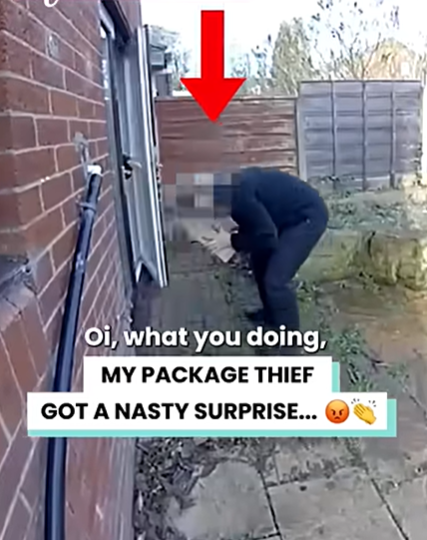
A confrontation over a stolen package quickly turned into a surprising lesson for one young man after a homeowner caught him on camera and later faced an angry visit from his father. What began as a simple theft from a front doorstep became a tense neighborhood moment involving accusations, denial, security footage, and consequences at home.
The video begins with the homeowner noticing a young man on her property near where a package had been left. From the way the scene unfolds, it appears she immediately recognizes what is happening. The young man is not simply passing by or standing near the house. He is close to the package, bending down and acting in a way that raises suspicion. The homeowner reacts quickly, calling out to him and making it clear that she has caught him in the act.
The moment becomes even more dramatic when the homeowner throws a bucket of water over him. The water soaks the young man, surprising him and sending him running away from the property. It is a sudden and humiliating moment, and it appears to be the homeowner’s way of stopping him or at least making sure he understands that his actions have not gone unnoticed.
For the homeowner, the reaction seems to come from frustration rather than just one isolated incident. According to her, this was not the first time packages had gone missing from her home. She later explains that items had been disappearing for months, leaving her suspicious, annoyed, and likely feeling targeted. Package theft can feel deeply personal because it happens right at someone’s home, a place where people expect safety and respect.
About an hour later, the situation escalates when the young man returns, this time with his father. The father appears angry and defensive, believing his son’s version of the story. According to him, the boy had claimed he was only sitting on a wall and had done nothing wrong. From the father’s point of view, the homeowner had unfairly soaked his son without any real reason.
The father confronts the homeowner, demanding to know why she threw water on his child. He seems convinced that his son was innocent and that the homeowner had overreacted. At this stage, the father appears to believe he is standing up for his child against an adult who treated him unfairly. He has likely come to the house expecting an apology or at least an explanation.
The homeowner, however, does not back down. Instead, she calmly begins explaining that the young man was not simply sitting on a wall. She says he had been stealing packages from her property and that this had been happening for some time. She specifically mentions missing items, including an Xbox and cleaning supplies, making it clear that the problem was not just one small parcel.
This changes the tone of the confrontation almost immediately. The father, who arrived ready to defend his son, suddenly hears information that does not match what he was told. The mention of the Xbox is especially important because it connects directly to something the father recognizes. According to the homeowner, the father realizes that the Xbox in his son’s bedroom may not have been bought honestly after all.
The father had apparently believed his son’s earlier explanation that the Xbox had been purchased from a friend for £50. At the time, that may have seemed suspicious but not impossible. Many teenagers buy second-hand items from friends, and a parent may accept that explanation if they have no reason to believe otherwise. But when the homeowner says an Xbox had been stolen from her packages, the father begins to understand that his son may have lied to him.
The young man is then placed in an uncomfortable position. His father is no longer simply arguing with the homeowner. He is now questioning his own son. The situation shifts from a neighbor dispute to a family confrontation. The son’s story begins to fall apart, and the father’s anger turns from the homeowner toward the boy.
Still, the father asks for proof. This is a natural reaction, especially when the accusation is serious. No parent wants to believe their child has been stealing from neighbors, and before accepting it, he wants evidence. The homeowner then shows him security footage from her Ring doorbell camera.
That footage becomes the turning point. The camera appears to show the young man taking packages from the property, making it difficult for him to deny what happened. The homeowner’s claim is no longer just an accusation. It is supported by video evidence, and the father has to face the reality that his son lied to him.
Once the proof is shown, the young man confesses. He apologizes to his father, seemingly realizing that he cannot talk his way out of the situation anymore. The apology appears to be directed more toward his dad than the homeowner, which shows how much the exposure has affected him. He is not only caught stealing; he is caught lying to his family.
The father’s reaction is a mix of anger, embarrassment, and disappointment. He came to the homeowner’s property believing his son had been mistreated, only to find out that his son had misled him. That kind of public embarrassment can be difficult for any parent, especially when they defended their child so strongly before learning the truth.
As a consequence, the father cancels a trip the boy had been looking forward to the following week. Instead of going away, the boy is ordered to stay home and do chores. The punishment is direct and meaningful because it takes away something the boy wanted and replaces it with responsibility. The father appears determined to make sure his son understands that stealing and lying come with consequences.
The video stands out because it shows how quickly a situation can change once evidence is introduced. At first, the father believes he is confronting a homeowner for treating his son unfairly. But after hearing the homeowner’s side and seeing the footage, he realizes the person he should be confronting is his own child.
The homeowner’s frustration is understandable. Package theft has become a common problem in many neighborhoods, especially with more people ordering items online. A package left outside a door can disappear within minutes, and unless there is a camera, it can be difficult to prove who took it. For victims, it is not only about the cost of the item. It is also about the feeling that someone has crossed a boundary and taken something from their home.
The fact that the homeowner mentioned multiple stolen items suggests that she may have been dealing with this for a long time. Missing cleaning supplies may seem minor, but over time, repeated thefts can become exhausting. The stolen Xbox, however, appears to be a much bigger loss. That detail makes the father’s realization even more serious, because it connects the alleged theft to something already inside his home.
The father’s initial defense of his son also makes the story more relatable. Many parents naturally want to believe their children. When a child comes home upset and says someone treated them unfairly, a parent’s first instinct may be to protect them. In this case, the father seems to have trusted his son’s version without knowing all the facts.
But the confrontation shows the danger of reacting before hearing both sides. The father walked into the situation angry, believing the homeowner had done something wrong. Once the truth came out, he had to reverse his position in front of the same person he had accused. That made the moment more embarrassing and likely more upsetting for him.
For the young man, the consequences go beyond losing a trip. He has lost trust. His father now knows he lied about what happened at the house, and he may also have lied about where the Xbox came from. Rebuilding that trust may take much longer than doing chores or missing one outing.
The homeowner, meanwhile, appears to have finally reached a moment of validation. After dealing with missing packages and possibly wondering who was responsible, she was able to show proof. The camera footage gave her the evidence she needed, not only to defend herself but also to reveal the truth to the boy’s father.
The video also highlights the role of home security cameras in modern neighborhood disputes. Without the Ring footage, the confrontation may have ended very differently. The father might have continued believing his son, and the homeowner might have been left trying to prove something with only her word. The footage removed much of the uncertainty and forced the truth into the open.
At the same time, the homeowner’s decision to throw water on the boy is likely to divide opinions. Some people may see it as a funny or harmless reaction to catching a thief. Others may argue that it was not the best way to handle the situation and that she should have simply recorded him or called authorities. Either way, the video makes clear that her reaction came from catching someone she believed had been repeatedly stealing from her.
The father’s response after seeing the evidence is also important. Instead of continuing to deny everything or blame the homeowner, he appears to accept the truth. He confronts his son, expresses anger at being lied to, and gives him a consequence. That shift shows that although he arrived defensively, he was willing to change his view when shown proof.
The boy’s confession brings the confrontation to a close, but it does not erase the damage. The homeowner still lost packages. The father still has to deal with his son’s behavior. The boy still has to face the consequences of both theft and dishonesty. A few stolen items have now created a much bigger problem involving family trust, neighborhood tension, and personal accountability.
The story also shows how one bad decision can lead to many others. The young man allegedly took packages, then lied about what happened, then allowed his father to confront the homeowner based on that lie. Each step made the situation worse. If he had admitted the truth earlier, the confrontation may not have escalated in the same way.
For the father, the most painful part may not have been the theft itself, but the fact that his son let him defend a false story. Parents often feel responsible for their children’s behavior, especially when that behavior affects other people. Being placed in a position where he publicly defended his son, only to be shown proof that the son lied, likely made him feel humiliated.
The homeowner’s use of specific examples, like the Xbox and cleaning supplies, made the accusation harder to dismiss. Instead of making a vague claim that “packages have gone missing,” she pointed to real items. That made the father think back to what he had seen at home and connect the dots. The Xbox became the detail that exposed the lie.
This is why the moment is so dramatic. It is not just a homeowner catching someone taking a parcel. It is a father realizing, in real time, that something in his son’s room may have come from a neighbor’s doorstep. That realization changes everything. The father is forced to move from anger at the homeowner to disappointment in his child.
The canceled trip becomes a symbol of that disappointment. It shows the father wants his son to understand the seriousness of what happened. A trip is a privilege, and by taking it away, the father is making it clear that trust and good behavior matter. Staying home to do chores is not just a punishment; it is a way of replacing fun with responsibility.
The video also offers a broader reminder about honesty. The young man’s first mistake may have been taking the packages, but the lie afterward made the situation far worse. Once his father became involved, the lie affected another person too. His father’s reputation and pride were pulled into the situation because he trusted what his son told him.
For neighbors, incidents like this can create lasting unease. A package thief is not just a stranger passing through; in this case, the alleged thief appears to be someone from nearby. That can make residents feel uncomfortable because it suggests the problem is close to home. People may start watching their doorsteps more carefully, checking cameras more often, or feeling suspicious of people in the area.
For the homeowner, catching the thief may bring relief, but it may also bring frustration that it took so long. If packages had truly been disappearing for months, then this confrontation was likely the result of built-up anger. The bucket of water may have been a sudden reaction after finally seeing the person she believed was responsible.
The incident is also a reminder that small crimes can have large consequences. A stolen parcel may seem minor to the person taking it, especially if they convince themselves it is not a big deal. But for the victim, it can mean lost money, stress, delayed deliveries, and the feeling of being violated. For the thief, being caught can lead to family conflict, punishment, embarrassment, and possibly legal consequences.
In the end, the confrontation did not unfold the way the father expected. He arrived ready to defend his son, believing the homeowner had unfairly soaked him for sitting on a wall. Instead, he left knowing that his son had been caught stealing, had lied about it, and had possibly brought stolen property into their home.
The homeowner, meanwhile, was able to stand her ground because she had proof. The security footage turned the conversation from a heated argument into an undeniable moment of accountability. Once the video was shown, the son’s story could no longer hold up.
What began as a package theft became a lesson in truth, trust, and consequences. The young man lost more than a dry set of clothes when the homeowner threw water on him. He lost his father’s confidence, his upcoming trip, and the ability to pretend that his actions had gone unnoticed. The father, though embarrassed, responded by holding him accountable. And the homeowner finally had the evidence she needed to show that the problem on her doorstep was real.
The situation also shows how important it is for parents to pause before reacting to a child’s version of events. The father’s first instinct was to protect his son, which is understandable. Many parents would feel angry if their child came home soaked and claimed that an adult had done it for no reason. But children and teenagers sometimes tell only the part of the story that makes them look innocent. In this case, the boy reportedly left out the most important detail: he had been caught taking a package from someone else’s property.
That missing detail completely changed the meaning of the incident. Without it, the homeowner looked unreasonable. With it, the homeowner looked like someone who had finally reached the end of her patience after repeated thefts. The father arrived thinking he was demanding justice, but he ended up discovering that the person who owed an apology was not the homeowner. It was his son.
The public embarrassment may have made the lesson even stronger. The boy was not only caught by the homeowner; he was caught in front of his father. He had to stand there while the lie unraveled piece by piece. First, the homeowner challenged his story. Then she mentioned the stolen items. Then the Xbox became part of the conversation. Finally, the security footage removed any possible excuse. By the end, there was nowhere left for him to hide from the truth.
For the homeowner, the security camera became more than just a device for monitoring the front door. It became protection against being falsely accused. Without the footage, the father may have continued insisting that his son was innocent. The homeowner may have been forced into a shouting match with no clear way to prove what had happened. But the video gave her confidence. She could say, in effect, that this was not about opinion or misunderstanding. The camera had recorded the behavior.
This is one reason many homeowners now rely on doorbell cameras and outdoor security systems. Package deliveries have become a normal part of daily life, but so have concerns about porch theft. People order valuable items, household supplies, gifts, electronics, clothes, and groceries, and those packages often sit outside until someone gets home. A camera cannot always stop a theft, but it can help identify what happened and who was involved.
The incident also raises a larger question about how young people understand consequences. The boy may have thought taking a package was easy and low-risk. He may have assumed no one would notice, or that even if they did, they could not prove it. But each package belonged to someone. Each missing delivery created frustration for the homeowner. And once the pattern continued, it became more likely that the homeowner would start watching carefully.
What may have seemed like a small act to the boy became a serious breach of trust. In a neighborhood, people often depend on basic respect from those around them. They expect that a package left at the door will still be there later. They expect that neighbors, including young people, will understand the difference between public space and private property. When someone from nearby is accused of stealing from porches, it can make everyone feel less secure.
The father’s decision to cancel the trip was likely about more than punishment. It was a message that privileges are connected to responsibility. A child who lies, steals, and allows a parent to defend that lie cannot simply continue as if nothing happened. By canceling something the boy had been excited about, the father made the consequence feel real. The chores were also symbolic. Instead of enjoying a trip, the boy would spend time at home doing something productive and reflecting on what he had done.
Some viewers might feel the punishment was strict, while others might say it was exactly what was needed. But the father’s response showed that he took the matter seriously once the truth became clear. He did not continue making excuses for his son. He did not blame the homeowner after seeing the evidence. He turned his attention to the person responsible and made it clear that lying had only made everything worse.
The apology, while important, was only the beginning. Saying sorry after being caught is different from taking full responsibility. The boy would likely need to return or repay what was stolen, depending on what happened to the missing items. If the Xbox truly came from the homeowner’s stolen package, then the father may also have to deal with returning it or compensating the victim. The cleaning supplies and any other missing packages would also need to be addressed if the family wanted to make things right.
The homeowner may also be left wondering how many times the boy had visited her property without being noticed. That can be unsettling. Package theft is not just about the item that disappears. It is about the thought of someone repeatedly coming close to your front door, looking around, and taking what does not belong to them. For many people, that creates a feeling of vulnerability.
The father’s embarrassment may eventually turn into a difficult conversation at home. He may have to ask his son why he stole, how long it had been happening, whether anyone else was involved, and what he planned to do to repair the damage. Those conversations are not easy, but they are necessary. If the issue is ignored or treated as a one-time mistake, the lesson may not last. If handled seriously, it could become a turning point.