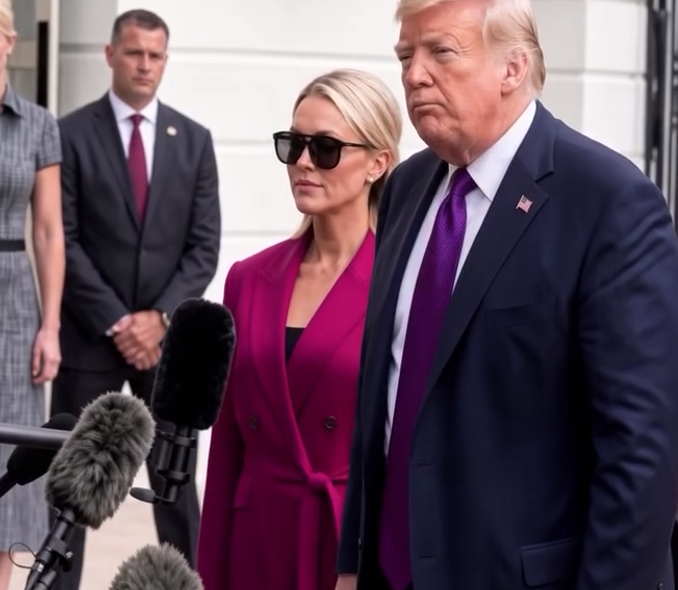
President Donald Trump offered unusually personal praise for outgoing White House press secretary Karoline Leavitt as her departure from the administration approached, calling one of his most visible aides effectively “irreplaceable” and highlighting a relationship that developed through the 2024 presidential campaign, the presidential transition and nearly two years inside the White House.
The remarks came during an August interview with Fox News correspondent Alexis McAdams after Leavitt announced that she would leave her position at the end of the month to spend more time with her family. Trump had already described Leavitt as one of his “most trusted aides” and announced that she would remain connected to his political operation as an outside adviser after leaving the White House.
When McAdams asked Trump directly whether Leavitt was replaceable, his response was immediate.
“No, she’s not. She really isn’t,” Trump said, noting that Leavitt was standing nearby and adding that she had “done a great job.”
The exchange then became more lighthearted. Trump joked that he had discovered Leavitt liked her children more than she liked him, pretending to be concerned about that fact as he acknowledged the family considerations behind her decision. Asked who might take her place at the White House podium, Trump jokingly suggested McAdams herself.
The comments captured something unusual about Leavitt’s departure. This was not being presented by the administration as a political firing, a demotion or the consequence of a falling-out with the president. Instead, Trump publicly praised her work while acknowledging that the demands of raising a young family had become an important factor in her decision to leave one of Washington’s most relentless communications jobs.
Leavitt had recently returned from maternity leave after giving birth to her second child in May. The demands of the White House press secretary position are considerable under any president, but serving as Donald Trump’s chief public spokesperson carries a particularly intense workload because of the speed at which Trump generates news, the number of issues surrounding his administration and his direct relationship with both traditional and social media.
Leavitt’s departure therefore closes an important chapter in Trump’s second administration.
At 28, she had already established herself as one of its most recognizable figures.
When Trump selected her as White House press secretary following his 2024 election victory, Leavitt became the youngest person ever appointed to the position. She had already served as national press secretary for Trump’s 2024 campaign and as a spokeswoman during the transition, giving her an unusually close understanding of the president’s communication style before she ever stepped behind the White House briefing-room podium.
That background proved important.
Trump is not a conventional political communicator.
He frequently speaks directly to reporters, calls television programs, publishes messages online and makes major announcements himself. He can change the news cycle with a short statement or social-media post, sometimes leaving administration officials with little time to prepare before reporters begin demanding explanations.
A Trump press secretary therefore faces a different challenge from someone serving a president whose public communications are tightly scripted.
The job requires reacting rapidly.
It requires knowing the president’s position.
It requires defending policies across an enormous range of subjects.
And perhaps most importantly in Trump’s political operation, it requires understanding how Trump himself communicates.
Leavitt appeared comfortable operating within that environment.
Her briefings were often confrontational and highly partisan. Supporters saw that approach as one of her greatest strengths, arguing that she refused to allow hostile reporters to dictate the terms of White House communications. Critics reached almost exactly the opposite conclusion, accusing her of treating legitimate scrutiny as political opposition and transforming the traditional press-secretary role into an extension of Trump’s political messaging.
Those competing interpretations became central to her public identity.
Leavitt was rarely a neutral presence at the podium.
She defended Trump aggressively.
She challenged premises she believed were misleading.
She criticized news organizations.
She frequently accused reporters of approaching stories with political bias.
And she became a recognizable media personality in her own right rather than remaining an anonymous spokesperson standing behind the president.
That visibility explains why replacing her is more complicated than simply assigning someone else to read prepared statements.
The White House press secretary performs several jobs simultaneously.
The most visible is conducting press briefings.
But much of the actual work happens away from television cameras.
The press secretary coordinates with senior officials, communications staff, policy advisers and the president. The office must understand developing stories before reporters begin asking about them. It must determine what information can be released, what remains classified or sensitive and how the administration wants to frame complicated policy decisions.
When international crises erupt, those responsibilities become more difficult.
When Congress is negotiating legislation, reporters want to know the president’s position.
When economic statistics are released, the White House needs a response.
When an administration official creates controversy, questions arrive immediately.
When the president makes an unexpected remark, the press office may have to explain what he meant.
A successful press secretary therefore requires more than confidence in front of cameras.
The job demands an enormous command of information.
Trump’s description of Leavitt as effectively irreplaceable reflects how difficult it can be to find someone capable of performing all of those functions while maintaining the president’s confidence.
That final requirement may be the most important.
Presidents need to trust the person speaking publicly on their behalf.
A press secretary who does not understand the president’s thinking can create contradictions.
A spokesperson who lacks access to the president can become ineffective.
A spokesperson who loses the president’s confidence rarely survives long.
Leavitt entered the second Trump administration with an advantage because she had already worked closely with his campaign.
She understood his political instincts.
She knew the issues that motivated his supporters.
She understood the language the campaign had used successfully during the election.
And she was comfortable defending Trump against aggressive questioning.
Trump clearly valued those characteristics.
His public praise surrounding her departure was not the first time the word “irreplaceable” had become associated with Leavitt.
Earlier in 2026, while Leavitt was on maternity leave, Secretary of State Marco Rubio temporarily stepped behind the briefing-room podium. Rubio later joked that he was merely a “pinch-hitter” and said, “Karoline is irreplaceable,” adding that he could not wait for her to return.
Trump had also previously praised Leavitt in similar terms when discussing whether she could be replaced.
The repetition reveals how central she had become to the administration’s public presentation.
Yet no White House official is literally irreplaceable.
Presidents change advisers.
Press secretaries leave.
Cabinet secretaries resign.
Chiefs of staff come and go.
Administrations continue.
The significance of Trump’s wording lies less in the literal claim than in what it reveals about his assessment of Leavitt’s performance.
For a president famously willing to criticize aides who disappoint him, such praise carries particular political meaning.
Trump’s relationship with staff has historically been intensely performance-driven.
During both his business career and political life, he has publicly celebrated people he considers effective and turned sharply against some former allies after relationships deteriorated.
Leavitt left under very different circumstances.
Rather than distancing himself from her, Trump announced that she would continue working with him from outside the White House.
When announcing her departure on August 12, Trump said she would become one of his top outside advisers and predicted that she would remain an influential Republican voice as the party focused on the midterm elections.
That detail is important.
Leavitt is leaving the press secretary position.
She is not necessarily leaving Trump’s political world.
The transition could instead expand her options.
A White House press secretary speaks under significant constraints.
Every public statement can be interpreted as an official administration position.
A former press secretary operating as an outside adviser can appear on television, participate in political campaigns, advise candidates and engage more freely in partisan politics.
Leavitt’s experience gives her substantial value in that environment.
She knows the administration from inside.
She has national name recognition.
She understands television.
She has relationships throughout Republican politics.
And she has demonstrated that she can communicate Trump’s political message to his supporters.
That combination could make her influential during the next phase of Republican politics.
Trump’s decision to mention the midterms when announcing her departure suggests he already sees a political role for her beyond the briefing room.
For Leavitt herself, however, the decision was publicly framed around family.
“Serving as the White House Press Secretary over the past year and a half has been the honor and adventure of a lifetime,” she said when announcing that she would step down.
Her departure came shortly after the birth of her second child.
Balancing motherhood with senior White House service had already been a visible part of Leavitt’s story.
She gave birth to her first child during the 2024 presidential campaign. That happened just days before the attempted assassination of Trump in Butler, Pennsylvania. She returned to campaign work unusually quickly after the shooting, illustrating the extraordinary demands of presidential politics and the personal commitment she had made to Trump’s campaign.
Her second maternity leave offered a different moment.
By then Trump had returned to the presidency.
Leavitt was no longer fighting to win an election.
She was managing one of the most demanding communications operations in American government while raising two very young children.
The conflict between those responsibilities is easy to understand.
The White House does not operate according to predictable working hours.
International crises happen overnight.
Presidents travel.
Breaking news erupts on weekends.
Political controversies do not wait until children are asleep.
A press secretary cannot simply stop paying attention at five o’clock.
That makes the job extraordinarily difficult for any parent.
Trump’s joke about Leavitt preferring her children to him therefore carried an acknowledgment beneath the humor.
He understood what she had chosen.
And publicly, at least, he supported it.
That gave their exchange a warmer tone than the dramatic description “emotional interview” might imply. The verified conversation was affectionate and humorous rather than a lengthy emotional farewell. Trump praised her, joked about her family priorities and made clear that he did not believe replacing her would be easy.
The reaction to her departure nevertheless reflected the polarization surrounding her tenure.
Supporters celebrated Leavitt as one of the most effective press secretaries of the modern era.
They admired her ability to confront journalists directly, communicate without appearing intimidated and defend the president even when briefings became hostile.
For Trump’s political base, her willingness to challenge major news organizations was not a violation of the traditional role.
It was part of the reason they liked her.
Trump supporters have long believed that major American news organizations treat him and conservative voters unfairly.
From that perspective, a press secretary who aggressively challenges reporters is not undermining journalism.
She is correcting what supporters regard as an unequal relationship in which journalists previously controlled the conversation.
Leavitt’s critics see something very different.
They argue that a White House press secretary has an obligation to provide accurate information to journalists regardless of political disagreements and contend that her confrontational approach frequently blurred the distinction between government communication and partisan campaigning.
Some media critics accused her of attacking reporters rather than answering difficult questions.
Others objected to changes in White House press access during her tenure and argued that the administration favored friendlier conservative or alternative-media personalities.
Those criticisms form part of her legacy too.
An accurate assessment of Leavitt’s tenure therefore cannot simply describe her as universally admired or universally condemned.
She was effective according to the objectives Trump appears to value.
Whether those objectives strengthened or weakened the traditional relationship between the White House and the press is a separate and contested question.
The press secretary has always occupied an unusual position.
The person standing behind the podium is employed by the president, not by journalists.
Their job includes advocating for administration policies.
Every modern press secretary engages in political messaging.
Yet the position also functions as an important information channel between the executive branch and the public.
Reporters ask questions because citizens cannot personally walk into the Oval Office and demand answers from the president.
That creates an inherent tension.
The press secretary wants to present the administration positively.
Journalists want information the administration may prefer not to discuss.
The briefing room exists at the point where those interests collide.
Leavitt rarely attempted to disguise that conflict.
She approached many briefings almost as debates.
Questions could receive direct rebuttals.
Reporters could find their premises challenged.
News organizations themselves could become part of the answer.
That style was well suited to Trump.
Trump has never treated the national press corps as a neutral institution.
He frequently describes major outlets as politically motivated opponents and has built much of his communication strategy around bypassing traditional media.
Leavitt adapted the press office to that environment.
This may ultimately represent her most significant institutional impact.
The White House communications operation increasingly treats podcasts, influencers, streaming platforms and alternative-media personalities as important channels alongside traditional newspapers and television networks.
That transformation did not begin with Leavitt, but it accelerated during her tenure.
The media environment itself made some change inevitable.
Millions of Americans no longer receive political information from a nightly network broadcast or morning newspaper.
They listen to podcasts.
They watch YouTube.
They follow personalities on X, Instagram and TikTok.
They consume short clips rather than full press conferences.
A communications operation focused exclusively on traditional reporters would therefore ignore enormous audiences.
Leavitt understood that reality partly because of her age.
She entered the role as someone from a generation raised within digital media rather than adapting to it later in life.
Her briefings were designed not merely for the reporters sitting inside the room.
They generated clips.
A sharp exchange could become a social-media video within minutes.
A confrontation with a journalist could reach millions of Trump supporters who never watched the complete briefing.
This changed the incentives of the podium.
The journalist might believe the purpose of a question was extracting information.
The White House might simultaneously see the exchange as an opportunity to communicate directly with voters.
Both sides were speaking to audiences outside the room.
That dynamic will probably survive Leavitt.
Whoever succeeds her inherits a press operation transformed by both Trump and the modern media environment.
The next press secretary will therefore face an unusual challenge.
Trying to imitate Leavitt exactly could fail.
Personal communication styles are difficult to copy.
But abandoning the model completely could also conflict with Trump’s expectations.
The administration needs someone who understands policy, communicates rapidly, handles confrontational questioning and retains the president’s confidence.
Speculation about a successor began almost immediately after Leavitt announced her resignation. Several names circulated publicly, reflecting how prominent the position had become.
Trump himself contributed to that speculation when he jokingly suggested Fox correspondent Alexis McAdams during the interview in which he praised Leavitt.
There was no indication in that exchange that the suggestion represented a formal appointment.
It was classic Trump improvisation—turning a straightforward personnel question into a humorous interaction with the reporter asking it.
Behind the humor, however, the succession decision is consequential.
The person chosen will become one of the administration’s most visible representatives heading into an important political period.
The 2026 midterm elections will determine control of Congress.
Every economic statistic, foreign-policy crisis, legislative fight and political controversy will therefore carry electoral implications.
The White House will want a spokesperson capable of defending Trump’s record while responding to increasingly aggressive political scrutiny.
Leavitt’s departure removes someone who had been doing exactly that since the administration began.
Yet Trump’s decision to retain her as an outside adviser means he does not lose her entirely.
Her new role could even allow her to focus more directly on political strategy without carrying the daily obligations of government communications.
That arrangement also reflects a broader feature of Trump’s political organization.
Former officials frequently remain connected to his movement through television appearances, campaign work, political organizations and informal advisory roles.
The boundary between an administration and the political movement surrounding it can therefore remain fluid.
Leavitt seems positioned to move from one side of that boundary to the other.
At 28, she also has considerably more political career ahead of her than most departing senior White House officials.
She could return to government in another role.
She could become a television personality.
She could advise campaigns.
She could pursue elected office again, having previously run unsuccessfully for Congress in New Hampshire in 2022.
Or she could remain primarily focused on family while participating selectively in Republican politics.
Nothing about her departure requires an immediate decision about her long-term future.
What is already clear is that serving as White House press secretary has dramatically increased her national profile.
Before Trump’s 2024 campaign, Leavitt was known primarily within Republican political circles.
By the time of her resignation, she was one of the administration’s most recognizable officials.
That transformation happened rapidly.
It also demonstrates how the press-secretary position can create political figures rather than merely employ them.
Previous press secretaries from both parties have moved into television, consulting, corporate communications and political strategy after leaving government.
The podium provides something difficult to obtain elsewhere: repeated national exposure while speaking about virtually every major issue confronting the country.
Leavitt received that exposure at an unusually young age.
Trump’s praise therefore arrives at an important transition point.
Calling someone “irreplaceable” can sound like a simple compliment.
Within the context of the White House, however, it also recognizes institutional knowledge that disappears when a senior aide leaves.
Leavitt knows how Trump operates privately.
She knows how senior officials coordinate.
She knows which messages resonate with the president.
She knows how the administration reacts during crises.
A successor can study briefing books.
That person cannot instantly acquire twenty months of experience.
This is the sense in which important aides often become difficult to replace even when their formal duties can obviously be transferred.
The job can be filled.
The relationship cannot be duplicated.
Trump’s remarks suggest he understands that difference.
He was not saying the White House would permanently abandon the position because nobody else could perform it.
He was praising an aide whose combination of loyalty, experience, communication ability and personal rapport with him had become distinctive.
The word also carries particular significance in Trump’s political culture.
Loyalty matters enormously to the president.
He has repeatedly emphasized it when discussing aides and political allies.
Leavitt demonstrated that loyalty publicly through some of the administration’s most contentious moments.
She defended Trump’s decisions when criticism was intense.
She represented him in a briefing room populated by journalists who frequently challenged his policies and statements.
And she did so while becoming a target of political criticism herself.
Supporters interpret that as courage.
Critics interpret it as excessive partisanship.
Trump clearly interprets it as service worthy of praise.
His decision to keep Leavitt within his political orbit demonstrates that his appreciation extends beyond ceremonial farewell language.
Her departure therefore looks less like an ending than a change in position.
The daily briefings will eventually belong to someone else.
Another spokesperson will answer questions.
Another personality will develop relationships—and confrontations—with the White House press corps.
Another aide will become responsible for explaining Trump’s decisions to the country.
Comparisons with Leavitt will be inevitable.
If the successor struggles, Trump’s “irreplaceable” comment will resurface.
If the successor succeeds, the communications operation may evolve again.
Either way, Leavitt has already left an identifiable mark on the position.
She arrived as the youngest White House press secretary in American history.
She served during a highly consequential period of Trump’s second presidency.
She became one of his most aggressive public defenders.
She helped reshape the administration’s relationship with traditional and alternative media.
She balanced that role with becoming a mother for the second time.
And when she ultimately decided to leave, Trump did not respond with criticism or distance.
He praised her.
“No, she’s not,” he said when asked whether she was replaceable. “She really isn’t.”
Behind him stood the aide he was talking about.
Trump then did what Trump frequently does: he transformed a potentially sentimental moment into a joke, teasing Leavitt for choosing her children over him and joking about recruiting the reporter interviewing him as her replacement.
The humor should not obscure the underlying message.
Trump was saying goodbye to a press secretary he trusted.
Leavitt was leaving one of the most demanding jobs in Washington because she wanted more time with her young family.
And unlike many departures from presidential administrations, this one did not appear to result from political exile.
Trump had already announced her next connection to his movement.
She would remain an outside adviser and political voice as Republicans moved toward the midterms.
That may ultimately be the most important part of the story.
Karoline Leavitt is leaving the White House podium.
She is not disappearing from Trump world.
Her successor will inherit the briefing room, the reporters, the relentless questions and the responsibility of communicating for one of America’s most unconventional presidents.
Leavitt, meanwhile, leaves with something few departing Trump officials receive so publicly: the president’s enthusiastic endorsement.
Whether history ultimately views her tenure as a successful modernization of White House communications or a further politicization of the presidential press operation will remain contested.
Her supporters and critics are unlikely ever to agree about that.
But they can agree on one thing.
Karoline Leavitt changed the character of the job while she occupied it.
And Donald Trump, preparing to continue his presidency without the young spokesperson who became one of its most recognizable faces, made his own assessment unmistakably clear.
Finding another press secretary is possible.
Finding another Karoline Leavitt, in Trump’s telling, is something else entirely