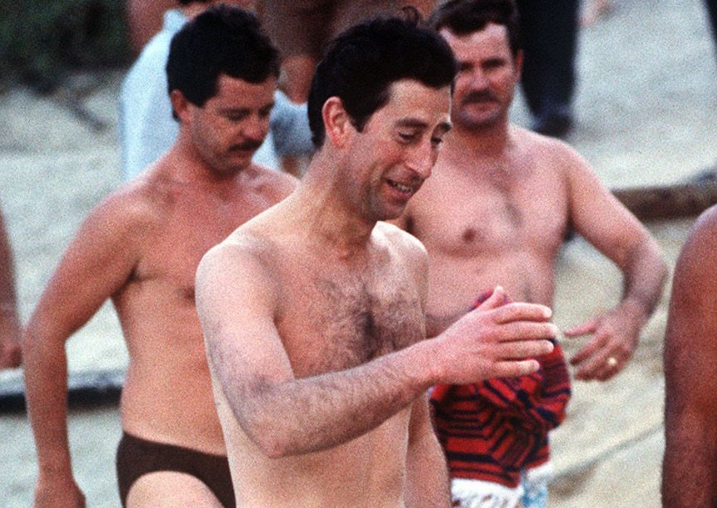
At first, the scene seems far removed from the world of royal ceremony. There is no grand staircase, no line of officials waiting to shake hands, and no imposing palace in the background. Instead, the story begins with a beach, a pair of swimming shorts, and a man taking time out beside the water. The surprise is not that someone has gone for a swim. It is that the person doing so is Prince Charles, decades before he became King Charles III. A recent retrospective revisits this less formal side of his public life through photographs associated with his visits to the coast.
The central episode takes us to Cottesloe Beach in Perth during the royal tour of Australia and New Zealand in 1983. This is more than a nostalgic anecdote: photographic archives document Charles swimming there that April, with images in the Tim Graham collection specifically dated April 8. He was 34 years old, already an experienced royal representative but still nearly four decades away from becoming monarch. That distance gives the scene its appeal. We are looking back not simply at a different outfit, but at an earlier chapter in a life that would continue unfolding in public for many years.
The retrospective draws attention to green athletic shorts and the absence of the tailored clothing associated with official appearances. Its invitation is to reconsider a familiar public figure in an unfamiliar setting. Yet the interesting contrast is not really between someone recognizable and someone unrecognizable. It is between the role and the activity. A prince walking across sand is still a prince, but the immediate business of the moment is no longer a speech, an inspection, or a formal greeting. The photograph asks the viewer to notice the swimmer before thinking about the title.
Cottesloe provides a distinctive setting for that change of perspective. On Perth’s Indian Ocean coast, it is known for a long stretch of pale sand and opportunities for swimming, surfing, and snorkelling. Tourism Australia’s description places the beach within a landscape of coastal recreation, with Norfolk Island pines and an esplanade overlooking the water. This is not merely an anonymous blue background for a celebrity photograph. It is a place with its own identity, one in which going into the sea makes immediate sense. The royal visitor enters an existing beach culture rather than creating the occasion around him.
That local history stretches far beyond the royal visit. The Town of Cottesloe’s account of the coast recognizes its importance to Aboriginal people as both a food source and a spiritual place. Its later development as a popular bathing destination belongs to another chapter of the area’s history. Remembering that wider context changes the photograph’s balance: the beach is not important only because a future king appeared there. For the communities connected to it, the shoreline already carried meaning. Charles’s swim becomes one small episode within a much longer story, rather than the event that defines the place.
Organized surf lifesaving was also established there long before the cameras followed a royal visitor onto the sand. Cottesloe’s club dates to 1909, and its own history describes an organization that combined beach safety with athletic activity. That background gives substance to the idea of a shared coastal setting. Swimming and physical recreation were not unusual interruptions in the life of Cottesloe; they were central to it. Against that backdrop, the remarkable thing about the royal photographs is how ordinary the activity itself remains. Remove the caption, and the basic subject is someone participating in a familiar local pastime.
Beyond the beach, however, the 1983 journey was a major public undertaking. Charles and Diana arrived in Alice Springs with their infant son, William, on March 20. It was Diana’s first overseas royal tour, and the visit came shortly after Bob Hawke became Australia’s prime minister. Contemporary coverage, revisited by Australia’s ABC, shows how closely the couple’s reception was watched. Their presence attracted attention not just as a royal appearance but as a family story, a diplomatic event, and a test of the young princess’s developing public role. A swim in Perth belonged inside this much larger schedule.
The photographic record of the tour shows how varied that schedule could be. Archive captions place the couple in an open vehicle in Sydney, meeting people in Newcastle, and riding in a Land Rover at a sports ground in Bunbury. Other photographs record gifts being offered for William and the movement of royal luggage between destinations. Together, these details suggest a visit experienced through repeated arrivals, greetings, journeys, and departures. The beach pictures offer a different rhythm. They replace the visual language of organized appearances with the practical sequence of entering the water, swimming, and returning to shore.
Diana’s popularity was an important part of the tour’s impact. Looking back in 2014, historian Aron Paul told the ABC that her informal manner contrasted with the greater distance associated with earlier royal visits. His interpretation helps explain why moments of apparent accessibility mattered within the broader coverage. The public image of the monarchy was being encountered through personalities as well as institutions. A greeting, a conversation, or a family appearance could communicate something different from a formal address. Charles’s beach outing fits into that visual world without needing to be treated as a calculated response to his wife’s reception.
William’s presence added another dimension. The coverage was not solely of two adults carrying out engagements; the visit also documented a young family travelling together. Photographs showed Diana carrying her baby on arrival and holding him during the Australian stay. Those pictures bring the story down to a scale easier to grasp than diplomatic schedules. A parent holding an infant and a visitor drying off after a swim are different subjects, but both offer alternatives to the formality of official public life. Neither requires an invented private conversation to be meaningful.
For Charles, being observed was hardly a new experience. He had become heir apparent at the age of three, following his mother’s accession, and was given the title Prince of Wales in 1958. His formal investiture followed in 1969. By the time of the Perth visit, the expectations attached to his future position had therefore existed for almost his entire life. The beach scene should not be mistaken for a glimpse of someone who had not yet encountered responsibility. It shows a man already accustomed to it, taking part in an activity that temporarily changes how that responsibility appears on camera.
Australia itself was also familiar territory. In 1966, Charles spent two terms at Timbertop, the rural campus associated with Geelong Grammar School in Victoria. He was a teenager then, years before the tour with Diana and William. That earlier stay gives the 1983 visit a personal background beyond the formal itinerary. The country was not somewhere he knew only through receiving lines and official receptions. Part of his education had taken place there, and his connection included experiences outside the settings in which visiting royals are usually photographed. The beach outing belongs within that longer relationship, not at its beginning.
Charles returned to those memories in a speech at Parliament House in Canberra in October 2024. He described his Australian schooling as formative and recalled the challenges of the bush around Mount Buller, including encounters with wildlife. His remarks were humorous, but their larger point was that his attachment to Australia had developed early. That later testimony cannot tell us exactly what he was thinking during a swim in 1983. It does, however, provide his own account of why the country held personal significance. The connection was more substantial than a succession of official visits recorded on a calendar.
His background also included active military service. The Royal Household’s biography records that he qualified as a helicopter pilot in 1974 and took command of the coastal minehunter HMS Bronington in 1976, during his final months in the Royal Navy. Those details offer another useful correction to an overly narrow image of a royal life spent entirely at receptions. By his early thirties, Charles had experience of demanding practical work as well as ceremony. A photograph of him swimming therefore need not be presented as a startling departure from every other part of his life. It reveals one aspect of a broader record.
Sport supplies further context. An official collection of biographical facts records his participation in a steeplechase at Ludlow in 1980 and his long involvement in polo. Separate photographic archives document him windsurfing in Deauville, France, in August 1978. These were different occasions, and they should remain distinct from the Perth visit. Taken together, however, they show why an informal coastal image is not an isolated curiosity. The public archive contains an active younger Charles as well as the formally dressed royal. Looking at both produces a fuller portrait than treating either one as the only authentic version.
There is another detail that complicates the idea of a completely private escape: the cameras were still there. An ITN footage description for the 1983 Cottesloe outing records Charles approaching the beach, catching a wave while bodysurfing, leaving the water, and eventually getting into a car. It also specifically mentions the press and spectators. The setting may have been informal, but it was not beyond public observation. That distinction makes the scene more interesting, not less. Charles could step away from a formal engagement without stepping entirely outside the machinery that documented his life. Relaxation and scrutiny occupied the same shoreline.
Cottesloe had already provided the setting for another much-discussed royal encounter in 1979, when model Jane Priest kissed Charles during a beach visit. That episode predates the tour with Diana and should not be folded into the 1983 story. In a later examination, the ABC described conflicting accounts of how the encounter had been arranged. Priest characterized it as a publicity exercise, while photographer Kerry Edwards gave a different account of who had initiated the idea. The disagreement is a reminder that a photograph can look spontaneous while leaving important questions about its circumstances unanswered.
Charles himself later recalled his coastal visits with humour. In a 2005 interview with ABC radio, subsequently revisited by the broadcaster, he remembered “swimming very early in the morning down the beach” and joked about people approaching him from the surf. His recollections add a personal voice to photographs usually discussed by journalists and spectators. They also suggest that the encounters had remained memorable to the person at their centre. Years after the original coverage, the beach was still part of the story he told about his experiences in Perth, rather than simply a setting selected by later commentators.
Other photographs bring the 1983 outing into sharper focus. A Jayne Fincher archive caption describes Charles running after his swim at Cottesloe that April. A Steve Wood photograph, dated April 8, records him wearing a towel afterward. These are modest details, but their modesty matters. They preserve the intervals around the swim rather than turning everything into one supposedly defining pose. Entering the water, coming out, and drying off make the outing a sequence of recognizable actions. The result is less like a ceremonial portrait and more like a small visual record of how part of a day was spent.
Placed beside the tour’s other images, those photographs also reveal how much a change of setting can alter a story’s emphasis. A sports ground appearance puts the visitor in relation to a crowd; a family photograph places him beside his wife and child; the beach sequence concentrates on physical activity. None cancels the others. Together, they resist the temptation to reduce an entire journey to a single triumphant or troubled interpretation. The archive allows different kinds of moments to coexist, and that variety is more persuasive than insisting that one informal frame reveals everything the official pictures conceal.
The journey continued in New Zealand from April 17 to April 30. There, the scale of public attention remained considerable. New Zealand’s official history site records that more than 40,000 children welcomed the royal visitors at Auckland’s Eden Park on April 18. The programme also included ballet, state banquets, Anzac Day commemorations, visits to Māori meeting grounds, and other engagements around the country. This continuation helps restore the beach outing to its proper proportions. The Perth swim was an interlude in a sustained tour, not the beginning of a long holiday or a withdrawal from the couple’s public commitments.
One of the New Zealand visit’s enduring family images involved William playing with a buzzy bee toy on the lawn at Government House in Auckland. The Ministry for Culture and Heritage notes that the photographs appeared on front pages internationally. A small child’s plaything had become part of the visual memory of a royal tour. Its appeal offers a useful parallel to the swimming photographs: an ordinary activity can make an exceptional setting easier to approach. The toy did not erase the significance of the visit, any more than a towel erased Charles’s position. Each simply offered a different point of entry.
The family connection gained a layer when William returned to Australia in 2014 with Catherine and their son George. ABC coverage explicitly compared their journey with the one William had made as a baby with Charles and Diana. The passage from infant passenger to adult royal visitor gives the older photographs a sense of time. They become more than illustrations of a single tour; they belong to a family record spanning generations. Seen in that light, the young father at Cottesloe is not simply a surprising version of a familiar figure. He occupies a particular point in a continuing story.
Cottesloe returned to that story in November 2015, when Charles celebrated his 67th birthday at the civic centre overlooking the beach. He and Camilla arrived as the sun was setting, and about 600 invited guests gathered for the occasion. The setting connected another stage of his life to the same stretch of coast. This time, the photographs were not of a young prince coming out of the surf, but of a birthday celebration with music, guests, and a large red velvet cake decorated with a chocolate sail. More than three decades separated the two visits.
The guest list included emergency service workers and children who shared his birthday, bringing a community dimension to the celebration. The weather supplied its own memorable ending: lightning appeared over the Indian Ocean before heavy rain sent guests seeking shelter beneath umbrellas. It was a very different Cottesloe occasion from the swimming photographs, but another in which the outdoor setting became part of the story. The same coastline had now provided the backdrop for youthful recreation and a birthday gathering later in life, linking the episodes through a place rather than a formal royal milestone.
Charles eventually became king on September 8, 2022, following the death of Queen Elizabeth II, and his coronation took place on May 6, 2023. Those later milestones affect how earlier photographs are read. A swim undertaken as Prince of Wales now appears in retrospectives about a monarch’s youth. Yet that change belongs to the viewer’s perspective as much as to the original image. The camera did not capture a coronation waiting to happen; it captured an earlier activity. The historical interest comes from holding the two moments together without pretending that the first could explain everything about the second.
The archive also gives the photographs a life beyond their original publication. The Fincher image is catalogued with an upload date in 2022, while the Wood towel photograph entered Getty’s online collection in 2024. Those dates refer to the digital records, not to when the events happened. The distinction is worth remembering whenever an old picture is presented as a fresh discovery. A newly encountered image is not necessarily a newly uncovered one. What can be genuinely new is the audience’s opportunity to see it alongside other material and understand where it belongs in the wider historical record.
Perhaps the most useful question, then, is not whether Charles looks completely different, but what the viewer expected to see. A formal setting encourages attention to status, while a beach setting encourages attention to movement and activity. Both are selective. Neither has to be dismissed as false for the other to be interesting. The appeal of this retrospective lies in allowing the less formal version some space without insisting that it overturns everything else. It is possible to find the scene engaging without romanticizing royal life, guessing at private emotions, or imagining that a change of clothes removed every boundary between the visitor and the people around him.
In the end, it is the modest scale of the scene that makes it worth another look. Its interest lies in its place among the other records: the arrivals and public appearances, the family photographs, the sporting images, and the later milestones. Each shows something different, and none tells the whole story alone. The beach episode offers a pause in that larger sequence, an occasion that can be described without making it carry the weight of an entire biography. What remains compelling is not the claim that the camera caught a completely unknown man. It is the opportunity to look at a familiar public life from a less familiar angle.