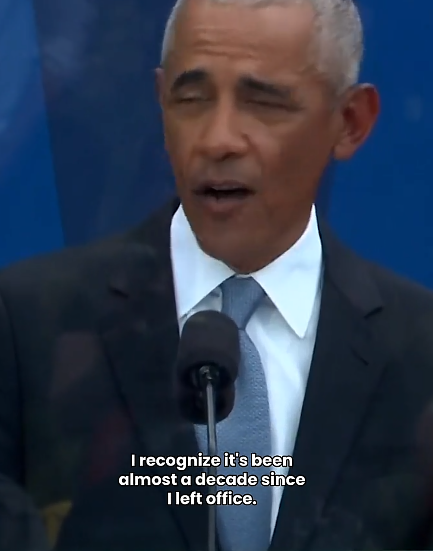
Former President Barack Obama delivered a message of hope, civic responsibility and perseverance as he marked the opening of the Obama Presidential Center in Chicago, urging Americans not to give in to cynicism, anger or despair at a moment when many people feel increasingly uncertain about the country’s future. Speaking before a crowd gathered for the long-awaited opening of the center on Chicago’s South Side, Obama reflected on the profound political, social and technological changes the United States has experienced since he left the White House nearly a decade ago. Rather than focusing his remarks on a particular political opponent or directly naming current political leaders, Obama used the occasion to speak about something broader: the condition of American democracy and the responsibility ordinary citizens have to protect it.
The former president’s remarks quickly attracted attention because of their timing and their tone. At a moment when political disagreements have become increasingly personal, social media has intensified polarization and many Americans express frustration with the direction of the country, Obama argued that giving up on democratic participation would only make the situation worse. His central warning was straightforward: Americans may be tired, angry or disappointed, but they should not allow those feelings to convince them that participation no longer matters. CBS News summarized the message as a warning against giving in to “cynicism and even despair,” a theme that ran throughout Obama’s keynote address.
@cbsnews Former President Barack Obama urged Americans not to “give in to cynicism and even despair” during his keynote address at the opening of the Obama Presidential Center in Chicago Thursday, saying, “I do not believe that is the story of America that prevails.” #obama #news #chicago #president
The speech came during the grand opening of the Obama Presidential Center, a project that has been years in development and that Obama described as more than simply a museum devoted to his presidency. The center is intended to serve as a place where history, civic engagement, education and community life come together. Its opening brought together thousands of people and several former presidents, including Bill Clinton, George W. Bush and Joe Biden, along with former first ladies and numerous political, cultural and entertainment figures. Reuters reported that the $850 million center was designed as a major civic and cultural investment on Chicago’s South Side, a part of the city that played a central role in Obama’s personal and political journey.
For Obama, the location carried particular significance. Chicago was where his political career developed, where he built his family life and where his rise to national prominence began. The presidential center therefore represents not only a record of his eight years in office but also an attempt to connect his political legacy with a larger conversation about citizenship and democracy. Instead of presenting the center as a monument to one individual, Obama emphasized the idea that democracy depends on millions of people accepting responsibility for the communities and country they share.
That message became especially important as Obama addressed the realities confronting Americans. He acknowledged that the country has endured enormous changes since he left office. The United States has experienced a global pandemic, wars, economic disruptions, mass demonstrations, political backlash, increasing distrust in institutions and a technological revolution that has transformed how people communicate and consume information. Obama argued that technology has brought extraordinary possibilities while simultaneously creating new problems.
People can now access almost limitless information from a device in their hands, but that does not necessarily mean they are better informed. In some cases, the enormous volume of information can make it harder to distinguish fact from fiction. Social media platforms can connect people instantly while also making individuals feel more isolated. Algorithms can expose users to an endless stream of outrage and controversy, rewarding the loudest and most extreme voices rather than encouraging thoughtful discussion. Obama warned that these forces can reinforce existing prejudices and push people further into political and social camps.
That environment, he suggested, creates fertile ground for cynicism. When people repeatedly see conflict, scandal, misinformation and political hostility, they can eventually begin to believe that nothing can change. They may conclude that voting is meaningless, civic participation is pointless and compromise is impossible. They may decide that political institutions are permanently broken and that helping others is naïve. Obama argued that this mindset can be more dangerous than political disagreement itself because it encourages people to withdraw.
The former president did not pretend that frustration was irrational. In fact, he acknowledged that he is not immune to anger or doubt himself. His argument was not that Americans should ignore legitimate problems or pretend everything is fine. Instead, he asked people to recognize the difference between acknowledging serious problems and surrendering to hopelessness.
That distinction is at the heart of his message. Democracy, Obama argued, is not sustained simply because democratic institutions exist on paper. It requires people who believe their actions have meaning. Voting matters because people vote. Citizenship matters because citizens participate. Communities improve when residents decide that they are responsible for something larger than themselves. If enough people conclude that their participation does not matter, they effectively surrender their influence to whoever remains willing to exercise power.
Obama warned that this creates an opening for people who are willing to exploit division, fear and resentment. When citizens lose faith in one another, they can become more vulnerable to leaders or movements that promise simple answers to complicated problems. Political opponents can be portrayed as enemies rather than fellow citizens. Entire groups can be treated as less deserving of respect. Government can become viewed not as a mechanism for serving the public but as a tool for rewarding allies and punishing opponents.
The former president made clear that he does not believe this represents the final story of America. His optimism was not based on the idea that the country has never experienced division or injustice. American history contains plenty of examples of both. Instead, his optimism appeared to come from his belief that the country’s history also demonstrates an ability to change.
Obama’s career has long been associated with the idea of political hope, dating back to his presidential campaigns and the message that helped define his rise to national prominence. At the opening of the presidential center, that theme returned in a different context. The optimism of his remarks was less about campaign slogans and more about endurance.
CBS Chicago described the speech as evidence that hope remains central to Obama’s public message. The publication noted how the former president connected the challenges of the present with the optimistic ideals associated with his political identity.
The significance of the moment was also amplified by the people attending the ceremony. The presence of multiple former presidents underscored the historical importance of the occasion. Clinton, Bush and Biden joined Obama at the event, creating an unusual gathering of former occupants of the White House. Their appearance offered a visual reminder that political disagreements can exist alongside a broader continuity in American democratic life.
The ceremony was also filled with music and entertainment. Major performers and public figures participated in the opening celebration, contributing to the sense that the presidential center was intended to be both a historical institution and a living cultural space. The event included appearances by musicians such as Stevie Wonder and Bruce Springsteen, while other prominent figures from politics, media and entertainment attended as well.
Yet despite the celebrity-filled atmosphere, Obama’s speech focused largely on ordinary Americans. He pointed to examples of people working together in their communities, rebuilding neighborhoods, supporting one another and solving problems without waiting for national politicians to provide every answer. His point was that the country’s future is not determined solely inside Washington.
That idea is particularly relevant in an era when national politics can dominate people’s attention. Cable news, social media and political commentary often make every disagreement feel like a national emergency. Americans can spend hours watching arguments between politicians while becoming less aware of what is happening in their own neighborhoods. Obama suggested that democracy also exists at the local level, where people work together to solve practical problems.
He highlighted communities that have attempted to reclaim streets from crime, rural communities working to rebuild local economies and people finding creative ways to address issues such as housing affordability. He also referred to ordinary residents in the Twin Cities who had stood together to help their neighbors during a period of intense uncertainty. His examples were intended to show that civic responsibility is not an abstract concept. It is something people practice when they look after one another.
The message also carried an implicit challenge to the culture of constant political outrage. Obama argued that people are not necessarily looking for endless anger and division. Beneath the noise of political arguments, he suggested, many Americans still want fairness, common sense and mutual respect.
That observation may be one of the most important elements of the speech because it challenges the assumption that the loudest voices on social media represent the majority of Americans. Online political conversations can create the impression that society is permanently divided into opposing camps. Algorithms often reward content that generates strong emotional reactions, meaning anger can receive more attention than calm discussion. Obama warned about precisely this dynamic.
The danger is not simply that people disagree. Disagreement is an unavoidable part of democracy. The danger comes when disagreement becomes a reason to stop recognizing the humanity of people on the other side.
Obama’s appeal was therefore not necessarily for Americans to agree with one another on every issue. Instead, he was calling for a willingness to continue engaging with people who have different political beliefs. Democracy requires disagreement, but it also requires a shared understanding that political opponents remain fellow citizens.
That may be increasingly difficult in an environment where political identities have become deeply connected to personal identities. People often receive political information from sources that reinforce what they already believe. They may rarely encounter arguments that challenge their assumptions. Over time, this can make compromise seem like betrayal rather than a normal part of democratic government.
Obama’s remarks suggested that Americans need to resist that temptation. The country cannot function if every political disagreement becomes a battle in which one side must completely defeat the other. A democracy built entirely around winners and losers risks creating permanent resentment.
His argument also extended beyond elections. Voting was an important part of the message, but Obama placed voting within a broader definition of citizenship. Casting a ballot is only one form of civic participation. Helping a neighbor, serving a community, volunteering, participating in local government, learning about public issues and treating other citizens with dignity can also strengthen democratic society.
The presidential center itself is an extension of that philosophy. Its purpose is not simply to preserve Obama’s presidential papers or display artifacts from his administration. The broader vision is to create a place where people can learn about history and participate in civic life.
The project has also taken on symbolic importance because of its location. Chicago was fundamental to Obama’s story, and the center’s presence on the city’s South Side connects his national legacy to the community where his political identity was formed. The development represents a substantial investment in an area that has experienced both challenges and revitalization efforts.
Reuters described the center as an $850 million landmark and reported that it could attract up to a million visitors annually. The complex includes a museum, performing arts spaces, a library and athletic facilities, making it significantly more expansive than a traditional presidential library.
For Obama, the opening was therefore both personal and political. It allowed him to reflect on the presidency while also looking toward the future. His remarks suggested that the most important question surrounding his legacy is not simply what happened during his administration but what future generations choose to do with the democratic system they inherit.
The timing of the ceremony also made the message particularly notable. Obama left the presidency in January 2017, but the political environment he returned to in his speech was dramatically different from the one he entered nearly two decades earlier. The country has experienced increasingly intense political polarization, major debates over democratic institutions and a transformation in the way Americans communicate with one another.
He did not directly name President Donald Trump during the speech, even though many observers interpreted portions of his remarks as an implicit criticism of the current political environment. CNN reported that Trump was not invited to the ceremony and was not mentioned by name, but Obama’s comments about division, political anger and the misuse of government power were widely viewed as relevant to the current moment.
That decision not to name specific political figures allowed Obama to frame his argument as something larger than a dispute between individual politicians. His message was about the kind of political culture Americans want to create.
The distinction matters because presidential speeches often become defined by partisan reactions. A speech criticizing a particular politician can quickly become another piece of ammunition in the political fight. Obama’s decision to focus on broader principles allowed him to make a different kind of argument: regardless of who holds office, citizens have a responsibility to protect democratic norms.
His comments also touched on the role of truth in modern society. The ability to distinguish fact from fiction has become more difficult in an age of artificial intelligence, manipulated media and algorithmically curated information. People can encounter thousands of claims every day, often without knowing where those claims originated or whether they are accurate.
This creates another challenge for democracy. A functioning democratic system requires citizens to make decisions based on some shared understanding of reality. People can disagree about what policies should be adopted, but if they cannot agree on basic facts, meaningful debate becomes much harder.
Obama’s concern about technology therefore goes beyond social media etiquette. He was pointing toward a deeper issue about how democratic societies function when information itself becomes contested.
At the same time, he did not portray technology as entirely negative. The technological revolution has created extraordinary opportunities in medicine, communication, education and scientific discovery. The problem is how society chooses to use these tools. Technology can connect people, but it can also isolate them. It can educate, but it can also spread misinformation. It can empower individuals, but it can also magnify inequality.
The challenge, then, is not to reject technological progress but to develop the civic and cultural habits necessary to use it responsibly.
Obama’s message ultimately returned to a simple idea: Americans should not surrender their ability to shape the future simply because the present is difficult.
That message helps explain why the phrase about cynicism and despair became the central takeaway from the speech. Cynicism can feel sophisticated. It can be easier to assume that politicians are all corrupt, institutions are all broken and nothing will ever change than to accept the responsibility of participating. Hope, by contrast, requires effort.
Hope does not mean believing that everything will work out automatically. It means believing that individual and collective actions can make a difference.
That was the kind of hope Obama appeared to advocate in Chicago. It was not an argument for ignoring problems. It was an argument against allowing problems to destroy the willingness to solve them.
The former president’s remarks also carried a personal dimension. Nearly ten years removed from the White House, Obama now speaks from a different position than he did while serving as president. He no longer controls government policy. He does not have the institutional authority that comes with the presidency. His influence is instead connected to his public voice, his foundation and the institutions built around his legacy.
That makes his appeal to citizenship particularly significant. Rather than suggesting that a former president can solve the country’s problems, he placed responsibility back in the hands of the public.
The idea is consistent with the broader purpose of the Obama Presidential Center. The center is meant to preserve history, but it is also designed to encourage civic participation. Its existence reflects the belief that studying the past should help people make better decisions about the future.
Michelle Obama reinforced that theme during the opening events. She described the center as a potential respite from the anxiety and division that have characterized the current period, while emphasizing optimism, empathy and vision. Her remarks complemented Barack Obama’s argument that Americans should resist the temptation to retreat into cynicism.
Together, the Obamas presented the center as more than a celebration of a presidency. They portrayed it as an invitation to think about what comes next.
For Barack Obama, the central question was whether Americans will continue to believe that democracy is worth the effort. That question does not have a simple answer, and his speech did not pretend otherwise. The country faces genuine challenges, and political disagreements are not going to disappear.
But Obama argued that disagreement does not have to lead to despair.
Americans can disagree and still cooperate. They can criticize government while remaining committed to democratic participation. They can be angry about injustice without becoming convinced that nothing can change. They can recognize political failures without abandoning the idea that institutions can be improved.
Most importantly, they can choose whether to turn away from one another or toward one another.
That final choice may be the heart of Obama’s message. The political climate can encourage people to see fellow citizens as enemies, but democracy depends on recognizing that the country belongs to everyone. The future cannot be controlled entirely by presidents, lawmakers, judges, political parties or activists. It is also shaped by millions of ordinary decisions made by citizens every day.
The opening of the Obama Presidential Center provided an unusually large stage for that argument. The building itself represents a chapter of American political history, but Obama’s speech was focused on what happens after the history is recorded.
His warning was that cynicism can become self-fulfilling. If enough people believe democracy cannot work, they may stop participating. If they stop participating, fewer people remain willing to defend democratic institutions. And when citizens withdraw, those who are most willing to pursue power without restraint gain greater influence.
His alternative was not blind optimism. It was active citizenship.
The former president’s remarks therefore offered a message that reaches beyond supporters or opponents of Obama himself. Americans do not have to agree with his politics to understand the broader argument. Political systems survive when citizens believe they have both a stake in society and a responsibility toward one another.
As the Obama Presidential Center begins its life as a public institution, that idea may ultimately become one of the most important parts of its legacy. The museum will preserve artifacts, documents and memories from Obama’s presidency, but the larger purpose is to encourage future generations to think about democracy as something they inherit and must continue to maintain.
The speech also serves as a reminder that the history of the United States has never been a straight line. The country has repeatedly faced periods of fear, division and uncertainty. Each generation has had to decide whether those circumstances justify withdrawal or whether they require greater participation.
Obama clearly believes the answer should be participation.
His appeal for Americans not to give in to cynicism and despair is ultimately an appeal for patience, courage and responsibility. Democracy is often frustrating because progress can be slow. Institutions can fail. Leaders can disappoint. Political compromise can be messy. Social change can take decades. But abandoning the process because it is difficult can leave the future to people who are willing to seize power while others step away.