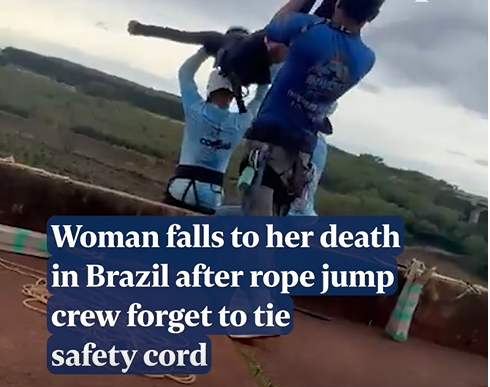
A tragic rope-jumping accident in Brazil has left a young woman dead and raised serious questions about safety standards, supervision, and responsibility in extreme sports activities promoted to the public as controlled adventures. The victim, identified in reports as 21-year-old Maria Eduarda Rodrigues de Freitas, died after she was launched from the edge of São Paulo state’s “Skeleton Bridge,” a structure in Limeira known locally as Ponte do Esqueleto, during what was supposed to be an organized rope-jumping experience. The activity, which is meant to give participants the sensation of a dramatic fall while they remain secured by specialized equipment, turned fatal when, according to local reports, the required safety rope had not been attached to her before she went over the edge. The bridge is reported to be around 40 meters high, making proper preparation, inspection, and connection to the safety system absolutely essential. In rope jumping, a participant is usually fitted with a harness or waist attachment connected to a rope system that controls the fall and prevents the person from hitting the ground. The entire activity depends on repeated safety checks, clear communication between crew members, and a final confirmation that the jumper is connected before any movement toward the edge. In this case, those basic safeguards appear to have failed in the most devastating way.
Video descriptions and witness accounts reported by local media suggest that moments after the young woman was thrown from the bridge, people nearby realized something was wrong and shouted, “Guys, the rope!” Those words have become one of the most disturbing details of the case because they suggest the missing connection may have been noticed only after it was too late. The incident reportedly happened on June 13 and led to the arrest of three people connected to the activity. Authorities are now investigating how a participant could be allowed to jump without the central piece of safety equipment in place, and whether the crew responsible for the event acted with negligence so serious that it crossed into criminal responsibility. For Maria’s family, friends, and community, the investigation cannot undo the loss, but it may help determine how such a preventable tragedy was allowed to happen. Extreme sports carry an element of risk, but that risk is supposed to be managed by trained professionals, proper equipment, strict procedures, and a culture where no jump begins until every connection has been checked and confirmed. Rope jumping is not simply a spontaneous dare from a bridge; when offered as a public activity, it requires planning, certified or competent operators, inspection of gear, emergency readiness, and clear roles for each worker involved. The jumper places trust in the crew. That trust is at the heart of the activity. Most participants do not have the technical knowledge to independently inspect every knot, carabiner, harness point, anchor, and rope system. They rely on the people running the event to know what they are doing and to follow a checklist without shortcuts. That is why the allegation that workers forgot to attach the safety rope is so shocking. A forgotten step in ordinary life may cause inconvenience, but a forgotten step in a high-risk activity can become fatal within seconds. The case has also drawn attention because videos of the incident reportedly circulated online, showing a cheerful activity turning into a moment of panic. While those videos have increased public awareness, they have also renewed conversations about the ethics of sharing footage of fatal accidents. The focus should remain on the victim, her loved ones, and the safety failures under investigation, not on turning a tragedy into viral entertainment. Maria was a young woman who expected an exciting experience, not a deadly one.
According to descriptions of the event, she believed she was participating in a controlled jump. Like many people who try adventure sports, she likely trusted the workers, the setup, and the appearance of professionalism around her. That is what makes the accident especially painful: the danger did not come from a random natural event or an unpredictable equipment failure reported after all safeguards were followed; the central allegation is that the rope was never attached before she was launched. If confirmed by investigators, that would represent a breakdown at the most basic level of safety procedure. The arrests following the incident show that police and judicial authorities are treating the case seriously. Reports state that three people were taken into custody after the fatal jump, and investigators are examining their roles before, during, and after the incident. In cases like this, responsibility may involve more than the person closest to the jumper. Authorities may look at who organized the event, who inspected the equipment, who gave instructions, who physically launched the participant, who supervised the crew, and whether the group had permission or proper qualifications to operate at the bridge. They may also examine whether the event had emergency plans, whether equipment was maintained correctly, whether participants signed waivers, and whether those waivers were valid if basic safety practices were ignored. A waiver cannot excuse reckless disregard for life. Adventure companies often use consent forms to explain risk, but participants consent to a managed risk, not to being sent over an edge without the necessary safety rope. The difference is critical. People who sign up for rope jumping understand that the activity may feel frightening and that accidents can happen, but they do not agree to careless handling of life-preserving equipment. This tragedy may therefore become a major example in Brazil of why extreme sport operators must be held to strict standards. The public reaction has been shaped not only by grief, but also by anger. Many people are asking how more than one worker could be present and still fail to notice that the jumper was not connected. In high-risk activities, safety systems are usually designed with redundancy. That means one person should not be the only barrier between a safe jump and a disaster. There should be a primary check, a secondary check, and often a verbal confirmation before the jump begins.
A crew member should confirm the harness is secure. Another should confirm the rope is attached. Someone should confirm the anchor and line are ready. The jumper should be told clearly when the system is live and when it is not. If any person on the team is unsure, the jump should stop immediately. The fact that people reportedly shouted about the rope only after she went over the edge suggests either there was no effective final check or it was not followed. This is the central issue investigators will likely have to answer: was this an isolated human error, a pattern of unsafe practice, or an activity operated without enough training and oversight? The answer matters because it affects not only the criminal case but also future regulation. Bridges and natural landmarks are often used for adventure activities because they offer height, dramatic scenery, and a feeling of freedom. But when public spaces become sites for paid or organized extreme sports, there must be clear rules about who can operate there and what safety requirements they must meet. Without oversight, informal operators can create the appearance of professionalism while missing the systems that keep people alive. Reports around the Brazil incident have suggested that the groups involved promoted jumps to the public, making the question of organization and accountability even more important. If people are invited to pay for or attend a rope-jumping experience, the organizers have a duty to make sure the activity is not improvised. Proper rope jumping requires technical knowledge of forces, anchors, equipment ratings, fall distance, rope length, and rescue procedures. It is not enough for workers to be confident or experienced casually; they must be disciplined and trained to treat every jump as potentially dangerous. Even a successful series of previous jumps does not prove a system is safe if procedures are loose. Many accidents happen not because nobody knows the risk, but because familiarity causes people to become careless. The more routine an activity feels to the crew, the easier it can become to skip a step, assume someone else checked, or rush to keep the line moving. That mindset is dangerous in any field involving heights, speed, water, machinery, or pressure. In rope jumping, the final connection is everything. Without it, the activity is no longer an extreme sport; it becomes an uncontrolled fall. That is why the phrase reportedly heard after the jump, “Guys, the rope,” has struck so many people. It captures the horror of a simple missing action being recognized only after the point of no return. The legal consequences may be severe. Brazilian authorities reportedly arrested three men and the case has been described in some reports as involving homicide with dolus eventualis, a legal concept used when a person may not intend a death directly but is alleged to have accepted or disregarded a known risk that death could occur. Whether prosecutors can prove that level of responsibility will depend on evidence gathered from witnesses, videos, equipment checks, communications, and the conduct of the organizers. Defense arguments may focus on accident, confusion, lack of intent, or the roles of each person involved. But the public concern remains clear: when people run an activity where one missed connection can kill someone, “we forgot” is not a small mistake.
It is exactly the kind of failure that safety procedures are designed to prevent. The incident also highlights the need for participants to ask questions before taking part in extreme activities, although the burden should never be placed entirely on the customer. Participants can ask whether the operators are licensed or certified, what safety checks are performed, who inspects the equipment, how many people confirm the connection, and what emergency plan is in place. They can also watch whether the crew appears organized, calm, and consistent. However, even the most careful participant may not be able to detect a hidden failure, which is why regulation and professional responsibility are essential. A young person standing at the edge of a bridge may be nervous, excited, distracted, or trusting. That is not the moment when they should be expected to protect themselves from a crew’s mistake. The crew’s job is to create a system where the participant cannot be launched unless every safety condition is complete. In many safety-critical industries, professionals use checklists because memory alone is not reliable. Aviation, medicine, construction, diving, climbing, and rescue operations all depend on repeatable checks because human beings can forget things under pressure. Rope-jumping operators should be no different. A written or verbal checklist might sound simple, but it can save lives: harness secured, rope attached, locking points checked, anchor confirmed, backup checked, communication clear, launch authorized. No step should depend on assumption. No person should say “ready” unless they have actually checked. No participant should move over an edge until the system has been verified. The tragedy in Limeira is therefore not only a story about one fatal accident; it is a warning about what can happen when extreme experiences are treated as entertainment first and safety second. For Maria’s loved ones, the conversation about regulation may feel painfully late. They are now facing the loss of a 21-year-old whose life was still beginning. The public should remember that behind every viral headline is a family receiving unbearable news, friends trying to understand how an exciting outing became a tragedy, and a community left with questions that may never feel fully answered. Responsible reporting should avoid turning her final moments into spectacle.
The important story is not the shock of the fall, but the alleged failure that allowed it to happen and the urgent need to prevent similar accidents. As the investigation continues, authorities will need to determine whether the event had authorization, whether the workers had adequate training, whether equipment was used correctly, whether safety protocols existed, and whether anyone attempted to avoid responsibility afterward. Those findings may influence criminal charges, civil liability, and future restrictions on rope-jumping activities at the bridge and similar locations. The case may also push local governments to inspect adventure sport sites more closely and require clearer permits, insurance, emergency plans, and professional standards. Extreme sports can be thrilling and meaningful when practiced responsibly. Many people safely enjoy bungee jumping, rope jumping, climbing, zip-lining, and other activities because trained operators respect the danger and prepare for it. The goal is not to create fear around every adventure activity, but to insist that excitement must never come at the cost of basic safety. A safe rope jump should show a participant attached securely at the waist or harness, connected to a rope system that has been checked before the jump begins. That standard is not optional. It is the foundation of the activity.
The video report’s final demonstration of a typical rope jump, showing a person properly attached before jumping, underlines the contrast between what should happen and what reportedly happened in Maria’s case. That contrast is why the accident has caused such outrage. The difference between a safe jump and a fatal one may come down to a single connection, but that connection is surrounded by a full chain of responsibility. Every person in that chain must understand that there is no room for distraction, rushing, showing off, or assuming someone else handled it. When a human life depends on a rope, the rope must be attached, checked, and confirmed before anything else happens. Maria Eduarda Rodrigues de Freitas’ death is a heartbreaking reminder that safety rules are not formalities. They are written in response to real danger, and when ignored, the consequences can be irreversible. The arrests after the incident may begin the legal process, but the broader lesson reaches beyond one bridge and one crew.
Any organization offering high-risk experiences must prove that it values life more than spectacle, more than speed, and more than profit. Participants deserve more than confidence from operators; they deserve competence, transparency, and systems that do not fail at the most important moment. As Brazil waits for the investigation to clarify exactly what happened on June 13, the tragedy stands as a call for accountability and reform. A young woman arrived expecting a controlled moment of fear and excitement. She should have returned safely with a story to tell. Instead, her death has become a national warning about negligence, oversight, and the urgent need to treat adventure sports with the seriousness they demand.
The tragedy has also opened a wider conversation about how extreme activities are promoted online, especially to young people who may see these experiences as exciting, unforgettable, and safe because they are presented with confident advertising and dramatic videos. Social media often shows only the thrilling side of rope jumping, bungee jumping, and similar sports: the countdown, the scream, the rush, and the celebration afterward. What viewers usually do not see are the safety briefings, equipment inspections, emergency plans, and professional checks that must happen before the camera starts rolling. When those hidden steps are missing or performed carelessly, the glamorous image of adventure can quickly become dangerous. This case reminds the public that the most important part of any extreme sport is not the jump itself, but the preparation before it.
For many people watching the story unfold, one of the hardest parts to understand is how such a basic safety step could allegedly be forgotten. Attaching the rope is not a minor detail in rope jumping; it is the core of the entire activity. Every other part of the experience depends on that connection being properly secured. A participant can wear the right clothes, stand in the right place, follow instructions, and trust the crew completely, but none of that matters if the safety system is not connected. That is why investigators will likely focus on whether the workers had a structured routine, whether one person was responsible for final checks, whether anyone was supervising the process, and whether the activity was being run with the level of seriousness required for an event involving a 40-meter fall.
The case may also lead to stronger public pressure for authorities to review adventure sports businesses and informal operators in Brazil. Activities involving height and high physical risk should not be treated like casual entertainment that anyone can organize. They require permits, training, certified equipment, maintenance records, emergency access, and clear accountability. When a company or group invites members of the public to participate, it takes responsibility for lives that depend on its competence. If regulations are weak or poorly enforced, tragedies like this can expose the gap between what participants believe they are signing up for and what safety systems are actually in place.
There is also an emotional side to the story that should not be overlooked. Maria Eduarda was only 21 years old, an age when many people are exploring life, taking chances, building dreams, and creating memories with friends. A rope jump should have been a moment of excitement, something she could remember as a bold and joyful experience. Instead, her life ended in a way that has shocked people far beyond her local community. Her family is now left not only with grief, but with the painful knowledge that the accident may have been preventable. That kind of loss carries a different weight because it is surrounded by questions: Who was responsible? Who checked the equipment? Who gave the signal? Who should have stopped it?
As the legal process continues, it will be important for the public to allow investigators to establish the facts carefully. Viral videos and emotional reactions can spread quickly, but criminal responsibility must be based on evidence. Authorities will need to examine witness statements, recordings, equipment, contracts, safety procedures, and the exact roles of the people arrested. At the same time, the seriousness of the allegations cannot be ignored. If the safety rope truly was not attached before Maria was sent over the edge, then the case represents one of the most severe failures possible in an organized extreme sport activity.