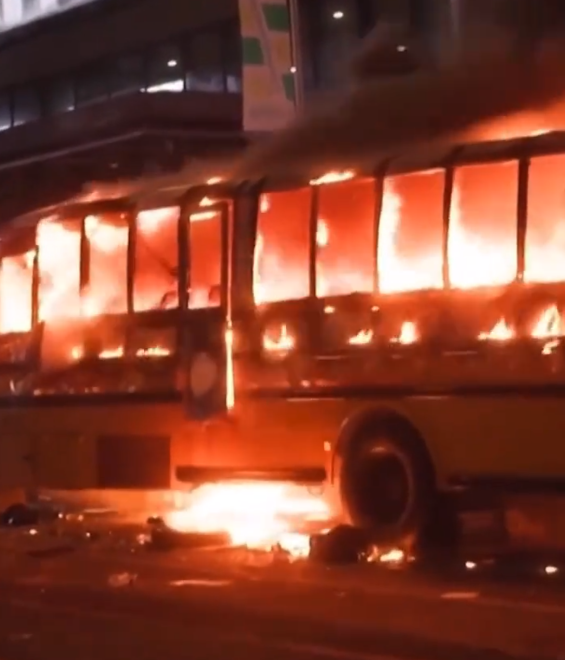
NBA Finals Chaos in New York: Celebration Turns Violent Outside Madison Square Garden as Dozens Arrested and Officers Injured
What began as one of the most electric nights in New York sports history quickly spiraled into scenes of chaos, violence, and disorder as thousands of fans flooded the streets surrounding Madison Square Garden following Game 4 of the NBA Finals. In a city that had waited nearly three decades to see the Finals return, emotions were already running high. But as the New York Knicks completed one of the most dramatic comebacks ever seen in championship history, jubilation outside the arena gave way to unrest that left dozens in custody and multiple police officers injured.
According to the New York Police Department, at least 56 individuals were taken into custody in connection with the disturbances, while 10 officers suffered injuries during efforts to control the crowd. The scale of the chaos was fueled by the sheer size of the gathering, with estimates suggesting that up to 10,000 fans had taken to the streets between Fifth and Eighth avenues. The area quickly became overwhelmed, transforming from a celebratory environment into a volatile and unpredictable scene.
The unrest did not happen in isolation. It followed a controversial decision by Madison Square Garden to cancel its official Game 4 watch party earlier in the day, citing disputes with city officials over security restrictions. That decision, combined with heightened emotions surrounding the Knicks’ historic performance, created a perfect storm that ultimately spilled out into the streets.
A Night That Started With Celebration
The energy leading into Game 4 was unlike anything New York had experienced in years. The Knicks, one of the most storied franchises in NBA history, were playing in the Finals for the first time in nearly 30 years. Fans from across the city—and beyond—had been waiting for this moment, and anticipation reached a fever pitch as tipoff approached.
Even without an official watch party, thousands of fans gathered outside Madison Square Garden. Many stood behind metal barricades, watching the game on their phones, listening to cheers erupt from inside the arena, and feeding off the collective energy of the crowd. For hours, the atmosphere felt celebratory, almost festival-like.
Inside the arena, celebrities filled the seats, adding to the sense of spectacle. High-profile figures including Taylor Swift, Sydney Sweeney, and Scooter Braun were spotted courtside, while former New York City Mayor Eric Adams made his presence known as well. The night had all the ingredients of a defining sports moment for the city.
Then came the game itself.
The Comeback That Sparked an Explosion
The Knicks delivered what many are calling one of the greatest comebacks in NBA Finals history. As the game unfolded, momentum shifted dramatically, turning what seemed like a difficult battle into a stunning victory. The roar of the crowd inside Madison Square Garden could be heard outside, echoing through the streets.
Fans gathered outside began reacting in real time, often hearing cheers before seeing updates on their phones. Each moment of excitement amplified the energy, building toward a final eruption when the Knicks secured the win.
For a brief moment, the city felt united in celebration.
But as the game ended and the crowd’s adrenaline surged, that celebration began to take a darker turn.
From Celebration to Chaos
As fans poured into the streets, the atmosphere shifted rapidly. What had started as cheering and chanting soon escalated into reckless and dangerous behavior. Fireworks were set off in densely packed crowds, creating moments of panic and confusion. Traffic came to a standstill as large groups blocked major roads, refusing to disperse despite repeated warnings from police.
Videos circulating online showed individuals climbing scaffolding, scaling light poles, and jumping onto moving vehicles. In one particularly alarming incident, a group of people attempted to flip a taxi, rocking it violently as the driver remained inside. The situation grew increasingly volatile as objects were thrown into the air and across the crowd.
Police described scenes in which individuals broke into a tractor-trailer, removing items and throwing them at both officers and other bystanders. Glass bottles were used as projectiles, with one officer reportedly struck in the head, contributing to the total of 10 injured officers.
The chaos spread across multiple blocks, creating a patchwork of disturbances that stretched law enforcement resources thin.
Mass Arrests and Charges
As police worked to regain control, they began making arrests. Of the 56 individuals taken into custody, 41 were released with criminal court summonses, while 15 faced formal charges. These charges ranged from disorderly conduct to more serious offenses, including assault on a police officer, possession of a weapon, reckless endangerment, and obstruction of governmental administration.
Authorities emphasized that many of those involved had ignored repeated orders to disperse. The refusal to comply, combined with the escalating nature of the behavior, forced officers to take decisive action.
The damage extended beyond individuals. At least four NYPD vehicles were significantly damaged during the unrest, with shattered windshields and other visible destruction. The physical toll of the night reflected the intensity of the situation and the challenges faced by law enforcement.
The Watch Party Controversy
Underlying the chaos was a dispute that had been brewing for days.
Madison Square Garden had planned an official watch party for Game 4, similar to those held during previous playoff games. However, tensions between arena officials and the city escalated over the scope of security measures required for the event.
City officials, led by Mayor Zohran Mamdani, implemented a security plan that included a restricted perimeter and capacity limits. The permit granted to MSG allowed for up to 999 attendees, a number that arena representatives argued was far too low given the level of public interest.
MSG ultimately decided to cancel the watch party, stating that it would be unfair to allow only a limited number of fans to participate while thousands were left outside. Arena officials criticized the city’s restrictions, suggesting they were unnecessarily strict and would prevent fans from celebrating together.
City officials pushed back, maintaining that the security measures were standard for events of that size and necessary to ensure public safety. The disagreement became increasingly public, with both sides exchanging statements in the lead-up to the game.
A Pattern of Escalating Incidents
Wednesday’s chaos was not an isolated event.
In the days leading up to Game 4, several incidents had already raised concerns about crowd behavior. A watch party in Bryant Park earlier in the week resulted in 21 people being taken into custody after violence broke out. Multiple officers were injured during that event as well.
There had also been reports of fights, vandalism, and dangerous behavior during previous games. In one particularly troubling incident, a man wearing a Spurs jersey was attacked by a group of individuals who attempted to rip the jersey off him before knocking him to the ground and stealing his phone.
Additionally, a stabbing at Penn Station—located directly beneath Madison Square Garden—left six people injured just days before Game 4. These incidents contributed to the heightened security measures implemented by the city.
The Role of Security Measures
City officials defended their approach, emphasizing that the restrictions were designed to prevent exactly the kind of chaos that ultimately unfolded. The security plan included controlled entry points, screening procedures, and limitations on access to certain areas.
These measures were similar to those used during major events such as New Year’s Eve celebrations and Fourth of July gatherings. Officials argued that without such precautions, the risks to public safety would be significantly higher.
However, critics, including MSG owner James Dolan, argued that the restrictions were overly burdensome and prevented fans from celebrating in a natural and organic way. This tension between safety and accessibility became a central theme in the debate surrounding the events.
Economic Impact and Business Activity
Despite concerns that the security perimeter would harm local businesses, the NYPD reported that bars and restaurants within the restricted zone remained busy throughout the game. Long lines were observed at several establishments, suggesting that demand remained strong despite the limitations.
This aspect of the situation highlights the complexity of managing large-scale events in densely populated urban areas. Balancing economic activity with public safety is a constant challenge, particularly when dealing with unpredictable crowd behavior.
A City Divided Between Celebration and Concern
The events of the night left New York City grappling with conflicting emotions.
On one hand, there was undeniable excitement about the Knicks’ performance and their position in the Finals. For many fans, the victory represented a moment of pride and a chance to celebrate a long-awaited return to prominence.
On the other hand, the chaos outside Madison Square Garden raised serious concerns about public safety and the ability to manage large crowds. The injuries to police officers, the arrests, and the damage to property all served as reminders of how quickly celebrations can turn dangerous.
Looking Ahead to Game 5
With the Knicks now leading the series 3-1, attention has turned to Game 5 in San Antonio. The potential for the team to secure a championship adds another layer of intensity to an already charged situation.
City officials, law enforcement, and arena management will likely need to reassess their strategies to prevent a repeat of the chaos seen after Game 4. This may involve adjustments to security plans, clearer communication with the public, and additional resources to manage crowds.
A Defining Moment for New York
Ultimately, the events surrounding Game 4 represent more than just a single night of unrest. They highlight broader issues related to crowd management, public safety, and the role of large-scale celebrations in urban environments.
They also underscore the power of sports to bring people together—and the challenges that come with that unity when emotions run high.
For New York City, the night will be remembered as both a moment of triumph and a moment of caution.
A reminder that even in celebration, the line between joy and chaos can be thinner than anyone expects.
When Celebration Turned Into Destruction
As the final buzzer echoed through Madison Square Garden and the Knicks sealed their historic comeback, the energy outside reached a boiling point. For a brief moment, it was pure celebration—people hugging, screaming, jumping, and chanting into the night.
But that moment didn’t last.
Within minutes, the mood shifted. The excitement didn’t disappear—it escalated. And with no structured event, no controlled space, and thousands packed into tight streets, the celebration began to spiral into something much darker.
The first signs were subtle.
Fireworks.
At first, they were just small bursts—harmless, celebratory, part of the moment. But then they became louder, closer, more aggressive. Some were thrown directly into crowds, exploding near people’s feet, sending others scrambling in panic.
The sound echoed off buildings, creating confusion. People couldn’t tell if it was celebration—or something more dangerous.
And that confusion quickly turned into chaos.
The Streets Taken Over
Entire blocks surrounding Madison Square Garden were soon overwhelmed.
Traffic came to a complete halt.
Cars were trapped, surrounded by crowds that had no intention of moving. Some drivers tried to inch forward, only to be blocked by groups standing in the middle of the street, chanting and waving their arms.
Then came the escalation.
Fans began climbing onto vehicles—first standing on hoods, then jumping on roofs. Videos showed people stomping on cars, denting metal, cracking windshields, turning vehicles into platforms for celebration.
In one of the most shocking moments, a yellow taxi became the center of a growing mob.
A group surrounded it.
They began rocking it back and forth.
Back.
Forth.
Back.
Forth.
The movement became more aggressive, more coordinated—as if they were trying to flip it entirely. The driver inside had no control, no way out, trapped in a situation that could turn dangerous in seconds.
The attempt to overturn the taxi became a symbol of how far things had escalated.
This was no longer celebration.
It was loss of control.
Fire and Panic in the Crowd
As the night went on, flames began to appear.
Small fires at first—burning trash, debris set alight in the street. But in dense crowds, even small fires create massive danger. People began pushing, trying to move away, creating waves of pressure that rippled through the crowd.
Fireworks continued to explode.
Glass shattered.
Sirens grew louder.
At multiple points, witnesses described scenes where people were running—not celebrating—running.
The line between party and panic had been completely erased.
Objects Turned Into Weapons
What made the situation even more dangerous was the shift in behavior.
People didn’t just celebrate—they began throwing.
Glass bottles.
Cans.
Random objects grabbed from the street.
Police officers became targets.
One officer was struck directly in the head with a glass bottle—a moment that could have easily turned fatal. Others were hit with debris as they tried to move through the crowd.
The chaos made it nearly impossible to identify where objects were coming from.
Everything was happening at once.
And no one was fully in control.
Breaking Into the Streets – Literally
One of the most shocking developments came when a group broke into a tractor-trailer.
Instead of walking past it, they forced it open.
Inside were items that quickly became ammunition.
Objects were pulled out and thrown—at police, at the crowd, into the streets.
What started as a single act quickly turned into a chain reaction. Others joined in, grabbing whatever they could, turning the street into a scene of destruction.
It wasn’t organized.
It wasn’t planned.
But it spread fast.
Because in large crowds, behavior spreads like wildfire.
Climbing, Hanging, Falling
As the streets filled beyond capacity, people began looking for higher ground.
Scaffolding.
Street poles.
Traffic lights.
Anything they could climb.
Videos showed individuals scaling structures not designed to hold that kind of weight. Some hung off ledges, others balanced dangerously above crowds.
Below them, people continued pushing, jumping, and moving unpredictably.
One slip.
One fall.
And the consequences could have been catastrophic.
Police later described these actions as some of the most dangerous of the night—not because they caused immediate damage, but because they could have led to mass injuries in seconds.
Police Overwhelmed
Law enforcement faced an almost impossible situation.
Thousands of people.
Multiple incidents happening at once.
Limited space to maneuver.
Officers attempted to form lines, push crowds back, and restore order—but the scale of the situation made it extremely difficult.
Commands to disperse were ignored.
Some crowds refused to move.
Others moved unpredictably, making it impossible to contain the situation in one place.
Officers found themselves surrounded, outnumbered, and under pressure from all sides.
Despite this, they continued pushing forward—trying to prevent the situation from escalating even further.
The Arrests That Followed
As control slowly began to return, arrests followed.
Not randomly—but targeted.
Individuals who were:
- Throwing objects
- Damaging property
- Assaulting officers
- Refusing to disperse
were taken into custody.
Some were released with summonses.
Others faced serious charges.
But the arrests only told part of the story.
Because by the time they began, the damage had already been done.
A City Left in Shock
When the crowds finally began to thin and the streets started to clear, what remained was the aftermath.
Broken glass.
Damaged vehicles.
Burn marks.
Police cars with shattered windows.
Debris scattered across entire blocks.
For residents and businesses, the night was not just chaotic—it was alarming.
Because what they witnessed was not just a celebration gone wrong.
It was a moment where control was lost.
The Bigger Question: How Did It Get This Far?
The chaos didn’t come from nowhere.
It built up.
From the canceled watch party.
From the massive crowd.
From the emotional intensity of the game.
From previous incidents earlier in the week.
Everything added up.
And when the moment came—it exploded.
What Happens Next?
With Game 5 approaching, one question now dominates:
Can this happen again?
And more importantly:
Can it be prevented?
Because if a win in Game 4 caused this level of chaos…
What would a championship celebration look like?
A Warning Sign for the Future
What happened outside Madison Square Garden wasn’t just a one-night incident.
It was a warning.
A demonstration of how quickly energy can turn into danger when structure disappears and crowds take over.
Because in the end…
It only takes a few moments for celebration to become something else entirely.
The Moment the City Lost Control
What made the situation even more unsettling wasn’t just what people did—it was how quickly everything escalated.
There was no single moment where chaos officially began.
It spread.
One group lighting fireworks encouraged another.
One person climbing a structure led to ten more following.
One object thrown turned into dozens flying through the air.
Within minutes, the energy shifted from celebration to something unpredictable—something that even those in the crowd could no longer control.
People who had come simply to celebrate suddenly found themselves caught in the middle of something far more dangerous. Some tried to leave but couldn’t move through the packed streets. Others stood frozen, unsure of what was happening around them.
And in that confusion, the risk only grew.
Because when thousands of people are packed tightly together, even small actions can trigger massive consequences.
A push becomes a surge.
A firework becomes panic.
A thrown object becomes a chain reaction.
That’s what made the night so volatile.
It wasn’t just isolated incidents—it was the speed at which everything spread.
A Thin Line Between C e l e b r a t i o n and C h a o s
By the time police began restoring order, the damage had already revealed something deeper.
The line between celebration and chaos is thinner than most people realize.
And on this night in New York, that line disappeared completely.
What should have been remembered purely as one of the greatest nights in Knicks history will now also be remembered for something else—
A moment when the city didn’t just celebrate…
I t l o s t c o n t r o l.