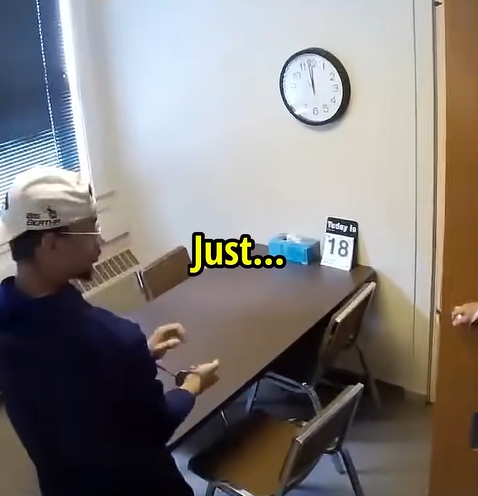
@badgecam2 Cop Funny moments😂#cops #trendingvideo #police #bodycam #running
The video shows a short but surprising escape that appears to unfold because of a moment of opportunity and a serious lapse in supervision. A young man is seen handcuffed inside a room with a police officer nearby. At first, the situation appears calm and controlled. The suspect is already restrained, the officer is present, and the room seems to be a temporary holding or interview area. However, once the officer leaves the room and closes the door behind him, everything changes within seconds.
As soon as the officer is gone, the young man looks for a way out. Instead of remaining seated or waiting for the officer to return, he immediately moves toward the window. The speed of his reaction suggests that he had either noticed the window earlier or quickly recognized it as his only possible escape route. Even though he is handcuffed, he is still able to move freely enough to reach the window, open it, and climb out. The footage makes the escape feel almost too easy, because there is no visible struggle, no guard posted at the door, and no immediate reaction from anyone inside the building.
A brief security camera clip then shows the young man outside, running across a lawn after escaping through the window. The outside footage confirms that he successfully made it out of the room and away from the building before anyone noticed. The fact that he was able to leave the room, exit through the window, and run across the property shows that the officer’s absence gave him enough time to act without being interrupted. It also suggests that the room was not properly secured for holding a handcuffed suspect, especially if a window could be opened from the inside.
The most striking part of the incident is the delay before the escape is discovered. Fourteen minutes after leaving the room, the officer returns carrying papers and a water bottle. He appears to be coming back as if the situation is still under control, likely expecting to find the suspect exactly where he left him. Instead, he walks into the room and quickly realizes something is wrong. The open window reveals what happened while he was gone. The suspect is no longer there, and the officer is left standing in the room, faced with the reality that the person in custody has escaped.
The scene is notable because it shows how quickly control can be lost when a restrained person is left unattended in an unsecured space. Handcuffs may limit someone’s movement, but they do not make escape impossible. If a person can walk, open a window, climb through it, and run, then the restraints alone are not enough to prevent them from fleeing. In this case, the suspect’s hands may have been cuffed, but he still had enough mobility to take advantage of the room’s weakness.
The escape also highlights the importance of checking the environment before leaving someone in custody. A room used to hold or question a suspect should not have an easily accessible exit point. Windows, doors, ceiling panels, and other openings can become escape routes if they are not locked or monitored. The officer may have assumed the suspect would remain where he was because he was handcuffed, but the video shows why that assumption can be risky. A person who believes they may face charges or jail time may act quickly if they see a chance to run.
The timing of the escape makes it even more dramatic. The suspect does not wait several minutes before deciding what to do. He moves almost immediately after the officer exits. This suggests that the opportunity was obvious to him and that he understood he had only a small window of time before the officer came back. His actions appear deliberate and fast. Once he opens the window, he wastes no time leaving the room and getting as far away as possible.
The officer’s return creates the strongest moment of realization in the video. He enters with ordinary items in his hands, possibly expecting to continue paperwork or processing. But instead of finding the suspect waiting, he finds an empty room and an open window. That discovery likely turns a routine custody situation into an urgent search. The officer’s body language in that moment would naturally shift from calm to alarm, because the suspect has not only fled but has had a fourteen-minute head start.
The incident raises obvious questions about procedure. Why was the suspect left alone? Why was the window accessible? Why was there no immediate monitoring of the room? Why did it take fourteen minutes for the officer to return and discover the escape? These questions matter because once a person is in police custody, officers are responsible for keeping them secure. If that person escapes, it creates risks for the public, for the officer, and for the suspect himself.
The video also shows how small mistakes can have major consequences. Leaving a room for a few minutes may seem harmless, especially if the person inside is handcuffed. But in this case, that decision gave the suspect all the time he needed. The open window turned into an exit, and the lack of immediate supervision turned into a successful escape. By the time the officer returned, the opportunity to stop him had already passed.
In the broader sense, the footage is a reminder that custody does not only depend on restraints. It depends on supervision, secure spaces, and constant awareness. A handcuffed person can still run. A closed door does not matter if another exit is available. A quiet room can become an escape route if officers assume too much and check too little. This incident shows how quickly a controlled situation can fall apart when a suspect is left alone in a room that was not fully secured.
By the end of the video, the escape feels both sudden and avoidable. The young man saw a chance and took it almost immediately. The officer returned too late and discovered the mistake only after the suspect was already gone. What began as a routine moment inside a police room became an embarrassing and serious security failure, captured clearly by the footage. The open window became the central symbol of the incident: a simple exit point that should have been secured, but instead became the suspect’s path to freedom.
What makes the escape especially remarkable is how ordinary the setting appears before everything goes wrong. There is no dramatic chase at the beginning, no visible struggle, and no obvious sign that the young man is about to make a move. He is simply inside a room, handcuffed, with an officer nearby. That calm appearance may be exactly why the situation became vulnerable. When a scene looks routine, people can become comfortable. The officer may have believed the suspect was secure enough to be left alone for a short period, especially because he was already restrained. But the video shows that routine moments can become dangerous or embarrassing when basic security details are overlooked.
The suspect’s behavior after the officer leaves is also revealing. He does not appear confused or hesitant for long. Instead, he immediately begins moving toward the window, suggesting he had already noticed it as a possible exit. He may have been watching the officer, waiting for the moment the door shut. The fact that he acted so quickly shows that the opportunity was too tempting for him to ignore. Even with handcuffs on, he understood that the room gave him a way out, and he took advantage of it before anyone could return.
The window becomes the most important object in the entire incident. In a secure room, a window should either be locked, reinforced, alarmed, or positioned in a way that prevents a person in custody from using it as an exit. Here, the window appears to function almost like an unlocked door. The suspect is able to reach it, open it, and leave through it without setting off an immediate alarm or drawing attention. That detail turns the escape from a spontaneous act into a clear example of poor security planning. A handcuffed suspect should not have access to any exit that can be opened from the inside.
The fourteen-minute delay adds another layer to the seriousness of the situation. If the officer had returned after thirty seconds or one minute, the suspect might have been caught nearby or stopped before getting far. But fourteen minutes is a long time for someone who has already left the building and is running outside. In that amount of time, a person can cross several streets, hide in a nearby neighborhood, get into a vehicle, contact someone for help, or disappear into a public area. By the time the officer returned and noticed the open window, the suspect had already gained a major advantage.
The officer’s return is almost painfully ironic. He comes back carrying papers and a water bottle, suggesting that he had stepped away for ordinary processing or administrative reasons. He likely expected to continue the same routine interaction. Instead, the room had become empty. That contrast makes the discovery more dramatic. The officer left to handle paperwork or get water, but when he came back, the entire situation had changed. The suspect was gone, and the officer was left to explain how someone in custody managed to escape from a room through a window.
The footage also raises the question of whether the suspect had been searched properly before being left alone. While the summary does not mention any tools or objects, any person in custody should be checked for items that could help them escape, damage property, or harm themselves or others. Even without tools, the suspect was able to use the environment itself to flee. That shows why officers cannot rely only on handcuffs or searches. The room must also be secure, and the person must be monitored.
Another important point is that handcuffs can create a false sense of control. To many people, a handcuffed suspect appears completely restrained. In reality, handcuffs mostly limit the use of the hands. They do not stop someone from walking, running, climbing, kicking, opening some objects, or using body weight to push through an opening. A determined person can still move quickly. In this video, the young man’s hands may have been restricted, but his legs were free, his awareness was clear, and the window was accessible. Those factors were enough for him to escape.
The incident also shows how custody requires constant attention. Once officers take control of a suspect, they are responsible for keeping that person secure until the next step in the process. That could mean transport, booking, questioning, or release. Leaving a suspect unattended creates risk, especially if the room is not designed for detention. Even if the officer expected to be gone briefly, the suspect did not need much time. The escape happened almost immediately. The long delay simply allowed him to get farther away before the mistake was discovered.
The outside security footage makes the escape feel more real because it shows the suspect moving through open space. Inside the room, the escape could almost seem like a small act of slipping away. But once the camera shows him running across the lawn, the seriousness becomes obvious. He is no longer just out of the chair or away from the officer. He is outside the building and actively fleeing. That brief clip confirms that the failure was not contained inside the room. It had now become an active search situation outside.
This kind of escape can create several consequences. First, officers may have to launch an immediate search, using additional units, radio alerts, and possibly K-9 assistance or perimeter checks. Second, nearby residents or businesses may need to be informed, depending on the seriousness of the original charges and the risk the suspect may pose. Third, the department may have to review what happened internally to determine whether policies were violated. Even if the suspect is later found, the escape itself becomes a separate issue that must be explained.
The video also highlights how one person’s quick decision can expose weaknesses in a system. The suspect did not need a complicated plan. He did not overpower the officer, break through a locked door, or use a hidden device. He simply waited until he was alone and used the easiest exit available. That simplicity is what makes the incident look so preventable. If the window had been locked, if the officer had kept the suspect in view, or if another officer had watched the room, the escape likely would not have happened.
For the officer, the moment of discovery must have been deeply stressful. Walking into the room and seeing the open window would immediately bring the realization that the suspect was gone and that valuable time had already been lost. The officer would have to act quickly, alert others, and begin trying to recover from the mistake. That kind of moment can be professionally serious because it raises questions about judgment, supervision, and policy compliance. It can also be personally embarrassing because the escape happened in such a direct and visible way.
The incident may also affect public trust. People expect police departments to keep suspects secure once they are taken into custody. When a handcuffed person can escape through a window while an officer is away, it can make the department appear careless or unprepared. Even if the suspect was not accused of a violent offense, the escape still matters because custody is a basic responsibility. The public may wonder how the situation was allowed to happen and whether similar security gaps exist elsewhere.
At the same time, the video also shows how suspects can be unpredictable. A person may appear calm one moment and run the next. Officers often deal with people who are scared, desperate, or willing to take risks to avoid jail. Even a quiet suspect should not automatically be assumed to be compliant. The young man in the video may have seemed under control while the officer was present, but as soon as he was alone, his behavior changed. That sudden shift is one reason custody procedures are supposed to be strict.
The escape is also a reminder that physical spaces matter in law enforcement. Not every room is appropriate for holding a suspect. An office, interview room, or administrative room may seem convenient, but if it has unsecured windows, loose objects, or multiple exits, it may not be safe for custody. A proper holding area should be designed to reduce opportunities for escape. This includes secure doors, limited access to windows, surveillance, and clear visibility for officers. The room in the video appears to have failed at least one of those basic requirements.
Another issue is the length of time the suspect was left alone. Even if the officer expected the room to be secure, fourteen minutes without checking on a handcuffed suspect is significant. A lot can happen in that period. A person could attempt to escape, become injured, damage property, or experience a medical emergency. Regular monitoring is important not only to prevent flight but also to protect the person in custody. Leaving someone unattended can create risks in multiple directions.
The officer’s decision to close the door behind him also matters. A closed door may have made the room appear more secure, but it also blocked direct visual supervision. If the officer or another staff member could not see inside, they had no way of knowing what the suspect was doing. A closed door can create privacy, but it can also create opportunity. In this case, the door shutting appears to be the moment the suspect needed. Once he was out of sight, he moved immediately.
The young man’s escape across the lawn also suggests that the surrounding area may not have been secured. If the building had a fenced area, controlled exits, or officers nearby, he might have been stopped quickly. Instead, the security footage shows him running away into open space. That makes the escape more than just an interior failure. It suggests that once he left through the window, there was nothing outside immediately preventing him from fleeing farther.
The incident also has a dramatic storytelling quality because of the delayed realization. Viewers see the suspect escape, then they know something the officer does not know. For fourteen minutes, the audience understands that the room is empty while the officer is elsewhere. That delay builds tension. When the officer finally returns, viewers are waiting for the moment he discovers the open window. The video becomes almost like a scene built around a simple but powerful reveal: the suspect is gone.
The fact that the officer returns with a water bottle gives the scene an almost ordinary detail that makes the escape feel even more surprising. It is not a tactical return or an urgent entry. It looks like a normal moment in a routine process. That normality is suddenly broken when the officer sees the window. Small details like that make the footage memorable because they show how quickly a regular task can turn into a serious incident.
From a procedural standpoint, the escape could lead to changes inside the department. Supervisors might require officers to keep suspects in approved holding cells only, check windows and doors before leaving anyone inside, use constant camera monitoring, or avoid leaving handcuffed individuals unattended. They might also review whether the officer followed policy and whether the room itself should ever have been used for that purpose. Incidents like this often become training examples because they show clearly what can happen when precautions are missed.
The suspect’s decision to run may also create additional legal trouble for him. Even if the original reason he was in custody was less serious, escaping can bring new charges or consequences. Running from custody often makes a situation worse. A person may think escape gives them freedom, but it can lead to a larger search, more charges, and a stronger response from law enforcement once they are found. In that sense, the young man’s quick decision may have created a bigger problem for himself as well as for the officer.
The incident is also a reminder that desperation can override common sense. A handcuffed person escaping through a window is taking a risk. He could fall, get injured, be quickly caught, or face more serious consequences later. But in that moment, he apparently decided that running was worth the risk. That split-second choice shows how powerful the fear of custody or punishment can be. When someone sees even a small chance to escape, they may take it without thinking through the long-term outcome.