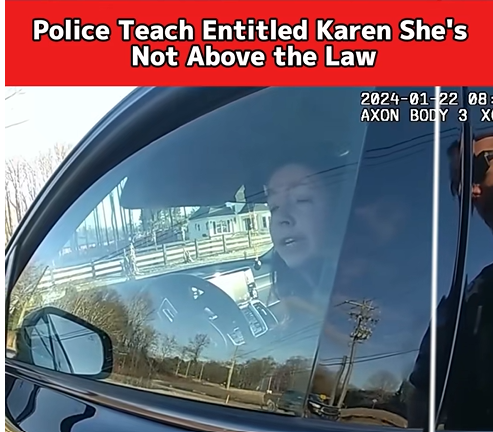
@.justbodycams Part 2 | Police Teach Entitled Karen She’s Not Above The Law #bodycam #copsoftiktok #fypシ #police #crime #tiktokviral #viralvideo #fyp
The third video focuses on a traffic stop that took place on January 22, 2024, after a woman was pulled over for speeding through a school zone. According to the officer, the driver had been clocked traveling more than 50 miles per hour in a 35 mile-per-hour zone. What could have been a routine citation quickly turned into a tense roadside confrontation when the driver refused to accept that she had violated the law and repeatedly declined to provide her driver’s license.
The encounter began with the officer explaining the reason for the stop. He told the driver that she had been speeding in a school zone, which is treated seriously because school zones are designed to protect children, pedestrians, school staff, and other drivers in areas where traffic safety is especially important. Instead of responding by handing over her license or asking basic questions about the citation, the driver immediately challenged the officer’s authority. She asked, “Where’s the victim?” and argued that she had not committed a crime because, in her view, there was no injured person or direct victim.
The officer tried to explain that the stop was not based on a traditional criminal charge involving a specific victim. It was based on a traffic infraction and a violation of state law. Speeding, especially in a school zone, does not require an accident or an injured person for enforcement to occur. The purpose of the law is to prevent harm before it happens. The officer appeared to be trying to keep the situation simple: he wanted to identify the driver, write the citation, and allow both of them to move on. However, the driver continued to argue that she had done nothing wrong.
The disagreement quickly became less about the speed itself and more about whether the driver recognized the officer’s legal authority during the stop. The officer repeatedly asked for her driver’s license, but she refused to hand it over. Her refusal became the central problem in the encounter. During a lawful traffic stop, officers are generally allowed to request a driver’s license, registration, and proof of insurance. The driver, however, claimed that Georgia law did not require her to provide identification under the circumstances. She framed the stop as unlawful and insisted that she was not obligated to comply.
As the conversation continued, the driver began using language often associated with sovereign citizen-style arguments. She referred to herself as a “walker” or a “sovereign” and invoked “constitutional law” as a reason for refusing to follow the officer’s instructions. She appeared to believe that because she did not recognize the traffic violation as a crime, she did not have to provide her license. The officer firmly rejected that argument. He explained that the stop was lawful, that she was operating a vehicle on a public road, and that state law required her to provide her driver’s license when requested during a legal traffic stop.
The officer seemed to understand that the situation could escalate if the driver continued refusing. He attempted to de-escalate by telling her that he was not trying to make the situation bigger than it needed to be. He explained that he simply wanted to complete the citation and let her leave. His message was direct: if she provided her license, the stop could remain a traffic matter. If she continued refusing, the consequences would become more serious. The driver, however, kept challenging him and repeating her belief that she did not have to identify herself.
The tension grew as the officer became more firm. He warned the driver that refusing to provide her license during the stop could lead to her arrest for obstruction. This warning marked a turning point. The officer was no longer only addressing the speeding violation. He was now dealing with her refusal to comply with a lawful command. He told her that she was not making things easy on herself and made it clear that the situation was moving toward jail if she continued down the same path.
For the driver, the warning did not appear to change her position. She seemed convinced that her interpretation of the law protected her from having to cooperate. Her repeated references to constitutional law suggested that she believed she was standing on a higher legal principle. In her mind, the officer may have been acting outside his authority by demanding identification when she believed no real crime had occurred. This belief kept her from seeing the stop as a standard traffic enforcement matter.
For the officer, the situation was much more straightforward. He had stopped a driver for speeding in a school zone. He needed her license to complete the citation. Her refusal to provide it was not a legal debate in his eyes; it was noncompliance. The officer tried to explain that traffic laws still apply even when there is no crash, no injury, and no individual victim standing at the scene. He also made clear that driving is a regulated activity, and drivers are required to carry and present a valid license when lawfully stopped.
The driver’s question, “Where’s the victim?” became one of the most revealing parts of the encounter. It showed that she viewed law through a narrow idea that something is only punishable if a person has been directly harmed. Traffic law works differently. Speed limits, stop signs, school-zone restrictions, and licensing requirements exist to reduce danger before someone gets hurt. If officers had to wait until a child, pedestrian, or another driver was injured before enforcing school-zone speed limits, the law would lose its preventive purpose.
The school-zone setting also made the stop more serious. Speeding in a regular area is already a violation, but speeding through a school zone carries added concern because those areas often include children crossing streets, buses stopping, parents dropping students off, and unpredictable pedestrian movement. Even if no one was hit, traveling more than 50 miles per hour in a 35 mile-per-hour zone could create a dangerous situation. The officer’s decision to stop her was based on that risk.
As the driver continued refusing, the encounter showed how quickly a simple citation can become a possible arrest. At the start, the driver was facing a speeding ticket. If she had provided her license, the stop likely would have ended with paperwork and a fine or court date. Instead, the refusal to identify herself created a second issue. The officer now had to decide whether to keep explaining, call for backup, remove her from the vehicle, or arrest her for obstruction if she continued to resist his instructions.
The video highlights a common problem in traffic stops involving people who claim sovereign or constitutional arguments. These individuals often believe that certain legal terms or personal declarations can exempt them from ordinary traffic laws. They may claim they are not “driving” but “traveling,” or that they are not subject to state statutes unless they consent. Officers, however, do not accept those arguments during stops. From the officer’s perspective, the person is operating a motor vehicle on a public road and is therefore subject to traffic regulations.
The driver’s use of the word “walker” also added confusion to the conversation. She seemed to be trying to separate herself from the legal category of a licensed driver. By describing herself in that way, she may have been attempting to claim that she was not engaged in a regulated activity. But the facts of the stop were simple: she was behind the wheel of a vehicle, on a public road, after allegedly speeding through a school zone. The officer did not treat her personal label as legally meaningful.
The officer’s patience was important throughout the exchange. He did not appear to begin with threats or force. Instead, he repeatedly told her what he needed and what would happen if she refused. He tried to keep the matter limited to a citation, but he also made clear that he would not allow the stop to turn into an endless roadside argument. This is a common turning point in police encounters: officers may answer some questions and explain the reason for a stop, but they usually will not allow a driver to refuse required documents while debating the law indefinitely.
The driver’s refusal also placed her in a worse position than the original speeding allegation. A traffic citation is usually manageable. It may involve a fine, points, or a court appearance, depending on the circumstances. An obstruction arrest, however, is far more serious. By refusing to provide her license, she risked turning a minor traffic matter into a criminal situation. The officer’s warning that she was not making things easy on herself reflected that reality.
The encounter also shows the difference between disagreeing with a citation and refusing to comply during the stop. A driver can usually challenge a ticket later in court. They can argue about the speed reading, the signage, the location, or the officer’s observations. But the roadside is not the courtroom. The officer was not asking the driver to admit guilt. He was asking her to provide identification so the legal process could continue. By refusing, she shifted the focus away from whether she was speeding and toward whether she was obstructing the officer’s duties.
From the driver’s perspective, she may have believed that handing over her license would mean agreeing that the stop was valid or admitting that she had done something wrong. But providing a license during a traffic stop is not the same as admitting guilt. It simply allows the officer to identify the driver and issue the citation. The driver would still have the opportunity to contest the ticket afterward. Her refusal, however, created immediate consequences that could not be solved by later arguments in court.
The officer’s warning about jail was direct because the situation had reached a point where further debate was no longer productive. He had explained the violation, corrected her misunderstanding, and told her the legal requirement. Still, she refused. At that stage, the officer had to make clear that the stop would not continue on her terms. His statement that she could go to jail for obstruction was meant to show that the situation had moved beyond a simple disagreement.
The video demonstrates how legal misinformation can escalate ordinary encounters. The driver appeared confident in her claims about constitutional law and Georgia law, but confidence does not make an argument legally correct. When someone relies on incorrect legal theories during a police stop, they may make choices that increase the risk of arrest. In this case, the driver’s belief that she did not have to provide her license became the very reason the situation escalated.
The incident also reflects how officers must balance patience with enforcement. If an officer escalates too quickly, the public may view the response as heavy-handed. But if an officer allows a driver to refuse basic legal requirements without consequence, the stop becomes impossible to complete. In this situation, the officer tried to explain the law and give the driver several chances to comply. The more she refused, the more the officer had to move toward enforcement.
The driver’s repeated claim that she had done nothing wrong also ignored the purpose of traffic enforcement. Many traffic violations do not involve a direct victim at the moment they occur. A person can run a red light without hitting anyone, drive without insurance without causing a crash, or speed through a school zone without striking a pedestrian. These actions are still violations because they create risk. The law does not require harm to occur before the state can regulate unsafe driving behavior.
By continuing to argue, the driver appeared to misunderstand the practical reality of the stop. The officer was not going to debate constitutional theory on the roadside. He was not going to cancel the stop because she rejected the idea of victimless traffic infractions. He was not going to accept her claim that Georgia law did not apply to her. His position remained the same: provide the license, receive the citation, and address the matter later through the proper legal process.
The stop became a clear example of how refusing a simple instruction can create a much larger problem. The driver had a path that would have allowed the encounter to end quickly, even if she disagreed with the ticket. She could have provided her license, accepted the citation, and challenged it later. Instead, she chose to turn the stop into a confrontation over legal authority. That decision placed her at risk of arrest and made the encounter longer, more tense, and more serious.
In the end, the third video shows a familiar pattern seen in many traffic stop confrontations. A driver is stopped for a violation, disputes the officer’s authority, refuses to provide required documents, and invokes broad legal language that does not change the officer’s duties. The officer attempts to explain the situation, gives warnings, and eventually makes clear that continued refusal will lead to arrest. What began as a speeding stop in a school zone became a standoff over identification, compliance, and the limits of roadside legal arguments.
The incident leaves a strong impression because it shows how easily a person can turn a citation into a much bigger legal issue. The driver’s belief that she was a “sovereign” or protected by her interpretation of constitutional law did not prevent the officer from enforcing traffic rules. Instead, it brought her closer to being arrested for obstruction. The officer’s message was simple: she could disagree with the ticket, but she still had to provide her license. The driver’s refusal to accept that basic requirement became the reason the traffic stop escalated.
Another important part of the stop is the officer’s repeated effort to keep the situation focused on the original violation. He did not appear to be asking the driver to explain her entire legal philosophy or justify her personal beliefs. He was asking for one basic requirement during a traffic stop: her driver’s license. That single document would allow him to confirm her identity, check whether she was legally allowed to drive, and issue the citation. The driver’s refusal made that simple process impossible. Instead of the stop moving forward normally, it became stuck in a cycle of arguments, warnings, and repeated demands.
The driver’s belief that there needed to be a victim in order for the stop to be valid showed a misunderstanding of how traffic laws work. Many laws are preventive, meaning they exist to reduce the chance of harm before something serious happens. A school-zone speed limit is one of the clearest examples of that. The law is designed to slow vehicles near schools because children may cross the road, buses may stop unexpectedly, and parents or staff may be moving around the area. The absence of an injured person does not erase the danger created by speeding in that location.
Her argument also showed how some people confuse criminal law with civil infractions or traffic violations. Not every violation requires the same kind of victim, intent, or harm that a major criminal case might involve. A person can receive a ticket for speeding, failing to stop, driving without a license, or violating registration rules even if no one is hurt. The point is not only to punish harm after it happens, but to create rules that help prevent harm from happening in the first place. The officer attempted to explain this, but the driver remained fixed on her own interpretation.
The use of sovereign-style language made the stop more difficult because it turned a practical situation into an ideological argument. Instead of discussing the speed reading, the location, or whether the school-zone sign was visible, the driver challenged the entire system of traffic enforcement. She seemed to believe that by calling herself a “sovereign” or a “walker,” she could avoid being treated as a driver subject to state law. But in the real-world setting of a roadside stop, those labels did not change the officer’s authority or her responsibilities.
The officer’s patience had limits because he could not complete the stop without identifying her. A traffic stop cannot simply end with the driver refusing to provide information. If that were allowed, any person could avoid a citation by declining to hand over a license and claiming not to recognize the law. The officer’s warning about obstruction was his way of making clear that refusal itself had become a separate issue. At that point, the driver was not just disputing the ticket; she was preventing the officer from carrying out his duty.
This is where the stop became more serious. Speeding through a school zone is already an important violation, but obstruction carries a different meaning. It suggests that the person is interfering with an officer’s lawful actions. The driver may have believed she was defending her rights, but the officer viewed her behavior as blocking a lawful investigation. That difference in interpretation created the risk of arrest. The longer she refused, the more likely it became that the officer would stop explaining and begin taking enforcement action.
The video also shows why remaining calm during a traffic stop matters, even when someone believes the officer is wrong. A driver does not have to agree with a citation. They can challenge it later through the proper legal process. They can ask for evidence, appear in court, or explain their side to a judge. But the roadside is not usually the place where the legal dispute gets decided. The officer’s role during the stop is to enforce the law and document the violation. The court’s role comes later.
In this situation, the driver seemed to treat the roadside conversation as if it were a courtroom hearing. She tried to argue legal principles, challenge jurisdiction, and demand proof of a victim. The officer, however, was not there to hold a debate. He was there because he believed she had violated a school-zone speed limit. His goal was to complete the citation and move on. That mismatch made the conversation frustrating for both sides. The driver wanted the officer to accept her legal theory. The officer wanted the driver to follow the basic steps required during a stop.
The fact that the officer told her she was not making things easy on herself was important. It was not just a criticism; it was a warning that her choices were creating additional consequences. At the beginning of the stop, the situation could have remained simple. She could have handed over her license, received the citation, and later decided whether to pay it or fight it. By refusing, she gave the officer a reason to consider arrest. The warning was meant to give her one more chance to avoid that outcome.
The incident also highlights how misinformation can feel empowering in the moment but harmful in practice. People who follow sovereign-style arguments often speak with confidence, using phrases about constitutional law, common law, traveling, consent, and jurisdiction. These phrases may sound powerful, but they usually do not succeed during ordinary traffic stops. Instead, they often cause the situation to escalate because officers are trained to enforce traffic laws, not accept personal declarations as exemptions from them.
For viewers, the stop may feel frustrating because the solution seems so simple. The driver could disagree with the officer while still providing her license. Providing identification would not mean she agreed that she was guilty. It would not prevent her from challenging the ticket later. It would simply allow the officer to finish the traffic stop. Her refusal turned a routine process into a confrontation where she risked being taken to jail over something that could have ended with a citation.