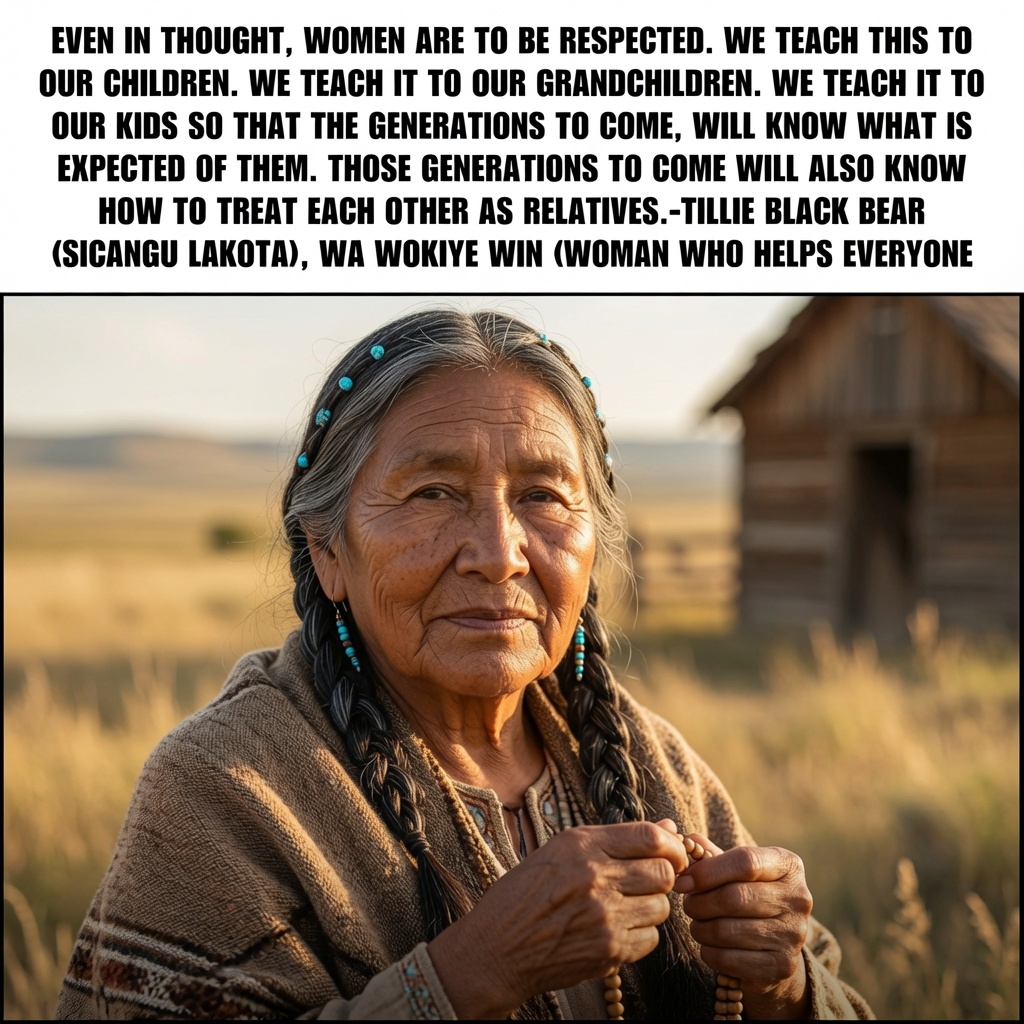
In many Native Nations, respect has never been something that exists only in words or written teachings. It has always lived in action, in behavior, in the quiet and consistent ways people treat one another every single day. It is not something that is taught once and forgotten, but something that is shown repeatedly through example, through family, and through community. Children do not simply learn respect by being told what it means; they learn it by watching how it is practiced. They observe how elders are spoken to, how mothers are honored, how grandmothers are listened to, and how every person is treated as part of a larger whole. In this way, respect becomes not just a value, but a way of life.
Within this structure, women have always held a central and sacred role. They are not seen as secondary or supporting figures, but as pillars of life itself. Women are life-givers, not only in the physical sense, but in the cultural, emotional, and spiritual sense as well. They carry knowledge, pass down traditions, nurture families, and protect the continuity of their people. In many Indigenous cultures, women are recognized as leaders, decision-makers, and keepers of wisdom. Their presence is not simply valued; it is essential.
This understanding of women’s roles stands in contrast to many outside systems that have historically minimized or misunderstood the importance of women in society. In Native communities, women are often seen as the center of balance, the ones who hold together the threads that connect generations. Grandmothers, in particular, are viewed as living libraries of knowledge, carrying stories, teachings, and histories that define the identity of a people. Their voices are not only heard but respected, because within them lies the memory of everything that came before.
Tillie Black Bear, a Sicangu Lakota woman known as Wa Wokiye Win, or “Woman Who Helps Everyone,” carried these teachings into the modern world in a way that continues to inspire many today. Her life’s work was rooted in the belief that respect for women must go deeper than action; it must begin in thought. This idea may seem simple on the surface, but it carries profound meaning. To respect someone in thought means to see their humanity, their value, and their dignity at all times, not just when it is convenient or visible. It means recognizing that respect is not something that is turned on or off, but something that is constant.
This teaching reflects a broader worldview within many Indigenous communities, where relationships are understood in terms of connection rather than separation. The idea of treating one another as relatives is not symbolic; it is a guiding principle. It shapes how people interact, how they resolve conflicts, and how they support one another. When every person is seen as part of a larger family, the responsibility to care, protect, and respect becomes shared. It is no longer about individual actions alone, but about the well-being of the entire community.
For children growing up within this framework, these lessons become part of their identity. They learn that no one is disposable, that every life has value, and that their actions have an impact on those around them. They are taught that honor begins at home, in the smallest interactions, in the way they speak, listen, and treat others. These teachings are not enforced through punishment alone, but through example, through the consistent modeling of behavior by those they look up to.
However, the history of Native Nations also tells a story of disruption and hardship, particularly during the period of colonization. The arrival of outside systems brought with it profound changes that deeply affected Indigenous communities. Land was taken, families were separated, and traditional ways of life were challenged. Among the many impacts of colonization was an attempt to weaken the roles that women held within their communities. Systems that once valued women as leaders and protectors were replaced with structures that often sought to silence or diminish their voices.
Boarding schools, forced removals, and policies aimed at assimilation disrupted the transmission of cultural knowledge, separating children from their families and from the teachings that had guided their communities for generations. These efforts were not only about changing behavior; they were about reshaping identity. They sought to replace Indigenous values with external ones, often at great cost to the people involved. Yet, despite these efforts, Indigenous communities did not lose their sense of self.
Native women, in particular, played a crucial role in ensuring the survival of their cultures during these difficult times. They found ways to preserve languages, to pass down traditions, and to hold families together even when faced with overwhelming challenges. Their resilience was not always visible in public spaces, but it was deeply felt within their communities. They became the quiet protectors of identity, carrying forward what others tried to erase.
This resilience is a defining feature of Native history. It is a story not only of pain, but of endurance and strength. Women organized, resisted, healed, and led in ways that ensured their communities could continue to exist and grow. They did not abandon their traditions; instead, they adapted them, finding ways to keep them alive in changing circumstances. This ability to hold on to identity while navigating change is a testament to their strength and determination.
Tillie Black Bear’s work is an example of how these traditional teachings can be brought into the modern world to address contemporary challenges. She recognized that the issues facing Native women and families were deeply connected to the loss of traditional values and structures. Rather than looking outside for solutions, she turned to the teachings that had always existed within her culture. She understood that respect, safety, and healing were not separate from sovereignty, but were essential parts of it.
Her efforts helped to build movements that focused on protecting Native women and strengthening families. These movements were not just about addressing immediate concerns; they were about restoring balance and reconnecting with values that had been disrupted. By emphasizing respect, not only in action but in thought, she highlighted the importance of addressing the root causes of harm rather than just the symptoms.
The idea that respecting women is tied to the survival of a people is a powerful one. It suggests that the well-being of a community is directly linked to how it treats its most vital members. When women are honored, they are able to fulfill their roles as caregivers, teachers, and leaders more fully. This, in turn, creates a stronger foundation for the entire community. Children who grow up in environments where respect is practiced are more likely to carry those values forward, creating a cycle that strengthens future generations.
This interconnectedness extends beyond individuals to the broader structure of society. When grandmothers are respected, the knowledge they carry is preserved. When mothers are safe, families are more stable. When girls are valued, they grow up with a sense of confidence and purpose that shapes the future. Each of these elements contributes to the overall health and resilience of a community.
It is important to recognize that Native American history is not defined solely by hardship. While the challenges faced are significant, they are only part of the story. Equally important are the stories of strength, creativity, and perseverance that have allowed Indigenous communities to thrive despite adversity. Women have been at the center of these stories, guiding their communities through difficult times and ensuring that their identities remain intact.
The lessons that come from these histories are not limited to Indigenous communities; they have relevance for anyone seeking to build a more respectful and connected society. The idea of treating others as relatives, of valuing every life, and of recognizing the importance of respect in thought as well as action are universal principles. They offer a way of thinking that emphasizes connection over division and responsibility over indifference.
As the world continues to change, these teachings remain as important as ever. They remind us that the strength of a society is not measured solely by its achievements, but by how it treats its people. They encourage us to look beyond individual success and consider the well-being of the community as a whole. In doing so, they offer a path toward a future that is more inclusive, compassionate, and resilient.
Ultimately, the story of Native Nations is one of continuity, of knowledge passed down through generations, and of values that have stood the test of time. It is a story that begins with respect—respect for women, for elders, for children, and for one another. This respect is not abstract; it is lived, practiced, and carried forward every day.
Respect women. Respect elders. Respect children. Respect each other as relatives. These are not just words; they are principles that have guided communities for generations. They are the foundation of survival, the key to preserving identity, and the path toward a future that honors the past while embracing what is yet to come.
As these teachings continue to be shared across generations, they also reveal something deeper about the nature of strength within Native communities. Strength has never been defined solely by physical power or authority, but by the ability to nurture, to guide, and to sustain life in all its forms. Women, in this sense, have always embodied a kind of strength that is both visible and invisible—visible in their roles as leaders and protectors, and invisible in the quiet ways they hold families together, carry knowledge, and pass on traditions that ensure continuity. This kind of strength is not always recognized by outside systems, yet it is fundamental to the survival of a people.
The teachings that emphasize respect for women, elders, and children are not separate ideas, but interconnected principles that form the foundation of community life. When one part of this system is weakened, the effects ripple outward, impacting the entire community. Colonization sought to disrupt this balance, introducing systems that often devalued women’s roles and replaced collective responsibility with individual control. These changes were not only political or economic; they were deeply cultural, affecting how people saw themselves and each other. Yet, even in the face of these disruptions, the core teachings remained, carried quietly through generations by those who refused to let them disappear.
One of the most powerful aspects of Indigenous resilience is the ability to remember. Memory, in this context, is not simply about recalling events, but about holding onto identity, values, and ways of being. Grandmothers, as keepers of memory, play a crucial role in this process. They carry stories that stretch back through time, stories that teach lessons about survival, respect, and connection. These stories are not just told for entertainment; they are shared with purpose, guiding younger generations and helping them understand their place within a larger continuum.
In many ways, the act of remembering becomes an act of resistance. When systems attempt to erase culture, language, and identity, holding onto those elements becomes a way of asserting existence. Native women have been at the forefront of this resistance, ensuring that what was nearly lost is not forgotten. They have done so not only through words, but through actions—through the continuation of ceremonies, the teaching of traditional skills, and the preservation of languages that carry the essence of their people.
Language, in particular, holds a special place in this process. It is more than a tool for communication; it is a reflection of how a people understand the world. Many Indigenous languages contain concepts that do not have direct translations in English or other colonial languages, concepts that emphasize relationships, balance, and respect. When these languages are lost, so too are the ways of thinking they represent. The efforts of Native women to preserve and revitalize these languages are therefore not just cultural initiatives; they are acts of survival.
The idea that respect begins in thought also challenges modern societies to reflect on their own values. In many contexts, respect is often associated with outward behavior—what people say or do in visible ways. However, Tillie Black Bear’s teaching reminds us that true respect goes deeper. It begins with how people think about one another, how they perceive value, and how they recognize the humanity in others. This internal aspect of respect is what shapes actions, influencing how individuals treat one another even when no one is watching.
This teaching becomes especially important when considering the ways in which societies address harm and injustice. If respect is only practiced on the surface, it can be easily broken or ignored. But when it is rooted in thought, it becomes a guiding principle that influences decisions and behaviors consistently. This is the kind of respect that builds trust, strengthens relationships, and creates environments where people feel safe and valued.
The connection between respect and safety is another key element of these teachings. When women are respected, they are more likely to be protected from harm. When children are valued, they are more likely to grow up in environments that support their well-being. When elders are honored, their knowledge continues to guide the community. Each of these elements contributes to a sense of stability and continuity, creating a foundation upon which future generations can build.
The work of Tillie Black Bear and others like her highlights the importance of addressing both historical and contemporary challenges through a return to these foundational values. Rather than seeking solutions that are disconnected from cultural identity, her approach emphasized the importance of reconnecting with traditional teachings. This approach recognizes that the answers to many modern problems can be found in the wisdom that has existed for generations.
Her legacy continues to inspire movements that focus on protecting Native women and families, emphasizing that these efforts are not just about addressing individual cases, but about restoring balance within communities. This restoration involves acknowledging past harms, supporting healing, and creating systems that reflect the values of respect, connection, and responsibility. It is a process that requires both reflection and action, guided by the understanding that true change begins at the level of thought and intention.
As these ideas continue to spread, they also challenge broader societal norms, encouraging people to rethink how they approach relationships, community, and responsibility. The concept of treating others as relatives, for example, offers a powerful alternative to more individualistic perspectives. It suggests that people are not isolated, but connected, and that their actions have an impact on those around them. This perspective fosters a sense of accountability, encouraging individuals to act in ways that support the well-being of the whole.
In a world that often feels divided, these teachings offer a path toward greater unity and understanding. They remind us that respect is not limited by culture or background, but is a universal principle that can be practiced by anyone. By adopting these values, it becomes possible to create environments where people feel seen, heard, and valued, regardless of their differences.
At the same time, it is important to recognize that these teachings are not abstract ideals, but lived experiences that have been carried forward by Indigenous communities for generations. They are rooted in specific histories, cultures, and ways of life that deserve to be respected and understood in their own context. Learning from these teachings involves not only adopting their principles, but also acknowledging their origins and the people who have preserved them.
Ultimately, the strength of Native Nations lies in their ability to hold onto these teachings despite the challenges they have faced. It lies in the women who continue to lead, teach, and protect, ensuring that the values of respect and connection are passed on to future generations. It lies in the communities that continue to see one another as relatives, bound together by shared responsibility and care.
As we look toward the future, these lessons remain as relevant as ever. They remind us that survival is not just about enduring, but about maintaining identity, preserving values, and fostering connections that support the well-being of all. They challenge us to think more deeply about what it means to respect one another, to care for one another, and to build a world that reflects these principles.
Respect women. Respect elders. Respect children. Respect each other as relatives. These teachings are not bound by time; they are living principles that continue to guide and inspire. They are the foundation upon which communities are built, the threads that connect past, present, and future.
And in honoring these teachings, we do more than preserve a way of life. We contribute to a vision of the world where respect is not an exception, but a constant—where every person is valued, every voice is heard, and every generation is given the strength to carry the story forward.
As these teachings continue to guide both individuals and communities, they also offer a reminder that respect is not something that can be practiced occasionally—it must be lived consistently. It is present in everyday choices, in the tone of a voice, in the patience shown when listening, and in the willingness to protect others even when it requires personal effort. These small, daily actions may seem simple, but together they create a culture where dignity is upheld and where people feel a sense of belonging. This is the kind of environment where families grow stronger and where future generations are given the tools to carry these values forward.
In many ways, the enduring strength of Native Nations comes from this consistency. Even when external forces attempted to disrupt their ways of life, the core teachings remained intact because they were rooted not just in formal systems, but in relationships. They lived in how people treated one another, in how children were raised, and in how elders were honored. These relationships became the foundation that allowed communities to survive and continue, even under the most difficult circumstances.
This is why the message remains so powerful today. It is not only about honoring the past, but about shaping the future. When respect is practiced fully—in thought, in word, and in action—it creates a world where people are not divided by difference, but connected by shared humanity. It builds communities that are resilient, compassionate, and grounded in values that do not fade with time. And through this, the teachings continue to live, not as something remembered, but as something actively carried forward by each new generation.