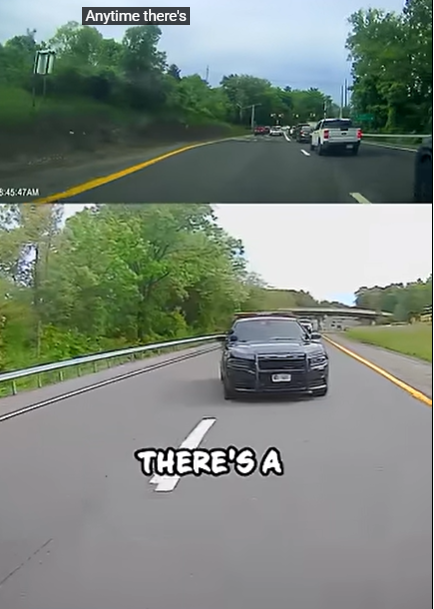
The video begins like a normal dashcam recording from a busy road, with traffic moving ahead and vehicles traveling in their lanes. At first, nothing seems especially unusual. Cars are moving forward, the road is active, and the driver appears to be continuing with the flow of traffic. But behind the driver, a police vehicle follows closely. That detail becomes more important as the video continues. What looks like an ordinary moment on the road turns into an unexpected crash when traffic ahead begins to slow and the officer fails to stop in time. Instead of safely reacting to the slowdown, the police vehicle rear-ends the driver’s car.
The impact immediately changes the entire situation. A police officer who was apparently following the driver becomes the person responsible for striking the vehicle from behind. For the driver, the crash is frustrating, shocking, and badly timed. He can be heard reacting with disbelief, saying that he was just rear-ended and explaining that he is on his way to a doctor’s appointment. That detail makes the incident feel even more irritating from his perspective. He was not simply driving around with nowhere to be. He had somewhere important to go, and now he is dealing with the stress of a collision caused by the very officer who was behind him.
Rear-end crashes are often associated with distraction, following too closely, or failing to maintain enough stopping distance. In ordinary driving, the responsibility usually falls heavily on the driver in the rear because every driver is expected to leave enough space to react if traffic slows. That expectation should apply even more strongly to police officers, who are trained drivers and public safety professionals. If an officer is following another vehicle, especially on a busy road, he needs to remain alert to the traffic ahead. A police vehicle is still a vehicle. It still needs time and distance to stop. The badge does not change physics.
The most striking part of the video is what the officer says afterward. After stepping out to assess the situation, he tells the driver to hang on and says that he was originally coming to pull him over for speeding. That statement adds a strange and frustrating twist to the crash. From the officer’s point of view, he may have been focused on initiating a traffic stop. But from the driver’s point of view, the officer rear-ended him and then immediately brought up the reason he had been following him in the first place. The timing makes the statement feel almost absurd. The officer had intended to stop the driver for speeding, but before he could do so, he crashed into him.
This creates a strange reversal of authority. Usually, when a police officer pulls someone over, the officer is the one questioning the driver’s behavior. The driver may be accused of speeding, unsafe driving, or another traffic violation. In this video, however, the officer’s own driving becomes the issue. The driver may have been speeding, according to the officer, but the officer was the one who failed to stop before hitting the vehicle. That does not automatically erase any possible speeding allegation, but it does shift the focus. The most immediate and visible violation of road safety is the rear-end collision.
The driver’s frustration is easy to understand. Being pulled over is stressful enough. Being rear-ended is stressful enough. Experiencing both at once, especially while trying to get to a medical appointment, would make almost anyone angry. The driver likely expected the officer to acknowledge the crash first and deal with the accident calmly. Instead, hearing that the officer was about to stop him for speeding may have sounded like an attempt to redirect blame or justify why the officer was following so closely. Even if the officer did not mean it that way, the driver could reasonably hear it as unfair.
The video also raises an important question about attention. If the officer was preparing to stop the driver, he may have been watching the target vehicle, checking speed, looking for a safe place to initiate the stop, communicating with dispatch, or preparing to activate lights. But none of those tasks removes the responsibility to watch the road. Police driving requires divided attention, but the first priority must always be avoiding a crash. If traffic ahead slows, an officer needs to react like any other driver. Public safety cannot be protected by creating a new danger.
This is where the situation becomes a lesson about professional responsibility. Police officers are allowed to enforce traffic laws because unsafe driving can harm the public. But that authority carries an expectation that officers themselves will drive safely. When an officer follows too closely or fails to react in time, it weakens the moral authority of the stop. A driver being accused of speeding may naturally wonder why the officer’s own unsafe following distance is not being treated with equal seriousness. Enforcement works best when the person enforcing the rule is also following the rule.
The dashcam perspective makes the incident especially powerful. Dashcams are often used to protect drivers by recording what happens before and after a crash. In this case, the recording appears to capture not only the collision but also the context: traffic slowing, the police vehicle behind, and the driver’s reaction afterward. Without video, the story might be harder to explain. A driver saying, “The officer rear-ended me while trying to pull me over” might sound unusual or disputed. But dashcam footage gives viewers a clearer sense of how the incident unfolded.
The video also highlights how stressful it can be to be followed closely by police. Even before the crash, a driver may feel pressure when a patrol car is directly behind them. They may wonder whether they are about to be stopped, whether they are doing something wrong, or whether they should change lanes. That pressure can make a driver more cautious or nervous. If traffic suddenly slows and the police vehicle is too close, the driver may have no control over what happens next. The person in front can brake normally, but if the officer behind is not paying attention, the crash becomes unavoidable.
There is also a practical issue: after the collision, the driver’s doctor’s appointment may be delayed or missed. That might sound small compared to a crash, but medical appointments can be difficult to schedule, especially if someone has waited weeks or needs care urgently. A collision can disrupt the entire day. The driver may need to exchange information, wait for another officer or supervisor, file a report, contact insurance, inspect damage, and possibly deal with pain or vehicle repairs. A few seconds of inattention can create hours, days, or weeks of inconvenience.
The officer’s statement about speeding may also raise concerns about how the crash will be documented. The driver may worry that the officer will frame the incident in a way that protects himself or shifts attention to the driver’s alleged speed. That is why transparency matters so much when police are involved in crashes. If an officer causes a collision, the investigation should be clear, fair, and ideally handled by someone other than the officer involved. The driver should not feel that he has to argue against the officer’s version alone. Accountability requires proper documentation, bodycam or dashcam review, and an honest assessment of fault.
The incident also reminds viewers that police officers are human and can make ordinary driving mistakes. They can be distracted, misjudge stopping distance, follow too closely, or become too focused on one task. But because they hold authority and operate official vehicles, their mistakes carry extra weight. A private driver who rear-ends someone may receive a citation, insurance consequences, or civil responsibility. An officer should not be automatically excused simply because he was on duty. If anything, the public expects a higher standard because officers are trained to handle stressful driving situations.
This does not mean the officer intended to crash or acted maliciously. Most likely, it was a mistake. But mistakes still matter. A rear-end collision can injure people, damage property, and create fear. The driver’s anger should not be dismissed simply because the collision involved an officer. If an ordinary driver had hit him from behind and then said, “I was about to confront you about your driving,” the response would probably be the same: first, deal with the fact that you hit me. The person who caused the crash has to answer for that before shifting the conversation elsewhere.
The video also shows how quickly a traffic enforcement situation can become messy. A speeding stop is supposed to be simple: observe the violation, activate lights, pull the driver over safely, explain the reason, and issue a warning or citation if appropriate. But once the officer crashes into the vehicle, the entire situation changes. Now it is not only a traffic stop. It is an accident involving a police vehicle. The officer is no longer just the enforcer. He is also a participant in the incident. That dual role can create tension because the driver may feel the officer has too much control over the narrative.
The phrase “I was coming to pull you over for speeding” also has a defensive quality, even if that was not the officer’s intention. It sounds like an explanation for why he was close behind. But being on the way to pull someone over does not justify hitting them. If anything, it means the officer should have been especially careful. Initiating a traffic stop requires choosing a safe moment and maintaining control of the patrol vehicle. A stop that begins with a crash is not controlled or safe.
There is also an irony in the situation. The officer was apparently preparing to address unsafe driving, but his own driving produced the immediate hazard. That irony is what makes the video memorable and shareable. Viewers can immediately understand the contradiction. The officer may have been focused on the driver’s speed, but the crash shows that speed is not the only form of unsafe driving. Following distance, attention, braking, and awareness are just as important. A driver going too fast can be dangerous, but so can a driver following too closely.
The driver’s emotional reaction gives the video its human center. He is not speaking like someone trying to create drama for no reason. He sounds like someone who has just been hit and is trying to process the absurdity of the situation. His mention of the doctor’s appointment adds a personal detail that makes the frustration feel real. People watching can imagine being in his position: already focused on getting somewhere important, then suddenly being struck from behind by a police vehicle, then hearing the officer say he was about to pull them over. It would feel unfair, stressful, and maybe even intimidating.
The crash also raises questions about how officers should behave immediately after causing an accident. The first priority should be safety: check for injuries, move vehicles if necessary, call for assistance, and make sure the roadway is not blocked dangerously. The second priority should be accountability: acknowledge what happened, exchange information, and make sure the incident is properly reported. Bringing up the intended traffic stop may be relevant later, but in the first moments after the crash, the person who was hit needs reassurance that the collision will be handled fairly.
This situation could also affect public perception because people often feel that police receive different treatment when they make mistakes. If the officer is not cited or disciplined when an ordinary driver would be, people may see that as unfair. Public trust depends on the belief that rules apply to everyone. If police enforce traffic laws, they must also be accountable to traffic laws. A patrol car should not be treated as exempt from basic driving duties unless it is operating under specific emergency conditions, and even then, officers are usually expected to drive with due regard for safety.
The video may also encourage drivers to invest in dashcams. Many people use dashcams because they provide an objective record during accidents or disputes. When the other party is a police officer, a dashcam can be especially important because it gives the driver evidence that does not depend only on memory or official reports. It can show traffic conditions, following distance, braking, impact, and conversation afterward. In a world where road incidents can quickly become disputed, video can protect ordinary drivers from being misunderstood or blamed unfairly.
At the same time, the video should not be reduced only to a joke about an officer crashing while trying to stop someone. There is humor in the irony, but there is also real risk. Rear-end collisions can cause neck injuries, back pain, headaches, vehicle damage, and anxiety. Even a low-speed impact can create problems. The driver may need medical evaluation, especially since he was already on his way to a doctor. The crash could worsen existing health concerns or create new ones. That is why it should be treated seriously.
The broader lesson is about attention and humility. Drivers often criticize others for speeding, braking too hard, changing lanes poorly, or not paying attention. Police officers do the same in an official capacity. But everyone behind the wheel has the same basic responsibility: watch the road, keep distance, and be ready to stop. Authority does not remove that responsibility. In fact, authority should make a person more careful, not less.
In the end, the video is memorable because it flips the expected roles. The officer was following the driver to enforce the law, but the officer’s own mistake became the main event. The driver may have been accused of speeding, but the police vehicle caused the crash. The officer may have intended to initiate a stop, but instead he created an accident scene. That reversal is what makes the footage so striking.
The strongest takeaway is simple: public safety begins with the person behind the wheel, no matter who they are. A police officer following a suspected speeder still has to maintain control, leave space, and react to slowing traffic. A badge does not prevent a rear-end collision, and an intended traffic stop does not excuse one. If anything, the incident shows that the people responsible for enforcing road safety must hold themselves to the same standard they expect from everyone else. When they do not, the public has every right to question it.
Another important part of this incident is the way it changes the usual story people expect from traffic stops. In most traffic enforcement videos, the driver is the person being judged. The officer explains the violation, the driver reacts, and the viewer is asked to consider whether the stop was fair. Here, the focus shifts because the officer’s own behavior becomes the clearest safety issue. Even if the driver had been speeding earlier, the crash itself shows that the officer failed to maintain enough space to stop safely. That matters because public trust depends on consistency. If officers expect drivers to follow traffic laws carefully, then officers must also show that same care when they are behind the wheel.
The road conditions in the video also make the situation feel preventable. Traffic ahead was slowing, which is a normal and expected part of driving on a busy road. Cars slow down for congestion, lane changes, construction, traffic lights, exits, emergency vehicles, or simple changes in flow. A safe driver should always anticipate that the vehicle in front may brake. This is why following distance is one of the most basic rules of road safety. It gives the driver time to see, think, react, and stop. When a following vehicle is too close or the driver is distracted, even a normal slowdown can turn into a crash. The officer, especially while driving an official vehicle, should have been prepared for exactly that kind of situation.
There is also a difference between watching a car and watching the road. If the officer was focused mainly on the driver he intended to stop, he may have lost awareness of the bigger traffic environment. That is a common danger in driving. People can become so focused on one thing, such as a license plate, a speed reading, a radio call, or a planned stop, that they fail to notice the broader flow of traffic. For police officers, this risk can be higher because they often handle many tasks at once. But multitasking does not excuse a collision. It means officers need strong training and discipline to avoid tunnel vision.
The driver’s frustration about his doctor’s appointment also adds a real-life consequence that viewers should not ignore. A crash is not only about vehicle damage. It interrupts someone’s day, schedule, health needs, and peace of mind. If the appointment was important, missing or delaying it could create stress or even affect the driver’s care. He may have had to reschedule, wait longer, explain the situation, or deal with pain from the impact. This is why even a “minor” crash can feel major to the person affected. The officer may have been thinking about a traffic violation, but the driver was thinking about his health, his time, and the shock of being hit from behind.
The video also shows why the first words after a crash matter. When someone is rear-ended, they want to hear concern first: “Are you okay?” “Are you hurt?” “Let’s get to a safe place.” If the first major explanation is about why the officer had been following them, it can feel like the officer is defending himself before caring about the person he hit. Even if the officer did check on the driver, the statement about speeding stands out because it sounds like a justification. In emotionally charged moments, people remember tone and priority. A calm acknowledgment of responsibility can reduce anger, while a defensive explanation can increase it.
There is also a strong accountability issue because a crash involving a police car should be handled with extra transparency. The driver should not have to wonder whether the officer’s version will be favored automatically. There should be a clear report, a supervisor response, available camera footage, insurance information, and a fair process for determining fault. If the officer would have cited an ordinary driver for following too closely or failing to stop, then the same standard should be considered here. Accountability does not mean treating officers unfairly. It means not giving them special protection from the same rules they enforce.
The incident is also a reminder that traffic enforcement should never become so focused on punishment that it creates more danger than it prevents. If the driver was truly speeding, the purpose of the stop would be to improve safety. But a stop that begins with a rear-end crash has already failed that purpose. The goal of road safety is not just to catch violations; it is to prevent harm. Officers must balance enforcement with safe driving tactics. Following too closely in preparation for a stop can create exactly the kind of danger traffic laws are meant to reduce.