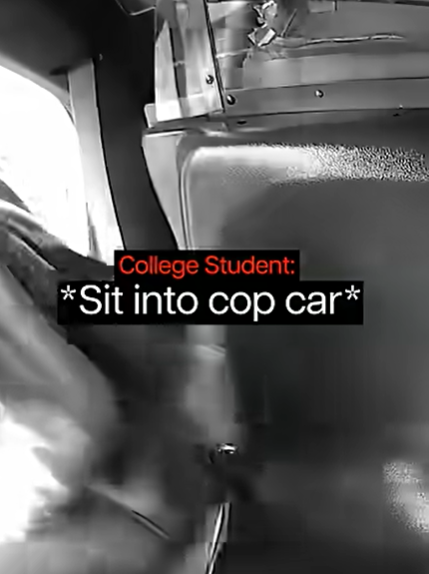
The video begins with a situation that feels almost unbelievable at first: a college student gets into the back seat of a parked police cruiser, apparently expecting to be driven to a nearby bar. It is the kind of moment that sounds like a joke until the officer opens the door, gets inside, and realizes someone is sitting in the back of her vehicle. What might have started as a careless or intoxicated mistake quickly becomes a tense and embarrassing encounter. The student explains that she was hoping for a ride, but the officer is clearly not amused. To the officer, this is not a funny misunderstanding. It is disrespectful, inappropriate, and possibly unlawful.
The strange part of the incident is how casually it begins. Most people would never think of entering a police cruiser without permission. A marked patrol car is not just a vehicle; it is part of an officer’s workspace and authority. It may contain equipment, official documents, electronics, and sometimes weapons or restricted materials. Even the back seat, where detained people are usually placed, is not a public waiting area. For the student to simply climb inside suggests either poor judgment, confusion, intoxication, or a complete misunderstanding of boundaries. Whatever her intention, the action immediately puts the officer on alert.
When the officer discovers the student inside, her reaction is sharp. She questions why the student is there, and when the student says she wanted a ride to a bar, the officer becomes offended. That reaction is understandable. Police officers are not taxi drivers, and a patrol car is not a rideshare vehicle. Officers may sometimes give people rides for safety reasons, especially if someone is stranded, vulnerable, or in danger, but that is very different from someone entering the car without permission and expecting transportation to a bar. The student’s assumption makes the officer feel disrespected, as if her official vehicle and role have been treated like a convenience service.
The confrontation quickly becomes a lesson in consequences. The officer orders the student out of the car and demands identification from both her and her friend. The mood changes from awkward to serious. The student may have expected annoyance, a warning, or maybe a lecture, but the officer treats the incident as something more significant. From the officer’s point of view, the student did not merely ask for help. She entered a police vehicle without permission. That detail matters because it crosses a line. Asking an officer for a ride is one thing. Getting into the cruiser first and explaining afterward is something else.
The student’s friend also gets pulled into the situation because the officer wants to know who was involved and what exactly happened. In moments like this, friends often become part of the consequences even if they did not make the main decision. If they encouraged the student, laughed about it, or failed to stop her, the officer may view them as part of the problem. Even if the friend did nothing wrong, they still become part of the investigation because they were present. This is one reason poor judgment in public can affect more than just the person who acts first.
The officer’s frustration seems to come from more than the physical act of entering the cruiser. It also comes from the attitude behind it. The student appears to have treated the police car like an available ride, something she could use because it was there. That kind of assumption can feel insulting to someone in uniform. Officers already deal with unpredictable situations, disrespect, danger, and public pressure. Finding someone casually sitting in the back of the cruiser asking for a ride to a bar would likely feel absurd and disrespectful at the same time. The officer’s anger reflects the feeling that the student failed to understand the seriousness of what she was doing.
There is also a safety issue. An officer returning to a cruiser and finding an unexpected person inside could reasonably be startled. Police vehicles are controlled spaces. Officers need to know who is near them, who is inside their vehicle, and whether any equipment has been touched. Even if the student had no harmful intent, the officer could not know that immediately. The moment she found someone in the back seat, she had to assess whether the person was intoxicated, confused, dangerous, or simply foolish. That uncertainty explains why the encounter escalates quickly.
From the student’s perspective, the situation may have felt like a joke that suddenly became serious. She may have thought the officer would laugh, tell her to get out, and send her away. Many young people, especially in college environments, sometimes underestimate how serious public behavior can become when police are involved. A silly decision made in a playful mood can become a criminal charge if it violates boundaries or causes damage. The student may not have intended to commit a crime, but intent does not always erase consequences. The law often cares about what someone did, not only what they meant to do.
After speaking with a colleague, the officer decides to charge the student with criminal mischief. That decision shifts the entire event from a strange misunderstanding to a legal matter. Criminal mischief usually involves damaging, tampering with, or interfering with property, though the exact definition depends on location. In this case, the officer appears to view the student’s unauthorized entry into the police vehicle as serious enough to justify a charge. Whether viewers think that response is fair or excessive may depend on how they interpret the student’s behavior. Some may see it as a harmless mistake that deserved only a warning. Others may see it as a reckless act that needed consequences.
The final irony of the video is that the student ends up back in the police car, but not in the way she wanted. She initially entered the cruiser hoping for a ride to a bar. By the end, she is placed under arrest in the same type of seat, and the officer remarks that she is finally getting her wish for a ride. That line gives the video its sharp, memorable ending. It is almost poetic in a harsh way. The student wanted transportation, and she got it, but the destination changed completely. Instead of being taken to nightlife, she is taken into custody.
That ending is why the video works so well as a viral story. It has irony, embarrassment, authority, consequences, and a clear reversal. The student treats the cruiser like a taxi, and the officer turns that assumption into the central lesson of the encounter. Viewers can easily understand the punchline: she asked for a ride, and now she is getting one under arrest. But beneath the humor is a real warning about boundaries and respect. Police vehicles are not public property in the casual sense. They are official vehicles, and entering one without permission can create serious problems.
The incident also says something about college nightlife culture. Many college students go out with friends, move between bars, and sometimes make poor decisions late at night. In that environment, people may act impulsively, especially if alcohol is involved. They may joke with strangers, approach security, talk casually to officers, or assume that authority figures are there to help them get where they want to go. But alcohol, excitement, or youth does not remove responsibility. A bad decision made during a night out can still lead to charges, embarrassment, and a permanent memory of a moment that went wrong.
There is also a broader lesson about asking for help the right way. If the student truly needed help getting somewhere safely, she could have approached the officer respectfully and asked from outside the vehicle. The officer might have said no, suggested a rideshare, contacted campus safety, or helped in another appropriate way. But entering the vehicle first changed everything. It made the situation look entitled rather than vulnerable. It turned a request into an intrusion. That difference matters. People are often willing to help when they feel respected. They are much less willing when someone crosses a boundary and then expects kindness afterward.
The officer’s decision to demand identification also reflects the seriousness of the situation from her perspective. Once someone enters a police vehicle without permission, the officer needs to document who they are. It is not simply about scolding the student. It is about creating a record, confirming identities, and determining whether a law has been broken. The student and her friend may have felt the officer was overreacting, but the officer likely saw it as necessary procedure. In police work, small incidents can become bigger if they are not documented, especially when official property is involved.
Still, the video may divide viewers. Some people may feel the officer was too harsh, especially if the student was not threatening anyone and did not damage anything. They may argue that a stern warning would have been enough. Others may feel the arrest was justified because the student entered a police vehicle without permission and treated the situation like a joke. This divide is common in viral police clips. Viewers bring their own assumptions about authority, youth, alcohol, public behavior, and fairness. The same video can look like accountability to one person and overreaction to another.
What is clear, though, is that the student’s decision created the situation. The officer did not randomly pull her off the street for asking a question. The student placed herself inside the cruiser. That act gave the officer a reason to respond. Even if people debate the severity of the charge, the basic mistake is obvious. Some spaces are not meant to be entered casually, and a police car is one of them. The student crossed that boundary and then had to deal with the result.
The video also highlights the importance of understanding symbols of authority. A police cruiser is not just a car with lights. It represents state authority, law enforcement, and restricted access. Sitting in the back seat of one without permission can carry meanings the student may not have considered. It may suggest interference, trespass, tampering, or disorderly behavior. Even if she thought she was being funny or practical, the officer did not have to interpret it that way. Public actions are judged not only by what the person intended but also by how those actions reasonably appear to others.
The officer’s offended reaction also reflects a personal side of policing. Officers are trained professionals, but they are still human. Being treated like a taxi driver by someone who climbed into the cruiser could feel insulting, especially if the officer was in the middle of work. The student’s request reduced the officer’s role to a convenience. That does not mean officers should act out of ego, but it does explain why the tone became sharp. Respect matters in public interactions, and when it disappears, encounters can become tense very quickly.
At the same time, the student’s behavior may reveal immaturity more than malice. Many young adults are still learning the difference between a funny story and a serious mistake. They may act first and think later, especially in social settings. The problem is that the law does not always treat immaturity gently. A moment that friends might laugh about can look very different to an officer writing a report. That gap between youthful foolishness and legal consequence is one of the main lessons of the video.
The outcome is embarrassing because it is so avoidable. Nothing about the situation required the student to get into the cruiser. She could have called a taxi, used a rideshare app, walked with friends, contacted campus transportation, or asked for help properly. Instead, she made the one choice most likely to anger the officer. That is why the story feels almost like a cautionary tale. It shows how a simple failure of judgment can turn into a public incident and an arrest.
The line about finally getting her wish for a ride gives the story its dark humor, but it also reinforces the seriousness of consequences. People often want immediate convenience without thinking about boundaries. The student wanted a ride, so she got into the nearest vehicle that looked capable of taking her somewhere. But not every vehicle is available. Not every person in uniform is there to solve personal inconveniences. Not every impulsive decision can be laughed away. Sometimes the world responds with rules.
The video also serves as a reminder that public behavior is often recorded now. Bodycams, security cameras, and phones mean that embarrassing decisions can become widely shared. A moment that might once have stayed between a student and an officer can now become online content watched by thousands or millions. That adds another layer of consequence. The legal outcome may be one thing, but public embarrassment can become its own punishment. The student may be remembered online not by her normal life, studies, or personality, but by one strange decision to climb into a police car for a ride to a bar.
This is why young people especially need to understand that “funny in the moment” does not always mean harmless. Friends may laugh, but officers may not. A dare, a joke, or a careless assumption can become trespassing, disorderly conduct, criminal mischief, or another charge depending on the circumstances. The safest approach is simple: do not enter official vehicles, restricted areas, or private spaces without clear permission. If help is needed, ask respectfully from a safe distance and wait for instructions.
There is also a lesson here for officers about how to handle absurd situations without losing professionalism. The officer’s frustration is understandable, but the best police responses are still measured. A person can be corrected firmly without unnecessary humiliation. In this case, the officer did consult with a colleague before deciding on the charge, which suggests she did not act entirely on impulse. That consultation matters because it adds a layer of review, even if brief. When an officer is angry or offended, checking with another officer can help ensure the response is grounded in policy rather than emotion.
The student’s arrest may feel ironic, but it is also a reminder that police cars are often one-way spaces. People usually enter the back of a cruiser because they are detained, arrested, or being transported for official reasons. Climbing in voluntarily for a casual ride blurs that meaning in a way that is almost absurd. By the end, the normal meaning is restored: she is in the back seat not as a passenger headed to a bar, but as someone facing a charge. The same seat becomes the symbol of her mistake.
In the end, the video is memorable because it combines comedy and consequence. The premise sounds ridiculous: a student mistakes a police cruiser for a taxi. But the result is serious: identification demands, reprimand, consultation, criminal mischief charge, and arrest. That contrast is what makes the story stick. It is funny from a distance, but probably humiliating and frightening for the student in the moment. It is also frustrating for the officer, who had to deal with an unnecessary intrusion into her vehicle.
The strongest takeaway is simple: respect boundaries, especially around official vehicles and law enforcement. If you need a ride, call someone whose job is to give rides. If you need help, ask clearly and respectfully. Do not assume that a police officer will treat a careless intrusion as a joke. A police cruiser is not a taxi, a prank location, or a shortcut to the bar. It is an official vehicle, and entering it without permission can turn a silly idea into a criminal charge.
The student may have wanted a harmless favor, but her method made all the difference. She did not just ask for a ride; she placed herself inside a restricted space and expected the officer to accept it. That expectation collided with reality. The officer’s final remark captures the irony perfectly: the student wanted a ride, and she got one, but not the kind she imagined. What began as a careless attempt to get to a bar ended as a lesson in authority, boundaries, and how quickly a bad decision can become a legal problem.
Another important layer in this story is how easily confidence can become entitlement when someone misunderstands the role of public services. Police officers are there to respond to emergencies, enforce laws, protect public safety, and assist people in genuine need. They are not there to provide casual transportation for nightlife. The student may not have meant to insult the officer, but her action carried that message anyway. By entering the cruiser without permission, she treated the officer’s workplace as if it were open for personal use. That kind of behavior can feel especially disrespectful because it ignores the seriousness of the job and the boundaries that come with it.
The situation also shows the difference between asking for help and assuming help is owed. If the student had approached the officer politely and said she felt unsafe walking or needed assistance getting home, the officer might have responded differently. Even if the officer could not give her a ride, she may have helped her contact a safe transportation option. But the student did not begin with a respectful request. She began by sitting inside the vehicle. That changed the power and tone of the interaction immediately. Instead of being seen as someone asking for help, she became someone who had crossed a line.
This is why judgment matters so much in public spaces, especially during late-night college life. A person may feel relaxed, playful, or bold when surrounded by friends, but the outside world does not always share that mood. What feels like a funny idea in a group can look reckless or suspicious to someone else. A police officer returning to her cruiser and finding an unexpected person inside has no reason to assume it is harmless at first. She has to consider whether something was taken, damaged, touched, or interfered with. That uncertainty is enough to make the situation serious.
There is also a lesson here about how quickly embarrassment can turn into defensiveness. Once the officer confronts the student, the student may have realized that her decision was not being received as a joke. In moments like that, people often try to explain themselves, minimize what happened, or act as though the other person is overreacting. But the better response would be immediate honesty and apology. A simple admission like, “I’m sorry, that was stupid, I should not have gotten in,” might not have removed the consequences, but it could have shown maturity. When someone owns the mistake early, it can sometimes lower the emotional temperature of the encounter.
The officer’s final comment about the student finally getting her ride is memorable because it turns the student’s own request back on her. It is sarcastic, but it also summarizes the whole situation in one sharp sentence. The student wanted convenience without considering boundaries. Instead, she received consequences. The ride she imagined was casual, fun, and useful. The ride she actually got was official, uncomfortable, and legally serious.
In the end, the story works as a modern cautionary tale. It reminds young adults that not every impulsive idea becomes a funny memory. Some become reports, charges, bodycam footage, and public embarrassment. It reminds viewers that official spaces should be treated with respect, even when the situation seems harmless. Most of all, it shows that a single careless decision can completely change the direction of a night. One moment, the student was trying to get to a bar. The next, she was sitting in the back of a police car for a very different reason.