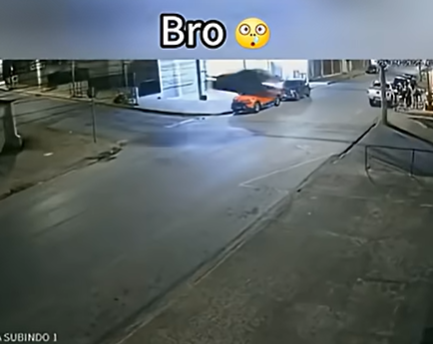
The video feels less like a normal police compilation and more like a strange tour through the most unpredictable moments that can happen on public roads. Set to upbeat music, it creates a sharp contrast between the seriousness of the incidents and the almost unbelievable way they unfold on screen. One moment, a car is flying through an intersection as if the road has turned into a stunt ramp. The next, a driver is spinning in circles, drifting away from police while bystanders stand nearby holding drinks as if they are watching a street performance instead of a dangerous situation. The tone of the video is chaotic, bizarre, and almost surreal. It captures the kind of moments where viewers can only stare and think, “How did this even happen?”
The first clip immediately sets the mood. Security camera footage shows a car launching over an intersection before crashing hard back onto the street. Because the camera is fixed and distant, the scene feels even more shocking. There is no dramatic buildup, no close-up of the driver, no explanation beforehand. The street appears ordinary, and then suddenly a vehicle enters the frame in a completely unexpected way. It flies through the air, crosses the intersection, and lands with violent force. The moment is so unusual that it almost looks unreal, like something from a movie or a video game. But the grainy security footage makes it feel grounded and real. It reminds viewers that chaos on the road can erupt without warning, turning an empty intersection into the scene of a crash in seconds.
What makes that first clip so memorable is the speed and silence of the visual. Security footage often has a cold, detached feeling because it simply records what happens without emotion. There is no narrator screaming, no dramatic camera shake, and no cinematic angle. The car just appears, flies, lands, and leaves the viewer trying to process it. That kind of footage can feel more disturbing than a dramatic recording because it shows how sudden accidents can be. A normal road becomes dangerous instantly. It also raises questions that the video does not answer. Was the car speeding? Did it hit something before launching? Was the driver being chased? Did the road shape cause the jump? The lack of context makes the clip more bizarre, because viewers are left with only the image of a vehicle doing something vehicles are never supposed to do.
The second clip shifts the energy from shock to absurdity. A driver performs donuts and drifts away from a police cruiser while bystanders watch from the side, some holding drinks. The scene feels like a strange mix of illegal street takeover, police pursuit, and public spectacle. The driver spins the car with confidence, using the street like a stage. The police cruiser is present, but for a moment, it does not seem to control the situation. The bystanders make the scene even more unusual because they do not appear to be running away in panic. Instead, they are watching as if they came to see a show. That reaction adds to the bizarre atmosphere. A dangerous act becomes entertainment for the people nearby, even though one wrong movement could send the car into the crowd or another vehicle.
This clip says a lot about how risky behavior can become normalized when people treat it like content or performance. Donuts, drifting, and street stunts may look exciting on video, especially when paired with upbeat music, but they are dangerous in real life. A vehicle is heavy, fast, and difficult to control when intentionally pushed into a slide. The driver may feel skilled, but the environment is unpredictable. Roads have bumps, curbs, poles, parked cars, pedestrians, and other drivers. A small mistake can turn a stunt into a serious crash. The presence of police makes the situation even more unstable because the driver may take greater risks to escape or impress the crowd. What looks funny or wild online is, in reality, a public safety threat.
The third clip adds another unusual image: a car speeding past a church while a police vehicle and a flatbed tow truck trail behind it. The combination is strange enough to feel almost comedic. Police chases usually involve police cars, maybe helicopters, and sometimes spike strips or roadblocks. Seeing a flatbed tow truck following the action makes the scene feel oddly specific and confusing. It creates the impression that the situation has already gone through several stages before the clip even begins. Perhaps the vehicle had been targeted for towing, perhaps the driver fled during a recovery attempt, or perhaps the tow truck became involved for another reason. Whatever the context, the image of a speeding car, a police vehicle, and a tow truck moving past a church feels like a snapshot from a day where everything went wrong at once.
The church in the background also adds a strange contrast. Churches are usually associated with peace, quiet, and order. A police chase tearing past that setting creates a visual clash between calm and chaos. It is the kind of scene that makes viewers laugh nervously because the location feels so mismatched with the action. A quiet street near a church suddenly becomes part of a pursuit. That contrast is one reason compilations like this spread online. They show familiar places being interrupted by completely unexpected behavior. The humor comes not from the danger itself, but from the absurdity of the setting and the strange combination of vehicles involved.
The fourth clip returns to a more traditional police chase image: a sedan speeding down a street while several police SUVs follow with flashing lights. This is the kind of scene people are used to seeing in news footage or dashcam videos. Yet it still carries tension because multiple police vehicles indicate that the situation has escalated. Once several SUVs are involved, the chase becomes larger than a simple traffic stop. It becomes a coordinated pursuit, with officers trying to contain a moving threat while also protecting other drivers and pedestrians. The flashing lights create urgency, but they also remind viewers that the road is still shared by ordinary people who may have no idea what is coming behind them.
Police pursuits are complicated because they involve competing risks. On one hand, officers may need to stop someone who is suspected of a serious offense or who is driving dangerously. On the other hand, the chase itself can create danger. A fleeing driver may speed through intersections, ignore traffic signals, drive on the wrong side of the road, or make sudden turns. Police vehicles following behind can also add risk, even when officers are trained. Every second of a pursuit requires judgment: is continuing the chase safer than stopping it? Is the suspect dangerous enough to justify the risk? Are there pedestrians nearby? Is traffic heavy? The clip does not answer these questions, but it shows the kind of pressure that can build quickly when one driver refuses to stop.
The fifth clip is one of the strangest and most memorable: a suspect nicknamed “Spider-Man” abandons a white van on a highway and scrambles up a tall brick retaining wall to escape police officers. The nickname fits because the person appears to climb in a way that seems almost unbelievable in the moment. After leaving the van, the suspect moves toward the wall and begins climbing upward while officers are left below trying to respond. The scene shifts from a vehicle chase into a foot chase, and then into something closer to an urban climbing stunt. It is bizarre because highways are not designed for escape routes like that. Retaining walls are supposed to hold back land, separate levels, or protect roadways, not become ladders for fleeing suspects.
This clip stands out because it changes the rhythm of the compilation. Cars are expected in police chase videos. A person climbing a tall wall like a comic-book character is not. The sudden switch from driving to climbing makes the scene feel unpredictable and almost cartoonish. But again, beneath the absurdity is real danger. A person climbing a tall wall during a police chase could fall, injure themselves, or create more risk for officers and drivers nearby. Highways are dangerous places to be on foot. Vehicles move fast, shoulders are narrow, and everyone around the scene may be distracted. What looks like a wild escape attempt also shows how desperate people can become when trying to avoid arrest.
The “Spider-Man” moment also shows how quickly people online turn real incidents into characters and jokes. A suspect climbing a wall becomes “Spider-Man.” A chaotic driver becomes a meme. A crash becomes a clip with funny text over it. This is part of how internet culture processes bizarre events. It gives them labels, edits them with music, and turns them into entertainment. That can make the content more shareable, but it can also flatten the seriousness of what happened. Real people are involved. Real risk exists. Police, suspects, bystanders, and drivers can all be harmed. The nickname may be funny, but the situation itself is not harmless.
The sixth clip features a black SUV weaving through traffic and looping around an intersection to evade police. This type of pursuit is especially stressful because intersections are among the most dangerous places for high-speed or unpredictable driving. They involve cross traffic, pedestrians, turning vehicles, traffic lights, signs, and multiple directions of movement. A driver looping around an intersection while trying to escape creates confusion for everyone nearby. Other drivers may not know whether to stop, continue, or move aside. Police must follow while trying not to cause a collision. The suspect may take sudden risks to gain distance. It is the kind of scene where everything depends on split-second decisions.
The black SUV’s movement also gives the clip a chaotic rhythm. Instead of a straight chase down a highway, the vehicle circles and weaves, turning the intersection into a maze. That kind of evasive driving can look almost playful on video, especially with upbeat music, but it is deeply dangerous. The driver is not simply avoiding police; they are forcing everyone around them to react. Innocent people become part of the chase without choosing to be. A person waiting at a red light, crossing the road, or turning into the intersection can suddenly find themselves in the path of a fleeing vehicle. This is why pursuits in urban areas are so risky. The environment is crowded, unpredictable, and full of people who are not involved.
The seventh clip shows aerial news footage of a police SUV attempting a PIT maneuver on a silver sedan on a highway. A PIT maneuver is a tactic where a police vehicle makes contact with a fleeing vehicle in a controlled way to cause it to spin out or stop. In the clip, the police SUV makes the move, and for a moment, it looks like the sedan may be stopped. But then the sedan recovers and continues driving away. That moment is dramatic because it shows the uncertainty of pursuit tactics. Even when police use a trained maneuver, the outcome is not always guaranteed. The fleeing vehicle may regain control, the road conditions may affect the result, or the maneuver may not fully disable the car.
Aerial footage changes how viewers experience the chase. From above, the vehicles look smaller, almost like pieces moving on a board. The distance can make the scene feel less personal, but it also makes the danger clearer. Viewers can see surrounding traffic, lane changes, and the way the chase unfolds across the highway. When the PIT attempt fails and the sedan continues, the tension rises because the pursuit is not over. The police tried to end it, but the driver escaped the maneuver. That means more road, more speed, and more risk ahead.
What ties all the clips together is the feeling of unpredictability. Each scene begins with a recognizable situation: a car on a road, police nearby, a driver fleeing, a public street at night. But then each clip takes a strange turn. A car flies through an intersection. A driver performs donuts in front of police. A tow truck joins a pursuit. A suspect climbs a wall. A black SUV circles through traffic. A PIT maneuver fails. The compilation works because viewers never know what kind of chaos will come next. It captures the wild, messy, and sometimes ridiculous side of real-world incidents that do not follow the clean structure of movie chase scenes.
Unlike movies, real police chases are not choreographed. There is no stunt coordinator making sure the street is clear. There is no script deciding when the chase ends. There are no controlled explosions, planned camera angles, or guaranteed safe outcomes. Real chases unfold in public spaces with real uncertainty. That is why they can look so chaotic. The drivers may panic. Officers may have incomplete information. Roads may be crowded. Bystanders may react unpredictably. A fleeing suspect may make irrational choices. The result is a kind of disorder that no fictional scene can fully reproduce.
The upbeat music in the video changes the way viewers process the footage. Music can make dangerous moments feel funny, exciting, or less serious. A crash paired with tense silence might feel frightening. The same crash paired with energetic music might feel like part of a comedy compilation. This contrast is common in viral videos. Editing can turn fear into entertainment. It can make a police chase feel like a montage rather than a public safety emergency. That does not mean viewers are wrong to laugh at the absurdity, but it is worth remembering that music changes perception. Behind every funny edit is a real event that could have ended badly.
The text on the screen, such as “Bro” with a shocked emoji, adds to the internet humor. It tells viewers how to react: disbelief, surprise, maybe laughter. The word “Bro” is simple, but it captures the feeling of watching something so strange that a full explanation seems impossible. It is the language of online reaction, the kind of caption people use when they see something that defies normal expectations. In that sense, the video is not just documenting events; it is packaging them for a specific type of audience response. It invites viewers to see the incidents as chaotic entertainment.
Still, the real lesson beneath the humor is that roads can become dangerous very quickly when people make reckless decisions. Fleeing from police almost always makes a situation worse. A traffic stop, stolen vehicle investigation, reckless driving incident, or other offense can escalate into a chase that endangers many more people. Once a driver decides not to stop, they increase the risk for themselves, passengers, officers, pedestrians, and other motorists. Even if they temporarily escape, the danger created along the way can lead to more serious consequences. The clips show different versions of the same basic truth: panic and defiance behind the wheel can turn a bad situation into a public hazard.
The compilation also shows how bystanders are often drawn to chaos. In the donut clip, people stand nearby watching. In many real-life incidents, crowds gather when something dramatic happens. Phones come out. People record, shout, laugh, or move closer for a better view. This reaction is understandable because unusual events capture attention, but it can also be dangerous. Standing near a drifting car or active police situation is risky. A vehicle can lose control, officers may need space to work, and the situation can change quickly. Viral culture encourages people to record everything, but sometimes the safest choice is to move away.
There is also a deeper reason people watch videos like this: they show moments where order temporarily breaks down. Roads are supposed to be controlled by rules. Cars stop at lights, stay in lanes, follow signs, and move predictably. Police are supposed to enforce those rules. But in these clips, the rules collapse. Cars fly, spin, flee, climb curbs, circle intersections, and refuse to stop. Police chase, react, recover, and try again. Viewers are fascinated because the ordinary system of traffic becomes chaotic. It is unsettling but captivating, like watching a machine malfunction in public.
The video also reflects the strange relationship between danger and comedy. Many of the clips are funny only because the viewer is watching from a distance and because the editing makes them feel absurd. A car flying over an intersection is terrifying if you are nearby, but shocking and bizarre if you see it later on a screen. A suspect climbing a wall is dangerous in real life, but online it becomes a “Spider-Man” moment. A tow truck following a chase is risky and confusing, but visually ridiculous. This distance allows viewers to laugh, even while knowing that the events could have had serious consequences.
Police chases also reveal how hard it can be to restore control once someone refuses to follow basic rules. Officers have tools, vehicles, training, and communication systems, but a fleeing driver can still create chaos because movement itself becomes power. A car can cover distance quickly, enter crowded spaces, and force everyone else to react. Stopping that vehicle safely is not simple. Too much force can cause a crash. Too little pressure may allow the driver to keep endangering people. Every chase becomes a moving problem with no perfect solution.
That is why many departments have policies about when pursuits should continue and when they should be called off. The decision depends on the seriousness of the suspected offense, the danger posed by the driver, traffic conditions, weather, location, and available alternatives. The public often sees only the dramatic part: the chase itself. But behind the scenes, officers and supervisors may be weighing whether continuing is worth the risk. These clips do not provide that context, but they remind viewers why those policies matter. A pursuit is not just about catching someone. It is about whether catching them in that moment is safer than waiting for another opportunity.
The compilation also shows how different types of footage shape the story. Security camera footage feels detached and shocking. Street-level footage feels immediate and chaotic. Aerial news footage feels strategic and dramatic. Each angle creates a different emotional reaction. From the ground, viewers feel close to the danger. From above, they see the pattern of movement. From a fixed camera, they feel the suddenness of the event. Together, the clips create a full picture of public chaos from multiple perspectives.
In the end, the video works because it combines disbelief, danger, humor, and spectacle. It is easy to understand why people watch it. The clips are strange, fast, and unpredictable. They show cars doing things cars should not do, suspects making desperate choices, police trying to regain control, and bystanders reacting as if reality has briefly turned into a viral challenge. But underneath the entertainment is a serious reminder: reckless driving and police pursuits are not games. They may look funny in a compilation, especially with music and captions, but they involve real risk.