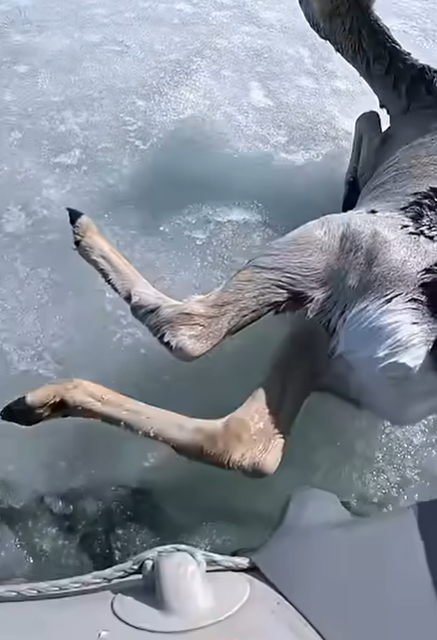
The sun glinted off the frozen expanse, casting a bright glare over a seemingly endless stretch of ice. From the first-person perspective, the world was a dazzling combination of white and blue, the frozen water reflecting the sky above in a way that made the air feel crisp and sharp. The hum of the hovercraft filled the otherwise silent landscape, its engine vibrating through the floor as the operator carefully maneuvered over the slick surface. The machine skated effortlessly across the ice, its fan propelling it forward, but beneath the calm motion lay a precarious situation, a life depending on careful attention and steady hands.
Ahead, movement caught the eye—an animal struggling against the unforgiving surface. A deer, large and powerful, appeared trapped, unable to free itself from the thin layer of ice or shallow water beneath. Its movements were frantic, the flailing of legs punctuated by brief, desperate breaths. The deer’s eyes reflected confusion and fear, and every motion sent ripples across the icy water, highlighting the fragility of the situation. The operator, recognizing the urgency, adjusted the craft’s trajectory with careful precision, approaching slowly to avoid further distress to the animal while ensuring the hovercraft remained stable on the fragile surface.
Grabbing a long pole, the operator reached toward the deer, the tension in the moment palpable. The animal flinched at first, uncertain of the intent, but the operator’s steady movements and calm approach gradually encouraged compliance. Each pull was deliberate, balancing strength with caution, the operator’s hands straining against the weight of the deer as water sloshed over the ice around them. The hovercraft tilted slightly under the effort, a reminder of the delicate balance between human action, mechanical force, and the unpredictable nature of the animal’s reactions.
With considerable exertion, the operator gradually coaxed the deer onto the vessel. The animal’s legs were soaked, its coat slick with water, and its breathing labored from the struggle. Yet, the immediate danger had passed, and the deer, now atop the hovercraft, rested momentarily, its muscles trembling with exertion. The operator adjusted the pole to ensure the animal remained stable while maintaining control of the craft, gliding across the ice with a careful rhythm, mindful of every movement and potential hazard.
As the hovercraft continued over the frozen expanse, the operator identified a section of thicker ice ahead. This solid surface represented safety, a place where the deer could regain its footing without risk of slipping into the water again. Maneuvering the craft closer, the operator prepared for the delicate task of transferring the animal from the hovercraft to the ice. Every push, every guiding movement required attention to detail: too much force could injure the deer or tip the craft, too little could leave the animal stranded or unstable.
Finally, with careful effort, the operator nudged the deer toward the solid ice. The animal hesitated, muscles exhausted from its ordeal, but gradually it accepted the guidance, stepping tentatively onto the frozen surface. Its breaths came in shallow, rapid pulls, reflecting both relief and fatigue. Once on the ice, the deer collapsed into a resting position, still alert but no longer in immediate danger. The operator watched carefully, ensuring the animal’s well-being before gradually backing the hovercraft away, leaving it a safe distance to recover from its ordeal.
Throughout the entire rescue, the environment played an essential role. The sun’s glare created challenging visibility, reflecting off both water and ice, yet it also highlighted the contours of the frozen surface, allowing the operator to gauge thickness and safety. The ice itself, variable and unpredictable, demanded constant attention; a wrong maneuver could result in instability, endangering both the human and the animal. The hum of the hovercraft provided a steady rhythm, but each shift in weight, each pull on the pole, had to be carefully balanced against the craft’s motion and the animal’s reactions.
This rescue exemplified the intersection of human skill, mechanical capability, and empathy. The operator’s attentiveness, patience, and calm presence ensured that the deer was guided to safety without unnecessary harm. The first-person perspective emphasizes the intensity of the moment: the tactile feel of the pole, the subtle adjustments of the hovercraft, the weight of responsibility for a life in distress. It is a vivid reminder of how ordinary technology, when combined with human care and awareness, can save lives in even the most challenging conditions.
Once the deer was safely on the ice, it took several moments to regain composure, standing tentatively and shaking its waterlogged coat. Its movements were cautious at first, a testament to the ordeal it had endured, but gradually it regained strength and stability. The hovercraft operator remained nearby, ready to intervene if necessary, but allowing the animal space to recover and resume natural behavior. The sun continued to reflect brightly off the ice, a silent witness to the successful rescue, turning what had begun as a precarious and life-threatening situation into a moment of relief and accomplishment.
In the quiet aftermath, the frozen expanse returned to its serene state, broken only by the subtle hum of the hovercraft as it glided away. The deer, now resting safely, became a symbol of resilience and the human capacity for careful, empathetic intervention. The scene, captured in continuous first-person perspective, offers a powerful narrative of urgency, skill, and compassion. It demonstrates how, with attention, patience, and careful maneuvering, even the most vulnerable creatures can be guided through danger and restored to safety.
The frozen landscape stretched endlessly, a vast white expanse under the clear blue sky. The air was crisp and biting, carrying the scent of cold water and ice, and every breath seemed to form visible clouds that dissipated almost instantly in the sunlight. From the first-person perspective, the world felt both beautiful and treacherous—a perfect mixture of serenity and danger. The hovercraft’s gentle hum cut through the silence, its fan propelling it smoothly over the frozen surface, yet the thin ice and scattered patches of open water served as constant reminders that one misstep could turn the tranquil scene into a disaster.
The deer, large and powerful, remained precariously caught between the fragile ice and the open water. Its movements were frantic, thrashing legs and panicked splashes a stark contrast to the calm shimmer of the frozen lake. Its eyes, wide and alert, reflected both confusion and fear, and each desperate attempt to free itself sent ripples through the icy water. The animal’s struggle was rhythmic in its intensity, alternating between flailing limbs and sudden pauses, a testament to both its strength and its exhaustion. Every second spent in the cold water threatened hypothermia or drowning, and the urgency of the situation pressed heavily on the hovercraft operator.
With a long pole in hand, the operator approached cautiously, mindful of both the deer’s power and the hovercraft’s stability. The first contact was tentative; the deer flinched, shaking its massive head and splashing water in all directions. But the operator’s calm, deliberate movements, combined with careful verbal encouragement, slowly coaxed the animal toward the edge of the vessel. Each inch gained required immense concentration, balancing the mechanical forces of the hovercraft with the unpredictable resistance of a frightened wild animal. Water sloshed over the sides as the operator leaned into the effort, muscles straining under the weight of both physical exertion and responsibility.
The ice beneath the hovercraft flexed subtly, a gentle vibration that reminded the operator of the thin line between safe navigation and potential catastrophe. The craft’s skirt shifted slightly as the combined weight of human and animal pressed down, yet the operator maintained a steady balance, adjusting the craft’s trajectory with small, precise corrections. The deer’s breathing was heavy and fast, nostrils flaring as it fought instinctively to free itself. Its coat, soaked and slick with water, reflected the sunlight in sharp, shimmering streaks. Every motion was a blend of raw power and desperate vulnerability.
After several tense minutes, the operator successfully maneuvered the deer fully onto the hovercraft. The animal collapsed momentarily, trembling, its legs weak from both exertion and cold. The operator carefully secured the pole, ensuring the deer remained stable, while adjusting their own balance against the craft’s movements. Every small sway of the hovercraft threatened to jolt the deer, and each motion required anticipation of the animal’s reactions. The calm focus of the operator contrasted sharply with the frantic movements of the deer, illustrating the delicate dance between human intervention and natural instinct.
As the craft glided forward, the operator navigated toward thicker, more solid ice, scanning the frozen expanse for potential hazards. Cracks in the ice, patches of thin water, and subtle undulations in the frozen surface all demanded careful attention. The deer remained still for a few moments, catching its breath, yet its alert eyes never fully relaxed, reflecting both the trauma of the experience and the instinctive awareness that danger could return at any moment. The operator spoke gently, reassurance in the tone, a rhythm of calm that mirrored the steady hum of the hovercraft beneath them.
Approaching a section of thick ice, the operator prepared for the final stage of the rescue: transferring the deer safely onto solid ground. The craft slowed, the fan’s noise steady but diminished as the operator manipulated the controls for precision. Each movement required awareness of the hovercraft’s balance, the deer’s shifting weight, and the unpredictable surface of the ice. A miscalculation could tip the animal or destabilize the craft, and the operator’s attention was absolute, every sense attuned to minute changes in the environment.
With measured effort, the deer was guided toward the ice’s edge. Tentatively, it extended a foreleg, testing the solidity of the surface. The ice held firm, and with encouragement, the deer slowly pushed itself onto solid ground. Its legs wobbled under the sudden stability, muscles trembling from exertion and cold. Once fully on the ice, the deer collapsed into a resting position, chest heaving and ears flicking as it regained equilibrium. Its eyes, though tired, held a glimmer of awareness and curiosity, and its breathing gradually slowed to a calmer rhythm.
The operator remained nearby, carefully adjusting the craft’s position to provide a buffer between themselves and the recovering deer. The ice was uneven, with subtle cracks and ridges that could injure the animal if it moved abruptly. The operator monitored the environment, ensuring no additional hazards—thin patches of ice, sharp protrusions, or sudden shifts—could compromise the animal’s safety. Every detail mattered; in this environment, even the smallest misstep could have dire consequences.
As the deer rested, the operator reflected on the sequence of events. From the first sight of the animal struggling to the final safe transfer, every decision had been critical. The combination of human skill, mechanical capability, and empathy had made the difference between life and death. The first-person perspective highlighted the intensity of the moment: the tactile feedback of the pole in the operator’s hands, the subtle adjustments of the craft beneath them, the weight of responsibility pressing down with every motion.
Environmental factors played a continuous role. The sun’s angle created glare on both the ice and water, complicating visibility and forcing careful adjustments to approach and positioning. Wind gusts, though slight, shifted the hovercraft subtly, requiring constant compensation. Temperature fluctuations affected both the ice’s strength and the deer’s stamina. Each environmental element introduced a layer of complexity, transforming what might seem a straightforward rescue into a delicate orchestration of precision, awareness, and adaptability.
The emotional dimension of the rescue was equally significant. The deer’s fear and exhaustion were palpable, and the operator’s empathy informed every action. Gentle verbal cues, slow and deliberate movements, and careful attention to the animal’s reactions all contributed to the success of the intervention. The experience highlighted the intricate balance between physical effort, environmental awareness, and emotional intelligence—a synergy that allowed a potentially fatal situation to be transformed into a successful rescue.
Once the deer had fully recovered its footing, it began to explore the ice cautiously, tentative steps followed by longer strides as confidence returned. Its movements remained careful but increasingly purposeful, a testament to both the resilience of wild animals and the effectiveness of the operator’s methodical approach. The hovercraft, now at a safe distance, allowed the deer to regain independence while remaining within a buffer zone to monitor for further hazards.
The rescue also illustrates broader themes of human responsibility and intervention in nature. The operator’s actions reflected a deep understanding of the interplay between mechanical tools, environmental conditions, and wildlife behavior. Their careful orchestration demonstrated not only technical skill but also a profound respect for the animal’s well-being, ensuring that every action prioritized safety, dignity, and life preservation.
From a broader perspective, the incident provides insight into the challenges of environmental rescue operations. Frozen landscapes present unique hazards: unpredictably thin ice, sudden shifts in surface conditions, and extreme temperatures all demand expertise, foresight, and adaptability. The integration of technology, in the form of the hovercraft, allowed the operator to extend human capability across terrain that would otherwise be inaccessible. Yet technology alone was insufficient—the operator’s judgment, skill, and empathy were the crucial elements that ensured the deer’s survival.
In conclusion, the hovercraft rescue demonstrates the delicate balance between risk, skill, and compassion. From first sight to the final moments of safety, every choice carried weight, every movement was consequential, and the outcome depended on the precise coordination of human awareness, mechanical function, and environmental observation. The deer, once trapped and vulnerable, now rested safely on solid ice, a living testament to the power of careful, deliberate human intervention in the natural world. The continuous first-person perspective not only captures the technical execution of the rescue but also conveys the emotional intensity, the ethical responsibility, and the profound satisfaction of saving a life in a challenging and unforgiving environment.
The frozen expanse stretched endlessly, glittering like fractured glass under the brilliance of the midday sun. The deer, now resting on the solid ice, remained vigilant, ears twitching at distant sounds and nostrils flaring with each gust of wind that carried scents from the surrounding forest and the open water beyond. Despite its exhaustion, there was a noticeable shift in its posture—a cautious relaxation, an acknowledgment that the immediate danger had passed, though instinct still dictated alertness. The ice beneath it seemed more secure now, thicker and less treacherous than the slushy, unstable patches that had threatened its life moments ago.
The hovercraft, meanwhile, hummed steadily as it floated over the ice. The operator’s first-person perspective captured every detail: the subtle flex of the craft’s skirt as it adjusted to uneven surfaces, the vibrations from the fan beneath, and the delicate balance required to maneuver over patches of thin ice without endangering the deer or themselves. Each movement of the craft was measured and precise, a careful negotiation between speed and caution, demonstrating an understanding of the fragile interface between technology and nature.
The operator exhaled slowly, taking stock of the situation. The deer had been successfully moved to safety, yet the responsibility had not ended. In this environment, danger lurked in the smallest details—the ice could crack unexpectedly, or the deer could slip and injure itself while attempting to stand fully. The operator’s eyes scanned the expanse, seeking the safest path back, aware that every decision mattered not only for the mechanical safety of the hovercraft but for the wellbeing of the animal. The wind picked up slightly, carrying flakes of snow and shifting the surface’s texture, a reminder that nature’s conditions were dynamic and required constant vigilance.
The deer shifted, testing its limbs and adjusting its stance. Its legs, once trembling and soaked, were now planted firmly on the ice, but each movement was cautious. It shook its fur, dislodging water droplets that glittered like diamonds in the sunlight, and took a few tentative steps forward. The operator observed, noting the animal’s rhythm, ensuring it did not overextend itself or attempt sudden movements that could compromise stability. There was a silent communication, a mutual awareness between human and animal: the operator understood the deer’s vulnerability, and the deer, in turn, seemed to recognize the calm guidance offered by the presence of the hovercraft.
Environmental awareness was crucial. The ice, though thicker here, remained uneven and interspersed with cracks that could widen without warning. The operator adjusted the hovercraft’s fan speed and trajectory to maintain a safe distance, preventing vibrations from causing undue stress to the deer or forcing it into unstable positions. Each meter traveled was calculated, a careful orchestration of mechanical power, human judgment, and environmental observation. The sound of the craft, a low, continuous hum, created a rhythm that matched the deliberate movements, a cadence that guided both operator and animal through the frozen terrain.
The sun began to angle lower in the sky, lengthening shadows across the ice and adding a new dimension of visual complexity. Reflections bounced unpredictably, occasionally masking cracks and thin spots in the frozen surface. The operator adjusted their gaze constantly, relying on both instinct and careful scanning to anticipate hazards. Each step of the rescue—from approaching the trapped animal to maneuvering the hovercraft and guiding it onto solid ice—was a choreography of precise awareness, blending reflex with forethought.
The deer, now standing on firm ice, began to explore its surroundings cautiously. Its breathing, once labored from exertion, slowed into a steadier rhythm, though its muscles remained taut, a reminder of the ordeal it had endured. The operator maintained a respectful distance, allowing the animal to regain autonomy while remaining vigilant for potential slips or hazards. Observing the deer’s gradual recovery offered a unique insight into the resilience of wild animals when aided by careful human intervention. The delicate balance of giving space while offering protection became apparent: too much interference could induce stress, too little could leave the deer at risk.
The hovercraft moved slowly across the ice, retreating to allow the deer a sense of security and autonomy. Each movement was deliberate, with adjustments made to maintain stability and avoid splashing residual water or ice shards that could startle the animal. The operator noted the subtle signs of stress in the deer’s posture—flattened ears, rapid head movements, and cautious glances—responding with calm, measured adjustments to minimize fear. The interplay of psychological awareness and mechanical precision was critical, demonstrating the operator’s capacity for empathy, observation, and real-time problem-solving under challenging conditions.
As the deer explored, its coordination gradually improved. Its hooves, once slipping and flailing, now found purchase on the ice, and its movements became more confident, though still tentative. The operator observed from a distance, allowing the deer to establish its footing while remaining within a safe observation range. This approach mirrored wildlife rehabilitation protocols, emphasizing the importance of minimizing human interference while providing necessary support for survival.
The experience highlighted the unpredictability inherent in natural environments. Each patch of ice, each hidden crack, each gust of wind introduced variables that demanded constant attention. The operator’s focus never wavered: hands adjusted controls, eyes scanned the surface, and mind calculated potential risks while anticipating the deer’s next movements. The synchronization of mechanical skill, environmental awareness, and emotional attunement was essential to ensuring that the rescue was successful not only in the immediate sense but also in preserving the animal’s well-being over the subsequent minutes and hours.