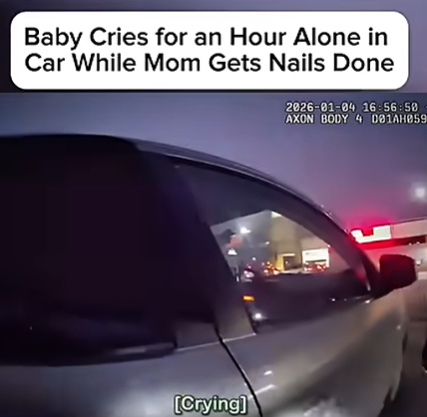
The bodycam video captures a disturbing and emotional incident involving a baby who was found left unattended inside a car while crying. Police officers respond after a witness from a nearby store notices the child alone in the vehicle and contacts authorities. From the start, the situation is serious because the child is extremely young, unable to care for themselves, and completely dependent on an adult for safety. A crying baby left alone in a car immediately creates concern, not only because of the emotional distress of the child, but also because vehicles can become dangerous environments very quickly. Even when the weather does not seem extreme, a car is not a safe place for an unattended baby.
The officers arrive and begin handling the situation as a child welfare emergency. The fact that a witness had to step in shows that the baby had already been left long enough for someone outside the family to notice something was wrong. That detail matters because it means the situation was not just a quick mistake where the mother stepped a few feet away for a few seconds. The baby was alone, crying, and visible enough to alarm a stranger. In many cases, witnesses are the reason these situations are discovered before something worse happens. Someone paying attention and deciding to report the incident may have prevented a far more dangerous outcome.
When the mother returns to the vehicle, she is holding a drink and is immediately confronted by the officers. Her return does not calm the situation; instead, it confirms that the baby had been left alone while she was somewhere else. The officers ask questions, and the mother admits that she left the baby in the car while she went to a nail salon. That admission becomes the center of the encounter. She does not deny leaving the child. Instead, she tries to explain the amount of time she was gone and the pressures she is dealing with. But the officers make it clear that her explanation does not change the seriousness of the decision.
The mother claims she was gone for “an hour” or “half an hour,” speaking as if the shorter estimate might make the situation less severe. But the officers immediately reject that reasoning. To them, the issue is not whether it was thirty minutes or sixty minutes. The issue is that a baby was left alone in a vehicle at all. A baby cannot open the door, call for help, regulate their environment, protect themselves from strangers, or respond to an emergency. Any amount of time creates risk, and the officers make that clear. Her attempt to minimize the duration does not help her because even the smaller estimate is far beyond what would be considered acceptable.
The detail about the nail salon makes the situation even more troubling to viewers because it suggests the child was left alone for something that was not an emergency. The mother may have had many personal struggles, and she tells officers that she has “a lot going on,” but going into a nail salon while leaving a baby in the car is not treated as a necessary or unavoidable action. The officers remain firm because the baby’s safety is the priority. Whatever stress the mother is facing, it does not justify leaving an infant unattended in a vehicle.
Her statement that she has “a lot going on” adds a human layer to the encounter. It suggests she may be overwhelmed, stressed, or dealing with difficult circumstances. Many parents experience pressure, exhaustion, financial issues, relationship problems, childcare challenges, and emotional strain. Those struggles can be real and serious. But the video shows that law enforcement is not willing to treat stress as an excuse for endangering a child. The officers’ response reflects the idea that adult difficulties cannot be allowed to place a baby at risk. The child’s immediate safety comes first.
The officer then instructs the mother to call the baby’s father so he can come pick up the child. This is a key moment because it shows that the officers are trying to make sure the baby is released to a responsible adult rather than staying with the mother at that moment. The focus is not only on arresting the mother; it is also on making sure the baby has safe care. Calling the father creates a plan for the child while the legal process moves forward. In situations like this, officers must think about both parts of the incident: what happens to the parent and, more importantly, what happens to the child.
The officer then informs the mother that she is being placed under arrest. This is the moment when the situation fully shifts from confrontation to legal consequence. The mother may have hoped that explaining herself, shortening the time estimate, or saying she had a lot going on would result in a warning or a lecture. Instead, the officer tells her that the decision to leave the baby in the car has crossed a legal line. Her arrest shows that the officers are treating the incident as child endangerment, not just poor judgment.
The officer explains the law to her, stating that under Illinois state law, leaving a child under six years old unattended in a vehicle for more than 10 minutes violates the statute. That legal explanation is important because it gives a clear standard. The law does not require the child to be injured before consequences apply. It recognizes that the act itself creates danger. A child under six is too young to be left unsupervised in a vehicle for that length of time. The officer’s explanation also removes any confusion about whether “half an hour” is acceptable. If the legal limit is more than 10 minutes, then both of the mother’s estimates are far beyond that.
The mention of the 10-minute rule makes the mother’s argument even weaker. She appears to think that saying she was gone for “only” half an hour might reduce the seriousness of the situation, but the law described by the officer says otherwise. Thirty minutes is not a small amount of time for a baby alone in a car. It is three times the legal threshold mentioned by the officer. If she was gone for an hour, that would be even more serious. Either way, the officers make clear that the baby should never have been left alone while she went inside a business.
The baby crying inside the vehicle adds emotional weight to the incident. Crying is one of the only ways an infant can communicate distress. The baby may have been hungry, uncomfortable, frightened, tired, too warm, too cold, or simply upset at being left alone. Unlike an older child, a baby cannot explain what is wrong or seek help. That helplessness is what makes the situation so alarming. The witness who found the child likely heard or saw the baby crying and understood that something was wrong. That moment of concern from a stranger became the reason police were called.
The vehicle itself is another major concern. Cars can become unsafe environments quickly. Temperatures can rise or fall, air can become uncomfortable, and a child strapped into a car seat cannot move freely. Even if the mother believed she would only be gone briefly, unexpected delays can happen. A nail appointment could take longer than expected. A line could form. A conversation could distract her. A phone call could delay her return. In the meantime, the baby remains alone and vulnerable. This is why officers are so firm when telling her that any amount of time is unacceptable.
The mother’s return with a drink also affects how the scene feels. Viewers may interpret it as a sign that she had time to go inside, handle her personal errand, and come back while the child remained unattended. Whether or not she intended harm, the image is difficult to ignore. The baby was left crying, a witness became concerned, police arrived, and the mother returned holding something for herself. That contrast makes the situation feel especially careless.
The officers’ tone appears firm because they are dealing with a clear safety issue. They do not seem interested in debating whether the mother had a difficult day or whether she meant to be gone for a shorter time. Their focus is on the fact that a baby was left alone. In child endangerment situations, intent is not always the central issue. A parent may not intend to harm a child, but the decision can still create unacceptable risk. The officers’ response reflects that distinction. They are not saying the mother wanted the baby to be harmed; they are saying her actions placed the baby in danger.
The decision to release the baby to the father also shows how officers separate the child’s needs from the mother’s arrest. The baby still needs care, comfort, transportation, and supervision. Taking the mother to the station does not solve those needs by itself. By instructing her to call the father, the officer is creating a safe handoff. This also prevents the baby from being taken into a more complicated custody process if a family member can appropriately take responsibility. The father’s involvement becomes the immediate solution for the child’s care.
The officer explains that the mother will be taken to the station, booked for child endangerment, and released with a court date. That explanation is direct and procedural. It tells her what will happen next without turning the scene into a long argument. Being booked means the incident will become part of a formal legal process. A court date means she will have to answer for the charge later. Even if she is released after booking, the consequences do not end at the scene. The decision to leave the baby in the car follows her into the legal system.
This is one of the strongest messages of the video: a short decision can create long-term consequences. The mother may have thought she was making a quick stop. She may have believed the baby would be fine. She may have assumed she could get in and out before anyone noticed. But once the baby was found crying and police were called, the situation changed completely. What she may have viewed as a temporary convenience became a criminal matter. That is the warning at the center of the footage.
The incident also shows how child safety laws exist to prevent tragedies before they happen. Some people only think of danger after a child is injured, but the law described by the officer is designed to step in earlier. Leaving a young child unattended in a vehicle is dangerous because the child cannot protect themselves. The statute gives officers a clear reason to act before the situation becomes worse. In this case, the baby was found alive and apparently safe enough to be released to the father, but the risk was still real.
The mother’s explanation that she had “a lot going on” may create sympathy from some viewers, but it also raises an important question about responsibility. Many parents face overwhelming pressure, but when a child is involved, the standard for safety remains high. If a parent cannot bring a baby inside, arrange childcare, or delay an errand, then the errand should not happen. A nail appointment is not worth the risk of leaving a child alone. The officers’ firm response makes that point clearly.
The witness’s role should not be overlooked. Without that person noticing the baby and contacting authorities, the mother may have returned later and no one outside the family would have known. The witness acted because a crying baby alone in a car is not something to ignore. This kind of public awareness can save lives. It is not about being nosy or judgmental; it is about recognizing a vulnerable child in a dangerous situation. The person who reported the incident helped bring the baby to safety and forced accountability for the decision that placed the child there.
The video also captures the uncomfortable reality that neglect can happen in ordinary places. This was not a dramatic emergency in an isolated location. It happened near a store, outside a business, during what appears to be a normal day. That is part of what makes the footage relatable and unsettling. A parking lot, a nail salon, a quick errand, a parent who says she is stressed — these are familiar details. But combined with a baby left alone in a car, they become evidence of a serious lapse in judgment.
The officers’ refusal to accept the mother’s excuses is important because it keeps the focus where it belongs. The conversation could easily drift into explanations about stress, timing, personal problems, or whether the baby seemed okay. Instead, the officers return to the basic fact: a child under six was left unattended in a vehicle for longer than the law allows. That clarity is necessary in situations where a parent may try to minimize what happened. The officers do not allow the mother to redefine the incident as harmless simply because she eventually came back.
The baby being released to the father brings some immediate relief, but it does not erase the seriousness of the event. The child still experienced being left alone and crying in a vehicle. The father now has to respond to an emergency created by the mother’s decision. The family may face legal, emotional, and child welfare consequences. One unsafe choice can affect everyone connected to the child.
By the end of the video, the encounter becomes a clear example of how child endangerment cases often involve both emotional explanations and firm legal boundaries. The mother says she has a lot going on, but the officers say the baby cannot be left alone. She says she was gone for half an hour or an hour, but the officer explains that more than 10 minutes violates the law for a child under six. She returns to the car, but the police have already been called. She may not have expected to be arrested, but the officers make clear that the decision has consequences.
The strongest takeaway from the footage is simple: a baby should never be left unattended in a car. Not for a quick errand, not for a nail appointment, not for half an hour, and not because a parent feels overwhelmed. A baby cannot ask for help, escape danger, or protect themselves. In this case, a witness noticed the crying child and called police before the situation became worse. The officers responded, confronted the mother, arranged for the father to pick up the baby, and placed the mother under arrest for child endangerment. The video ends as a reminder that parenting stress may explain a person’s state of mind, but it does not excuse decisions that put a child at risk.
Another reason the incident feels so serious is because the mother appears to misunderstand the difference between a child being unharmed and a child being safe. When officers confront her, she seems to rely on the fact that she returned and that the baby is still there as if that should reduce the severity of what happened. But safety is not measured only by whether the worst possible outcome occurred. A dangerous decision can still be dangerous even if tragedy is avoided. In this case, the baby was found crying, alone, and unable to protect themselves. That alone is enough to show that the situation had already crossed a serious line.
The officer’s explanation of the Illinois law also gives the scene a firm legal foundation. The issue is not just personal opinion or whether the officers personally disapprove of the mother’s choice. The law provides a clear limit for how long a young child can be left unattended in a vehicle, and the mother’s own estimates go far beyond that limit. By explaining this, the officer removes the possibility that the situation is only being handled emotionally. He is showing her that this is a legal matter, and that the arrest is connected to a specific statute meant to protect young children from exactly this kind of risk.
The mother’s attempt to explain that she had “a lot going on” may sound familiar to many viewers because stress is a real part of parenting. There are moments when parents feel stretched thin, exhausted, and desperate to finish errands or take care of personal needs. But the footage makes clear that a child’s safety cannot be pushed aside because an adult is overwhelmed. If anything, moments of stress require more caution, not less. A parent who knows they are under pressure has to slow down and make safer choices, especially when a baby is involved.
The baby’s father being called to pick up the child adds another emotional layer to the scene. It suggests that the officers are trying to keep the child with family while still removing the baby from the unsafe situation. That decision likely prevents the child from being placed into a more disruptive process at that exact moment, but it also means the family now has to deal with the consequences of what happened. The father is not simply picking up a child after an ordinary errand. He is responding to a police incident involving child endangerment, which can create shock, anger, fear, and serious questions about what should happen next.
The video also shows why community intervention matters. The person from the nearby store who noticed the baby could have ignored the situation, assumed the mother would return soon, or decided it was not their business. Instead, they acted. That decision mattered. A crying baby alone in a vehicle is a sign that something is wrong, and waiting too long could increase the danger. The witness’s choice to notify authorities brought help to the scene and ensured that the baby was checked on. Sometimes protecting a child begins with a stranger being willing to speak up.
The mother’s arrest may feel harsh to some viewers, but the officer’s explanation shows why the situation is treated seriously. Child endangerment laws are designed to prevent harm before it becomes irreversible. They are not only used after a child is injured. In this case, the baby did not need to be visibly hurt for the mother’s decision to be considered dangerous. Leaving an infant alone in a car removes all adult protection from a child who has no ability to respond to changing conditions.
By the end, the footage becomes a strong warning about convenience, stress, and responsibility. The mother may have thought she could finish her appointment and return without anyone noticing, but the risk was far greater than she seemed to understand. A baby’s safety cannot depend on luck, timing, or the hope that nothing will go wrong. The officers’ response makes that message clear: no errand, appointment, or personal problem justifies leaving a young child alone in a vehicle. What happened in that parking lot could have ended much worse, and the fact that it did not is exactly why intervention happened before the situation became a tragedy.