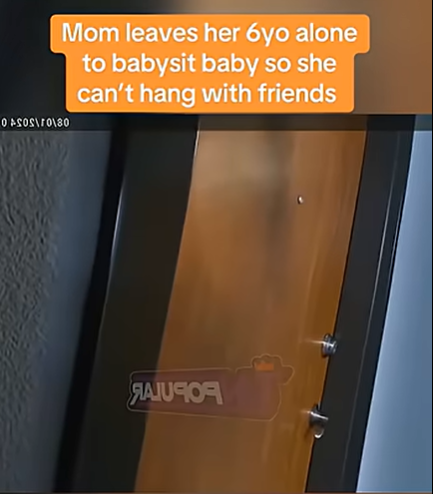
The bodycam video captures a deeply concerning situation at an apartment complex, where a police officer responds after a six-year-old girl named Kennedy is found wandering through the hallways. What begins as a welfare check quickly turns into a troubling look at how much responsibility had been placed on a very young child. Kennedy is not simply outside playing or briefly separated from an adult. According to what she tells the officer, her mother left her alone inside the apartment and expected her to look after her baby brother, Devon. The officer speaks with Kennedy inside the apartment, asking calm and careful questions to understand what happened, how long the children have been alone, and whether there is any immediate danger.
The most striking part of the video is Kennedy’s age. At only six years old, she is still a small child herself, yet she appears to have been left in charge of an even younger baby. That detail makes the situation feel serious right away. A six-year-old may be able to answer basic questions, recognize familiar people, and understand parts of a routine, but she is not old enough to safely care for an infant for hours. Babies need constant supervision, feeding, changing, comfort, and immediate help if something goes wrong. A child Kennedy’s age cannot reasonably be expected to handle an emergency, contact help, or make safe decisions if the baby becomes sick, injured, or distressed.
During the interview, Kennedy tells the officer that she has been awake for around 11 hours. That detail adds to the concern because it suggests she may be tired, confused, or overwhelmed. She also estimates that her mother has been gone for about three hours. For an adult, three hours may not sound long in normal circumstances, but for a six-year-old left alone with a baby, it is a very long time. The situation becomes even more alarming when Kennedy explains that this is not the first time. She says her mother has left her and her baby brother alone about three times total in the past, and that those previous times were usually around six hours long. That statement suggests a possible pattern, not just a one-time mistake or short absence.
The officer’s questions reveal how vulnerable Kennedy and Devon are in that moment. Kennedy does not know her mother’s phone number. She does not know exactly where her mother went. She only knows that her mother’s name is Taylor and that she works as a nurse during the daytime at “Mercy” downtown. For a child, those details may feel like enough information, but from an emergency perspective, they are very limited. If something had happened before the officer arrived, Kennedy would likely not have known how to reach her mother directly. She may not have known what to do if the baby became ill, if someone tried to enter the apartment, or if she became scared and needed help.
The fact that Kennedy was found wandering in the hallways also shows that she was already trying to solve the problem on her own. A six-year-old leaving the apartment and walking through the building may have been looking for help, looking for a familiar adult, or simply feeling unsure about what to do next. In an apartment complex, hallways can expose a child to strangers, unsafe areas, stairwells, elevators, or exits leading outside. Even if the building is usually quiet, a child wandering alone is a clear sign that there is not proper supervision. The person who reported her likely recognized that something was wrong and contacted authorities because a young child should not be alone in that situation.
Inside the apartment, the officer also checks on the baby, Devon, and finds that he is doing fine. That is a relief, but it does not erase the seriousness of the situation. The baby being okay at the moment does not mean the decision to leave the children alone was safe. Many dangerous situations are discovered before something tragic happens, and that early discovery is exactly what prevents harm. In this case, the officer’s arrival means the children are no longer completely alone, and someone responsible is finally assessing whether they are safe. Still, the fact that Devon was fine should not distract from the risk both children were placed in.
The officer offers Kennedy food and drink, which she declines. That small moment adds a human layer to the scene. Kennedy may be nervous, unsure how to respond, or simply focused on answering the officer’s questions. Children in stressful situations do not always ask for what they need. They may say they are fine even when they are hungry, tired, or scared. The officer’s offer shows that he is not only investigating what happened, but also trying to care for Kennedy in the moment. His tone appears to be calm and non-threatening, which is important when speaking with a young child. Kennedy needs to feel safe enough to answer honestly without feeling like she is in trouble.
One of the most difficult parts of the video is how matter-of-fact Kennedy seems while explaining the situation. Children often describe serious things in simple language because they do not fully understand how dangerous the situation is. When Kennedy says her mother has left them alone before, she may not realize how concerning that sounds to an adult. To her, it may feel like something that happens sometimes. That innocence makes the scene even heavier. She is not trying to accuse anyone or dramatize the story. She is simply answering questions the best she can, and those answers reveal a situation that should never have been placed on her shoulders.
The mother, Taylor, is described by Kennedy as a nurse who works during the daytime at Mercy downtown. That detail creates a complicated emotional reaction. On one hand, nursing is a demanding job, and many parents struggle with work schedules, childcare costs, and limited support. On the other hand, those difficulties do not make it safe to leave a six-year-old alone to care for a baby. The video does not provide the full background of Taylor’s circumstances, so it is impossible to know what pressures she may have been facing. But the immediate facts are still serious: two young children were left without adult supervision, one of them was an infant, and the older child ended up wandering through the apartment complex.
When the officer calls Taylor, he explains that police are at the apartment because someone reported Kennedy wandering around outside. That phone call becomes an important turning point because the officer is no longer only gathering information from Kennedy. He is now speaking directly to the mother and making it clear that the situation has been discovered. He instructs Taylor to call a family member to come over and look after the children. This instruction shows that the immediate priority is child safety. The officer needs an adult to arrive quickly so Kennedy and Devon are not left alone again.
Kennedy then offers to lead the officer to her aunt’s apartment nearby to see if she is awake. That moment is both helpful and heartbreaking. It shows that Kennedy knows there may be a trusted adult nearby and is willing to help solve the problem. But it also shows how much responsibility she has already taken on. At six years old, she should not be the one coordinating adult supervision or helping police locate someone to care for her and her baby brother. She should be asleep, eating, playing, or being cared for by adults, not guiding an officer through an apartment complex because her mother is gone.
The officer’s response throughout the video appears focused on keeping the children safe without frightening Kennedy. That matters because children can be easily overwhelmed by police presence, especially when officers are inside their home and asking questions about a parent. Kennedy may worry that her mother is in trouble, that she did something wrong by leaving the apartment, or that something bad will happen next. A calm approach helps reduce that fear. The officer’s questions are practical: how long has she been awake, how long has her mother been gone, has this happened before, does she know her mother’s phone number, where is the baby, and is there someone nearby who can help?
The situation also highlights the importance of community awareness. If someone had not noticed Kennedy wandering and reported it, the children may have remained alone for much longer. In apartment complexes, neighbors, staff, and other residents sometimes become the first people to notice when a child is unsafe. Reporting a wandering child is not about causing trouble for a family; it is about preventing possible harm. In this case, the report brought an officer to the apartment before anything worse happened.
The video also shows how child neglect cases can be quiet rather than dramatic. There is no loud confrontation at the beginning, no visible injury, and no immediate panic from the baby. Instead, the danger is in the absence of supervision. That kind of risk can be easy to overlook until something goes wrong. A child left alone may seem fine for a while, but emergencies do not announce themselves in advance. A baby could choke, fall, become ill, or need care that a six-year-old cannot provide. The older child could leave the apartment, get lost, or encounter someone unsafe. The fact that Kennedy was already in the hallway shows that the situation had already moved beyond the apartment walls.
Kennedy’s estimate that her mother had been gone for three hours also shows how children understand time differently. A six-year-old may not be able to measure time accurately, especially if she is tired or worried. When she says three hours, it could be close, or it could be her best guess. Her statement that she has been awake for 11 hours also suggests she is trying to answer carefully, but she may not fully understand the exact timeline. Officers in these situations have to listen to the child while also verifying information through phone calls, witnesses, and other evidence.
The mention that Taylor had left the children alone before for around six hours is one of the most serious parts of the interview. A repeated pattern changes how the situation may be viewed. If this were a brief and unusual emergency, the response might focus mainly on immediate safety and support. But if a parent has repeatedly left a six-year-old to supervise a baby for several hours, authorities may become more concerned about ongoing risk. The officer’s questions help establish whether this is an isolated event or something that has happened multiple times. Kennedy’s answer suggests that the concern may extend beyond this single day.
The CRITICAL part of the scene is that Kennedy is both a child in need of care and the person providing the information. She becomes the witness to her own unsafe situation. That can be difficult because young children may want to protect their parents. They may answer honestly but still not understand that their answers could lead to consequences. They may also minimize problems because they love their family and do not want anyone to get in trouble. The officer must gather the facts while being careful not to pressure or confuse her.
This video also creates a wider conversation about childcare support. Many families struggle to find affordable, reliable childcare, especially parents working long or irregular hours. If Taylor is truly working as a nurse, she may face demanding shifts and pressure to be present at work. But even when a parent is under stress, leaving very young children alone is not a safe solution. The correct response in difficult circumstances is to contact family, friends, childcare services, emergency support, or community resources before leaving. The officer’s instruction for Taylor to call a family member reflects that basic need: an adult must be present.
The emotional core of the video is Kennedy’s innocence. She answers questions, mentions her baby brother, explains what she knows about her mother, and offers to take the officer to her aunt. She seems helpful and composed in a situation that should never have required her to be so responsible. That contrast is what makes the footage so memorable. Kennedy acts older than her age because the situation demands it, but the viewer is constantly reminded that she is only six. Her ability to speak clearly does not mean she is ready to handle adult responsibilities.
The officer checking on Devon is also an important moment because it confirms that the baby is physically okay at that time. However, babies can change quickly. A baby who is fine now may need care minutes later. That is why constant adult supervision matters. A six-year-old cannot be expected to know how to respond if the baby begins choking, has a fever, cries uncontrollably, or needs feeding and changing. Even if Kennedy loves her brother and wants to help, she is not equipped for that responsibility.
As the scene develops, the officer’s goal becomes clear: make sure the children are safe, contact the mother, and arrange for a responsible adult to be present. He does not appear focused on frightening Kennedy or blaming her. Instead, he uses her answers to understand the risk and move toward a solution. The call to Taylor and the attempt to contact a nearby aunt show that the immediate concern is not punishment in that moment, but protection. The legal or child welfare consequences may come later, but first the children need supervision.
The video leaves viewers with a strong sense of relief that Kennedy was found before something worse happened. At the same time, it leaves a deeper concern about what could have happened if no one noticed her in the hallway. A six-year-old wandering alone is vulnerable. An infant left behind is even more vulnerable. The fact that Kennedy knew her aunt lived nearby may have helped, but she should not have had to rely on that knowledge to keep herself and her brother safe.
In the end, the footage is a powerful reminder that children should not be forced into adult roles. Kennedy may be bright, helpful, and caring toward her baby brother, but she is still a child. Being left alone to babysit an infant for hours places her in a position she cannot safely manage. The officer’s calm response helps bring order to the situation, but the deeper issue remains: young children need dependable adult supervision. The scene shows how quickly neglect can be discovered through a small detail, like a child wandering in a hallway, and how that discovery can reveal a much larger problem inside the home. What begins as a simple report from someone at an apartment complex turns into a serious welfare concern involving two children, a missing parent, and the urgent need for a responsible adult to step in.
Another part of the situation that makes the footage so concerning is how normal the arrangement seems to Kennedy. She does not appear to describe the situation as something shocking or unusual. Instead, she answers the officer’s questions in a straightforward way, as if being left alone with her baby brother is something she has had to understand before. That calmness can be misleading. A child may sound composed while still being placed in an unsafe situation. Children often adjust to whatever adults around them make normal, even when that responsibility is far beyond what they should carry. Kennedy may know how to watch Devon for a short time, where certain things are in the apartment, or which relative lives nearby, but none of that makes her old enough to be responsible for a baby.
The fact that she cannot call her mother directly is especially troubling. In any emergency, the first step would usually be contacting the parent or another trusted adult. Kennedy does not know her mother’s phone number, and she does not know where her mother went. That means if Devon had needed urgent help, Kennedy would have had very few options. She might have tried to find a neighbor, wander the hallway again, or wait and hope her mother returned. For a six-year-old, even recognizing what counts as an emergency can be difficult. Something as simple as a baby crying for too long, needing food, or needing a diaper change can quickly become overwhelming.
The officer’s calm tone is important because Kennedy is not the person who caused the problem. She is a child trying to answer adult questions about an adult’s decision. If the officer had spoken harshly or made her feel responsible, she might have shut down or become frightened. Instead, the officer appears to gently gather the details he needs while making sure both children are safe. That approach helps Kennedy remain comfortable enough to explain what happened. In situations involving children, especially very young children, patience can make the difference between getting clear information and creating more fear.
Kennedy offering to take the officer to her aunt’s apartment shows both her innocence and her resourcefulness. She knows there may be someone nearby who can help, and she wants to assist. But that moment also highlights how backwards the situation has become. A six-year-old should not have to guide police to find childcare. She should not have to think through which adult might be awake or available. She should not be the person helping solve a supervision problem that adults were supposed to prevent. Her helpfulness is sweet, but it also reveals how much pressure she has been placed under.
The mother’s absence raises serious questions, even if the full background is not shown. There may be work stress, childcare struggles, financial pressure, or a belief that Kennedy is mature enough to manage for a while. But none of those reasons changes the risk. A baby and a six-year-old cannot safely be left alone for hours. Even if nothing bad happened this time, the danger was real. Neglect is often discovered in moments where everyone is physically okay, but the circumstances show that something could have gone wrong very easily.
The video also reminds viewers that children may not always express fear in obvious ways. Kennedy declines food and drink, answers questions, and cooperates with the officer, but that does not mean she is unaffected. She may be tired after being awake for many hours. She may be worried about her mother. She may not fully understand whether she or her brother will be taken somewhere. She may also feel protective of her mother and unsure whether telling the truth will get anyone in trouble. Children in these situations can carry confusion quietly.
By the end of the encounter, the most important outcome is that Kennedy and Devon are no longer invisible. Someone noticed Kennedy wandering, made a report, and brought help to the apartment. The officer checked on both children, contacted their mother, and tried to arrange for a family member to come over. That chain of action may have prevented a far worse outcome. The footage leaves a strong reminder that when a young child is found alone, it should always be taken seriously. What looks like a small moment in a hallway can reveal a much bigger problem behind a closed apartment door.