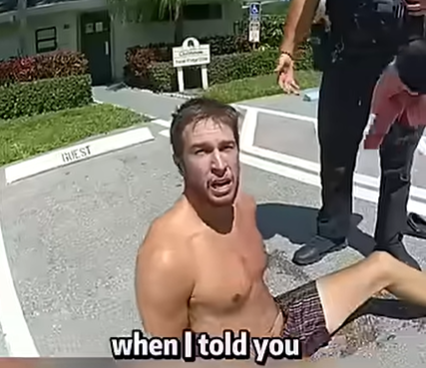
The bodycam video captures a tense and frustrating police encounter involving a shirtless man named Ryan, who is seen handcuffed on the ground while several officers stand around him. From the beginning, the situation appears heated, not because Ryan is shown threatening anyone, but because he repeatedly asks why he is being detained and why officers have placed him in handcuffs. He points out that he is only wearing a swimsuit and does not have a weapon, trying to make the officers understand that he does not believe he poses any danger. His questions are direct and emotional, but they also show confusion. Ryan appears to feel that he is being treated like a suspect even though, according to the later explanation in the video, he was actually the person who called for help in the first place. That detail makes the encounter even more troubling, because it suggests that a person who may have been seeking protection or assistance ended up restrained on the pavement while trying to explain himself.
The main officer involved in the confrontation is identified as Officer Guerrero. Her interaction with Ryan appears aggressive from the start. Instead of calmly explaining the reason for the detention or attempting to lower the tension, she commands him to shut his mouth and insists that he failed to listen to her orders. According to her, the issue began because Ryan kept putting his hands in his pockets after being told not to. From an officer-safety perspective, commands about hands are often treated seriously, because officers want to know whether someone may be reaching for a weapon or another object. However, Ryan argues that the situation is being blown out of proportion. He repeatedly says he is only wearing a swimsuit and has nowhere to hide a weapon. He seems to believe Officer Guerrero’s reaction is excessive, especially because he says he called police for help, not because he was trying to create a problem.
As Ryan remains handcuffed on the ground, he asks for a supervisor. That request becomes an important part of the video because it shows he does not feel he is being treated fairly by the officers already on scene. Asking for a supervisor is often a way for someone to seek a second opinion or hope that another officer will review what happened more calmly. Ryan’s frustration grows because he feels trapped: he is on the ground, handcuffed, unable to stand, and surrounded by officers who appear to accept Officer Guerrero’s version of events without first examining the full context. His tone reflects anger, discomfort, and disbelief. He is not only upset about being detained, but also about the way the officers are speaking to him and the fact that no one seems interested in hearing his explanation.
The video narrator states that the other responding officers failed to properly assess the situation when they arrived. Instead of stepping back, gathering details, and figuring out why Ryan was on the ground, they allegedly took Officer Guerrero’s side almost immediately. This is one of the most concerning parts of the encounter because it suggests that the officers may have treated the situation as already decided before understanding the full story. When officers arrive at an active scene, especially one involving another officer and a handcuffed person, it can be easy for them to assume that the officer already present had a valid reason for the detention. But the narrator’s point is that this assumption can become dangerous when no one takes the time to verify what happened.
Ryan’s position on the hot pavement adds another layer of tension. According to the video summary, the officers refused to let him stand up even though he was lying or sitting on the ground in uncomfortable conditions. This detail makes the scene feel more humiliating and physically stressful for him. He is shirtless, wearing only a swimsuit, and trying to explain that he is not armed. Being kept on hot pavement while handcuffed can make a person feel powerless and ignored, especially if they believe they did nothing wrong. Ryan’s anger appears to come not only from the handcuffs, but from the feeling that the officers are treating him like a threat while refusing to acknowledge the situation he originally called about.
The officers’ decision to consider charging Ryan with resisting arrest also becomes a major issue in the video. According to the narrator, some of the officers had just arrived and had not seen the full interaction that led to him being handcuffed. Despite that, they still appeared willing to support a resisting charge. This is important because resisting arrest charges often depend heavily on the details of what happened before and during the detention. If officers do not fully understand the sequence of events, charging someone with resisting can become questionable. Ryan’s argument seems to be that he was not resisting a lawful action, but reacting to what he saw as an unfair and unnecessary escalation.
When the supervisor finally arrives, Officer Guerrero explains her side of the story. She says Ryan repeatedly put his hands in his pockets, pulled out a phone, and refused to comply with her commands. From her perspective, Ryan’s behavior may have raised safety concerns. Officers often treat repeated hand movements as a risk, especially in calls involving possible weapons. If she believed Ryan was ignoring clear commands and reaching into pockets, she may have felt the need to act quickly. However, the larger problem presented by the video is whether her response matched the actual threat level. Ryan’s clothing, the setting, his role as the person who called for help, and the lack of an obvious weapon all raise questions about whether the situation could have been handled with more patience and communication.
The background revealed at the end changes how the entire encounter is understood. According to the video, Ryan had spent nearly 10 minutes before this dealing with an individual who had allegedly threatened people with a gun. That means Ryan was not simply a random shirtless man being difficult with police. He may have been directly involved as a witness, victim, or caller in a dangerous situation. If he called police because someone else was armed and threatening people, then his frustration becomes easier to understand. He likely expected officers to arrive and help deal with the actual suspect. Instead, he found himself handcuffed and accused of refusing orders.
This shift in context is what makes the footage so powerful. At first glance, viewers may see a man yelling at police while handcuffed and assume he must have done something to deserve that treatment. But as the narrator adds background information, the situation appears more complicated. Ryan may have been trying to help or report a serious threat. The actual suspect, according to the video, was later located by police. That final detail suggests that Ryan’s original concern was real. If officers eventually found the person who had allegedly threatened others with a gun, then Ryan’s insistence that he was not the threat carries more weight.
The encounter also highlights the importance of de-escalation. Police officers are often placed in uncertain and potentially dangerous situations, and they have to make fast decisions. But fast decisions still need to be followed by reassessment. Once Ryan was handcuffed and no immediate weapon was visible, officers had an opportunity to slow down, ask questions, and determine whether they were dealing with the right person. Instead, the narrator suggests they continued treating Ryan as the problem. De-escalation does not mean ignoring safety. It means controlling the scene while also reducing unnecessary tension. In this case, the situation may have benefited from a calmer explanation, a supervisor being called sooner, and officers taking a moment to separate Ryan’s frustration from actual danger.
Ryan’s repeated statement that he had no weapon is central to the emotional tone of the video. He seems desperate for officers to acknowledge what is obvious to him: that he is shirtless, in a swimsuit, and not equipped like someone hiding a gun. Of course, officers may still be cautious because weapons can sometimes be hidden in unexpected ways. But Ryan’s point is that his appearance and behavior should have been considered in context. He was not wearing heavy clothing. He was not shown holding a weapon. He was asking why he was detained. To him, the officers’ level of force and suspicion did not match the reality of the scene.
Officer Guerrero’s command for Ryan to shut his mouth stands out because it affects how viewers may judge her professionalism. Even when officers are frustrated, the way they speak to people matters. A harsh command can quickly make a situation feel personal instead of procedural. Ryan was already upset, and being spoken to aggressively likely made him more defensive. When someone feels disrespected, especially while restrained, they may become louder and more emotional. That does not always help their situation, but it is a predictable human reaction. A calmer approach might have prevented the argument from growing even worse.
The other officers’ behavior is also significant because they had a chance to act as a stabilizing force. When multiple officers are present, one officer can sometimes step in and calm the conversation, ask clarifying questions, or make sure the detained person is safe. According to the narrator, that did not happen here. Instead, the other officers allegedly supported Officer Guerrero’s position and refused to let Ryan stand up. This creates the impression of a group response where the officers protect each other’s decisions before fully understanding the civilian’s side. That kind of dynamic can damage public trust, because people expect officers to investigate facts, not simply confirm each other’s assumptions.
The supervisor’s arrival should have been the moment when the situation became more balanced. Supervisors are expected to review tense scenes, listen to the officers involved, and determine whether the response is appropriate. Officer Guerrero gives her explanation, but the key question is whether the supervisor also listens carefully to Ryan and considers the full context. The video summary focuses on Officer Guerrero explaining that Ryan put his hands in his pockets, pulled out a phone, and refused commands. But Ryan’s side is that he was the caller, he was unarmed, and he was being overtreated as a suspect. The truth of the situation depends on the full sequence of events, not only on one officer’s description.
The fact that the actual suspect was eventually located makes the earlier treatment of Ryan even more questionable. If police later found the person connected to the reported gun threat, then Ryan was not simply inventing danger or distracting officers. He had apparently been involved in a real emergency. That does not automatically mean every action he took during the police encounter was perfect, but it does mean officers needed to be careful about identifying who was a threat and who was seeking help. Misidentifying a caller or witness as the problem can make people less willing to call police in the future, especially if they fear they might be detained instead of assisted.
This video also shows how quickly police encounters can become shaped by first impressions. Officer Guerrero appears to have interpreted Ryan’s hand movements as noncompliance or a potential threat. Ryan interpreted her response as overreaction and disrespect. Once both sides settled into those interpretations, the situation became harder to fix. He became more upset because he felt wrongly detained, and she became more forceful because she believed he had refused commands. The other officers then arrived and seemed to accept the officer’s interpretation, making Ryan feel even more ignored. This is how misunderstandings can harden into conflict.
The pavement detail also matters symbolically. Ryan being kept on the ground while asking questions makes the power imbalance very visible. He cannot leave. He cannot stand. He cannot use his hands. He is physically controlled while officers stand over him. In that position, even a calm person may feel embarrassed or angry. If the pavement is hot, the discomfort adds urgency to his requests. Refusing to let him stand may have been justified by officers as a control measure, but from Ryan’s perspective it likely felt unnecessary and punishing.
The narrator’s criticism of the officers centers on their lack of independent judgment. In difficult scenes, officers need to support each other for safety, but support should not mean blindly accepting one version of events. If the goal is public safety, then accurately identifying the real threat is essential. The video suggests that while officers focused on Ryan, the real suspect was elsewhere. That raises the question of whether the confrontation with Ryan distracted from the original emergency. Instead of using Ryan as a source of information about the armed individual, officers ended up debating his behavior and whether to charge him.
The encounter is also a reminder that police communication can determine whether a scene calms down or escalates. If Ryan had been told clearly, “We are detaining you briefly because your hands kept going near your pockets, and we need to make sure everyone is safe while we sort this out,” he might still have been upset, but he would at least have been given an explanation. Instead, being told to shut his mouth likely confirmed his belief that the officer was not interested in understanding him. People are more likely to comply when they understand what is happening and believe they are being treated with basic respect.
For viewers, the video may create frustration because Ryan appears to be asking reasonable questions while receiving aggressive responses. At the same time, some viewers may understand why officers become alert when someone repeatedly reaches into pockets during a weapons-related call. That is what makes the situation complicated. Officer safety concerns can be real, but so can overreaction. The key issue is whether the officers adjusted their response once they had more information. According to the narrator, they did not do enough to reassess, de-escalate, or recognize Ryan’s role as the caller.
In the end, the video presents a troubling example of how a person seeking help can become the focus of police suspicion. Ryan’s frustration comes from feeling that the system turned against him in the very moment he expected assistance. Officer Guerrero’s explanation centers on noncompliance and hand movements, while Ryan’s argument centers on context, lack of weapons, and the fact that he called for help. The later discovery of the actual suspect adds weight to Ryan’s side of the story and raises questions about whether officers handled the scene properly from the beginning.
The strongest takeaway from the footage is that every police response requires more than control; it requires careful judgment. Officers must protect themselves, but they must also identify who is actually dangerous, who is a witness, and who may be a victim or caller. When those distinctions are missed, a situation can quickly become unfair and damaging. Ryan’s encounter shows how quickly frustration grows when someone feels unheard, restrained, and wrongly accused. What began as a call for help turned into a confrontation on hot pavement, with Ryan handcuffed and asking for a supervisor while officers debated whether to charge him. The video leaves viewers with a clear sense that the situation could have been handled differently, especially once more officers arrived and had the chance to slow things down, listen, and focus on the actual threat that brought police there in the first place.
Another important part of the encounter is the way the officers’ assumptions appear to guide the entire response. Once Officer Guerrero frames Ryan as noncompliant, the other officers seem to treat that version as the starting point rather than as one piece of a larger story. That matters because police scenes often move fast, and the first explanation officers hear can strongly influence how they interpret everything afterward. If the first explanation is incomplete, exaggerated, or missing context, the entire response can move in the wrong direction. In Ryan’s case, the missing context appears to be crucial: he was not simply a man refusing police instructions, but someone connected to the original emergency call involving a separate armed suspect. Without that context, officers may have viewed his frustration as defiance instead of the reaction of someone who felt wrongly targeted.
The scene also raises a larger question about how police should treat callers and witnesses during chaotic incidents. People who call for help are often scared, upset, or emotional, especially if they have just dealt with a dangerous person. They may not act perfectly calm when officers arrive. They may talk loudly, move anxiously, or try to explain too much at once. That does not mean officers should ignore safety concerns, but it does mean they need to separate nervous behavior from threatening behavior. Ryan’s frustration may have made him difficult to deal with, but the video suggests his anger came from confusion and disbelief rather than an attempt to harm anyone.
This is where communication becomes so important. A few clear sentences from the officers could have changed the tone of the entire stop. If Ryan had been told exactly why he was being detained, how long it might take, and what officers needed from him, the situation may have cooled down faster. Instead, the aggressive command to be quiet seems to make Ryan feel even more unheard. When someone is already handcuffed and on the ground, words matter even more because the person has no physical control over the situation. Respectful communication does not weaken officer authority; in many cases, it strengthens it by making the person more likely to cooperate.
The video also shows how public trust can be damaged in moments like this. If a person calls police because someone else is threatening people, they expect officers to arrive and focus on the actual danger. If that caller ends up handcuffed, shouted at, and nearly charged, it sends a discouraging message to viewers. People may wonder whether calling for help could put them at risk of being treated like a suspect. That concern is especially serious in emergency situations, where fast reporting can protect others. When witnesses or callers feel they may be punished for being involved, they may hesitate the next time they need help.
Ryan’s request for a supervisor also reflects a common public expectation: when someone believes an officer is acting unfairly, they hope a higher-ranking officer will step in and restore balance. The arrival of a supervisor should create an opportunity to review the facts, lower the emotional temperature, and make sure the response is appropriate. But for that to happen, the supervisor must listen to more than just the officer’s version. The detained person’s explanation, the original call details, witness information, and the current threat level should all matter. A supervisor’s role is not only to support officers, but also to make sure the scene is being handled correctly.