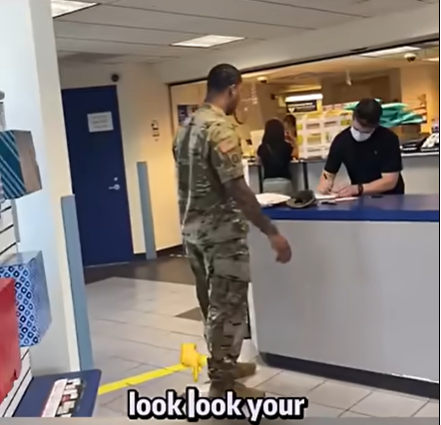
The video takes place inside a post office lobby in Washington State, a space that is open to the public and used every day by people mailing packages, checking boxes, buying postage, and handling personal errands. At first, the scene appears to be a normal public setting, but the mood changes when a man walking around with a camera begins filming inside the lobby. He is described as an “auditor,” a person who records in public places to test how people react and whether government employees or citizens understand the rules around filming. While he may believe he is exercising his rights, several people in the lobby clearly feel uncomfortable being recorded while they are simply trying to conduct private personal business in a public building.
The tension begins when a woman approaches the auditor and challenges him about the camera. She does not want to be filmed and appears frustrated that he continues recording despite her objections. For many people, being filmed unexpectedly can feel intrusive, even in a place open to the public. A post office lobby may not be fully private, but people still often expect a basic level of personal space. They may be mailing documents, handling addresses, or simply not wanting their faces captured by someone they do not know. The woman’s reaction reflects that discomfort. She sees the camera pointed around the lobby and feels that her presence is being taken without permission.
Behind her are two men with military backgrounds: an active-duty Army soldier and a veteran wearing blue clothing. They are not initially the center of the conflict. Like everyone else, they appear to be there for normal personal business. But as the argument grows, they become involved. The veteran steps in and tells the auditor to put the camera down. He claims that there are regulations requiring written consent from the postmaster before anyone can film inside a post office. His tone suggests that he believes he is correcting the auditor and defending the people who do not want to be recorded.
The auditor immediately disputes the veteran’s claim. He argues that the information is wrong and insists that filming in the public lobby is legal. This is where the disagreement becomes more than a personal argument about comfort. It becomes a clash between two different understandings of rules, rights, and public space. The veteran believes there are restrictions that apply inside the post office. The auditor believes the lobby is a public area where he is allowed to record. Neither side seems willing to back down, and the people around them become part of an increasingly tense exchange.
The situation highlights a difficult issue that often appears in these types of videos. Public spaces are not always simple. A person may have a legal right to record in certain publicly accessible areas, but other people may still feel uncomfortable, exposed, or disrespected. The law and basic social courtesy do not always feel the same to everyone in the moment. The auditor focuses on what he believes he is allowed to do. The customers focus on how the filming affects them personally. That gap creates frustration on both sides.
Another woman repeatedly asks the auditor not to record her. She makes it clear that she does not want to be on camera. Her request is direct and personal. She is not necessarily making a legal argument; she is expressing a boundary. But the auditor refuses to stop filming. To him, the request does not override what he believes is his right to record. To her, his refusal feels disrespectful and unnecessary. This repeated back-and-forth adds to the tension because it is no longer just one complaint. Multiple people in the lobby are now uncomfortable with the camera.
The staff members inside the post office generally appear to stay out of the argument. That is an interesting part of the scene because it shows how these situations can place employees in a difficult position. Postal workers may not want to escalate the conflict, especially if the auditor is not directly interfering with their work. At the same time, customers are clearly upset and may expect staff to step in. The video notes that police have already been called, which suggests that rather than handling the dispute directly, someone decided to let law enforcement respond and sort out the issue.
As the argument continues, the veteran remains firm in his belief that filming should not be happening without permission. His intervention seems to come from a place of wanting order and respect in the lobby. He may see the auditor’s behavior as disruptive, especially because multiple customers are asking not to be filmed. From his perspective, the camera is causing unnecessary conflict in a place where people are just trying to complete errands. But the auditor continues pushing back, repeating that he is allowed to film and that the veteran’s understanding of the rules is incorrect.
The active-duty Army soldier becomes more involved later in the confrontation. At first, he appears to be observing the situation, but his attitude changes when the auditor reportedly uses discriminatory words toward the woman who did not want to be filmed. That moment appears to shift the soldier’s reaction from irritation to visible anger. He does not simply disagree with the filming anymore; he seems offended by the way the auditor is speaking to someone in the lobby. The conflict moves from a debate about cameras into a more personal confrontation about respect and behavior.
The soldier then confronts the auditor and challenges him to go outside for “hand-to-hand combat.” This is the point where the situation becomes especially tense. The soldier’s response is emotional and aggressive, likely driven by anger at what he heard and the auditor’s refusal to respect the woman’s request. But even if his frustration is understandable, challenging someone to fight is dangerous and could make the situation much worse. The auditor, instead of calming things down, reportedly eggs him on. That kind of response only increases the risk of escalation.
This is one of the most important parts of the video because it shows how quickly a verbal dispute can move toward a physical confrontation when people feel provoked. The auditor’s filming already made people uncomfortable. The veteran’s challenge over regulations intensified the argument. The woman’s repeated request not to be recorded created more emotional pressure. Then the reported discriminatory language pushed the soldier into a much angrier state. Each moment built on the one before it, until the interaction became less about rules and more about pride, anger, and confrontation.
The soldier’s reaction also shows how protective instincts can take over in public conflicts. He may have felt that the woman was being disrespected and that no one else was stepping in strongly enough. Because of his military background, he may also have been used to direct confrontation and standing up when he believes someone is acting wrongly. But in a public lobby, especially with police already called, the safest response would have been to avoid giving the auditor the reaction he seemed to want. Auditors often rely on strong reactions to make their videos more dramatic. When someone becomes angry, the confrontation becomes the content.
The auditor’s behavior, based on the description, appears designed to test limits and provoke responses. He continues filming even after people ask him to stop, argues with those who challenge him, and reportedly encourages the soldier’s anger rather than trying to de-escalate. That does not mean every person filming in public is automatically wrong, but it shows why these encounters become so controversial. There is a difference between calmly documenting a public space and continuing to film people who are clearly uncomfortable while pushing the interaction toward conflict.
For the customers in the lobby, the experience is likely stressful. They came to the post office for ordinary reasons, not to become part of someone’s video. Even if the lobby is public, people may not expect to be recorded closely or placed in an online confrontation. The woman who repeatedly asks not to be filmed likely feels trapped because she cannot fully control whether the camera captures her. She can ask, she can object, and she can move away, but if the auditor refuses, she has limited options. That lack of control can make people feel powerless and angry.
The veteran’s argument about postal regulations adds another layer. Many public buildings have rules that are more specific than people realize. Some areas are open to the public, while others are restricted. Some kinds of filming may be allowed in certain spaces but not in others, depending on purpose, signage, local policy, or whether filming disrupts operations. In the moment, though, neither side appears to be calmly checking the rules. The veteran states what he believes to be true, and the auditor rejects it. The disagreement becomes a contest of confidence rather than a careful review of policy.
The post office staff’s decision to mostly ignore the conflict may be interpreted in different ways. Some viewers may think they should have stepped in earlier to protect customers’ comfort. Others may think they were wise not to escalate and to wait for police. Employees in these situations have to be careful. If they order someone to stop filming without knowing the exact rules, they could create a larger dispute. If they do nothing, customers may feel abandoned. There is no easy position for them once the lobby becomes tense.
The presence of the soldier and veteran also makes the scene more emotionally charged. Military service often carries strong associations with discipline, respect, and protecting others. When the veteran tells the auditor to put the camera down, he may believe he is restoring order. When the soldier reacts angrily to the reported language, he may feel he is defending someone from disrespect. But the auditor seems to interpret their reactions as part of the challenge. Instead of seeing them as concerned citizens, he treats them as people trying to restrict his rights.
The conflict reflects a larger cultural tension around public recording. Cameras are everywhere now: phones, security systems, body cameras, dashcams, doorbell cameras, and livestreams. Many people accept that public spaces are no longer fully anonymous. At the same time, being recorded by a stranger who refuses to stop can feel very different from being captured by a security camera. A security camera is usually fixed, silent, and used for safety. A person with a handheld camera can follow, confront, and publish. That makes people feel personally targeted.
The auditor likely sees himself as testing government transparency or defending constitutional rights. Supporters of this kind of filming often argue that people need to understand that public servants and public buildings can be recorded. They may believe discomfort is not a reason to stop someone from exercising a right. But critics argue that some auditors use the idea of rights as a shield for rude or provocative behavior. They say that the goal is often not transparency, but conflict and viral attention. This video appears to show why the debate is so heated.
The woman who does not want to be filmed is in a difficult position because she is not a public employee performing official duties. She is a private person using a public lobby. The auditor may believe he can record her because she is in public, but from a human perspective, her discomfort still matters. Respecting someone’s request not to be filmed, when possible, can be a simple act of courtesy. Refusing that request may be legal in some situations, but it can still be perceived as intentionally disrespectful.
The soldier’s challenge to fight outside becomes the most dramatic moment because it risks turning a verbal dispute into something more serious. The fact that the auditor reportedly eggs him on makes the exchange feel even more reckless. A person who truly wants to document peacefully would likely step back, lower the tension, or remind everyone that police are on the way. Encouraging a confrontation suggests that the conflict itself may be part of the goal. That is why many viewers may find the auditor’s behavior irritating, even if they believe filming in public can be lawful.
At the same time, the soldier’s reaction is also a reminder that anger can create consequences. If he had acted physically, he could have faced serious trouble, regardless of what the auditor said. Words can be offensive, insulting, or provocative, but responding with violence or threats can shift the focus away from the person who started the conflict. In these situations, the person who stays calm often ends up in the stronger position. The auditor may have been counting on someone losing control.
The veteran and soldier both appear to represent a sense of public decency in the moment, at least from their perspective. They see people being made uncomfortable and try to intervene. But the way they intervene matters. The veteran argues rules. The soldier moves toward confrontation. The most effective response may have been to disengage, document the auditor’s behavior if needed, and wait for police or management. That is easier said than done, especially when someone is provoking people in a confined public space, but it is usually safer.
The video also shows how bystanders can become pulled into conflicts they did not create. The women, the veteran, the soldier, the staff, and the auditor all become part of the same tense environment. The lobby is no longer just a place to mail packages. It becomes a stage for a public argument. Customers who wanted privacy are now more visible because of the dispute. The more they object, the more attention the interaction receives. That is one of the frustrating dynamics of these encounters: resisting the camera can sometimes make the camera focus even more on the person resisting.
The arrival of police, or the expectation that police are coming, hangs over the scene. Everyone seems to know that the situation may soon be judged by someone with authority. The auditor may expect the police to confirm his right to record. The customers may expect police to make him stop or leave. The staff may simply want the situation to end without disruption. Until officers arrive, the conflict remains unresolved, and each side continues trying to assert its version of what should happen.
This kind of video can divide viewers. Some will side with the auditor, saying that filming in public is a protected activity and that people need to accept being recorded in public spaces. Others will side with the customers, saying that just because something may be allowed does not mean it is respectful, especially when private citizens are clearly uncomfortable. Some will focus on the soldier’s reaction, saying he should not have challenged the auditor physically. Others will understand why he became angry if discriminatory language was used. The video contains enough tension for people to argue from many angles.
The deeper issue is the balance between rights and responsibility. Having a right to do something does not always mean doing it in the most confrontational way possible is wise or decent. At the same time, being uncomfortable with someone’s lawful behavior does not always mean that person can be forced to stop. Public life requires people to manage both principles. Freedom and courtesy should not have to be enemies, but in moments like this, they often collide.
The auditor’s refusal to stop filming the woman who asks not to be recorded shows the limits of social pressure. She can ask politely or firmly, but if he is determined to continue, her request alone may not change anything. That can make the situation feel unfair to her. The veteran tries to add authority by citing regulations. The auditor rejects that too. The soldier responds emotionally. The auditor pushes back again. Every attempt to stop the filming seems to deepen the confrontation.
What makes the setting important is that the post office is not a street corner or a park. People go there for official and personal tasks. They may have packages with addresses, documents, identification, or other sensitive details. Even if the camera is not focused on those items, customers may worry about what could be captured. That concern is not unreasonable. A public lobby can still contain personal information. This is why filming in such spaces can feel more intrusive than filming a wide outdoor scene.
The staff’s quiet response may also suggest that they are trained not to escalate these encounters. Government employees may be told to avoid arguing with people recording unless the person disrupts operations, enters restricted areas, or violates a clear rule. If police were already called, staff may have decided that engaging further would only give the auditor more material and create more conflict. Their silence may look passive, but it could also be a deliberate attempt to prevent escalation.
The soldier’s visible displeasure after the reported discriminatory words is understandable on a human level. Most people do not like seeing someone insulted or targeted, especially when that person has already said they feel uncomfortable. But the challenge to fight outside creates a dangerous turn. It gives the auditor an opportunity to portray himself as the victim of aggression. It also risks creating legal problems for the soldier. The better choice, difficult as it might be, would be to avoid giving the auditor the reaction he appears to be seeking.
The video ultimately becomes less about whether filming is allowed and more about how people treat each other in public. The legal answer may matter, but the emotional reality matters too. A person can be technically correct and still behave in a way that feels needlessly cruel or provocative. Another person can be morally offended and still respond in a way that escalates the problem. The scene is messy because both rights and emotions are involved.
In the end, the post office lobby becomes a small example of a much larger debate about privacy, public access, respect, and provocation. The auditor continues filming because he believes he has the right. Customers object because they feel uncomfortable and disrespected. The veteran tries to stop the recording by citing rules. The soldier becomes angry after hearing language he finds unacceptable and challenges the auditor to take the confrontation outside. Staff stay mostly out of it while police are reportedly on the way. Each person reacts from their own point of view, but the result is a tense public scene that could have been avoided if everyone had chosen de-escalation over confrontation.
The most important lesson from the video is that public rights and public behavior should go together. Recording in public may be legally protected in many situations, but using a camera to provoke people can create unnecessary conflict. At the same time, responding to provocation with threats or challenges can make the situation worse and place the angry person at risk of consequences. The safest and most effective response in moments like this is usually calm distance, clear boundaries, and waiting for the proper authority to handle the dispute.
What began as a man filming inside a public post office became a heated argument involving customers, a veteran, an active-duty soldier, and postal staff watching from the background. It shows how quickly discomfort can turn into confrontation when people feel ignored, disrespected, or challenged. It also shows how cameras can change the mood of a room, especially when the person recording refuses to consider how others feel. By the end, the scene is not only about a camera in a lobby. It is about dignity, restraint, and the difficult line between exercising a right and respecting the people around you.