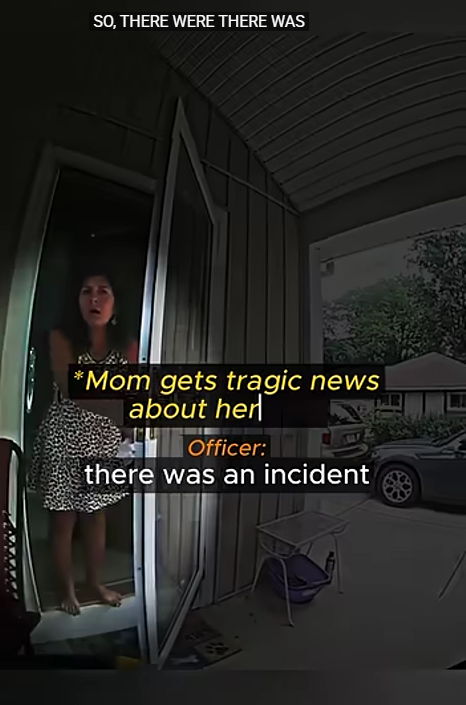
The video captures one of the most emotionally devastating moments that can occur between law enforcement and a civilian family: the delivery of sudden death notification to a mother outside her home. It documents a heartbreaking sequence of events where officers must inform a parent that her child has been killed in a car accident, transforming an ordinary front porch interaction into a moment of irreversible grief. The footage is not about action, conflict, or investigation, but about the raw human impact of tragedy delivered face-to-face, where words alone are enough to completely change a life in seconds.
The situation begins with officers arriving at a residential home to speak with a mother named Christine. Their approach is calm and professional, as is standard in situations involving sensitive inquiries. Law enforcement officers are trained to handle death notifications with care because they understand that the way information is delivered can significantly affect how a person processes sudden loss. Even before any details are shared, the presence of officers at a home often signals seriousness, which can already create anxiety for the person answering the door.
When Christine steps outside to meet them, the conversation begins with a simple and seemingly routine question. The officers ask her when she last saw her son, Dominic. This type of question is often part of standard procedures following accidents or emergencies, as investigators try to establish timelines, identify victims, and notify families appropriately. Christine responds that everyone was home the night before, a statement that reflects normal daily life, completely unaware of the tragedy that has already occurred.
At this stage, there is still a sense of uncertainty. From her perspective, the interaction may still feel like a general inquiry rather than a life-altering conversation. However, for the officers, the weight of what they are about to say is already present. Delivering fatal news is one of the most difficult responsibilities in law enforcement, and officers are often trained to proceed carefully, ensuring they communicate clearly while also preparing emotionally for the reaction that will follow.
As the conversation continues, one of the officers begins to explain that there has been a serious automobile accident involving three individuals: McKenzie, who was driving, DaVon, and a passenger believed to be Dominic. This clarification immediately shifts the emotional tone of the interaction. Accidents involving multiple people are often chaotic and complex, and families are rarely prepared for the possibility that loved ones may be involved until names are confirmed.
At this point, the officer encourages Christine to take a deep breath before continuing. This instruction is not just procedural but compassionate, intended to help her emotionally prepare for what is coming next. Officers often use grounding language like this because sudden shock can cause immediate physical reactions such as dizziness, fainting, or difficulty processing information. The warning acts as a brief buffer between uncertainty and devastating reality.
Then comes the moment that changes everything.
The officer delivers the news that while McKenzie survived the crash and is currently at the hospital, both DaVon and Dominic did not survive the accident and have passed away.
In an instant, the conversation transitions from uncertainty to irreversible reality.
For Christine, this information represents not just news, but emotional collapse. Hearing that a child has died is one of the most traumatic experiences a parent can face. The mind often struggles to process such information immediately, leading to shock, disbelief, and emotional overload. Even when spoken gently and carefully, the meaning of the words itself carries overwhelming weight.
Her reaction is immediate and visceral. She breaks down on the porch in a state of profound grief, overwhelmed by shock and emotional pain. In moments like this, people often struggle to stand, speak, or fully comprehend what they have just heard. The body reacts before the mind fully catches up, leading to trembling, crying, and a sense of disorientation. The porch, a place normally associated with everyday life and routine, becomes the setting for unimaginable loss.
The officers remain present during this reaction, a crucial part of their role in death notification situations. They are not only there to deliver information but also to ensure the person receiving it is not left alone in the immediate aftermath. In many cases, officers stay until additional family members or support systems arrive, helping to stabilize the situation as much as possible in the first moments of grief.
The emotional weight of the scene extends beyond just Christine’s reaction. It also reflects the broader tragedy of sudden accidents where multiple lives are lost and families are forever changed within seconds. Car accidents remain one of the most unpredictable and devastating types of incidents because they occur without warning, often involving people going about completely normal parts of their day.
The fact that McKenzie survived while two others did not adds another layer of complexity to the situation. Survivors of fatal accidents often carry their own emotional trauma, guilt, and long-term psychological impact. At the same time, families of victims are left trying to process unimaginable loss while also seeking answers about what happened in the moments leading up to the crash.
For officers, delivering such news repeatedly throughout their careers can also carry emotional consequences. While they are trained to remain composed and professional, they are still human beings who witness grief firsthand. Death notifications are often described as one of the most emotionally challenging parts of police work because there is no way to soften the impact of the truth being delivered.
The video’s power comes not from dramatic action but from its raw simplicity. There is no confrontation, no escalation, and no confusion about what happened once the information is given. Instead, the moment is defined entirely by emotional reality—the instant a mother learns her child is gone. It is a type of footage that forces viewers to confront the fragility of life and the suddenness with which it can change.
Another important aspect of the scene is the setting itself. The front porch represents home, safety, and normal daily life. It is a place where people expect routine interactions, not life-shattering news. The contrast between the environment and the emotional content of the conversation intensifies the impact of the moment. A familiar domestic space becomes the backdrop for grief that will likely be remembered forever.
The officers’ tone throughout the interaction also reflects training in empathy and communication. They do not rush the information, nor do they present it abruptly without preparation. Instead, they attempt to ease into the message while still being direct and clear. This balance is essential because vague or delayed communication can increase confusion and emotional distress, while overly blunt delivery can feel even more traumatic.
Christine’s reaction represents a universal form of grief that transcends the specifics of the situation. While every person experiences loss differently, the immediate shock of losing a child is widely understood as one of the most intense emotional experiences a human can endure. In that moment, time often feels distorted, and reality itself can feel unreal.
The video ultimately serves as a reminder of how fragile and unpredictable life can be. One moment, everything is normal, with family members at home and routines intact. The next, a single conversation delivered by officers can permanently alter the course of a family’s life. There are no dramatic actions or resolutions—only the stark reality of loss and the beginning of a grieving process that will continue long after the officers leave the porch.
In the end, the footage stands as a somber depiction of human vulnerability, the responsibilities carried by law enforcement in delivering devastating news, and the profound emotional impact that sudden tragedy has on families. It is not a story of conflict or resolution, but of irreversible change—where a single moment transforms an ordinary day into one defined by grief, memory, and loss that can never be undone.