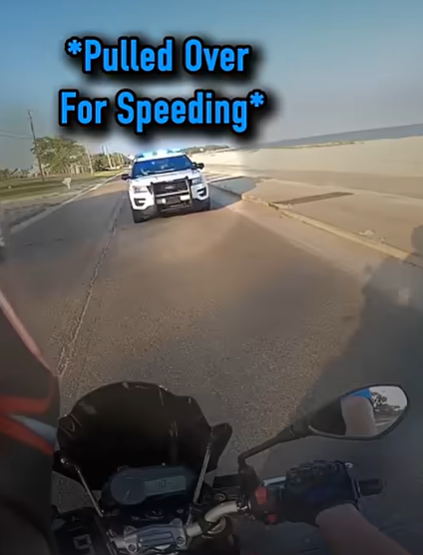
A simple traffic stop along a coastal road turned into a calm and surprisingly reasonable exchange between a police officer and a motorcyclist who had been riding faster than the posted speed limit. Instead of becoming tense, argumentative, or overly formal, the encounter unfolded in a respectful way, with the officer choosing to focus less on punishment and more on safety, responsibility, and common sense.
The video begins with the officer pulling over the motorcyclist after noticing the bike traveling too fast along the road. The setting appears to be a coastal area, the kind of place where the scenery can easily tempt riders and drivers to relax, enjoy the view, and sometimes push the speed a little more than they should. Roads near the water often feel open and inviting, especially when traffic is light, the weather is good, and the ride feels smooth. For a motorcyclist, that combination can make it easy to lose track of speed. But even when the road feels calm, the posted limit still matters, especially in areas where pedestrians, cyclists, parked cars, curves, and tourist traffic may all be nearby.
The officer approaches the motorcyclist not with anger, but with a measured and practical tone. He does not seem interested in turning the stop into a confrontation. Instead, he speaks to the rider like someone trying to make a point that will actually be heard. That makes the interaction stand out right away. Many traffic stops can become uncomfortable because the driver or rider feels defensive and the officer feels the need to assert authority. In this case, the officer still maintains control of the stop, but he does it without unnecessary harshness.
The first important detail he points out is the speed limit. He reminds the biker that the limit on that stretch of road is 25 mph. That is a relatively low speed limit, and on a motorcycle it can feel especially slow. A bike can accelerate quickly, and riders often feel the speed differently because they are exposed to the air, the road, and the environment around them. Still, a 25 mph zone usually exists for a reason. It may be a residential area, a tourist-heavy road, a beach access route, or a place where people frequently cross the street. Low speed limits are often designed to give drivers and riders enough time to react to unexpected movement.
Rather than simply writing a ticket, the officer chooses to explain his concern. He tells the biker that if they are going to go over the speed limit, they should keep it within a small margin, no more than about 5 to 10 mph over. That statement is informal, but it reveals the officer’s practical approach. He is not pretending that every person on the road always drives at exactly the posted number. He understands that people sometimes go slightly above the limit. But he is drawing a line between a small, manageable difference and the kind of speed that creates real danger.
The officer’s tone suggests that his goal is not to trap the motorcyclist or ruin their day. His goal is to make sure the rider understands why the speed matters. He talks about safety, specifically the possibility of accidents involving pedestrians or the motorcyclist themselves. That is a key point. On a motorcycle, the rider is far more exposed than someone inside a car. If something goes wrong, even at a speed that may not seem extreme, the consequences can be serious. A sudden pedestrian crossing, a car door opening, sand or gravel near the shoulder, or a driver pulling out unexpectedly can all become dangerous very quickly.
The officer also mentions that he does not want to have to fill out an accident report. On the surface, that line may sound casual or even humorous, but it carries a serious meaning. Accident reports are not just paperwork. They represent something bad that has already happened. They mean someone may have been hurt, vehicles may have been damaged, and a normal day has turned into an emergency. By saying he does not want to fill one out, the officer is really saying that he does not want the rider or anyone else to get hurt.
That kind of explanation can be more effective than a lecture. Instead of saying only, “You broke the law,” the officer explains the real-world reason behind the rule. Speed limits are not just numbers on signs. They are tied to reaction time, stopping distance, road conditions, and the safety of everyone sharing the area. On a coastal road, especially one with a low speed limit, the risk may not always be obvious to a rider who is focused on the ride itself. The officer’s conversation helps bring that risk back into focus.
The motorcyclist responds well. The rider apologizes, which helps keep the stop calm. That apology matters because it shows the biker is listening rather than arguing. In many traffic stops, the direction of the encounter depends heavily on the first few responses. If the rider had become defensive, denied everything, or tried to challenge the officer aggressively, the tone could have changed quickly. Instead, the apology signals respect and cooperation. It tells the officer that the message has been received.
The officer’s decision not to issue a formal ticket also shapes the mood of the encounter. A ticket can be expensive and frustrating, and it often leaves the driver or rider feeling punished rather than educated. In this case, the officer appears to believe that a warning and a conversation are enough. That does not mean speeding is harmless. It means he uses discretion. He sees an opportunity to correct the behavior without making the situation more severe than necessary.
Police discretion is a major part of everyday traffic enforcement. Officers often have to decide whether a warning, citation, or stronger action is appropriate. Not every violation receives the same response because not every situation is the same. A driver who is reckless, rude, impaired, or putting people in immediate danger may receive a very different response from someone who is cooperative and willing to slow down. Here, the officer seems to judge that the motorcyclist can be trusted to take the warning seriously.
The interaction feels respectful because both sides play their part. The officer speaks calmly and clearly. The biker listens and apologizes. Neither person tries to turn the moment into a battle of ego. The officer does not humiliate the rider, and the rider does not challenge the officer just for the sake of argument. That mutual calmness allows the stop to end quickly and peacefully.
The thumbs-up from the officer at the end gives the encounter a positive closing. It is a small gesture, but it says a lot. It shows there is no lingering hostility. The officer has made his point, the biker has accepted it, and both can go on with their day. In a world where many police videos show conflict, tension, or escalation, this one stands out because it ends with a simple sign of goodwill.
The setting of the coastal road adds meaning to the stop. Roads near beaches, marinas, boardwalks, or scenic viewpoints often attract pedestrians and visitors who may not always behave predictably. People may cross the road to reach the water, step out from between parked cars, walk in groups, carry beach gear, or stop suddenly to take photos. Drivers and riders passing through those areas need extra caution because the road is not just a route for vehicles; it is part of a shared public space.
For motorcyclists, scenic roads can be especially enjoyable. The sound of the engine, the open air, the curves, and the view can create a strong sense of freedom. But that freedom comes with responsibility. A motorcycle is smaller and more agile than a car, but it is also less forgiving when something goes wrong. A rider who speeds through a low-limit area may feel in control, but control can disappear quickly when another road user does something unexpected.
The officer seems to understand that. His concern is not only about the law but about preventing a situation where the biker has no time to react. At 25 mph, a rider has more time to slow down, stop, or maneuver around an unexpected hazard. At higher speeds, the window for reaction shrinks. Even a small increase in speed can make a big difference in stopping distance and impact force. That is why the officer draws attention to keeping any extra speed within a limited range.
His comment about pedestrians is especially important. Pedestrians are vulnerable in the same way motorcyclists are vulnerable compared with cars. They have little protection if struck. In coastal areas, pedestrians may be distracted, relaxed, or unfamiliar with the road. A person might cross without looking carefully or assume vehicles are moving slowly because of the posted limit. If a motorcycle comes through faster than expected, both the pedestrian and rider could be put at risk.
The officer also mentions the motorcyclists themselves, showing that he is not treating the biker as the only source of danger. He is thinking about the rider’s safety too. That kind of concern can make a warning feel less like punishment and more like advice from someone who has seen accidents before. Officers who work traffic enforcement often witness the aftermath of crashes. They know how quickly a fun ride can become a serious incident. That experience likely informs the officer’s calm but serious tone.
The line about not wanting to fill out an accident report may also reflect that experience. Behind every accident report is a scene: damaged vehicles, injured people, shaken witnesses, blocked roads, and families who may receive terrible news. The paperwork is only the final administrative step after something has gone wrong. By referencing it casually, the officer makes the point without becoming overly dramatic. He is telling the biker, in a practical way, that prevention is much easier than dealing with the aftermath.
The rider’s apology helps turn the stop into a successful warning. A warning only works if the person receiving it is willing to accept the message. The motorcyclist’s response suggests they understand the officer’s point and do not want to create trouble. That is likely why the officer feels comfortable letting the rider go without a formal citation. The officer has achieved the purpose of the stop: getting the rider to slow down and think more carefully.
This kind of encounter can be useful for viewers because it shows a model of how traffic stops can end well. The officer does not need to yell to be taken seriously. The motorcyclist does not need to argue to protect their dignity. Both people speak like adults, and the situation resolves without drama. It is a reminder that respect can change the entire tone of a roadside stop.
It also shows that warnings can sometimes carry more emotional weight than tickets. A ticket may make someone angry and focused on the cost. A calm conversation may make someone reflect on the reason behind the law. The officer’s message is simple enough that the rider will likely remember it: the road is 25 mph, keep it close, watch out for pedestrians, and do not make this become an accident report. That is clear, practical, and easy to apply.
The biker’s apology likely comes from recognizing that the officer is being fair. When a person knows they could receive a ticket but instead gets a reasonable explanation, it can create a sense of gratitude. The rider may feel lucky, but also reminded to be more careful. That combination can be powerful. A harsh lecture might create resentment, but a respectful warning can create cooperation.
The video also highlights the difference between enforcing the law and helping people understand the law. Enforcement can be done with punishment alone, but it can also be done through education and discretion. This officer appears to choose the second approach. He still stops the rider. He still identifies the violation. He still makes it clear that the speed limit matters. But he frames the conversation around safety rather than authority.
That approach does not make the officer weak. In fact, it may make the stop more effective. The officer remains in control while avoiding unnecessary conflict. He uses calm language, gives a clear boundary, and ends the stop professionally. The thumbs-up reinforces that the matter is closed as long as the rider corrects the behavior. It is authority delivered without hostility.
For the motorcyclist, the stop becomes a learning moment rather than a punishment. The rider is reminded that a scenic road is not a racetrack and that low-speed areas deserve caution. The apology suggests that the message lands. A rider who leaves a stop feeling respected may be more likely to follow the warning than one who leaves feeling humiliated.
The encounter also reflects a broader truth about road safety: most accidents are prevented before they ever happen. A small conversation, a warning, a moment of awareness, or a decision to slow down can prevent consequences that no one wants. The officer is trying to create that moment before anything bad occurs. He is not responding to a crash. He is trying to stop one from happening.
That is why the interaction feels positive despite being a traffic stop. The officer is not there to ruin the biker’s ride. He is there to make sure the ride does not end badly. The biker is not treated like a criminal. They are treated like someone who made a risky choice and needs to correct it. That difference matters.
The coastal road itself likely remains beautiful and calm after the stop ends. The biker can continue riding, but now with a stronger awareness of the surroundings. The officer can return to patrol knowing he addressed the issue without escalating it. No ticket is issued, no argument breaks out, and no accident occurs. In that sense, the stop accomplishes exactly what traffic enforcement is supposed to accomplish: safer behavior on the road.
The simplicity of the ending is part of what makes the video memorable. There is no dramatic twist, no arrest, and no confrontation. The officer gives a warning. The biker apologizes. The officer gives a thumbs-up. The rider goes on their way. It is ordinary, but in a refreshing way. It shows that not every police interaction has to become a viral conflict. Sometimes the most meaningful moments are the ones where people treat each other reasonably.
The officer’s warning about keeping it only 5 to 10 mph over the limit is also interesting because it sounds like real-world policing rather than textbook enforcement. Technically, the speed limit is the limit. But the officer’s phrasing acknowledges that many drivers and riders drift slightly above it. His main concern is not catching someone for a tiny mistake. It is preventing excessive speed in a place where excessive speed could hurt someone. That practical honesty likely makes the rider more willing to listen.
At the same time, the officer is not giving permission to speed recklessly. He is setting a cautious expectation. He is saying that if the rider is going to exceed the limit at all, they should keep it minimal and safe. The underlying message remains: slow down. The difference is that he delivers it in a way that feels realistic, not robotic.
The encounter also shows why local knowledge matters. The officer likely knows that road well. He may know where pedestrians cross, where riders tend to speed, where accidents have happened, or where visibility becomes limited. The motorcyclist may simply see an open coastal stretch, but the officer may see a place where one bad decision could create a serious accident. His warning is shaped by that awareness.
The biker’s response suggests that the rider understands they are being given a break. An apology is the right response because it acknowledges the officer’s concern and helps close the interaction respectfully. Instead of arguing over the exact speed or making excuses, the rider accepts responsibility. That makes the officer’s decision not to issue a ticket feel justified.
There is also an element of trust at the end. The officer trusts the rider to leave and ride more carefully. The rider trusts that the officer is not trying to escalate the situation unnecessarily. The thumbs-up symbolizes that trust. It is a small sign that the stop has ended on good terms.
For viewers, the video can feel almost refreshing because it shows common sense on both sides. The officer does not overreact. The rider does not make the stop harder. The conversation stays focused on safety. The ending is polite. In a time when many videos of police encounters highlight conflict, this one highlights discretion and cooperation.
The article’s strongest takeaway is that a calm warning can sometimes be enough. The officer sees a speeding motorcyclist, stops them, explains the danger, and chooses not to issue a formal citation. The motorcyclist listens, apologizes, and leaves with a reminder to slow down. Nothing dramatic happens, and that is exactly the point. The best outcome in a traffic stop is often the one where everyone leaves safely and no further action is needed.
The video also reminds riders that beautiful roads can create hidden risks. A coastal route may feel peaceful, but it may also include tourists, pedestrians, narrow lanes, curves, driveways, and sudden distractions. A motorcycle may be built for speed and freedom, but responsible riding means adjusting to the environment. The officer’s warning is not meant to take away the joy of the ride. It is meant to keep the rider alive and keep others safe.
By choosing a conversation over a ticket, the officer turns the stop into a moment of prevention. He communicates that the speed limit matters, but he does so in a way that feels human. His concern about pedestrians and accident reports makes the warning practical rather than personal. The biker’s apology shows that the message was received. The thumbs-up at the end confirms that the situation has been resolved without hostility.
In the end, this coastal road traffic stop stands out because of its restraint. The officer had the authority to issue a ticket, but he chose to use the moment to teach rather than punish. The motorcyclist could have argued, but chose to apologize. The result is a calm, respectful exchange where safety remains the central point. A rider was reminded to slow down, an officer avoided unnecessary conflict, and the stop ended with a simple thumbs-up instead of a citation. It is a small moment, but it shows how effective a reasonable conversation can be when both sides are willing to listen.