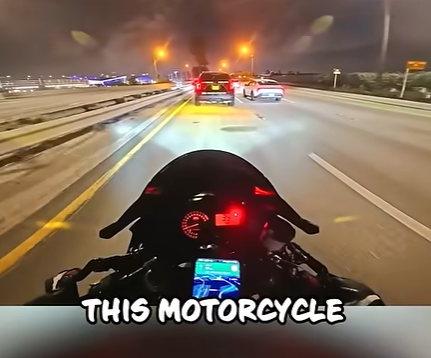
Late-night roads have a way of making even the smallest details stand out. The glow of streetlights, the red blur of taillights, the steady hum of engines, and the quiet stretch of pavement can make a simple ride feel almost cinematic. For one motorcyclist, what began as an ordinary nighttime ride turned into a strangely memorable encounter with a police officer, all because of one small detail on a patrol SUV: the gas cap door had been left open.
The rider was traveling through the dark when they noticed the police SUV ahead of them. At first, nothing seemed unusual. It was just another vehicle on the road, moving steadily with the flow of traffic. But as the motorcyclist got closer, they spotted something that seemed out of place. The small fuel door on the side of the police vehicle was hanging open. It was not a dangerous emergency, but it was still something worth pointing out. Anyone who has ever driven away from a gas station with a loose cap or open fuel door knows the small wave of embarrassment that can come afterward. For a police officer driving a marked vehicle, it was especially noticeable.
The motorcyclist decided to help. It was a simple act, the kind of thing one driver might do for another on the road. They tried the easiest and safest method first: flashing their high beams. The bright flicker of the motorcycle’s lights was meant to catch the officer’s attention without creating confusion. But the officer did not seem to notice. The SUV continued forward as if nothing was wrong.
The rider could have ignored it at that point. After all, it was not their vehicle, and the open gas cap door was not causing immediate danger. But sometimes small courtesies matter, especially on the road where people often pass each other without a second thought. The motorcyclist kept riding and looked for another way to let the officer know.
Since the high beams did not work, the rider carefully moved closer. Riding a motorcycle at night already requires focus, and approaching a moving police vehicle adds another layer of caution. The motorcyclist pulled up alongside the driver’s side of the SUV, close enough to shout toward the officer’s window. It was an unusual sight: a rider on a motorcycle next to a patrol vehicle, not trying to flee, not causing trouble, but simply trying to deliver a helpful message.
The motorcyclist called out to the officer, letting her know that her gas cap door was open. It was a quick, practical warning. The officer appeared to understand what the rider was saying, and soon after, the police SUV began moving toward the side of the road. The officer pulled over, likely to check the fuel door and fix it before continuing.
The rider then pulled in behind the police SUV. That should have been the end of the moment: a quick stop, a quick thank-you, and both people going on with their night. But then the scene took a funny and unexpected turn. As the motorcyclist came to a stop behind the patrol vehicle, they forgot one important step. They failed to put the kickstand down.
For anyone who rides, that small mistake can happen fast. One moment the bike is balanced; the next, gravity takes over. The motorcyclist accidentally dropped the motorcycle onto its side. It was not a dramatic crash, but it was definitely an awkward moment. After going out of their way to help the officer, the rider suddenly found themselves dealing with their own minor mishap right behind the squad car.
The officer noticed immediately and came back to check on the rider. Her first reaction was not irritation or suspicion, but concern. She wanted to make sure the motorcyclist was alright. That simple response helped turn the moment from awkward to human. The rider assured her that they were fine and explained what had happened. It was not a collision, not a fall caused by speed, not anything serious. They had simply stopped and forgotten to put the kickstand down.
The explanation made the situation almost humorous. The rider had successfully alerted the officer to the open gas cap door, only to accidentally drop their own motorcycle seconds later. It was the kind of thing that feels embarrassing in the moment but becomes a great story afterward. The officer thanked the motorcyclist for letting her know about the gas tank, and the brief roadside interaction ended on a friendly note.
What makes this moment interesting is how ordinary it is. There was no chase, no argument, no major emergency, and no dramatic confrontation. Instead, it was a small example of everyday awareness and kindness. The motorcyclist noticed something wrong and took the time to tell the officer. The officer, in return, checked on the rider when the motorcycle tipped over. Both people reacted in a way that showed patience and basic respect.
It also shows how unpredictable road interactions can be. A person may set out with one simple intention, only for the situation to unfold in a completely different way. The motorcyclist probably expected a quick wave or nod after warning the officer. They likely did not expect to be standing behind a patrol SUV explaining that they had dropped their motorcycle because they forgot the kickstand. Yet that is exactly what happened.
The incident also highlights the unique challenges of riding a motorcycle. Unlike a car, a motorcycle requires constant balance and small habits that become second nature over time. Putting the kickstand down is one of those automatic actions, but even experienced riders can forget it when they are distracted, tired, or focused on something else. In this case, the rider had just been concentrating on getting the officer’s attention, safely pulling over, and stopping behind the police SUV. That small break in routine was enough for the bike to tip.
Still, the rider handled the moment well. Instead of panicking or becoming defensive, they calmly explained what happened. The officer handled it well too, first making sure the rider was safe and then thanking them for the warning. The whole interaction could have been tense simply because it involved a motorcyclist and a police vehicle at night, but instead it remained calm, brief, and even a little funny.
There is also something refreshing about seeing a police interaction that is so simple and polite. The motorcyclist was not being stopped for a violation. The officer was not approaching with suspicion. The entire reason for the stop was a helpful warning about an open fuel door. That small detail changed the whole tone of the encounter. It became less about authority and more about two people helping each other in a normal, everyday situation.
The open gas cap door itself was not a major problem, but it was the kind of thing that can be annoying if ignored. It might flap in the wind, draw attention from other drivers, or make the officer wonder later how long it had been open. By pointing it out, the rider spared the officer from continuing down the road unaware. It was a small favor, but small favors are often what make public spaces feel more connected and less cold.
The funniest part, of course, is the timing. The rider took the initiative, pulled alongside a moving police SUV, shouted the warning, and successfully got the officer to stop. That part required confidence and good timing. But then, after all that effort, the motorcyclist forgot the simplest part of stopping a bike. The motorcycle tipped over right after the helpful deed was done. It is the kind of ironic moment that makes people laugh because it is so relatable. Everyone has had a moment where they tried to do something helpful or impressive, only to make a silly mistake right afterward.
The scene also reminds people that nobody is perfect on the road. Police officers can accidentally leave a gas cap door open. Motorcyclists can forget their kickstands. Drivers can miss signals. Riders can misjudge a stop. Most mistakes are not dramatic; they are just human. What matters is how people respond to them. In this case, both the officer and the rider responded with calmness and good humor.
Nighttime added another layer to the moment. Visibility is lower, communication is harder, and small details can easily be missed. Flashing high beams might not be understood right away. Shouting from a motorcycle to a moving SUV is not the easiest way to communicate. Yet the rider managed to get the message across. The officer pulled over safely, and the interaction was resolved without any conflict.
The motorcyclist’s decision to stop behind the officer also showed responsibility. They did not simply shout and speed away. They followed through, pulled over, and made sure the officer understood the warning. That is likely why the officer was appreciative. From her perspective, someone had gone out of their way to help her avoid a minor issue, and when that person had a small mishap, it was natural to check on them.
The moment could easily be described as wholesome. It was a quick roadside exchange between a rider and an officer, but it carried a lightness that many road incidents do not have. There was concern, gratitude, and a bit of accidental comedy. The rider’s dropped motorcycle became the unexpected punchline to an otherwise simple act of kindness.
For motorcyclists, the scene may feel especially familiar. Every rider knows the importance of small habits: checking mirrors, watching the road surface, using signals, balancing at stops, and setting the kickstand properly. Forgetting the kickstand is one of those mistakes that can happen in a split second. It is frustrating, but usually more embarrassing than harmful if the bike falls at a standstill. The rider was lucky to be fine, and the officer’s quick check helped make sure the situation stayed safe.
For drivers, the story is a reminder to stay aware of what other road users are trying to communicate. A flash of headlights, a hand signal, or someone pulling alongside may not always be aggression or impatience. Sometimes it is simply a warning. Of course, safety comes first, and no one should take unnecessary risks to communicate on the road. But the intention here was clearly helpful, and the result was positive.
The encounter also shows how motorcycles can sometimes make communication both easier and harder. A motorcyclist can move closer and use body language more visibly than someone inside a closed car, but they also have less protection and must be careful not to put themselves in a dangerous position. Pulling alongside a moving vehicle, especially a police SUV, requires caution. The rider appears to have done it only after the high beams failed, and the goal was simply to deliver a quick message.
In the end, the situation was resolved in the simplest possible way. The officer became aware of the open gas cap door. The rider confirmed they were not injured. The motorcycle mishap was explained. The officer thanked the motorcyclist. Then both could continue with their night. Nothing more needed to happen.
That simplicity is part of why the story works. It does not need a dramatic ending. The humor is already built into the contrast between the rider’s helpfulness and the accidental bike drop. The warmth comes from the officer checking on the rider and thanking them. The lesson comes from the reminder that small acts of attention can matter, even when they do not go perfectly.
A lot of road stories focus on frustration: drivers cutting each other off, people ignoring signals, or tense exchanges between civilians and police. This one feels different. It is about someone noticing a small problem and choosing to help. It is about an officer responding with concern rather than annoyance. It is about a minor mistake turning into a funny memory instead of a bigger issue.
The image of the motorcycle tipping over after the rider forgets the kickstand is likely what people will remember most. It turns the scene into something almost slapstick. The rider had the confidence to pull next to a moving police vehicle and shout a warning, but the bike still ended up on its side during the stop. That little contradiction makes the moment feel real. Real life is rarely smooth from start to finish. Even good intentions come with awkward endings sometimes.
The officer’s thank-you matters too. It acknowledged the rider’s effort. Even though the motorcyclist had just dropped the bike, the reason they stopped was still helpful. That gratitude kept the moment positive. Instead of the rider only feeling embarrassed, they could at least know their original purpose had been appreciated.
The interaction may have lasted only a few minutes, but it contained several small emotional beats. First, the rider noticed the open fuel door. Then came the attempt to flash high beams. Then the decision to pull alongside and shout. Then the officer pulled over. Then came the surprise of the dropped motorcycle. Then the officer checked on the rider. Finally, there was the explanation and the thank-you. Each step added something to the story.
It is also the kind of video or incident that people enjoy because it feels unscripted. Nothing about it seems planned. The rider did not expect a funny ending. The officer probably did not expect to be warned about her gas cap by a motorcyclist at night. The bike drop was not staged; it was just a human mistake. That natural quality is what makes the moment charming.
For the motorcyclist, it may have been embarrassing at the time, especially because it happened right behind a police vehicle. But embarrassment fades, and stories like this often become favorites. It is the kind of thing a rider might later tell friends with a laugh: “I pulled over to help a cop because her gas cap was open, then I forgot my kickstand and dropped my bike right in front of her.” It is a perfect little road story because it has kindness, irony, and a harmless ending.
For the officer, it was probably a small but appreciated interruption in her shift. Police work can involve stressful situations, but this was not one of them. This was a moment where a member of the public tried to help, and the only complication was a motorcycle tipping over at low speed. The officer’s concern showed that even in routine interactions, safety comes first.
The story also gently challenges the assumptions people sometimes make on the road. A motorcyclist approaching a police SUV at night could easily be misunderstood, but the rider’s purpose was completely innocent. A police officer pulling over could make a rider nervous, but the stop was not enforcement-related. Instead, both sides were just dealing with a small roadside issue.
By the end, the open gas cap door had been handled, the rider was okay, and the officer had received the message. The night continued. The road returned to normal. But for anyone who saw or heard about the moment, it became a funny reminder that helpfulness does not always look graceful. Sometimes being a good Samaritan ends with your motorcycle lying on its side while you explain that you forgot the kickstand.
And maybe that is what makes the incident so relatable. People like to imagine helpful actions going smoothly, but real life adds little surprises. A good deed can be followed by a clumsy mistake. A serious-looking police SUV can have something as ordinary as an open gas cap door. A confident motorcyclist can have a forgetful second at a stop. None of it has to become a big problem if the people involved respond with patience.
In this case, patience won. The rider did not get upset. The officer did not overreact. Both recognized the situation for what it was: a harmless, slightly funny roadside moment. The rider was fine, the motorcycle could be picked back up, and the officer could close the gas cap door and continue on patrol.
The incident leaves behind a simple message. Paying attention matters. Helping others matters. And when things get a little awkward, a calm reaction can turn a potentially embarrassing moment into a story worth sharing. What began with an open gas cap door ended with a dropped motorcycle, a concerned officer, and a thank-you. It was not a major event, but it was a memorable one — the kind of small human moment that stands out on an otherwise ordinary night.
It also says something about the strange little community that exists between people who share the road. Most of the time, drivers and riders are strangers passing each other for only a few seconds. They may never meet, never speak, and never know anything about each other. But in small moments, that distance disappears. A loose gas cap, a flashing headlight, a shouted warning, or a quick roadside check can briefly turn strangers into people looking out for one another.
That is why the motorcyclist’s choice stands out. It would have been much easier to keep riding. Many people might have noticed the open gas cap door, thought, “Someone else will tell her,” and continued on their way. But the rider did not leave it to someone else. They decided the small effort was worth it. Even though the issue was minor, the action showed awareness and consideration.
The dropped motorcycle made the whole thing more memorable, but it did not take away from the kindness of the gesture. In fact, it made the moment more human. Helpful people still make mistakes. Confident riders still have awkward seconds. Serious-looking situations can suddenly become funny. That is often how real life works: not perfectly polished, but full of unexpected little turns.
The officer’s reaction helped keep the moment positive. Instead of focusing only on the motorcycle falling over, she first checked on the rider. That showed the right priority. A bike can be lifted. A gas cap can be closed. But making sure a person is okay matters more than anything else. Once the rider confirmed they were fine, the tension in the moment likely faded quickly.
There may have been a brief pause where both of them realized how odd the situation was. The officer had pulled over because someone warned her about a simple mistake on her own vehicle. The rider had stopped to help but accidentally created a small problem for themselves. It was the kind of scene that probably felt awkward for a few seconds before becoming funny.
For viewers, the incident is easy to enjoy because nobody was seriously hurt and nothing escalated. It is rare to see a road interaction involving police, a motorcycle, and a nighttime stop that ends with such a harmless and friendly tone. There was no anger, no ticket, no lecture, and no confrontation. Just a quick warning, a little embarrassment, a thank-you, and a reminder that people can still be kind in ordinary situations.
The motorcyclist probably rode away with a mix of pride and embarrassment. Pride because they had done the right thing, and embarrassment because the motorcycle drop happened at the worst possible time. But that combination is exactly what makes the story worth telling. It was not a perfect good deed, but it was a real one.
In the end, the night carried on as if nothing had happened. The police SUV could return to patrol with its gas cap door closed. The rider could continue their trip, maybe a little more careful with the kickstand at the next stop. And the small encounter remained as a funny, wholesome reminder that even on dark roads, people still notice, still help, and sometimes still laugh at themselves when things do not go exactly as planned.