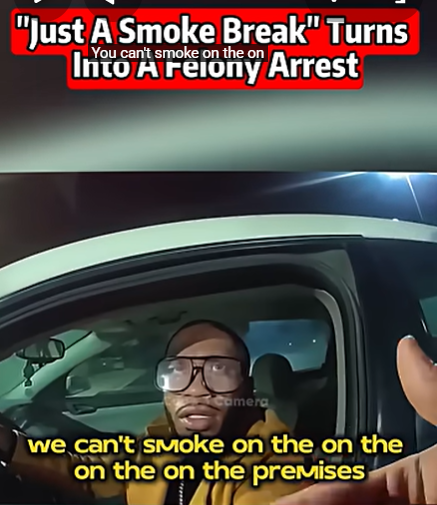
A routine police encounter quickly turned serious after officers approached a man sitting inside a parked vehicle and the conversation shifted from a smoking violation to questions about identity, marijuana, and a firearm. What appeared at first to be a simple interaction over a rule against smoking on the premises soon developed into a felony-level arrest, showing how quickly an ordinary stop can escalate when officers discover a weapon and cannot immediately confirm a person’s identity.
The encounter began when an officer approached the man and informed him that smoking was not allowed in the area. The man appeared to explain that he had only come downstairs briefly for a smoke break and did not expect the situation to become anything more than a short conversation. When the officer asked him for a driver’s license or identification, the man said he did not have it with him. That answer immediately complicated the encounter because officers typically need to verify who they are speaking with, especially when the person is inside or near a vehicle.
At first, the situation seemed relatively minor. A person sitting in a car, smoking where it is not allowed, would usually not be expected to lead to a major arrest. But police encounters often depend on what happens during the first few minutes. Once the officer began asking questions and the man could not provide identification, the focus shifted from the smoking issue to who he was, whether he had anything illegal in the car, and whether there were any safety concerns for the officers.
The officer then questioned the man about illicit substances. The man admitted that there was marijuana inside the vehicle but denied having harder drugs. That admission gave officers more reason to continue the investigation. Depending on the location, marijuana laws can vary, and possession may be treated differently depending on the amount, where it is found, and whether the person is legally allowed to have it. But regardless of the marijuana issue, the encounter became much more serious when the man admitted that there was also a firearm in the car.
The moment a firearm is mentioned during a police stop, the tone of the encounter changes. Officers are trained to treat the presence of a weapon as a safety concern, even if the person says the gun is legal or registered. The officer instructed the man not to reach for the weapon, which is a standard safety command meant to prevent any sudden movement that could be interpreted as a threat. Even if the man had no intention of using the gun, officers could not ignore the risk of a weapon being inside the vehicle within reach.
After the man admitted that he had a firearm in the car, officers moved to place him under arrest and handcuff him. From their perspective, the combination of no identification, admitted marijuana possession, and a firearm in the vehicle created a situation that required more control. The arrest marked a major shift from the original reason for contact. What started as a warning or questioning over smoking on the property became a criminal investigation involving a weapon.
While being detained, the man identified himself as Joseph Hamilton. He also claimed that he lived in Indiana and that the firearm was legally registered to him there. His explanation suggested that he believed he had a lawful reason to possess the gun, or at least that he wanted officers to understand the weapon was not stolen or illegally obtained. However, the officers did not appear ready to accept his statement without verification. Because he did not have identification on him, they could not immediately confirm whether the name he provided was accurate.
The officers expressed doubt about his identity and made it clear that giving a false name would create additional legal problems. They told him that they would verify his information at the police station. This part of the encounter is important because identity verification is a major issue in police work. If a person cannot provide a license, state ID, or other documentation, officers have to rely on the information the person gives them until they can confirm it through official records. If the name, date of birth, or address does not match, the person may face further charges.
The man’s claim that he lived in Indiana also added complexity. Gun laws differ from state to state, and a firearm that someone believes is legally possessed in one state may still create legal problems in another jurisdiction. Even if a gun is registered or legally owned elsewhere, officers must determine whether the person is legally allowed to possess it where the stop occurs, whether it was transported properly, and whether any other circumstances make possession unlawful. The presence of marijuana can also matter because firearms and controlled substances together can create additional legal concerns.
The video shows how quickly a person’s choices during a police encounter can influence the outcome. The man may have thought he was only stepping outside briefly and did not need his identification. But once police approached him, not having ID made the situation harder to resolve. If officers had been able to immediately confirm his identity and legal status, the encounter may have moved differently. Instead, the lack of identification left officers uncertain about who he was and whether his claims about the firearm could be trusted.
The firearm became the central issue because it created an immediate safety concern. Officers do not have to wait until someone reaches for a gun before taking precautions. Once they know a firearm is nearby, they usually move to secure the person and the weapon. In this case, the officer’s instruction not to reach for the gun was meant to keep the situation from becoming dangerous. The man’s cooperation at that moment was important because sudden movement around a weapon can escalate a stop very quickly.
The case also highlights the difference between a person believing they are legally allowed to have a firearm and officers being able to verify that claim. Someone may honestly believe their gun is legally registered or properly owned, but officers still have to check the law, the person’s record, and the circumstances of possession. If the person is in a different state, if the weapon is inside a vehicle, or if there are drugs present, the legal picture can change. That is why officers did not simply accept the man’s explanation and let him go.
The admission about marijuana also likely influenced the officers’ decision-making. Even in places where marijuana has been legalized or decriminalized in some form, police may still investigate when marijuana is found in a vehicle alongside a firearm. The combination can raise concerns about whether the person is legally allowed to possess both, whether the marijuana is being used or transported unlawfully, and whether the firearm is connected to any other criminal activity. This does not automatically mean the person is guilty of a felony, but it gives officers a reason to proceed carefully.
Another key point is the public or property-based setting of the encounter. The officer initially approached because smoking was prohibited on the premises. That means the stop may have begun as a rule enforcement issue rather than a traffic stop or a response to a violent crime. But once officers make lawful contact with someone and receive information about possible drugs or weapons, the situation can expand. This is why even minor encounters can become serious when new facts are discovered.
The man’s inability to provide identification placed him in a weaker position during the interaction. Without ID, he had to rely on verbal information, and officers had to decide whether they believed him. When a person is carrying or transporting a firearm, having proper identification becomes especially important. Officers need to confirm whether the person has warrants, prior convictions, protective orders, or other restrictions that could affect whether they may legally possess a gun. Until those checks are complete, officers may treat the situation as unresolved and potentially risky.
The officers’ statement that they would verify his information at the station shows that the encounter had moved beyond a simple field interview. Once a person is taken into custody, officers can run more complete checks and confirm whether the name provided matches official records. If the man was telling the truth, that information could help clarify the case. If he was not, it could lead to additional charges for providing false information or obstructing the investigation.
The case is also a reminder that firearm laws can be confusing, especially for people who travel between states. A gun owner may know the rules in their home state but not fully understand the rules in another. Registration, concealed carry permits, transport requirements, and possession restrictions can vary widely. A person who legally owns a firearm in Indiana may still need to follow different rules elsewhere. That becomes especially important when the firearm is inside a vehicle and police are involved.
From the officers’ perspective, the safest approach was to secure the man first and sort out the legal details afterward. This is common in encounters involving weapons. Officers are trained to prioritize safety before debating the legality of possession on the roadside or in a parking area. Once the person is handcuffed and the weapon is secured, they can investigate more fully. While that may feel sudden or unfair to the person being detained, officers often view it as necessary when a weapon is present.
The video also demonstrates how honesty can have complicated consequences during police encounters. The man admitted to having marijuana and a gun, which may have prevented officers from unexpectedly discovering the weapon during a search. On one hand, telling officers about a gun can reduce the risk of surprise and possible danger. On the other hand, that admission gave officers information that led directly to his arrest. It shows the difficult position people can find themselves in when they are questioned by police and unsure how serious the situation may become.
The encounter may have started with the man believing he had done very little wrong. He was sitting in his car, taking a smoke break, and did not have his identification because he had only come downstairs. But from the officer’s point of view, each answer raised a new concern. No identification meant identity could not be verified. Marijuana in the car meant possible drug-related issues. A firearm in the car meant officer safety concerns and possible weapons charges. The combination turned a minor rule violation into a much more serious investigation.
The felony nature of the arrest likely depended on the firearm issue and the specific laws in the jurisdiction. Firearm-related charges can become felonies when a person is accused of unlawful possession, carrying without proper authorization, possessing a weapon under prohibited circumstances, or combining a firearm with other illegal conduct. The exact charge would depend on the legal details, but the video’s description makes clear that officers treated the matter as serious enough to take him into custody.
For viewers, the case may appear surprising because of how quickly it escalated. One moment, the officer is talking about smoking rules; soon after, the man is handcuffed. But police encounters often unfold that way when new information emerges. The original reason for contact does not always remain the main issue. Once officers learn about drugs or weapons, their priorities change, and the encounter can move into a different legal category almost immediately.
The situation also highlights the importance of keeping identification available, especially when sitting in or around a vehicle. Even if a person is not driving at that moment, officers may still ask for identification during an investigation. Not having ID does not automatically mean someone has committed a crime, but it can make the encounter longer and more complicated. If other concerns are present, such as drugs or a firearm, the lack of ID can make officers less willing to resolve the matter on scene.
In the end, the encounter involving the man who identified himself as Joseph Hamilton shows how a minor property rule violation can uncover more serious issues. Police first approached because smoking was prohibited on the premises. The man said he did not have identification because he had only come downstairs for a brief smoke break. When questioned, he admitted there was marijuana in the vehicle and later acknowledged that there was a firearm inside the car. Officers instructed him not to reach for the weapon, placed him under arrest, and said they would verify his identity at the police station.
The case serves as a reminder that police encounters can change direction quickly when identification cannot be confirmed and a firearm is involved. It also shows that claiming a gun is legally registered in another state may not be enough to avoid arrest if officers cannot immediately verify the person’s identity or legal right to possess it. What began as a simple warning about smoking became a felony arrest because the investigation revealed drugs, a firearm, and uncertainty about the man’s identity.
Another important part of the encounter is how the man’s explanation, while understandable from his perspective, did not remove the officers’ concerns. He said he had only come downstairs briefly and therefore did not bring his identification. In everyday life, that may seem reasonable. Many people step outside for a short break without carrying their wallet, especially if they believe they are still close to home. But once police become involved, especially around a vehicle, identification becomes one of the first things officers ask for. Without it, the officer has to rely on verbal information, and that can create doubt, particularly when other issues are discovered during the conversation.
The presence of the car also matters because officers may view someone sitting in a vehicle differently than someone simply standing outside. A vehicle can contain personal belongings, substances, weapons, or other items that may not be immediately visible. It can also allow someone to leave quickly if officers do not control the situation. Because the man was inside or near the car, the officer had to consider not only the smoking violation but also whether there were any safety risks inside the vehicle. Once marijuana and a firearm were mentioned, the car became central to the investigation.
The man’s admission about marijuana appeared to be the first moment when the interaction moved beyond a simple premises rule. Even if marijuana laws in some places have changed, it can still create legal concerns in certain settings. Police may need to know whether the marijuana is legally possessed, whether it is inside a vehicle, whether it is accessible to the driver or passengers, and whether it is connected to any other issue. When a person admits to marijuana in a car, officers may believe they have a reason to investigate further.
The firearm admission raised the stakes even more. A gun inside a car creates immediate questions: Who owns it? Is it loaded? Is it accessible? Is the person legally allowed to possess it? Does the person have the right permit or license for that location? Has the firearm been reported stolen? Are there any active warrants, protection orders, or prior convictions that would make possession illegal? Officers cannot answer those questions just by listening to the person’s explanation. They need records, identification, and often a closer examination of the weapon itself.
The man’s claim that the firearm was legally registered in Indiana may have been his attempt to reassure officers that he was not hiding anything dangerous or stolen. However, that statement alone would not necessarily settle the matter. Even lawful firearm owners can run into serious legal trouble when crossing state lines or possessing a weapon in a place with different rules. A person may be allowed to own a gun in one state but still violate another state’s transport or carry laws. This is why officers appeared unwilling to resolve the issue on scene based only on his word.
The officers’ concern about a false name also became important. When someone does not have identification, police must check the information they provide verbally. A false name can slow down an investigation, hide warrants, or prevent officers from discovering a person’s criminal history. Officers often warn people that providing false information can lead to additional charges because they want the person to understand that honesty matters at that moment. In this case, the officers made it clear they would verify the information at the station, which suggests they were not fully confident they had the complete truth.
The man’s situation also shows how one missing item, his identification, affected everything that followed. If he had been able to hand officers a valid ID, they could have quickly checked his name, address, license status, and any legal restrictions. That would not automatically have prevented an arrest, especially with marijuana and a firearm involved, but it may have reduced uncertainty. Without ID, the officers had to treat his identity as unconfirmed. In police work, uncertainty often leads to more control, not less.
The safety instructions from the officer were also a major part of the encounter. Telling the man not to reach for the weapon was not just a casual warning. It was a command meant to prevent a dangerous misunderstanding. During a stop involving a firearm, even an innocent movement can be interpreted as a possible threat. If a person reaches toward the glovebox, center console, floorboard, or pocket after mentioning a weapon, officers may react immediately. That is why police often tell people to keep their hands visible and avoid sudden movements until the weapon is secured.
The fact that the man disclosed the gun before reaching for it may have helped prevent the encounter from becoming physically dangerous. Officers generally prefer to know about a weapon rather than discover it unexpectedly. However, the disclosure also made it necessary for them to take control of the situation. Once a firearm is acknowledged, officers cannot simply continue the conversation as if nothing has changed. Their first responsibility becomes making sure no one can access the weapon while the investigation continues.
The arrest may have seemed sudden, but from the officers’ point of view, it was likely the safest way to proceed. Handcuffing someone during an investigation does not always mean the final charges are already fully decided, but in this case, the situation had escalated enough that officers treated him as under arrest. They had a man without ID, a vehicle containing marijuana, and a firearm whose legal status they could not immediately confirm. Those factors together created enough concern for them to remove him from the car and secure him.