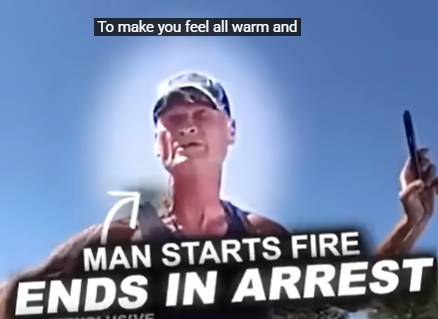
The afternoon heat rolled across the dry brushland like a wave, the kind of heat that made every patch of grass look ready to burst into flames. A few people driving along the nearby road noticed a thin line of smoke rising from an open area just beyond the trees. At first it looked harmless, almost like someone grilling food or warming up beside a small campfire, but within minutes the smoke became thicker and darker. The smell carried across the road, and several drivers slowed down to look. One person pulled over and called emergency services after spotting a man throwing dry branches into a growing fire despite warning signs clearly posted around the area.
The area had already been under a fire warning because of the dry weather conditions. Officials had repeatedly warned residents that even a tiny spark could lead to a dangerous wildfire. Campfires, burning debris, and open flames were strictly prohibited in that location. Locals knew the rules well because fires in previous years had destroyed nearby land and forced evacuations. That was why the sight of someone openly feeding a fire in the middle of dry brush immediately alarmed people nearby.
By the time officers arrived, the flames were still relatively small, but the conditions around them made the situation dangerous. The man stood a few feet from the fire, sweat dripping down his face as he tossed more sticks toward the flames. He appeared agitated even before police approached him. A cellphone was in one hand, and he kept pacing back and forth near the burning area. Several empty containers and camping supplies were scattered around him, making it look like he had been there for a while.
One of the officers stepped out carefully and immediately began speaking in a calm voice, telling the man he needed to back away from the fire. The officer explained that the area was under strict fire restrictions and that they needed to put the flames out immediately. Instead of cooperating, the man raised his voice almost instantly. Witnesses later said his attitude changed the moment officers started giving instructions. He appeared defensive, irritated, and unwilling to listen.
The officer repeated the request several times, telling him to step away so firefighters could safely deal with the flames. The man argued that he was “just trying to stay warm” and claimed the fire was under control. One officer pointed out the obvious danger around them, explaining that the dry grass could ignite in seconds if the wind shifted. Rather than calming down, the man became even more confrontational. He gestured angrily with his hands and accused police of harassing him for no reason.
As the conversation continued, another officer noticed something clipped near the man’s pocket. When asked whether he had any weapons on him, the man hesitated before admitting he had a knife. That instantly changed the tone of the interaction. The officers remained calm, but their voices became firmer. They instructed him several times not to reach toward his pockets or make sudden movements.
The man reacted badly to those instructions. He started shouting over the officers, insisting he was not a threat and demanding that they leave him alone. His voice echoed across the open area as smoke continued drifting upward behind him. The officers tried to keep distance while also making sure the situation did not escalate further. One officer calmly explained that nobody wanted things to get worse, but because he was armed and refusing commands, they needed him to cooperate.
Instead, he began pacing faster and talking louder. Witnesses described him as extremely angry and unpredictable. At one point he pointed toward the fire and claimed people were “overreacting.” Another time he accused officers of trying to control him unfairly. The officers repeatedly attempted to de-escalate the situation by speaking slowly and clearly, reminding him that reaching for the knife would create a serious safety risk for everyone involved.
The fire itself was still active during the argument. Small flames crackled through the dry wood while smoke drifted into the air. One firefighter moved closer with equipment ready but stayed back because officers were still handling the armed suspect. The possibility of the fire spreading while police dealt with the confrontation added even more pressure to the scene.
Several passing drivers had stopped nearby by then, watching from a safe distance. Some recorded the incident on their phones as the shouting continued. The man seemed aware he was being filmed, and at times he directed his anger toward the people watching. He yelled that everyone needed to “mind their own business” and complained that nobody understood his situation.
Officers continued giving simple instructions. They asked him to keep his hands visible. They asked him to slowly move away from the fire. They told him not to touch the knife. Every instruction was met with another argument. The longer the standoff lasted, the more tense the atmosphere became. The officers appeared increasingly concerned that the man’s emotions were overpowering his judgment.
One officer finally informed him that he was being detained for illegally starting the fire and for refusing lawful commands. The moment the word “detained” was mentioned, the man exploded with anger. He shouted that he was not going anywhere and took a step backward instead of complying. Officers immediately ordered him to stop moving and warned him again not to reach toward his pocket.
For a few seconds, the entire scene froze in tension. The man’s breathing appeared heavy and rapid. His face was red from heat and frustration. Officers carefully adjusted their positions, keeping distance while remaining prepared to act if necessary. One of them continued trying to calm him down, saying nobody wanted anyone hurt and that cooperation would make everything easier.
But the man refused to listen. He continued arguing loudly, insisting he had rights and claiming officers were treating him unfairly. At one point he briefly moved one hand toward the side of his pocket where the knife was located. Multiple officers immediately shouted commands telling him not to touch it. The sudden movement caused a visible shift in urgency.
The man quickly pulled his hand away but continued yelling. Officers later stated that moment significantly increased their concern because they could not know whether he intended to grab the knife or not. Given the unpredictable behavior, the active fire nearby, and his refusal to follow commands, they believed the risk level had become too high.
Despite the tension, officers still tried to avoid force. They continued talking to him for several more minutes, hoping he would finally calm down enough to surrender peacefully. One officer even explained step-by-step what would happen if he cooperated: he would be detained, searched safely, and transported without further issues. The man interrupted repeatedly, refusing to accept responsibility for the situation.
The wind suddenly picked up during the argument, blowing sparks from the fire toward nearby brush. Firefighters quickly moved to stop the flames from spreading. That moment seemed to increase urgency for everyone involved. Officers knew they could not continue negotiating indefinitely while the environmental risk remained active.
The man appeared increasingly exhausted but no less angry. His voice became hoarse from shouting, yet he continued resisting every attempt to resolve the situation peacefully. Witnesses later said it seemed like he took every instruction personally, responding with more frustration each time officers tried to calm him.
Eventually, officers decided they needed to physically take him into custody before the situation became more dangerous. They informed him one final time that he was under arrest and ordered him to place his hands behind his back. Instead of complying, he pulled away and tried to turn from the officers.
The arrest happened quickly after that. Officers moved in together, attempting to control his arms before he could reach anywhere near the knife. The man resisted almost immediately, twisting his body and shouting loudly as officers struggled to secure him. Dust kicked into the air during the struggle while firefighters continued working in the background to extinguish the fire.
Witnesses described the scene as chaotic but controlled. Officers repeatedly ordered the man to stop resisting while attempting to guide him safely to the ground. The man continued yelling angrily, accusing officers of attacking him. Several tense seconds passed before they finally managed to restrain his hands.
Once handcuffed, officers immediately secured the knife from his pocket. They later confirmed it was a folding knife with a sizable blade. Although he never fully removed it during the encounter, officers emphasized that his repeated refusal to comply and movements toward the pocket created a serious safety concern throughout the incident.
Even after being restrained, the man continued arguing loudly. He complained about being arrested and insisted the entire situation had been blown out of proportion. Officers escorted him toward a patrol vehicle while firefighters fully extinguished the flames behind them. Smoke continued rising from the wet ashes as the scene slowly settled down.
People nearby remained watching quietly as the man was placed into the patrol car. Some witnesses later expressed relief that the situation ended without anyone being seriously injured. Others focused on how dangerous the fire itself could have become given the dry conditions. Several locals pointed out that wildfires had devastated nearby areas in past years, making illegal fires a particularly sensitive issue.
Authorities later explained that the decision to arrest him was based on multiple factors, including the illegal fire, refusal to obey lawful commands, aggressive behavior, and the presence of the knife during the confrontation. Officers also noted that the situation could have escalated much more seriously if the man had attempted to draw the weapon or if the fire had spread beyond control.
Investigators spent time documenting the area afterward. Burn marks remained visible on the ground where the fire had been started. Fire crews ensured every remaining ember was completely extinguished before leaving. The dry conditions around the site highlighted just how quickly the incident could have turned into a major emergency.
As videos from the arrest spread online later that evening, reactions were divided. Some viewers criticized the man’s behavior, arguing that starting a fire during dangerous weather conditions showed reckless disregard for public safety. Others focused on the confrontation itself, debating whether the situation could have been handled differently. Still, many agreed that refusing commands while armed created a dangerous combination.
Former law enforcement officers commenting online pointed out how quickly situations involving weapons can escalate. Even if someone insists they do not intend harm, officers are trained to react cautiously whenever a suspect repeatedly ignores commands near a weapon. The uncertainty alone creates risk for everyone involved.
Fire officials also used the incident as another reminder about outdoor fire restrictions. They explained that many people underestimate how fast dry grass and brush can ignite. A small campfire may appear harmless for several minutes before wind suddenly spreads embers into surrounding vegetation. In some cases, massive wildfires have started from situations far smaller than the one officers encountered that day.
Neighbors near the area later described feeling frustrated because illegal fires had become an increasing concern during hot weather periods. Some said they worried every time they smelled smoke because they remembered previous evacuations and fire damage in nearby communities. Seeing someone openly ignore restrictions angered many residents who believed the rules existed for good reason.
The man reportedly continued complaining during transport to jail, insisting he had done nothing seriously wrong. Officers, however, maintained that the combination of fire danger, resistance, and the knife created a situation they could not ignore. According to reports, he faced multiple charges connected to the incident.
The story quickly gained attention online partly because of how preventable the entire situation appeared. Many people watching the footage felt the encounter could have ended peacefully if the man had simply followed instructions from the beginning. Instead, what started as an illegal campfire escalated into a tense arrest involving multiple officers and firefighters.
Some viewers who watched the video closely pointed out moments where officers attempted repeatedly to slow things down and avoid physical confrontation. Their instructions remained consistent throughout the encounter: step away from the fire, keep your hands visible, and do not touch the knife. But each attempt at communication was met with more hostility and resistance.
Experts later noted that emotional escalation often plays a major role in confrontations like this. Once a person becomes angry and defensive, they may stop processing instructions rationally. Every command begins to feel like a personal attack instead of a safety measure. That emotional reaction can quickly spiral into a dangerous standoff, especially when weapons are present.
The footage also sparked conversations about how stressful environmental conditions can influence behavior. The extreme heat, smoke, isolation of the area, and ongoing argument may all have contributed to the man’s emotional state. Still, officials emphasized that none of those factors excused creating a fire hazard or refusing lawful police instructions.
For firefighters, the incident represented another example of how dangerous wildfire prevention work can become. Instead of simply extinguishing a small illegal fire, crews had to wait while officers handled an armed and resistant suspect nearby. Those delays can matter significantly in dry conditions where fires spread rapidly.
By the next morning, the burned area remained taped off while authorities completed their investigation. Only a blackened patch of ground and damp ashes remained where flames had burned the day before. What could have been a quiet afternoon outdoors had instead ended with police lights, firefighters, shouting, and an arrest.
Many people who later discussed the incident online focused on one specific point: the refusal to comply after the knife was discovered. Even viewers sympathetic to the man’s frustration admitted that once officers knew he was armed, ignoring commands dramatically increased the danger. Several commenters wrote that the safest option would have been to cooperate first and argue later through legal channels instead of escalating face-to-face.
Others pointed to the fire restrictions themselves, noting how seriously authorities now treat outdoor burning during dry seasons. In many regions, even a single careless fire can destroy homes, wildlife, and lives. Officials across the country have repeatedly warned that climate conditions are making fires easier to start and harder to control.
The combination of an illegal fire, emotional confrontation, and visible weapon transformed what might have been a simple citation into a full-scale arrest. Officers later said they were grateful the situation ended without anyone being injured. Firefighters echoed that relief, especially considering how easily the surrounding brush could have ignited.
In the end, the scene served as a reminder of how fast ordinary situations can spiral when anger overrides judgment. A small fire became a dangerous confrontation. Simple instructions turned into arguments. A knife in a pocket created fear and uncertainty. And a refusal to cooperate ultimately led to handcuffs and arrest instead of a peaceful resolution.
Long after the patrol cars left and the smoke disappeared into the evening sky, many locals were still talking about the encounter. Some discussed the risks of wildfire season. Others debated the arrest itself. But nearly everyone agreed on one thing: in conditions that dangerous, one bad decision can affect far more than just the person making it.
As more details about the incident became public, additional witnesses began sharing what they had seen before police even arrived. One nearby worker said he first noticed the man nearly an hour earlier walking through the area carrying bags and pieces of wood. At first, nobody thought much of it because people occasionally passed through the open land despite the warning signs. But after spotting smoke rising higher and higher, several people became nervous. The witness explained that the weather conditions alone made the entire scene unsettling. The air was dry, the wind changed direction constantly, and the grass looked brittle enough to ignite instantly.
Another witness described hearing the man yelling to himself before officers arrived. According to her, he appeared frustrated long before anyone confronted him. She said he kept pacing around the fire pit area while speaking loudly and throwing pieces of wood into the flames aggressively. At one point she considered approaching him herself to warn him about the fire restrictions, but his body language made her uncomfortable enough to stay away and call authorities instead.
Several firefighters later explained just how dangerous the situation actually was. One firefighter said that people often underestimate how quickly fires spread in dry conditions because they only focus on the size of the visible flames. In reality, tiny embers can travel through the air and ignite brush dozens of feet away before anyone notices. That is why even “small” illegal campfires are treated seriously during restricted seasons. According to officials, the surrounding area contained enough dry vegetation for the fire to potentially spread rapidly if strong winds picked up.
During the arrest, officers reportedly noticed that the man’s emotional state seemed to shift constantly. Sometimes he appeared furious, shouting aggressively and refusing commands. Other times he sounded almost desperate, insisting repeatedly that he “wasn’t hurting anyone.” Officers later said those sudden emotional swings made the encounter even harder to predict. One moment he seemed like he might calm down, and the next he would explode into another argument.
The cellphone he carried throughout the incident also became part of the chaos. Witnesses said he occasionally lifted it as if recording officers himself, while at other moments he used it to gesture angrily during arguments. One officer reportedly warned him multiple times to stop waving his hands around while they were trying to safely detain him. Every unpredictable movement near the knife forced officers to remain extremely cautious.
After the arrest, authorities searched the area more thoroughly and reportedly found additional camping items nearby, suggesting the man may have intended to stay there longer than just a few hours. Investigators examined whether he had been living temporarily in the area or simply passing through. Some local residents later commented that they had seen unfamiliar people camping in restricted areas more frequently over the past year, creating ongoing concerns about fires and safety.
The footage recorded by bystanders spread rapidly online because of how tense the confrontation became. Clips showing officers repeatedly warning the man not to reach for the knife drew especially strong reactions. Some viewers commented that the officers appeared patient despite the hostility directed toward them. Others focused on how quickly the man’s anger escalated the moment arrest was mentioned. Many agreed the entire encounter felt unpredictable from the beginning.
One former wildfire official interviewed by local media explained that illegal fires are among the leading causes of preventable brush fires during dry seasons. He noted that people sometimes believe they can fully control a small fire themselves, but conditions can change within seconds. A sudden gust of wind or one unnoticed ember landing in dry grass can create a disaster faster than most people realize.
The man’s refusal to acknowledge the seriousness of the fire frustrated many viewers online. Even after officers explained the danger multiple times, he reportedly continued minimizing the risk and insisting the situation was harmless. That attitude especially angered residents who had previously experienced evacuations due to nearby wildfires. Some commenters described feeling emotional watching the footage because they remembered losing property or seeing entire hillsides burn in previous fire seasons.
Law enforcement experts later pointed out another important factor in the arrest: officer uncertainty. Even though the knife remained in the suspect’s pocket throughout most of the encounter, officers had no way of knowing his intentions. Training requires them to react based on potential threats, especially when a suspect repeatedly ignores commands and behaves unpredictably. Experts emphasized that hesitation during weapon-related incidents can have deadly consequences.
As night fell after the arrest, firefighters reportedly remained at the location longer than usual to monitor the burned area carefully. Hot spots buried beneath dirt or ash can sometimes reignite hours later if conditions remain dry enough. Crews poured additional water across the site and used tools to turn over the soil, ensuring every remaining ember was completely extinguished before leaving.
Meanwhile, the man reportedly continued acting confrontational during processing after arriving at jail. According to reports, he argued with officers about the arrest and repeatedly claimed he had been treated unfairly. Authorities, however, maintained that their actions were based entirely on public safety concerns involving both the illegal fire and the knife.
The incident became another example of how quickly routine police calls can become dangerous. What began as a report about a prohibited campfire transformed into an armed standoff involving multiple emergency responders. Officers later acknowledged that they were relieved the confrontation ended without serious injuries to the suspect, officers, firefighters, or bystanders nearby.
For many people following the story, the most striking part remained how avoidable the entire situation seemed. A simple decision not to start a fire in a restricted area could have prevented everything that followed. Even after police arrived, cooperation likely would have resulted in a far calmer outcome. Instead, anger, refusal, and emotional escalation turned the encounter into a tense public arrest watched by dozens of people and later by thousands online.
In the days following the incident, local authorities used the situation to once again remind residents about outdoor safety during high-risk fire conditions. Officials urged people to respect fire restrictions and report dangerous behavior immediately before small situations become major emergencies. They emphasized that protecting dry areas from wildfire requires cooperation from everyone, especially during extreme weather periods.