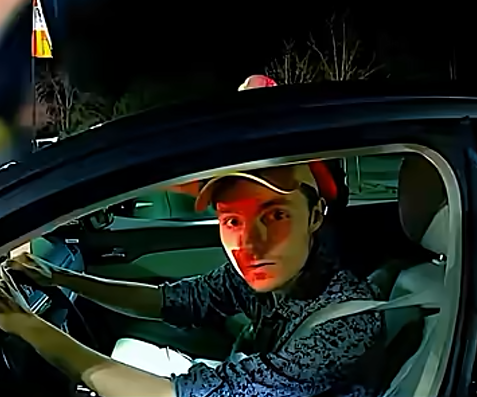
A DUI Arrest Built on Suspicion That Collapses Under Evidence
Few police encounters create more immediate frustration than a DUI stop where the central accusation appears to collapse the moment actual evidence is introduced. Drunk driving enforcement carries enormous public legitimacy for obvious reasons. Officers are expected to identify impairment, remove dangerous drivers from the road, and intervene before reckless behavior turns into injury or death. That authority is broad because the public risk is real.
But the legitimacy of DUI enforcement depends on something critical: the ability to distinguish suspicion from proof.
That is what makes this encounter so striking.
The officer believes he has enough reason to investigate a driver for impairment. He cites driving behavior. He cites speech patterns. He requests field sobriety testing. The driver refuses. He questions the basis for the stop, challenges the officer’s probable cause, and insists the situation is unjustified from the start.
The officer arrests him anyway.
Then the evidentiary foundation of the entire encounter appears to collapse in seconds.
At the sheriff’s office, the driver takes a breath test.
It returns 0.00.
No alcohol.
No measurable intoxication.
And in one moment, the central suspicion driving the arrest is stripped of its most obvious factual support.
That is what gives the video its force.
Because the clip is not simply about a DUI investigation.
It is about what happens when police suspicion survives long enough to justify arrest—but not long enough to survive evidence.
Why DUI Enforcement Depends on Fast Judgment
DUI enforcement is one of the clearest examples of how policing often requires officers to act before certainty exists. Unlike many other offenses, suspected impairment has to be addressed in real time. Officers cannot wait for perfect evidence before intervening because the risk of waiting may be immediate harm on the road.
That is why DUI stops are built around inference.
Officers look for signs:
- drifting,
- delayed reactions,
- inconsistent speed,
- slurred speech,
- confusion,
- odor,
- poor coordination.
None of these signs alone prove intoxication.
They are indicators.
That distinction matters.
DUI enforcement begins with pattern recognition, not laboratory certainty. Officers are trained to identify clusters of behavior that may justify further investigation before direct proof exists.
That is the practical logic behind roadside sobriety investigations.
It is also what makes them vulnerable to error.
Because the same system that allows officers to intervene quickly also gives them wide discretion to interpret ordinary ambiguity as possible impairment.
And once that interpretation hardens, the encounter can move very quickly.
Why Refusing Field Sobriety Tests Changes the Entire Encounter
The driver’s refusal to perform field sobriety tests is the turning point in the interaction because it transforms the stop from discretionary investigation into evidentiary confrontation.
That refusal matters for several reasons.
First, field sobriety tests are not just investigative tools.
They are performance-based evidence gathering.
They allow officers to generate additional observable indicators of impairment through divided attention tasks, balance tasks, and compliance-based instruction.
In practical terms, they help officers convert suspicion into documented behavior.
By refusing, the driver cuts off that evidentiary path.
That does not automatically prove innocence.
But it does remove one of the officer’s primary tools for strengthening the DUI case in real time.
And that changes the structure of the encounter immediately.
Without the tests, the officer is left with pre-arrest interpretation:
driving behavior,
speech,
impression.
That is thinner evidence.
Which means the arrest becomes more dependent on the officer’s subjective reading of the situation rather than objective roadside performance.
That is why the refusal becomes so central.
It forces the officer to decide whether suspicion alone is enough to carry the stop into custody.
The Driver’s Refusal Is Also a Challenge to Police Interpretation
The refusal is not just evidentiary.
It is adversarial.
By refusing field sobriety tests and explicitly questioning probable cause, the driver is not simply declining cooperation. He is challenging the officer’s interpretation of the encounter itself.
That matters because it changes the psychological dynamic immediately.
A compliant driver allows the officer to control both the process and the narrative.
A noncompliant but articulate driver disrupts that control.
Now the officer is not just investigating impairment.
He is defending his basis for suspicion in real time.
That changes the tone.
The driver is effectively saying:
you do not have enough,
and I will not help you create more.
That is a direct challenge to discretionary authority.
And in many police encounters, once a subject openly contests the legitimacy of the officer’s interpretation, the interaction becomes more rigid.
Not always because the officer is wrong.
But because the encounter is no longer only investigative.
It becomes a test of whether the officer’s judgment can survive refusal.
Why “Driving Behavior” and “Speech Patterns” Are So Powerful—and So Dangerous
The officer’s stated justification rests on two of the broadest and most flexible categories available in DUI enforcement: driving behavior and speech patterns.
That is precisely what makes them both powerful and dangerous.
These are useful indicators because they allow officers to identify possible impairment before direct evidence exists.
But they are also highly elastic.
“Driving behavior” can include:
- drifting,
- braking oddly,
- hesitation,
- delayed turns,
- lane correction,
- slow response.
“Speech patterns” can include:
- confusion,
- unusual cadence,
- nervousness,
- repetition,
- slowed response,
- irritation.
The problem is not that these indicators are meaningless.
The problem is that they are highly interpretive.
And because they are interpretive, they can be influenced by expectation.
An officer who suspects impairment may begin reading ambiguity through that suspicion.
That is where DUI stops become vulnerable to confirmation bias.
The officer sees behavior.
The officer interprets behavior.
Then the interpretation begins reinforcing itself.
That is what makes broad indicators so useful—and so risky.
The Arrest Happens Before the Evidence Does
What makes the encounter especially frustrating is that the arrest occurs before the strongest evidence is ever introduced.
That is the structural problem at the center of the video.
The officer arrests on suspicion.
The evidence arrives later.
And the later evidence appears to directly undermine the most obvious theory behind the arrest.
That is not unusual in procedural terms.
It is common in practical policing.
Arrests often occur before definitive testing.
But it becomes deeply controversial when the evidence obtained after arrest appears to invalidate the suspicion used to justify it.
That is what creates the emotional and legal tension here.
Because once the breath test returns 0.00, the question changes immediately.
The issue is no longer:
was suspicion enough to investigate?
The issue becomes:
was suspicion enough to arrest?
That is a much harder question.
Why 0.00 Changes Everything
The 0.00 reading is the defining moment in the video because it introduces something the roadside stop never had: objective chemical evidence.
That matters because objective evidence changes the power structure of the encounter immediately.
At roadside, the officer controls interpretation.
At the machine, interpretation loses power.
The breath test does not care about tone.
It does not care about suspicion.
It does not care about narrative.
It returns a number.
And that number is 0.00.
That does not necessarily resolve every possible impairment theory.
But it destroys the most obvious one.
Alcohol is no longer the explanation.
And once alcohol is removed, the original basis for the arrest becomes much harder to defend as confidently as it was presented roadside.
That is why the moment lands so hard.
Because objective evidence does not merely weaken the accusation.
It strips it of its clearest foundation.
Why the Officer’s Response Matters So Much
The officer’s acknowledgment that the breath machine only tests for alcohol is technically correct.
It is also revealing.
That response matters because it shows the immediate institutional pivot that often follows evidentiary collapse in roadside DUI cases.
Once alcohol is eliminated, the justification can shift:
fatigue,
drugs,
medical issue,
other impairment.
This is procedurally possible.
It is also exactly the kind of post hoc expansion that creates public distrust when introduced only after the primary theory fails.
That is what makes the response feel so unsatisfying.
Technically, the officer is right.
Practically, it sounds like retreat.
The original suspicion was framed around impairment serious enough to justify arrest.
The first hard evidence returns zero.
And the explanation immediately expands rather than narrows.
That may be legally defensible.
It is also exactly why these encounters generate skepticism.
The Problem of Confirmation Bias in DUI Stops
One of the clearest risks visible in this kind of encounter is confirmation bias.
Once an officer begins suspecting DUI, ordinary ambiguity can start being interpreted through that frame.
Nervousness becomes suspicious.
Irritation becomes impairment.
Unusual speech becomes intoxication.
Refusal becomes consciousness of guilt.
This is the danger of broad discretionary interpretation.
Once suspicion becomes the lens, contradictory behavior is often absorbed into the theory rather than allowed to weaken it.
That is what makes DUI enforcement especially vulnerable to overreach.
The same flexibility that allows officers to detect real impairment also allows them to overread normal variation as evidence of intoxication.
And once arrest enters the picture, the cost of that misread becomes much higher.
Why Refusal Is Often Treated Like Evidence
One of the most controversial dynamics in DUI policing is how often refusal itself becomes functionally treated like incriminating evidence.
Legally, refusal may limit investigative clarity.
Psychologically, refusal often deepens suspicion.
That is what appears to happen here.
The driver refuses field tests.
Instead of weakening the officer’s confidence, the refusal appears to harden it.
That is a common pattern.
Refusal is read not simply as noncooperation, but as strategic avoidance.
The officer may interpret:
an innocent person would comply.
That is not a legal standard.
But it is often an operational assumption.
And that assumption can make refusal less protective in practice than people imagine.
Because while refusal may limit evidence creation, it can also intensify officer certainty.
A Sober Driver and an Arrest That Outruns Its Evidence
What makes this encounter so compelling is not merely that the driver was arrested.
It is that the strongest objective evidence shown in the video appears to support the driver more than the officer.
That is what gives the clip its force.
The driver says he is sober.
The officer arrests him anyway.
The machine says 0.00.
And suddenly the most concrete evidence in the encounter belongs to the man in handcuffs.
That reversal is what makes the stop so difficult to ignore.
Because the video is not simply about police authority.
It is about what happens when discretionary suspicion carries enough force to justify arrest—but not enough accuracy to survive measurement.