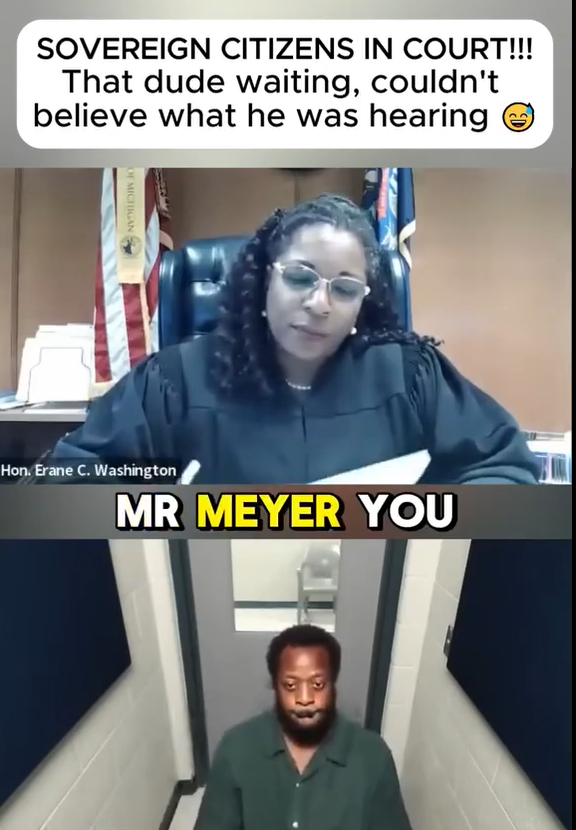
Courtrooms are designed to be places of order and authority, where justice is dispensed fairly and impartially. However, when a sovereign citizen enters the equation, these norms are put to the test. The case of Mr. Meyer and Judge Erane C. Washington in August 2023 is one such example. It began like any other day in court—a defendant facing charges and a judge tasked with administering justice. However, this case quickly escalated into something much more unexpected, as Mr. Meyer—a self-identified sovereign citizen—challenged the court’s authority in a way that left both the judge and the courtroom in disbelief.
The sequence of events began with a routine court session. Mr. Meyer appeared virtually before Judge Washington, a respected member of the judiciary known for her calm, firm handling of cases. The issue at hand was a financial obligation that Mr. Meyer was required to meet—a fine, something that is typically straightforward in most legal proceedings. However, when the judge informed him of the amount due and the court’s decision, Mr. Meyer’s response was one of defiance. He not only rejected the court’s authority but outright refused to pay the fine, claiming that the court had no jurisdiction over him as a sovereign citizen.
This confrontation, while it may seem like a simple matter of a defendant refusing to comply, is emblematic of a much larger challenge faced by the legal system: the rise of sovereign citizens and their growing influence in courtrooms across the country. Sovereign citizens reject the legitimacy of the state, including the courts, and believe that they are not bound by the laws of the land. Their beliefs challenge the foundation of the legal system, and when such individuals appear in court, it often results in dramatic and contentious interactions, such as the one between Mr. Meyer and Judge Washington.
A Sovereign Citizen’s Rejection of Court Orders
Sovereign citizens are individuals who subscribe to the belief that they are not subject to the laws of the government. They argue that the government, including the judiciary, operates without legitimate authority over them, and they refuse to follow legal procedures. These beliefs have been largely dismissed by the legal community, but they still pose significant challenges for judges and law enforcement. In the case of Mr. Meyer, his rejection of the court’s authority was not merely a refusal to pay a fine—it was a direct challenge to the very legitimacy of the judicial process.
When Mr. Meyer was informed by the judge that he was required to pay a fine, his reaction was swift and resolute. He adamantly refused to comply, asserting that as a sovereign citizen, he was not obligated to follow the orders of the court. This stance is not uncommon among those who identify as sovereign citizens, but it presents a unique challenge for judges. These individuals often do not accept the authority of the court and believe that they are above the law. They may argue that they are not “corporate persons” under the law, thus exempting themselves from legal jurisdiction.
The challenge for judges dealing with sovereign citizens is twofold: not only must they address the legal implications of the defendant’s refusal to cooperate, but they must also manage the court’s authority and ensure that order is maintained. In Mr. Meyer’s case, the judge’s authority was questioned, and her ability to effectively assert the legitimacy of the court was put to the test. His defiance added a layer of complexity to the court’s efforts to reach a resolution, forcing the judge to navigate through a difficult situation while upholding the rule of law.
The Judge’s Response: Maintaining Order in the Courtroom
Judge Erane C. Washington, as a seasoned and experienced judge, handled the situation with calm professionalism. She understood that maintaining order in the courtroom was crucial, especially when dealing with individuals who attempt to disrupt the legal process. Sovereign citizens often engage in disruptive tactics, such as arguing that the court has no authority, using pseudo-legal arguments to justify their refusal to comply with legal orders, or challenging the jurisdiction of the court. These tactics can prolong proceedings and complicate the administration of justice.
In this particular case, Judge Washington faced an uphill battle. She had to balance her responsibility to uphold the law with the necessity of ensuring the court’s authority was respected. Her response to Mr. Meyer’s defiance was both firm and measured. She asserted the court’s jurisdiction and reminded him that the court’s orders were legally binding, regardless of his personal beliefs. She carefully explained that the law applied to all citizens and that his rejection of the court’s authority would not alter the outcome of the proceedings.
Throughout the exchange, Judge Washington remained composed. She knew that allowing Mr. Meyer to derail the proceedings would only set a dangerous precedent, not just for him, but for future cases as well. By standing firm in her assertion of the court’s jurisdiction, she sent a clear message to both Mr. Meyer and the public: the law must be followed, and the court’s decisions must be respected. Her response demonstrated the critical role that judges play in maintaining the integrity of the legal system, even in the face of unconventional challenges.
The Defendant’s Defiance: Why Sovereign Citizens Reject Legal Authority
At the heart of the confrontation between Mr. Meyer and Judge Washington lies the ideology of the sovereign citizen movement. Sovereign citizens believe that the government, including the courts, has no legitimate authority over them. They argue that the legal system operates under a false premise, and they reject the idea that they are subject to government laws or taxes. This rejection of authority is rooted in a complex mix of legal theory, conspiracy beliefs, and personal ideology. While their beliefs are not widely accepted by the legal community, they continue to pose challenges for the courts.
Mr. Meyer’s defiance in court was not an isolated incident but part of a broader pattern of resistance by sovereign citizens. They often refuse to pay fines, reject court rulings, and seek to challenge the very foundations of the legal system. In some cases, they may represent themselves in court, arguing that they are not bound by the same rules as other individuals. Their refusal to accept legal authority can lead to protracted legal battles and often results in contempt charges or other penalties.
The rise of sovereign citizens in courtrooms across the country has forced judges and legal experts to find ways to address their challenges. In many cases, courts have developed strategies to handle these individuals, such as imposing fines for contempt or, in extreme cases, charging them with obstruction of justice. However, the ideological beliefs of sovereign citizens present a significant barrier to effective legal proceedings, as their defiance is often rooted in deeply held convictions that cannot be easily swayed by legal arguments or rulings.
The Courtroom’s Reaction: A Moment of Tension
The courtroom’s reaction to Mr. Meyer’s defiance was one of tension and disbelief. For the judge, this was a familiar but always challenging situation. Sovereign citizens are known for their unpredictable behavior, and their interactions with the court can often lead to delays, disruptions, and frustration for all parties involved. The judge’s ability to maintain order in such a charged environment is critical, as any lapse in control can escalate the situation and further undermine the court’s authority.
Mr. Meyer’s reaction to the judge’s ruling was one of shock and disbelief. He could not fathom that the court would proceed with its decision, despite his refusal to acknowledge its authority. His facial expressions, captured on camera, conveyed a mixture of frustration and confusion, as if he had not anticipated the judge’s firm stance. For him, the courtroom was a battleground where his beliefs about sovereignty would be tested. But, as the judge asserted her authority, Mr. Meyer was faced with the reality that his refusal to comply would not change the outcome.
For the bystanders in the courtroom, the scene was a reminder of the complexities of dealing with individuals who reject the authority of the court. While the vast majority of defendants in courtrooms across the country comply with the legal system, sovereign citizens present a unique challenge. Their actions force the legal system to confront issues of authority, jurisdiction, and the limits of personal belief in relation to the law.
The Power of Judicial Authority: Why Courts Must Uphold the Law
At the heart of this exchange between Judge Washington and Mr. Meyer lies the power of judicial authority. The court’s ability to uphold the law and ensure that justice is served is the cornerstone of the legal system. Judges like Erane C. Washington serve as guardians of the law, tasked with maintaining order and fairness in the courtroom. Despite the challenges posed by sovereign citizens, it is the judge’s duty to assert the authority of the court and ensure that the rule of law is respected.
In the case of Mr. Meyer, Judge Washington’s ability to remain calm and assert the court’s jurisdiction was a testament to the strength of the judicial system. While Mr. Meyer rejected the court’s authority, the judge’s decision was final. Sovereign citizens may attempt to challenge the legitimacy of the court, but the judge’s role is to uphold the law, regardless of the defendant’s personal beliefs. The refusal of a defendant to comply with the court’s orders does not negate the court’s power to enforce those orders.
The actions of the judge in this case demonstrate the importance of judicial authority in maintaining the integrity of the legal system. Sovereign citizens may continue to challenge the system, but the judiciary will remain steadfast in its commitment to administering justice. As this case illustrates, the law is designed to be impartial, and it is the responsibility of the court to ensure that justice is upheld, even in the face of defiance.
The exchange between Judge Erane C. Washington and Mr. Meyer highlights the ongoing challenge that sovereign citizens present to the legal system. While the courtroom remained a space for legal discourse, it also became a battleground for ideological differences about the legitimacy of the judicial system. The judge’s composed response was a demonstration of her role in asserting the law, even in the face of defiance.
As sovereign citizens continue to challenge the courts, the judiciary will be forced to adapt and find ways to address these challenges. Judges must continue to uphold the rule of law, even when faced with defendants who reject the very foundation of the legal system. While Mr. Meyer’s defiance may have caused a temporary disruption, the ultimate message is clear: the court’s authority cannot be undermined by personal belief systems.
This case serves as a reminder that, while personal beliefs may vary, the legal system operates to ensure fairness and equality under the law for all citizens. The outcome of such cases may shape the future of legal proceedings involving sovereign citizens, as courts work to address the tensions between personal belief systems and the rule of law.
In the end, the confrontation between Judge Washington and Mr. Meyer exemplifies the ongoing struggle between individual sovereignty and the collective responsibility of adhering to the laws of the land. As the legal system continues to evolve in response to these challenges, the role of judges in upholding justice remains more important than ever.
The encounter between Judge Erane C. Washington and Mr. Meyer was not an isolated incident but part of a larger and growing challenge within the U.S. legal system. The sovereign citizen movement, which rejects the legitimacy of government authority, including the courts, has been gaining attention over the past few decades. While the movement remains a fringe ideology, its adherents are increasingly finding their way into courtrooms, where they attempt to disrupt legal proceedings, challenge the court’s jurisdiction, and refuse to comply with court orders.
Sovereign citizens believe that they are not subject to the laws of the United States and argue that they should not be bound by the country’s legal system. They claim that they are only subject to the laws of their own creation, often invoking obscure legal theories and pseudolegal arguments to justify their actions. Some sovereign citizens believe that the United States government is a corporate entity and that they are exempt from its jurisdiction. Others reject the notion of a “citizenship” under the government, claiming that they are free individuals who should not be bound by laws they did not consent to.
These beliefs often lead to confrontations with law enforcement officers and judges, as sovereign citizens typically refuse to pay fines, follow court orders, or even recognize the authority of judges. For courts, dealing with sovereign citizens is a delicate matter. On the one hand, the court must uphold the law and maintain its authority; on the other hand, it must navigate the intricacies of these individuals’ beliefs without allowing them to derail legal proceedings.
The increasing presence of sovereign citizens in courtrooms has created a need for judges, law enforcement, and legal practitioners to better understand the movement and develop strategies for dealing with these individuals. The goal is not only to preserve the integrity of the legal system but also to ensure that justice is served fairly and without delay, even when faced with such ideological challenges.
The Psychological Aspect of Sovereign Citizens: A Complex Mindset
To fully understand the behavior of sovereign citizens in court, it is important to consider the psychological aspect of their beliefs. Many individuals who identify as sovereign citizens do so because they feel disempowered or alienated by the government or society. These individuals often view the legal system as an oppressive force that infringes upon their rights and freedoms. For them, rejecting the authority of the court is a way of asserting their independence and autonomy.
However, this mindset can have significant consequences. Sovereign citizens often become deeply entrenched in their beliefs, refusing to accept any argument or evidence that contradicts their worldview. They may dismiss legal rulings, challenge the legitimacy of government officials, and refuse to comply with court orders. This refusal to cooperate can create significant disruptions in the legal process, forcing the court to spend valuable time and resources addressing their claims.
Psychologically, the mindset of a sovereign citizen can be likened to a form of cognitive dissonance, where the individual holds on to a set of beliefs that conflict with reality and refuses to accept evidence to the contrary. The sovereign citizen’s belief in their own personal sovereignty and the illegitimacy of the legal system can become so strong that they perceive any legal authority as an unjust imposition. For them, the rejection of the legal system is not merely an act of defiance; it is a deeply held conviction that they believe is essential to their sense of self and identity.
This psychological aspect makes it even more challenging for judges to navigate these cases. Judges must balance their duty to uphold the law with the understanding that the defendant may not be acting out of malice or defiance, but rather from a deeply ingrained belief system. While judges have the authority to enforce the law, they must also be mindful of the psychological complexity at play when dealing with sovereign citizens.
Legal Challenges Posed by Sovereign Citizens
In addition to the psychological challenges posed by sovereign citizens, their arguments also create legal difficulties. Sovereign citizens often use pseudolegal arguments in court, citing obscure legal theories that are not grounded in any legitimate legal tradition. These arguments can take the form of long, convoluted documents or statements that claim to have legal authority, but are essentially meaningless in the eyes of the law. These tactics are often designed to confuse the court, delay proceedings, and create uncertainty.
In Mr. Meyer’s case, for example, he rejected the court’s authority by claiming that he was not subject to its jurisdiction as a sovereign citizen. This is a common tactic used by sovereign citizens, who argue that they are not bound by the laws of the country or the decisions of the court. Sovereign citizens may also refuse to sign documents, provide identification, or acknowledge the legitimacy of legal proceedings. This behavior can lead to significant delays in the resolution of the case and prevent the court from fulfilling its duties.
For judges and legal practitioners, dealing with these pseudolegal arguments requires a deep understanding of the law and the ability to recognize and dismiss such claims. Sovereign citizens often rely on outdated legal theories or misinterpretations of legal texts to justify their actions, and it is up to the judge to recognize these tactics and keep the proceedings on track. The use of pseudolegal arguments also raises questions about the boundaries of free speech and whether individuals who challenge the court’s authority in this way should be held accountable for disrupting the legal process.
In some cases, judges may be forced to impose sanctions on sovereign citizens for their disruptive behavior. This may include holding them in contempt of court or issuing fines for their failure to comply with court orders. However, these measures can only go so far in addressing the larger issue at hand—how to handle individuals who refuse to acknowledge the legitimacy of the court system.
Sovereign Citizens and the Broader Legal System
The rise of sovereign citizens presents a broader challenge for the legal system. As more individuals embrace these beliefs, courts may face increasing numbers of defendants who refuse to comply with the law. This raises important questions about how the legal system can adapt to these challenges while still upholding the principles of justice and fairness.
One of the key issues is the potential for disruptions in the legal process. Sovereign citizens often use delay tactics, such as filing frivolous motions or challenging the jurisdiction of the court, which can result in lengthy legal battles. These tactics can drain court resources and slow down the judicial system, affecting not only the sovereign citizen involved but also other individuals who are waiting for their cases to be heard.
Moreover, the rise of sovereign citizens presents a challenge to the enforcement of laws. If individuals are not held accountable for their refusal to comply with court orders, it undermines the legal system’s ability to maintain order and administer justice. Courts must find a way to enforce rulings and ensure that individuals who disrupt the process are held accountable, without allowing these challenges to derail the legal system.
One possible solution is for courts to develop clearer procedures for handling sovereign citizens. This might include more robust legal education for judges and law enforcement officers to help them understand the tactics used by sovereign citizens and how to address them effectively. Additionally, courts may need to work with lawmakers to address the growing influence of the sovereign citizen movement and determine how to handle these cases in a way that is fair to all parties involved.