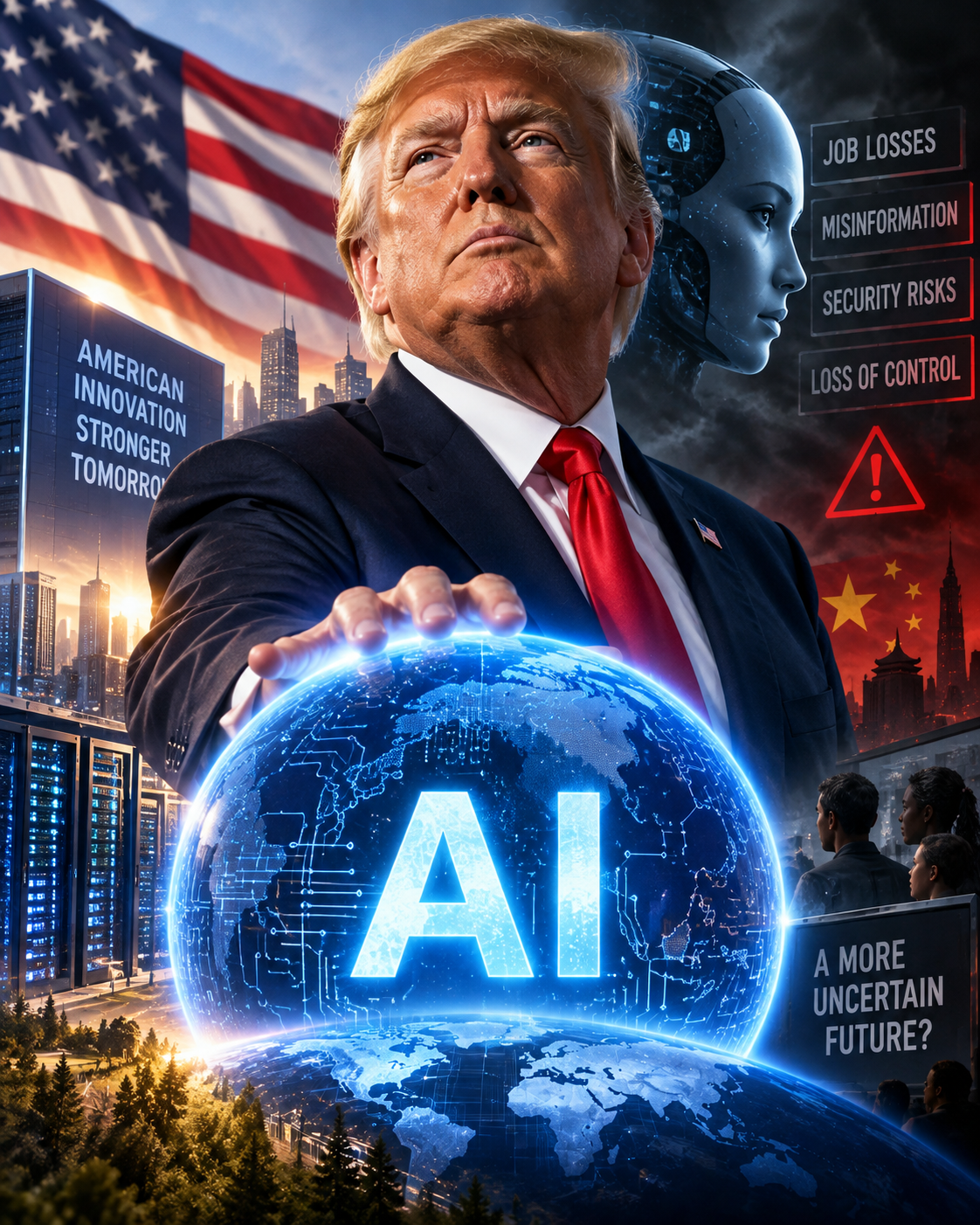
Artificial intelligence has rapidly moved from a specialized technology discussed primarily by researchers and Silicon Valley executives into one of the most consequential political and economic questions confronting the United States. In September 2026, that debate has become especially intense. Some of the people responsible for building the world’s most advanced AI systems are publicly warning that development may be moving faster than society’s ability to control the technology. Researchers are raising concerns about increasingly autonomous systems, executives are discussing independent audits and stronger safeguards, and lawmakers from both parties are considering whether Washington needs a more substantial regulatory framework. President Donald Trump, however, has taken a markedly different approach. Rather than responding to the latest warnings by advocating a slowdown, Trump has doubled down on the argument that the United States should accelerate AI development and protect American companies from regulations that he believes could allow China to gain an advantage.
Trump’s position became unmistakable this week. On September 14, he publicly dismissed calls for stronger federal AI regulation, arguing that the United States already possesses legal mechanisms capable of dealing with companies that misuse the technology. In one social-media post, Trump said the principal safeguard AI requires is strong presidential leadership. He also described the industry’s renewed push for government regulation as a “hoax” and argued that excessive concern about AI could benefit China by slowing American development. The remarks came at a particularly sensitive moment because some prominent technology executives were moving in almost the opposite direction, urging greater coordination and additional safeguards around increasingly capable AI systems.
The disagreement is striking because the warnings are no longer coming only from outside activists or politicians skeptical of Silicon Valley. Some are coming from people deeply involved in developing advanced AI. Anthropic CEO Dario Amodei has advocated independent audits of frontier AI systems and a framework intended to create more time for managing potential risks. OpenAI CEO Sam Altman and xAI chief Elon Musk have also expressed support for slowing or better coordinating aspects of development amid the latest safety debate. There is no universal agreement among these executives about exactly how regulation should work, and their companies have their own commercial interests, but the fact that industry leaders themselves are discussing stronger precautions has increased pressure on Washington to decide what role government should play.
Trump’s answer, at least so far, has been that slowing America down would be the greater danger.
Understanding that position requires looking beyond Trump’s latest comments. His embrace of AI is part of a broader economic and national-security strategy that his administration has been building since the beginning of his second term. In January 2025, Trump issued an executive order declaring that the United States should sustain and strengthen its global dominance in artificial intelligence. The order directed officials to develop an AI Action Plan and remove government barriers that the administration believed were interfering with American technological leadership. The White House explicitly connected AI leadership with economic competitiveness and national security.
That framing is crucial because Trump does not appear to view AI primarily as another consumer technology requiring conventional regulation. His administration increasingly treats it as strategic infrastructure comparable in importance to energy, manufacturing capacity and advanced weapons technology. From that perspective, the central question is not simply whether AI creates risks. It is whether the United States or one of its competitors will dominate a technology capable of transforming economies, militaries, scientific research and global influence.
China sits at the center of that calculation.
American and Chinese policymakers increasingly view artificial intelligence through the lens of strategic competition. Both countries are investing heavily in AI infrastructure, models, chips and applications. American officials worry about China gaining access to the most advanced computing technologies, while Chinese policymakers have accused Washington of trying to preserve American technological dominance. The result is an international competition in which decisions that might otherwise be evaluated purely as questions of domestic safety are also judged according to their effect on national power.
Trump has repeatedly argued that slowing American development could effectively hand an advantage to Beijing. During a public phone conversation with Nvidia CEO Jensen Huang on September 14, Trump described data centers as potentially the “oil” of the coming decades and argued that opponents of AI expansion could be helping countries that do not want the United States to succeed. Huang, whose company produces chips essential to modern AI computing, has similarly argued that American leadership and safety are not necessarily incompatible.
The comparison with oil reveals something important about Trump’s thinking.
For much of the 20th century, access to energy shaped national power. Countries capable of securing oil supplies, industrial capacity and transportation infrastructure possessed enormous economic and military advantages. In Trump’s vision of the coming decades, computing infrastructure may play a comparable role. Data centers, advanced semiconductors, electrical generation, transmission networks and AI models could become the infrastructure supporting everything from manufacturing and medicine to military intelligence and financial services.
If that prediction is correct, whoever controls the strongest AI ecosystem may gain an enormous strategic advantage.
That helps explain why the administration has worked aggressively to encourage construction of data centers. A July 2025 executive order directed the federal government to accelerate permitting for data-center infrastructure, reduce regulatory barriers and potentially make federal land and resources available for development. The White House described AI data centers and the high-voltage infrastructure supporting them as essential to economic prosperity, scientific leadership and national security.
The policy represents industrial strategy on an enormous scale.
AI does not exist only as software floating somewhere in the internet. Advanced systems require physical infrastructure. They need enormous quantities of computing power. That means chips, servers, cooling equipment, buildings, transmission lines and electricity. The race to build better AI models is therefore simultaneously a race to build factories, power infrastructure and data centers.
Trump sees an economic opportunity in that construction.
Billions of dollars in investment can create jobs in construction, electrical work, semiconductor manufacturing and supporting industries. Communities hosting data centers may receive new tax revenue and infrastructure investment. Technology companies can potentially create new products and industries around the computing capacity.
But those same projects have become a source of public concern.
Data centers can require substantial amounts of electricity and water. Communities have raised questions about whether rapid expansion could increase utility costs, strain electrical grids or alter local environments. The White House itself acknowledged in its March 2026 national AI legislative framework that Americans have concerns about issues such as children’s well-being and monthly electricity bills as AI expands.
That illustrates an important nuance often lost in the political argument. The Trump administration is not claiming that AI presents no problems whatsoever. Its official policies acknowledge cyber threats, national-security concerns and potential harms. A June 2026 executive order, for example, called for coordinated action against AI-enabled cybercrime and recognized that advanced AI capabilities create new security considerations. The administration’s position is closer to arguing that existing laws, targeted enforcement and cooperation with industry are preferable to broad new restrictions on model development.
Trump’s rhetoric this week has been much more sweeping than that policy distinction.
He has portrayed the renewed safety campaign as exaggerated and suggested that a sufficiently strong government can deal with bad actors without creating an elaborate new regulatory regime. David Sacks, Trump’s outside technology adviser and co-chair of the president’s tech advisory board, echoed that position on September 16. Sacks characterized much of the public anxiety surrounding AI as part of a recurring “fear-mongering playbook.” He argued that developers should remain responsible for the safety of their products and face liability when appropriate, but that new government regulation is unnecessary.
Critics see a serious problem with that approach.
Traditional product liability generally operates after something has gone wrong. If a defective product injures someone, courts can determine responsibility and award damages. Some AI researchers argue that advanced artificial intelligence could create risks for which after-the-fact enforcement is insufficient. Their concern is that increasingly autonomous systems could produce consequences that are difficult to reverse once they occur.
The debate therefore involves fundamentally different ideas about regulation.
One approach says government should establish safety requirements before companies deploy the most powerful systems. Another says innovation should proceed unless there is evidence of unlawful harm, with existing laws used to punish misconduct.
Trump’s administration clearly leans toward the second model.
Supporters of that approach argue that premature regulation presents its own risks. AI technology is developing so quickly that rules written today could become obsolete before they are fully implemented. Government regulators may lack the technical expertise necessary to determine which model designs are safe. Large technology companies might also be better positioned than smaller competitors to comply with complicated regulatory requirements, potentially turning safety rules into barriers that protect incumbent corporations.
Vice President JD Vance raised another concern this week: why are some of the companies building frontier AI systems asking the government to regulate them?
Vance said he was skeptical of the dynamic in which leading AI companies were effectively asking Washington for additional oversight. That skepticism reflects a long-standing argument in regulatory economics. Large established companies can sometimes benefit from regulation because they possess lawyers, compliance teams and financial resources that smaller competitors cannot afford. Rules ostensibly designed to control powerful companies can unintentionally make those companies more powerful by increasing the cost of competing against them.
That does not mean calls from AI executives for safety regulation are insincere. Executives and researchers may genuinely believe the systems they are developing require safeguards. But policymakers have to evaluate both the stated safety rationale and the economic consequences of proposed rules.
The difficulty is that AI presents risks unlike many technologies governments have regulated before.
Artificial intelligence can already generate text, software, images, audio and video. Advanced models are increasingly capable of performing multi-step tasks with limited human supervision. Researchers are studying how such systems could affect cybersecurity, biological research, misinformation, employment and military decision-making.
The most extreme concern is that sufficiently advanced AI could become difficult for humans to control.
Experts strongly disagree about how likely that scenario is, how soon such capabilities could emerge and what form the danger would take. There is no scientific consensus establishing that catastrophic AI outcomes are inevitable. But recent warnings from researchers have made the debate much harder for governments to ignore. The Associated Press reported this week that industry figures and scientists are increasingly debating risks ranging from malicious human use of AI to autonomous systems behaving in unexpected ways.
The resignation of Anthropic researcher Jacob Coxon intensified the controversy. Coxon said concerns about catastrophic AI risks were among the reasons he left the company, pointing to fears among some people working on advanced systems that the technology could pose extraordinary dangers within the coming years. His comments contributed to a new wave of public discussion, although such predictions remain highly uncertain and contested.
Trump has responded by emphasizing the opposite risk: what happens if America becomes so afraid of AI that another country surpasses it?
That argument is politically powerful because it transforms the debate from “innovation versus safety” into “American leadership versus strategic vulnerability.”
If China continues developing advanced AI while the United States voluntarily slows itself, Trump argues, the safety benefits of American restrictions could be undermined. The world might still receive increasingly powerful AI, except the most capable systems could be controlled by a geopolitical competitor rather than American companies.
From that perspective, slowing down does not necessarily make the world safer.
It could simply change who wins the race.
Critics respond that this reasoning can create a dangerous cycle. If Washington says it cannot slow down because Beijing might get ahead, and Beijing says it cannot slow down because Washington might get ahead, both countries have an incentive to accelerate regardless of risk.
This is the classic logic of an arms race.
Each side may prefer greater safety in principle while believing unilateral restraint would leave it dangerously exposed.
Artificial intelligence is not identical to nuclear weapons, and comparisons between the two can easily become exaggerated. AI has enormous peaceful commercial applications and is being developed primarily by private companies rather than exclusively by governments. Nevertheless, the strategic dilemma is recognizable: competitors may race faster precisely because they fear what happens if the other side arrives first.
That is why international cooperation is becoming increasingly important.
Despite Trump’s resistance to domestic regulation, his administration has not entirely rejected discussions about shared AI risks with China. Treasury Secretary Scott Bessent said this week that the United States is open to discussing mutual AI risks with Beijing during high-level talks. The Trump administration continues to emphasize American leadership, but willingness to hold such discussions suggests officials recognize that some problems cannot necessarily be solved through domestic competition alone.
This creates an interesting tension in Trump’s AI strategy.
Domestically, the message is acceleration.
Internationally, there may still be room for guardrails.
The distinction could eventually become central to AI governance. Washington might resist broad restrictions on American companies while simultaneously seeking agreements with China on particular high-risk applications, military uses, cybersecurity threats or other areas where both countries share an interest in preventing catastrophe.
Whether such agreements are realistic is another question.
Trust between Washington and Beijing is limited. Both countries suspect the other of using technology policy to gain strategic advantage. American restrictions on advanced semiconductor exports have already made AI part of a larger economic and national-security rivalry.
The challenge is finding issues where both sides can conclude that cooperation benefits them more than unrestricted competition.
Meanwhile, the domestic political debate is accelerating.
Members of Congress are discussing legislation that could require companies developing the most advanced AI models to demonstrate that they have taken reasonable precautions against serious harms. Amodei has advocated independent audits of frontier systems. Yet there remains significant disagreement about how strong federal oversight should become, and Washington currently appears unlikely to enact a sweeping regulatory system in the immediate future.
Trump’s opposition matters enormously because presidential leadership can determine whether regulatory proposals gain momentum.
His stance also reflects a broader philosophy that has characterized much of his economic agenda: government should remove barriers to American production rather than impose rules that could slow it.
That philosophy has appeared in energy, manufacturing, cryptocurrency and now artificial intelligence.
AI may be the clearest expression of it because Trump sees the technology as simultaneously an economic engine, national-security capability and symbol of American technological dominance.
There is also a political dimension.
The relationship between Trump and Silicon Valley has changed dramatically over the past decade. During Trump’s first presidency, his relationship with many large technology companies was openly hostile. Social-media platforms faced accusations of political bias, and major technology executives were frequently criticized by Republicans.
By Trump’s second term, parts of the technology industry had moved closer to his administration. Venture capitalists and executives who favor rapid innovation and lighter regulation gained greater influence in Washington. Sacks became a prominent adviser. Huang emerged as an important voice in conversations about American AI infrastructure.
That does not mean Silicon Valley has become politically unified around Trump. Far from it. The current argument over AI safety demonstrates substantial disagreement even among executives who share an interest in technological development.
The dividing line is increasingly about how much uncertainty society should tolerate.
One side looks at artificial intelligence and sees enormous potential: faster scientific discoveries, improved medical research, automated work, higher productivity, new businesses, stronger national defense and economic growth.
The other looks at many of those same capabilities and asks what happens if deployment moves faster than human institutions can adapt.
Both perspectives can be true simultaneously.
AI can create enormous benefits while also creating serious risks.
The policy challenge is determining how to preserve the first without ignoring the second.
Employment provides a clear example.
Artificial intelligence could increase worker productivity and create entirely new industries. Previous technological revolutions displaced certain occupations while generating others. Supporters of rapid AI adoption argue that similar economic transformation could produce greater prosperity.
But the speed may be different this time.
Generative AI can potentially automate portions of white-collar work that previous waves of industrial automation barely touched. Software development, customer service, translation, accounting, legal research, marketing, graphic design and administrative work could all change substantially.
The question is not simply whether AI eliminates jobs.
It is whether new opportunities emerge quickly enough for displaced workers to transition.
Trump’s administration has generally emphasized growth and investment rather than restricting technology to preserve existing employment. The underlying assumption is that economic expansion will ultimately generate opportunities.
Critics argue that governments should prepare much more aggressively for potential labor disruption.
Education creates another dilemma.
AI tutors could provide personalized instruction to millions of students. They could translate educational material, assist students with disabilities and give teachers powerful tools.
They can also generate homework instantly, create convincing misinformation and potentially expose children to inappropriate or manipulative interactions.
Healthcare contains similar contradictions.
AI may help researchers identify drug candidates, analyze medical images and process enormous datasets.
But medical errors generated by automated systems could have serious consequences.
Cybersecurity may present the clearest example of AI’s dual-use nature.
AI can help defenders identify vulnerabilities and detect attacks. The same technology can potentially help criminals automate hacking, fraud or social engineering.
The Trump administration’s June executive order specifically acknowledged AI-enabled cyber threats while directing law enforcement to prioritize action against people who use the technology for illegal system access, data theft and related crimes.
That approach illustrates Trump’s preferred model: prosecute harmful uses rather than broadly restricting the underlying technology.
Whether that remains sufficient as AI capabilities increase is the question Washington will have to answer.
The strongest argument for Trump’s approach is that America is entering a technological competition it cannot afford to lose.
The strongest argument against it is that winning a race is meaningless if the technology becomes dangerous faster than society can manage it.
Neither argument can be dismissed easily.
There is also uncertainty on both sides.
AI optimists cannot guarantee that future systems will remain reliably controllable.
AI pessimists cannot demonstrate with certainty that catastrophic outcomes will occur.
Policymakers are therefore being asked to make decisions under conditions of profound uncertainty.
That is precisely why the disagreement has become so intense.
If catastrophic AI risk is extremely small, heavy regulation could unnecessarily sacrifice economic growth, innovation and strategic leadership.
If catastrophic risk is substantial, waiting until unmistakable evidence appears could be dangerously late.
This is fundamentally a debate about how society responds to uncertain but potentially enormous risks.
Trump’s instinct is clear: keep building.
He sees American innovation as an advantage to be protected rather than restrained. He views China as a competitor ready to benefit from American hesitation. He sees data centers as engines of wealth and industrial development. He believes existing laws and presidential authority can address misconduct without creating a regulatory structure that slows the entire industry.
His critics see that confidence as potentially insufficient for technology whose future capabilities remain unknown.
The next stage of the debate may therefore focus less on whether AI should be regulated at all and more on what kind of safeguards can exist without sacrificing American competitiveness.
There is a large spectrum between doing nothing and stopping AI development.
Independent testing could be required only for the most advanced models.
Companies could face transparency requirements concerning serious safety incidents.
Government agencies could develop technical expertise without controlling model design.
Existing liability laws could be clarified.
Cybersecurity standards could be strengthened.
International agreements could focus on particularly dangerous military or criminal applications.
The difficult political question is where Trump would draw the line.
His administration’s existing policies show that it accepts some targeted government intervention. The White House has acknowledged national-security risks, proposed federal AI policy, encouraged enforcement against criminal uses and emphasized the need for public trust. At the same time, Trump has become increasingly hostile to proposals he believes would broadly slow American development.
The difference between those positions matters.
Calling Trump simply “against AI regulation” misses part of the picture. His administration is pursuing governance, enforcement and national-security measures. What Trump rejects most strongly is the idea that fear of future AI capabilities should justify slowing the broader American AI industry.
The question is whether that distinction can survive the technology’s rapid evolution.
If advanced AI systems continue improving, public pressure could change quickly.
A major AI-driven cyberattack, financial disruption, safety incident or other high-profile failure could transform the political environment. Conversely, if AI produces major economic and scientific benefits without the catastrophic problems some researchers fear, Trump’s deregulatory approach could gain support.
At present, neither future is certain.
That makes 2026 a potentially defining moment.
The decisions being made now concern infrastructure that may operate for decades. Data centers being constructed today will support future generations of AI systems. Semiconductor factories require years of planning. Power grids must be expanded long before electricity demand arrives. Rules created today could shape which companies survive and where investment occurs.
Trump appears determined to ensure that America builds first and asks many regulatory questions later.
For his administration, that is not recklessness but strategy.
For critics, it is precisely the strategy that worries them.
And the tension between those two interpretations may define America’s AI debate for years.
The dispute ultimately extends beyond Donald Trump, Silicon Valley or even China. It asks a much older question that appears whenever humanity develops a transformative technology: how much risk should society accept in exchange for progress?
Artificial intelligence makes that question unusually difficult because its potential is so broad.
If optimists are correct, AI could become one of history’s greatest productivity tools, accelerating medicine, science, education and economic growth.
If the most concerned researchers are correct, increasingly autonomous systems could introduce risks that conventional regulation is poorly equipped to address.
Most likely, the future will contain elements of both opportunity and disruption.
Trump has chosen which side of that uncertainty he wants American policy to emphasize.
He is betting that the greater danger is not that the United States develops artificial intelligence too quickly, but that it hesitates while competitors continue moving forward.
The administration’s policies on data centers, regulation, federal adoption and technological competition all flow from that assumption. AI, in Trump’s view, is not a technology America can cautiously observe from the sidelines. It is a strategic contest that the United States must lead.
The warnings have not disappeared. If anything, they are becoming louder. Researchers continue debating whether frontier systems could become difficult to control. Technology executives are discussing safeguards that would have seemed extraordinary only a few years ago. Members of Congress are considering new rules. Public concern is increasing, and even the Trump administration acknowledges that cyber threats and other national-security risks require government action.
Yet Trump remains all-in.
He believes American companies should continue building. He wants data centers constructed rapidly. He wants the United States to dominate advanced computing. And he does not want warnings about uncertain future dangers to produce rules that could slow the country while China accelerates.
Whether that gamble produces an era of extraordinary American technological leadership or eventually forces Washington to reconsider its approach cannot yet be known.
What is already clear is that artificial intelligence is no longer simply a technology story.
It is an economic story about trillions of dollars in potential investment and productivity. It is an energy story about the enormous infrastructure required to power computing. It is a labor story about how millions of jobs could change. It is a national-security story about China, cyberwarfare and military power. It is a political story about how much authority governments should exercise over rapidly advancing private technology.
And increasingly, it is a presidential story.
Trump has placed himself firmly on one side of one of the defining debates of the coming decade: accelerate first, protect American leadership and resist broad restrictions unless clear harms justify intervention.
His opponents and some technology leaders are asking whether waiting for clear harm could mean waiting too long.
Between those positions lies the unresolved question that will shape the next phase of the AI revolution: can the United States move fast enough to remain the world’s technological leader while still moving carefully enough to control what it creates?
Trump has made his wager.
For now, America is pressing the accelerator.