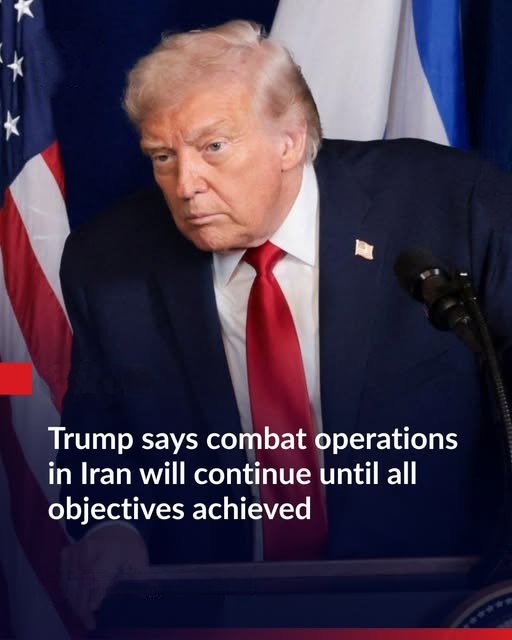
WASHINGTON — In a statement that immediately reverberated across global political and security circles, Donald Trump declared that United States combat operations in Iran would continue “in full force” until all American objectives are achieved.
The remarks, delivered through a video posted on Truth Social, marked one of the most direct acknowledgments by a U.S. president of sustained military action against Iran in recent history. Trump confirmed that three American service members had been killed and warned that further casualties were likely.
“Combat operations continue at this time in full force, and they will continue until all of our objectives are achieved,” Trump said. “We have very strong objectives.”
The statement immediately raised concerns about the possibility of a broader and more sustained conflict in the Middle East, a region already destabilized by proxy wars, political rivalries, and fragile alliances.
A Shift in Tone and Strategy
Trump’s words represented a shift from earlier messaging that emphasized deterrence and limited action. By framing the operations as ongoing and goal-oriented, the president signaled that the United States was prepared for a prolonged military engagement rather than a short-term response.
Political analysts noted that the phrase “until all of our objectives are achieved” leaves wide room for interpretation. It does not specify whether those objectives are narrowly military—such as neutralizing missile systems—or broader political goals, such as weakening Iran’s leadership or forcing changes in its regional policies.
This ambiguity has fueled speculation both inside and outside Washington about what the administration ultimately seeks to accomplish.
The Human Cost Acknowledged
In the same video message, Trump confirmed that three U.S. service members had been killed in the ongoing operations. He added that “there will likely be more casualties,” a rare acknowledgment of the human toll at an early stage of a conflict.
“We will avenge the deaths of Americans,” Trump said, striking a tone of resolve that appealed to supporters who favor a strong military posture.
Families of service members expressed concern as news of continued operations spread. Advocacy groups for military personnel urged transparency from the administration regarding mission goals and risks.
Domestic Political Impact
The announcement immediately sparked debate within the United States. Supporters praised the president’s decisiveness, arguing that failure to respond forcefully would embolden Iran and its regional allies.
Critics, however, questioned whether Congress had authorized expanded military action and warned of repeating mistakes from past Middle Eastern conflicts.
Several lawmakers called for emergency briefings on the scope and legality of the operations. Some demanded clarity on whether the U.S. was entering a formal war or conducting limited strikes under existing authorizations.
Public opinion appeared divided. Polls taken in the hours following Trump’s statement suggested concern about escalation but also lingering support for protecting U.S. forces and allies.
International Reactions Begin to Form
Allied governments reacted cautiously. European leaders emphasized restraint and called for diplomatic efforts to prevent a full-scale war. Middle Eastern states, particularly those hosting U.S. military bases, heightened their security levels in anticipation of potential retaliation.
Russia and China, both of which maintain strategic relationships with Iran, urged de-escalation and warned that continued combat operations could destabilize the entire region.
The United Nations Secretary-General issued a statement calling for immediate dialogue and respect for international law.
The Strategic Context
The current escalation follows weeks of rising tension between Washington and Tehran, including attacks on shipping routes, drone incidents, and strikes involving proxy forces.
Military analysts say the conflict has moved from indirect confrontation to more explicit engagement. While neither side has formally declared war, the language used by the U.S. president suggests the threshold of open conflict may be approaching.
Experts point out that Iran’s military strategy relies heavily on asymmetric warfare—using drones, missiles, and allied militias rather than direct conventional battles. This makes the conflict unpredictable and difficult to contain.
The Meaning of “Objectives”
One of the most critical questions raised by Trump’s statement is what exactly the United States considers its objectives in Iran.
Possible interpretations include:
-
Disrupting Iran’s missile and drone capabilities
-
Deterring further attacks on U.S. personnel and allies
-
Weakening Iran’s influence over regional militias
-
Forcing Tehran back into negotiations under pressure
Without a clearly defined endgame, critics warn that the conflict risks becoming open-ended.
Former military officials noted that modern conflicts often expand beyond their initial scope when political goals are not precisely articulated.
Messaging to Supporters and Adversaries
Trump’s direct and forceful rhetoric served two audiences: domestic supporters and international adversaries.
To his base, the message reinforced an image of strength and resolve. To Iran and its allies, it functioned as a warning that the United States would not withdraw under pressure.
However, such messaging can also harden positions on both sides. Diplomatic experts caution that public declarations of unwavering commitment reduce flexibility for negotiations and increase the risk of miscalculation.
A Precarious Moment
As of now, details about the scale of U.S. operations remain limited. Defense officials have not released comprehensive information about targets, troop movements, or timelines.
What is clear is that the conflict has entered a new phase—one defined by open acknowledgment from the highest levels of government and the acceptance that casualties are part of the unfolding strategy.
The coming days will likely determine whether this moment becomes a contained military episode or the beginning of a prolonged confrontation.
For many Americans and observers abroad, Trump’s words marked a turning point: a moment when tensions that had simmered for years crossed into sustained action.
Following the declaration by Donald Trump that combat operations in Iran would continue until all objectives were achieved, attention quickly turned to what those operations might look like on the ground — and how they could reshape an already volatile region.
The Nature of Modern Warfare With Iran
Unlike traditional wars involving large troop deployments and battlefield lines, conflict with Iran is characterized by indirect confrontation and technological warfare. Iran’s military doctrine relies heavily on:
-
Missile and drone systems
-
Cyber operations
-
Naval harassment in key shipping lanes
-
Proxy militias across the Middle East
U.S. officials have emphasized that their operations focus on neutralizing launch sites, command centers, and weapons storage facilities believed to be connected to attacks on American forces and allies.
Military analysts describe the situation as a hybrid conflict — part conventional airstrike campaign, part shadow war of intelligence, cyber actions, and regional pressure.
Proxy Networks and Regional Flashpoints
Iran’s influence extends far beyond its borders. Through alliances and militias, Tehran maintains leverage in several conflict zones:
-
Lebanon, through Hezbollah
-
Iraq, through multiple armed factions
-
Syria, through support for the Assad government
-
Yemen, through the Houthi movement
If U.S. operations continue, experts warn that retaliation may not come directly from Iran’s regular military but from these allied groups acting independently or with quiet coordination.
Already, regional capitals have increased security around embassies, military installations, and civilian infrastructure. Oil facilities, ports, and airports are considered particularly vulnerable.
Risks of Multi-Front Escalation
One of the greatest dangers of the current conflict is escalation across multiple fronts simultaneously. A single strike could provoke responses in different countries, creating overlapping crises that strain diplomatic and military resources.
Security officials fear a domino effect:
-
Drone attacks in Iraq
-
Rocket fire in Israel
-
Naval incidents in the Persian Gulf
-
Cyberattacks against Western infrastructure
Each incident increases the chance of miscalculation — a misread signal or mistaken attribution that could trigger a wider confrontation.
The Role of U.S. Allies
The United States does not operate alone in the region. NATO partners and Middle Eastern allies provide bases, intelligence, and logistical support.
However, many allied governments are walking a delicate line: supporting American security efforts while trying to avoid being drawn directly into a war with Iran.
European leaders have urged Washington to clarify its objectives and timeline, warning that prolonged conflict could destabilize neighboring countries already struggling with economic and political crises.
Iran’s Domestic Position
Inside Iran, the conflict has complicated internal politics. Hardline factions have used the situation to reinforce narratives of foreign aggression, while reformist voices caution that prolonged war could devastate the country’s economy and isolate it further from global markets.
State media has framed the confrontation as a matter of national survival, while independent analysts warn that civilian suffering could grow if infrastructure and supply chains are disrupted.
Food prices, fuel availability, and access to medicine are already sensitive issues. Expanded military operations could intensify hardship for ordinary Iranians.
Psychological and Information Warfare
Beyond missiles and drones, both sides are engaged in information battles. Social media platforms and international broadcasters are flooded with claims, counterclaims, and graphic imagery.
Experts say perception management is now as important as battlefield success. Leaders seek to show strength to domestic audiences while influencing global opinion.
The video statement released by Trump was seen as part of this strategy — signaling resolve while attempting to deter further attacks.
A Conflict Without Clear Boundaries
Unlike previous wars with defined battlefields, this confrontation lacks clear geographic limits. Cyberattacks can originate anywhere. Proxy groups can strike unpredictably. Commercial shipping routes thousands of miles from Iran may be affected.
This fluidity makes military planning difficult and increases the likelihood that civilians and neutral states will be caught in the crossfire.
As one defense analyst put it: “This is not a war with a front line. It is a war with fault lines.”
Growing Pressure for Diplomacy
Despite the rhetoric of continued operations, diplomatic channels remain active behind the scenes. Several countries are reportedly acting as intermediaries, attempting to prevent total breakdown in communication between Washington and Tehran.
Diplomats say the challenge is finding a formula that allows both sides to claim victory without appearing weak.
For the U.S., that means demonstrating deterrence. For Iran, it means preserving sovereignty and internal legitimacy.
Whether such a balance is possible remains uncertain.
Part 3: Global Impact, Economic Risks, and Future Scenarios
As combat operations continue, the conflict’s consequences extend far beyond the Middle East. Financial markets, global energy supplies, and international diplomacy are all affected by uncertainty surrounding U.S.–Iran relations.
Energy Markets on Edge
Iran sits near the Strait of Hormuz, a narrow maritime passage through which roughly one-fifth of the world’s oil supply flows. Any disruption in this corridor can cause immediate price spikes.
Even rumors of attacks or naval incidents have led to fluctuations in oil and gas prices. Shipping companies are already rerouting some tankers, increasing costs and delivery times.
Higher fuel prices ripple outward:
-
Transportation costs rise
-
Food prices increase
-
Inflation pressures intensify
For developing nations, this can trigger economic instability and political unrest.
Financial and Trade Consequences
Global markets dislike uncertainty. Stock exchanges have reacted nervously to news of continued operations, particularly in sectors tied to energy, shipping, and defense.
International investors fear that sanctions, cyber disruptions, or expanded warfare could slow economic growth worldwide.
Some countries dependent on Middle Eastern energy imports have begun stockpiling reserves, while others are seeking alternative suppliers.
Humanitarian Concerns
Beyond economics, humanitarian organizations warn of worsening conditions for civilians across the region.
Expanded fighting could displace families, strain hospitals, and interrupt aid deliveries. Refugee flows might increase, putting pressure on neighboring states already hosting large displaced populations.
Medical groups caution that conflict zones often suffer long-term damage to infrastructure, including water systems and electrical grids.
Political Consequences in the United States
At home, Trump’s declaration has become a defining political issue. Supporters argue that strength abroad ensures safety at home. Critics warn of repeating cycles of endless conflict.
Lawmakers from both parties are demanding clearer definitions of objectives and legal authority.
Public debate centers on three main questions:
-
How long will operations continue?
-
What constitutes success?
-
What level of sacrifice is acceptable?
These questions will likely shape elections and policy debates for years to come.
The Risk of a Wider War
The greatest fear among analysts is that a contained confrontation could transform into a regional or even global crisis.
If a major attack kills large numbers of civilians or military personnel, political pressure to retaliate could override restraint.
History shows that wars often begin with limited aims and expand through unintended consequences.
Possible Future Scenarios
Experts outline several paths forward:
1. Controlled De-escalation
Quiet diplomacy leads to reduced strikes and renewed negotiations. Both sides claim deterrence success without major concessions.
2. Prolonged Low-Level Conflict
Airstrikes, cyber operations, and proxy attacks continue for months or years without formal war declarations.
3. Regional War
Multiple countries become directly involved, triggering widespread instability.
4. Political Breakthrough
International pressure produces a new framework for security and dialogue.
Which scenario unfolds depends on decisions made in the coming weeks.
A Test of Leadership and Strategy
Trump’s statement that operations will continue “until all objectives are achieved” places enormous responsibility on policymakers and military planners.
Clear communication, disciplined strategy, and international coordination will determine whether the conflict remains limited or spirals out of control.
Diplomats stress that even strong military postures require off-ramps — paths toward negotiation and stability.
Conclusion: A Defining Moment
This moment represents one of the most serious confrontations between the United States and Iran in decades. It is shaped not only by missiles and troops, but by politics, economics, and public perception.
The coming period will test:
-
Global diplomacy
-
Regional alliances
-
The resilience of international markets
-
The patience of civilian populations
Whether history remembers this episode as a brief crisis or the beginning of a prolonged struggle depends on choices made now.
For the world, the stakes are immense. Peace, security, and economic stability hang in a delicate balance — one statement, one strike, or one negotiation away from changing course.
The continuation of combat operations in Iran, as outlined by Donald Trump, is far more than a tactical military campaign. It represents a complex geopolitical signal to allies and adversaries alike, emphasizing the interconnectedness of modern conflicts and the unpredictable ripple effects of aggressive foreign policy.
The Strategic Message to Regional Allies
U.S. allies across the Middle East are closely monitoring every move. Countries like Saudi Arabia, United Arab Emirates, and Israel see the statement as both a reassurance and a warning. On one hand, American assertiveness demonstrates a willingness to protect strategic interests and maintain regional influence. On the other hand, the explicit commitment to “continue until all objectives are achieved” introduces ambiguity: what defines success, and how long might operations continue?
Some regional observers suggest that the U.S. message is as much about deterrence as actual combat. By publicly signaling resolve, Washington may hope to discourage Iranian-backed militias or state actors from taking provocative action. However, the risk remains that Tehran interprets prolonged military operations as an existential threat, potentially escalating asymmetric responses across Iraq, Syria, Lebanon, and Yemen.
Domestic Political Calculus in the United States
Within the U.S., the statement has provoked debate not only about foreign policy but also about constitutional authority and public accountability. Members of Congress have highlighted the tension between the executive branch’s ability to conduct military operations and the legislature’s role in authorizing war.
Legal scholars point out that while the War Powers Resolution provides some oversight mechanisms, the language used by Trump suggests a broad mandate for operations. Critics argue that committing to an indefinite campaign without clearly defined metrics of success raises questions about accountability, civilian oversight, and the potential for prolonged entanglement in a conflict with no exit strategy.
Public opinion is similarly divided. Supporters of strong action see the commitment as protecting American lives and deterring further attacks. Opponents warn that unchecked military campaigns risk unnecessary casualties, economic disruption, and damage to U.S. credibility if operations are perceived as overreaching or ineffective.
International Diplomatic Pressure
Outside the region, Washington faces pressure from global powers to clarify objectives and ensure proportionality. European allies, including France, Germany, and United Kingdom, have called for restraint. They stress that unchecked escalation could destabilize global energy markets, jeopardize humanitarian aid to civilians, and risk a broader international crisis.
Meanwhile, powers like Russia and China are watching carefully. Russia’s military involvement in Syria and China’s energy investments in Iran create incentives for these nations to avoid full-scale confrontation while simultaneously safeguarding their strategic interests. Diplomatic communications are reportedly ongoing, aimed at preventing miscalculations that could inadvertently trigger wider hostilities.
Humanitarian and Civilian Considerations
One of the most pressing concerns is the potential impact on civilians both in Iran and neighboring countries. Past conflicts have demonstrated that even precision strikes and targeted operations can inadvertently harm infrastructure and essential services. Hospitals, schools, and water treatment facilities may face disruptions, while displaced populations could rise if fighting spreads to urban centers.
Humanitarian organizations are already preparing contingency plans. Aid agencies emphasize the importance of pre-positioning supplies, coordinating with regional partners, and maintaining open lines of communication with civilians. Any escalation could quickly exacerbate existing humanitarian challenges, particularly in war-affected areas like Syria and Yemen, where populations are already vulnerable.
Economic Implications and Global Supply Chains
Extended operations in Iran will also reverberate through the global economy. The Middle East remains a critical energy hub, and even minor incidents affecting shipping routes in the Persian Gulf could spike oil prices dramatically. Companies dependent on stable fuel prices and shipping schedules may face increased costs, while insurance premiums for maritime shipping could rise significantly.
Financial markets are already sensitive to geopolitical risk. Analysts predict that prolonged uncertainty could depress investor confidence, not only in energy sectors but also in global trade and emerging markets that rely on predictable supply chains. Central banks may need to adjust policies in response to inflationary pressures stemming from higher fuel and commodity prices.
Long-Term Strategic Considerations
Looking further ahead, the situation underscores broader challenges for U.S. foreign policy. Policymakers must balance military objectives with diplomatic engagement, civilian protection, and alliance management. While the declaration of continued operations signals resolve, it also commits Washington to sustained operational, logistical, and strategic responsibility.
Future scenarios could include:
-
Negotiated Ceasefire or Limited Agreement – Diplomatic intervention stabilizes the situation without major escalation.
-
Prolonged Low-Level Engagement – Airstrikes, cyber operations, and proxy engagements continue intermittently over months.
-
Full Regional Escalation – A miscalculation triggers broader conflict involving multiple states and proxy networks.
The decisions made in the coming weeks will determine which path the conflict follows. Success will likely require a combination of military precision, strategic communication, humanitarian planning, and diplomatic leverage.
The Human Element
Beyond strategy and geopolitics, the human dimension remains critical. Service members on the ground face risk, civilians bear the brunt of instability, and policymakers must weigh the moral and ethical consequences of extended operations. The public’s perception, both domestic and international, will shape the narrative around U.S. actions for years to come.
Ultimately, the statement that operations will continue “until all objectives are achieved” reflects a commitment to pursue strategic goals, but it also carries with it enormous responsibility. Maintaining proportionality, preventing unintended escalation, and protecting civilians will define the credibility and effectiveness of the campaign in the eyes of allies, adversaries, and global observers alike.