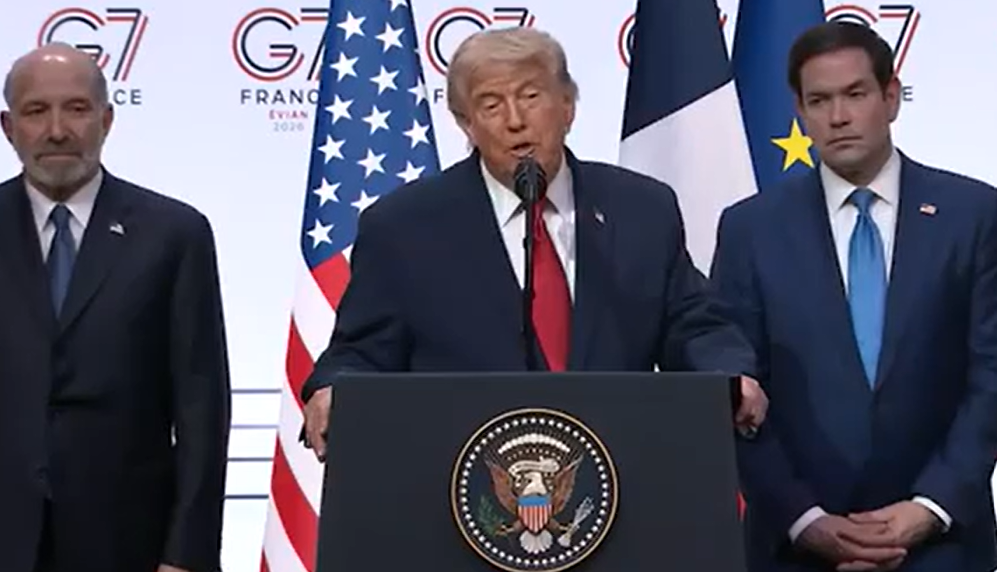
President Donald Trump used a press conference on the sidelines of the G7 summit to return to one of the most controversial foreign policy battles of the last decade: the Iran nuclear deal negotiated under former President Barack Obama. Speaking about Iran, Israel and his own approach to the Middle East, Trump recalled Israeli Prime Minister Benjamin Netanyahu’s long-running effort to stop the Obama-era agreement, saying Netanyahu had tried to kill the deal but failed, while Trump claimed he was the one who eventually “finished the job.” His remarks reopened a bitter debate over the Joint Comprehensive Plan of Action, known as the JCPOA, and placed Trump’s current Iran policy directly against Obama’s diplomatic legacy.
The Iran nuclear deal was signed in 2015 by Iran, the United States, Britain, France, Germany, Russia, China and the European Union. Under the agreement, Iran accepted limits on its nuclear program in exchange for relief from economic sanctions. Supporters of the deal argued that it created inspections and restrictions that slowed Iran’s path toward a nuclear weapon. Critics, including Netanyahu and many Republicans in the United States, argued that the deal was weak, temporary and dangerous because it allowed Iran to keep parts of its nuclear infrastructure while eventually letting some restrictions expire.
Netanyahu was one of the most forceful opponents of the agreement from the beginning. He warned that the deal did not eliminate Iran’s nuclear ambitions and said it gave Tehran money and international legitimacy while leaving Israel exposed. His opposition became especially visible in 2015, when he addressed the U.S. Congress and urged lawmakers to reject the Obama administration’s deal. That speech created political tension in Washington because it was seen by many Democrats as an attempt by a foreign leader to challenge a sitting U.S. president on American soil. But for Netanyahu, the issue was existential. He believed the agreement failed to remove the threat Iran posed to Israel.
Trump, who was then a presidential candidate, also attacked the deal repeatedly. He called it one of the worst agreements ever made and promised that if elected, he would undo it. After taking office, he kept that promise. In 2018, Trump announced that the United States would withdraw from the JCPOA, arguing that the deal had not done enough to stop Iran’s nuclear ambitions, missile program or regional influence. His administration then reimposed sanctions on Iran as part of what it called a “maximum pressure” campaign.
At the G7 press conference, Trump presented that decision as a turning point. He said Netanyahu had fought hard against the Obama deal but could not stop it at the time. Trump then framed himself as the leader who completed what Netanyahu had wanted by pulling the United States out of the agreement. In Trump’s telling, the JCPOA was not a serious long-term solution but a dangerous temporary arrangement that would have left Israel and the wider Middle East in danger. He argued that the deal’s restrictions were too short-lived and that allowing it to continue would have created disastrous consequences.
Trump’s comments were not only about the past. They came as he defended a new agreement with Iran after a period of intense conflict. The president presented his approach as stronger and more successful than Obama’s, saying he had used pressure, force and negotiation to reach a better outcome. His critics, however, argued that the new arrangement looked like a return to diplomacy after years of confrontation and that Trump had created a crisis only to negotiate his way back toward a deal.
The comparison between Obama’s Iran deal and Trump’s Iran policy has always been politically charged. Obama and his supporters viewed the JCPOA as a practical agreement that blocked Iran’s nuclear path without another war in the Middle East. They argued that diplomacy, inspections and international unity were better than military threats or isolation. Trump and his allies saw the deal differently. To them, it rewarded Iran, ignored its wider behavior and delayed rather than solved the nuclear problem. That divide has shaped American foreign policy for years.
Netanyahu’s role in the debate adds another layer of complexity. For Israel, Iran’s nuclear program has long been viewed as a direct threat. Israeli leaders have repeatedly said they cannot allow Iran to obtain nuclear weapons. Netanyahu built much of his foreign policy identity around warning the world about Iran. His critics said he exaggerated threats and pushed the United States toward confrontation. His supporters said he understood the danger more clearly than Western leaders who trusted diplomacy too much.
Trump’s latest remarks suggested admiration for Netanyahu’s earlier fight against the JCPOA, but they also carried a message of personal superiority. By saying Netanyahu tried and failed while he finished the job, Trump placed himself at the center of the story. He implied that Netanyahu saw the problem, but Trump had the power and determination to act. That framing fits Trump’s broader political style, in which he often presents himself as the leader who succeeds where others only talked.
His words also reflected the long shadow of Obama in Trump’s politics. The Iran deal was one of Obama’s signature foreign policy achievements, and Trump spent much of his first term trying to dismantle major parts of Obama’s legacy. The Affordable Care Act, climate agreements, immigration policies and the Iran nuclear deal all became targets. For Trump, withdrawing from the JCPOA was not only a foreign policy decision; it was also a political symbol. It allowed him to say he had rejected what he saw as weakness and replaced it with strength.
But the results of Trump’s Iran strategy remain heavily debated. After the United States withdrew from the JCPOA, Iran gradually moved away from some of its commitments under the agreement. Tensions increased across the region. Sanctions placed heavy pressure on Iran’s economy, but they did not produce a simple surrender. Instead, the relationship between Washington and Tehran became more unstable. Supporters of Trump’s approach said pressure was necessary and that Iran only understands strength. Critics said leaving the deal removed limits on Iran’s nuclear program and made conflict more likely.
Now, with Trump discussing a new agreement, both sides of the debate are using the moment to support their own argument. Trump’s allies say his willingness to use military force and economic pressure forced Iran to negotiate under worse conditions. They argue that Obama gave Iran too much in exchange for temporary promises, while Trump forced Iran to face consequences. They also say that Netanyahu’s warnings about the original deal were proven right by later events.
Critics see it differently. They argue that Trump abandoned an agreement that was working, created years of instability, and then returned to negotiations after a costly confrontation. Some say the new deal does not clearly achieve more than the JCPOA did and may even offer Iran benefits that Trump once condemned. They argue that Trump’s claim of “finishing the job” is misleading because ending a deal is not the same as solving the problem. From that view, the collapse of the JCPOA did not make the world safer; it made diplomacy harder and the region more dangerous.
Trump’s comments about Obama were also unusually harsh. He criticized the former president in personal terms and claimed Iran had laughed at the United States because of the original deal. That language showed how the Iran issue remains tied to domestic political anger. Instead of being only a policy disagreement, it has become part of a larger partisan story about strength, weakness, pride and humiliation. Trump often uses foreign policy to make that argument, saying that other countries respected or feared America under his leadership but took advantage of it under his opponents.
The G7 setting made the remarks even more important. The summit brought together major world leaders at a moment of global concern over Iran, Israel, energy markets and regional stability. When an American president speaks about Iran at such a gathering, the message is not only for voters at home. It is also for allies, adversaries and markets watching for signs of what the United States will do next. Trump’s words suggested that even while discussing diplomacy, he wanted to project toughness.
The issue of Israel remained central. Netanyahu’s opposition to the Obama deal was based on the belief that Israel could not trust Iran’s promises. Trump echoed that concern by saying the deal would have placed Israel in grave danger if it had continued. Whether one agrees with that assessment or not, it reflects how deeply Iran policy is tied to Israeli security in American politics. Many U.S. lawmakers, especially Republicans, view support for Israel and opposition to Iran as linked positions. The JCPOA divided that consensus by raising the question of whether diplomacy with Iran could protect Israel better than pressure and threats.
Obama’s defenders would say that the deal was never based on trust. It was based on verification. The JCPOA created a system of inspections and limits that were meant to make it harder for Iran to secretly build a nuclear weapon. Supporters argued that without the deal, Iran would be freer to expand its program. They also said that the agreement focused on the nuclear issue because trying to solve every problem with Iran at once would have made any deal impossible.
Trump rejected that narrow approach. He believed the nuclear deal should also have addressed Iran’s missile program and support for armed groups in the region. To him, a deal that limited uranium enrichment but left other threats untouched was incomplete. This disagreement goes to the heart of the debate: should diplomacy solve one urgent problem at a time, or should it demand broader changes before sanctions are lifted? Obama chose the first path. Trump insisted the second was necessary.
Netanyahu’s failed effort to stop the original deal became a symbol of that divide. He warned the United States before the agreement was finalized, but Obama moved forward. Years later, Trump withdrew from it. Now, Trump is using that history to argue that he corrected a mistake that Netanyahu had identified early. But history is rarely that simple. The consequences of withdrawing from the deal, the impact of sanctions, the growth of Iran’s nuclear activity after the withdrawal and the current need for new negotiations all complicate the claim of a clean victory.
The political power of Trump’s statement lies in its simplicity. “He tried, I finished it” is an easy message for supporters to understand. It casts Netanyahu as the early truth-teller, Obama as the failed negotiator, and Trump as the decisive leader. But the policy reality is more difficult. Iran remains a major challenge. Israel remains worried. The United States remains divided. And every administration continues to face the same hard question: how can Iran be prevented from developing nuclear weapons without triggering a wider war?
Trump’s new agreement with Iran will likely face intense scrutiny for that reason. If it reduces tensions and creates stronger limits, he will claim vindication. If it appears to give Iran concessions similar to or greater than the Obama deal, critics will accuse him of hypocrisy. They will ask why the United States had to endure years of confrontation only to return to negotiations. They will also compare the details of the new agreement to the JCPOA and ask whether Trump truly achieved something better.
For Netanyahu, the situation is also delicate. He opposed the Obama deal and welcomed Trump’s withdrawal from it. But if Trump now reaches a deal with Iran that Israel sees as too soft, the relationship could become more complicated. Israeli leaders have historically valued U.S. support, but they have also acted independently when they believed their security was at stake. Trump’s comments praised Netanyahu’s earlier position, but his current diplomacy may not fully align with Israel’s preferences.
The broader Middle East is watching closely. Iran’s nuclear program is not only a concern for Israel and the United States. It also affects Gulf states, European powers, Russia, China and global energy markets. Any deal involving Iran can influence oil prices, shipping routes, military deployments and regional alliances. That is why the future of the Iran agreement matters far beyond Washington politics. A breakdown could increase the risk of conflict. A successful agreement could reduce tensions, at least temporarily.
Trump’s remarks also showed how past decisions continue to shape present crises. The 2015 JCPOA was meant to create time and space for diplomacy. The 2018 withdrawal was meant to force a stronger deal. Years later, the argument is still unresolved. Each side believes the other caused the problem. Obama’s supporters say Trump destroyed a functioning agreement. Trump’s supporters say Obama created a weak agreement that had to be destroyed. Netanyahu’s supporters say he warned everyone from the start. Critics of Netanyahu say his pressure helped push the region toward endless confrontation.
In reality, Iran policy has troubled every recent U.S. president because there are no easy options. Military action can delay or damage nuclear capabilities, but it can also provoke retaliation and wider war. Sanctions can pressure Iran’s economy, but they can also hurt ordinary people and strengthen hardliners. Diplomacy can create limits and inspections, but it often requires compromise with a government the United States deeply distrusts. Every path carries risk, and every president tries to present his path as the only responsible one.
Trump’s claim that he finished the job is therefore both a political statement and a challenge to his own record. If ending the Obama deal was the job, then he did finish it in 2018. But if the real job is preventing Iran from becoming a nuclear-armed state while avoiding a catastrophic war, then the final result is still being judged. That judgment will depend not only on speeches and slogans, but on what Iran actually does, what inspectors can verify, how Israel responds and whether the region becomes more stable or more dangerous.
The press conference captured Trump’s familiar style: combative, personal and confident. He attacked Obama, praised his own decisions, recalled Netanyahu’s earlier warnings and argued that history had proved him right. To his supporters, it was another example of Trump speaking bluntly about a deal they had always hated. To his critics, it was another example of Trump simplifying a complex issue and taking credit for a crisis he helped create.
What is clear is that the Iran nuclear debate is not over. More than a decade after the JCPOA was negotiated, it remains one of the most divisive foreign policy issues in American politics. Trump’s comments brought that old fight back into the center of the news, but they also connected it to a new and uncertain chapter. The United States is again dealing with Iran, again trying to prevent nuclear escalation, again balancing diplomacy and threats, and again arguing over whether strength or negotiation is the better path.
For Obama, the Iran deal remains part of his legacy as a president who believed diplomacy could solve problems that war could not. For Netanyahu, opposition to the deal remains part of his legacy as a leader who warned that Iran could not be trusted. For Trump, withdrawal from the deal remains part of his identity as a president who says he rejected weakness and forced a new reality. The question now is not only who was right in the past, but whether the decisions made since then have brought the region closer to peace or further into danger.
Trump’s words at the G7 summit were designed to sound final. He said Netanyahu tried to stop the Obama deal and failed, while he finished the job. But the story of Iran, Israel and the United States is not finished. It continues through every negotiation, every inspection, every military warning and every political argument that follows. The old deal may be gone, but the central problem remains. Iran’s nuclear future is still a global concern, Israel’s security fears remain intense, and American presidents are still searching for a solution that can survive longer than one administration.
That is why Trump’s statement matters. It was not just a comment about Netanyahu or Obama. It was a reminder that foreign policy decisions can echo for years, shaping alliances, conflicts and elections long after the original agreement is signed or abandoned. Trump may believe he closed the book on Obama’s Iran deal, but the larger story is still being written. And as the world watches the next stage of U.S.-Iran diplomacy, the real test will be whether Trump’s approach produces lasting security or simply another chapter in a conflict that no president has yet been able to end.
The political argument around Trump’s comments also shows how deeply the Iran deal has become part of the larger fight over presidential legacy. Foreign policy agreements are often judged over decades, not weeks or months, and the JCPOA is a clear example of that. Obama’s team believed the agreement proved that diplomacy could restrain a hostile government without sending American troops into another Middle Eastern conflict. Trump’s team believed the same agreement proved the opposite: that diplomacy without enough pressure could reward a hostile government while postponing danger instead of removing it. Both arguments continue to shape how voters, lawmakers and foreign leaders interpret every new development involving Iran.
For Trump, reminding people of Netanyahu’s failed push against the deal was also a way to connect his presidency to Israel’s security concerns. Many of Trump’s strongest supporters see his relationship with Israel as one of the defining parts of his foreign policy record. They point to his decision to move the U.S. Embassy to Jerusalem, his recognition of Israeli sovereignty over the Golan Heights, and his tough stance toward Iran as evidence that he stood more firmly with Israel than previous presidents. By saying he completed what Netanyahu could not, Trump was again presenting himself as the American leader who acted when others hesitated.
But the comment also carried risk. Any time a U.S. president appears to frame American policy as fulfilling the wishes of another country’s leader, critics can argue that American interests are being blurred with foreign political goals. Trump’s allies reject that criticism and say that opposing Iran serves both American and Israeli interests. They argue that Iran’s nuclear ambitions, missile program and regional activities threaten U.S. troops, allies and global security. Still, the language of “finishing the job” for a goal Netanyahu once pursued gives opponents room to question whether the decision was strategic, political or personal.