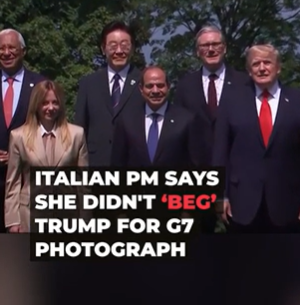
United States President Donald Trump has intensified a public dispute with Italian Prime Minister Giorgia Meloni by insisting that she repeatedly sought photographs with him during a recent Group of Seven summit because she wanted to improve her political popularity at home. Meloni strongly rejected the account, describing it as invented and accusing Trump of launching unnecessary attacks against a country that has traditionally been one of the United States’ closest European allies.
The unusual exchange between the two leaders emerged after the G7 summit held from June 15 to June 17, 2026, in Évian-les-Bains, France. Trump and Meloni were seen speaking on several occasions during the gathering, including in conversations away from the larger group of leaders. Their interactions initially appeared to suggest that they were attempting to repair a relationship that had become increasingly strained by disagreements over the conflict involving the United States, Israel and Iran.
However, any impression of reconciliation quickly disappeared after Trump discussed Meloni during an interview broadcast by the Italian television channel La7. The interviewer had reportedly been asking the American president about Ukraine when Trump changed the subject and began talking about the Italian prime minister.
Trump claimed that Meloni had strongly wanted a photograph with him and had repeatedly asked for one. He said that he eventually agreed because he felt sorry for her. He also suggested that Meloni was probably pleased that he had spoken with her at the summit.
The comments presented Meloni as a leader seeking Trump’s attention for political advantage. They also suggested that appearing publicly with the American president could help her improve her approval ratings in Italy. Trump later repeated the claim on his Truth Social platform, saying that Meloni wanted to restore their friendship in order to raise her political numbers.
Meloni responded publicly and forcefully. In a video posted on social media, she said she was astonished by Trump’s account and described it as completely fabricated. She rejected the suggestion that she had begged him for a photograph and declared that neither she nor Italy begged anyone for anything.
Her response went beyond simply disputing the details of the encounter. Meloni accused Trump of showing greater respect toward opponents of the Western alliance than toward established allies. She suggested that his treatment of Italy reflected a broader problem in the way he approached countries that had long maintained close political, military and economic relations with the United States.
Trump did not withdraw his comments. Instead, he escalated the argument, maintaining that Meloni had asked for a photograph “over and over.” He claimed that she wanted to become friendly with him again because her popularity in Italy was supposedly declining.
In a Truth Social post, Trump misspelled Meloni’s first name while questioning her domestic political standing. He also linked the dispute to Italy’s position during the conflict with Iran, criticizing Meloni for not allowing the United States to use Italian landing strips or runways for military operations.
Meloni answered again in English, calling Trump’s repeated attacks senseless and unprovoked. She told him that her popularity was none of his concern and suggested that he focus on his own approval ratings.
The Italian leader also defended her government’s decisions concerning American military activity in Italy. She said that Italy was following existing agreements and protecting its national interests. Her position indicated that, despite her ideological similarities with Trump on several issues, she was unwilling to allow those similarities to override Italian sovereignty or domestic political considerations.
The argument represents a dramatic deterioration in a relationship that had once appeared unusually close. Meloni and Trump are both associated with nationalist and conservative political movements. They have shared positions on immigration, criticism of parts of the political establishment and the importance of national identity.
Because of these similarities, Meloni was sometimes described as one of the European leaders best positioned to communicate with Trump. Some commentators referred to her as a possible bridge between Washington and European governments that often found Trump unpredictable or difficult to manage.
Meloni visited Trump in the United States and appeared at events connected to his political movement. Trump had previously praised her leadership and described her as an important European partner. Their political connection was viewed by supporters as evidence that Italy might gain influence in Washington during Trump’s presidency.
That relationship became more complicated as the United States adopted policies that affected Europe’s security and economy. Trade disagreements, demands over defense spending and uncertainty about American commitments to NATO created pressure on European leaders, including those who had initially welcomed Trump’s return to office.
The conflict involving Iran added another major source of tension. Italy, like several other European countries, faced economic and security consequences from the fighting. Meloni had to consider domestic opposition to military involvement, concerns about energy prices and public anxiety about a wider regional war.
Italy has traditionally maintained a close defense relationship with the United States and hosts American military personnel and facilities. However, the presence of those facilities does not mean Washington has unlimited authority to use Italian territory for every operation. Decisions involving military bases can depend on treaties, legal agreements and approval from the Italian government.
Trump’s criticism suggested that he believed Meloni had failed to provide the level of assistance expected from an ally. Meloni’s response emphasized that support for the Western alliance did not require Italy to approve every American request automatically.
The dispute therefore involved more than a disagreement about a photograph. It reflected deeper tensions over power, national sovereignty and the expectations placed on allies. Trump framed the issue in personal and political terms, portraying Meloni as someone who needed his support. Meloni framed it as a matter of dignity and respect for Italy.
For Meloni, the claim that she had begged for a photograph carried particular political risks. She has built much of her public identity around strength, patriotism and the defense of Italian interests. Being portrayed as pleading for attention from a foreign leader could weaken that image if voters believed the story.
Her rapid response appeared designed to prevent Trump’s version of events from becoming accepted without challenge. By stating that Italy did not beg, she transformed the argument from a personal insult into an issue of national pride.
That strategy also allowed Meloni to receive support from some political opponents. Italian politicians who often disagree with her policies nevertheless criticized Trump’s remarks as disrespectful to the prime minister and to the country.
Italian Foreign Minister Antonio Tajani also condemned the comments. Reports indicated that he canceled a planned trip to the United States as the disagreement intensified. The decision demonstrated that the conflict had begun to produce diplomatic consequences beyond an exchange of social media posts.
The cancellation was significant because high-level diplomatic visits are normally used to coordinate policy, manage disagreements and reinforce alliances. Calling off such a visit sent a message that the Italian government regarded Trump’s remarks as more than casual political teasing.
It also raised questions about how the disagreement might affect cooperation between Washington and Rome. The two countries work together on NATO operations, trade, intelligence, regional security and diplomatic efforts across Europe and the Mediterranean.
A personal dispute between leaders does not automatically end that cooperation. Governments have extensive relationships involving officials, diplomats, military officers and businesses. However, hostility between national leaders can make communication more difficult and increase the risk that disagreements in one area will spread into others.
Trump has frequently used personal language when discussing foreign leaders. He often describes relationships between countries in terms of whether individual leaders like, respect or support him. This approach can make diplomatic disagreements appear similar to personal conflicts.
Supporters of Trump may see such language as direct and honest. They may argue that he is willing to publicly criticize allies when he believes they are not contributing enough or acting fairly toward the United States.
Critics say the approach can weaken alliances by humiliating leaders who must answer to their own voters. A prime minister who appears to accept public insults without responding may face political pressure at home, even if maintaining a calm relationship with Washington would be diplomatically useful.
Meloni’s reaction illustrates this challenge. She had previously invested considerable political effort in maintaining good relations with Trump. However, once he publicly accused her of begging for his attention, remaining silent could have been interpreted as weakness.
Her response was unusually personal for a diplomatic exchange. Telling the American president to focus on his own popularity showed that she was prepared to answer him in the same public style he had used against her.
The disagreement may affect how Meloni is perceived inside Italy. Before the dispute, critics sometimes accused her of being too close to Trump and of placing her ideological connection with the American president above Italy’s independent interests.
By confronting him, she may strengthen her position among voters who value national independence. The argument gives her an opportunity to show that she is willing to challenge a powerful ally when she believes Italy has been treated unfairly.
The dispute could therefore produce the opposite result from the one Trump predicted. Instead of damaging Meloni’s popularity, his comments may allow her to present herself as a leader defending Italian dignity.
At the same time, the political effect is uncertain. Some voters may question why a relationship that Meloni had promoted as valuable deteriorated so publicly. Others may worry that her confrontation with Trump could reduce Italy’s influence with the American administration.
Italian opposition parties may also use the episode to criticize her diplomatic strategy. They could argue that relying heavily on a personal relationship with Trump was always risky because his alliances can change quickly.
The photographs at the center of the dispute have become symbols of the larger political conflict. Images of leaders together are a routine part of international summits. Politicians use them to demonstrate access, cooperation and international importance.
A photograph with the American president can carry political value, particularly for a leader who wants to show that their country has influence in Washington. However, photographs at events such as the G7 are common and do not necessarily prove that one leader requested special attention from another.
Trump’s account has not been independently demonstrated through publicly available evidence. Meloni has denied it completely. Video from the summit showed the leaders interacting, but it did not by itself establish who requested photographs or why.
The disagreement is therefore based largely on two sharply different accounts. Trump says Meloni repeatedly sought pictures with him to improve her standing. Meloni says he invented the story.
Without additional evidence, news organizations must clearly attribute the claims rather than presenting either account as proven fact. Trump’s statements are allegations about Meloni’s behavior and motivation, while Meloni’s statements represent her denial and interpretation of the exchange.
The episode also demonstrates the importance of careful language in political reporting. Headlines may summarize Trump’s claim that Meloni wanted photographs to increase her popularity, but they should not suggest that her motive has been independently confirmed.
Descriptions such as “Trump said,” “Trump claimed” or “Trump alleged” are necessary because the Italian prime minister disputes the story. Similarly, Meloni’s accusation that Trump fabricated the account is her response, not a judicial finding or independently established conclusion.
The public nature of the dispute reflects how diplomacy has changed in the era of social media. In earlier periods, disagreements between allied leaders might have been addressed through private phone calls, diplomatic notes or carefully worded statements.
Trump and Meloni instead communicated directly to millions of people through television interviews, video messages and social media posts. Their statements were quickly translated, shared and debated across several countries.
This immediate communication allows leaders to defend themselves without relying on traditional news organizations. It also reduces the time available for advisers to calm a disagreement before it becomes public.
Once the argument began, each new statement created pressure for another response. Trump’s original remarks led to Meloni’s denial. Her denial was followed by Trump’s repeated accusation. His second attack led to Meloni’s warning that he should focus on his own popularity.
The cycle illustrates how social media can turn a diplomatic disagreement into a continuing personal confrontation. Each leader speaks not only to the other but also to domestic supporters, political opponents and international audiences.
Trump’s comments may have been intended partly for his own political base. Presenting a foreign leader as seeking his approval reinforces his image as a powerful figure whose support other politicians value.
Meloni’s response served a similar domestic purpose. Declaring that Italy does not beg reinforced her nationalist message and allowed her to separate herself from the suggestion that she depended on Trump’s personal favor.
Both leaders therefore had political incentives to appear strong. That made compromise or a quiet correction more difficult.
The disagreement may also influence the wider European debate about relations with the United States. European governments remain dependent on American military power in several areas, but many leaders are seeking greater independence because of concerns that Washington’s policies can change rapidly.
Meloni had often argued that Europe could maintain a strong transatlantic relationship while working constructively with Trump. Her public dispute with him may strengthen those who believe that European countries should prepare for a less predictable American partnership.
However, it may also demonstrate the value of leaders who can openly disagree without abandoning the alliance completely. Meloni has not indicated that Italy intends to leave NATO or end cooperation with the United States.
Her message appears to be that partnership must include mutual respect. She has described Italy as a loyal ally while rejecting the idea that loyalty means silence or obedience.
Trump’s criticism of Italy’s decisions during the Iran conflict remains an important part of the argument. His posts suggested that he connected Meloni’s refusal to support certain American military requests with the collapse of their friendship.
This raises concerns about whether personal relationships are being used as rewards for policy agreement. Alliances normally require negotiation between governments with different laws, interests and public opinions.
An Italian prime minister is responsible to Italy’s parliament, legal system and voters. Even a leader who shares Trump’s political views cannot make every decision according to what benefits the American administration.
Meloni emphasized this point by arguing that her actions were based on Italian interests. She said that she had paid a political price for supporting Trump in the past, challenging the suggestion that her association with him had always improved her popularity.
Her statement implied that appearing close to Trump could also create political difficulties in Italy. Trump remains a controversial figure across Europe, where his policies on trade, climate, immigration, NATO and international conflicts have produced both support and strong opposition.
The claim that Meloni needed photographs with him may therefore oversimplify Italian public opinion. A picture with Trump could appeal to some conservative voters while upsetting others who oppose his foreign policy.
The argument has also created a challenge for diplomats trying to prevent personal comments from harming long-term cooperation. Officials in both governments may seek to continue practical discussions even while the leaders exchange criticism.
Italy and the United States have significant economic ties. American companies operate in Italy, Italian businesses sell products in the United States and the two countries cooperate in areas including technology, defense and energy.
A lasting diplomatic conflict could create uncertainty for those relationships. However, political disputes between allied leaders often fade when governments need to address shared concerns.
The immediate question is whether Trump and Meloni will continue responding publicly or attempt to end the exchange. Meloni said she did not want to keep discussing the matter indefinitely, although she also made clear that she would defend herself and her country.
Trump’s decision to repeat the allegation after her denial suggests that he was unwilling to allow her account to stand without another challenge. Further comments could make reconciliation more difficult.
A meeting, phone call or statement from diplomatic officials could eventually reduce the tension. Neither government benefits from allowing a disagreement about photographs to permanently damage cooperation.
Nevertheless, the episode may leave a lasting effect on the personal relationship between the two leaders. Meloni may become more cautious about presenting herself as a close Trump ally, while Trump may treat her as less reliable than before.
The controversy demonstrates the instability of political relationships built heavily around individual personalities. Shared ideology can create a strong connection, but it does not remove conflicts over national interests.
Leaders who appear politically aligned may disagree sharply when military action, economic pressure or domestic popularity is involved. In such situations, personal friendship can quickly become secondary.
For the public, the most important issue is separating verified events from competing political narratives. It is confirmed that Trump and Meloni met and spoke during the G7 summit. It is confirmed that Trump said she sought photographs and wanted to improve her popularity. It is also confirmed that Meloni denied the account and accused him of inventing it.
What remains disputed is whether she repeatedly requested the photographs and what her motivation may have been. No publicly reported independent evidence has settled that question.
The episode should therefore be understood as an escalating diplomatic and political row rather than as proof of either leader’s version of the private interactions.
Trump’s remarks have placed Meloni in the unusual position of defending herself against a leader with whom she was once considered especially close. Her response shows that ideological friendship has limits when national dignity and personal credibility are involved.
Meloni’s statement that neither she nor Italy begs was designed to speak to more than Trump. It addressed Italian citizens, European allies and political opponents who were watching to see whether she would tolerate the insult.
Trump’s insistence that she needed him to improve her numbers similarly communicated a broader claim about his own international importance. It suggested that association with him is politically valuable and that foreign leaders seek his approval.
The conflict between those two messages explains why a disagreement over a photograph became a diplomatic controversy. For Trump, the image represented his influence. For Meloni, the allegation represented an attack on her independence and Italy’s status.
Whether the dispute eventually affects policies between the two governments will depend on what happens next. Both countries have strong reasons to maintain cooperation, but the exchange has exposed disagreements that existed beneath their leaders’ previously friendly appearances.
The controversy has also shown how quickly a carefully managed summit image can be transformed. Photographs that initially seemed to represent renewed cooperation are now being used as evidence in a public argument about power, popularity and respect.
For Meloni, the challenge will be to defend Italy without causing unnecessary long-term damage to its relationship with Washington. For Trump, the challenge will be whether he can criticize an ally without weakening the partnership he expects that ally to support.
The dispute may eventually be remembered as a temporary political clash. It may also mark a deeper turning point in a relationship once presented as one of the strongest personal connections between Trump and a European leader.
For now, the two sides remain publicly divided. Trump insists that Meloni repeatedly sought photographs with him to help her popularity. Meloni insists that the story is false and that her political standing is not his concern.
Behind their exchange is a larger struggle over how allies communicate, how national leaders protect their political image and how personal diplomacy affects international relationships. The argument began with a claim about a photograph, but it has developed into a wider confrontation involving the Iran conflict, military cooperation, national sovereignty and the meaning of respect between allied countries.