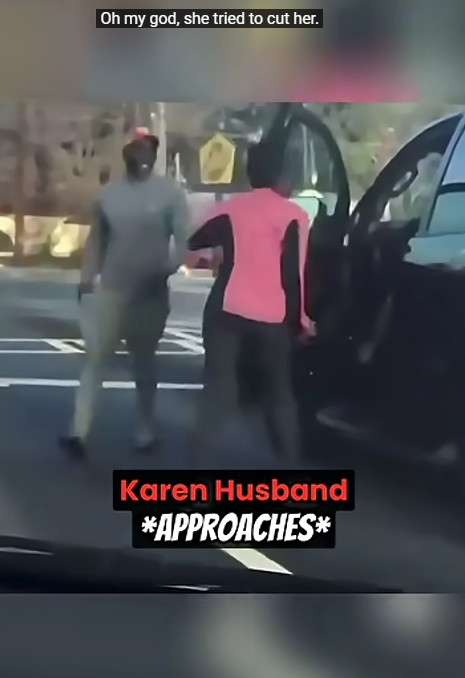
This short video documents a road rage incident that escalates rapidly in a public traffic setting before being brought under control by a sudden police intervention. The footage captures a sequence of aggressive behavior involving multiple individuals and shows how a dispute between drivers can quickly develop into a more serious confrontation when emotions override restraint. The events unfold in real time, beginning with a verbal and physical altercation at a stopped vehicle and ending with law enforcement arriving and taking immediate action.
The video begins with traffic appearing to be halted or slowed, with an SUV positioned in a lane where interaction with surrounding vehicles is possible. At this moment, a woman wearing a pink jacket is seen approaching the driver-side area of the SUV. Her movement is direct and assertive, and she quickly closes the distance to the open driver-side door. Her posture and gestures suggest anger or frustration, and she appears to be engaging the driver in a confrontation that has likely begun moments earlier off-camera or during the stop in traffic.
As she reaches the vehicle, her behavior becomes more aggressive, focusing attention on the driver inside the SUV. The situation escalates when her husband approaches from behind. Rather than calming the situation, he becomes actively involved and takes over the confrontation. His intervention shifts the dynamic from a single-person confrontation to a coordinated escalation involving two individuals acting toward the driver of the SUV.
The husband physically pushes his partner aside, stepping into the immediate space beside the open driver-side door. This action signals a transition from verbal confrontation to physical aggression. He attempts to reach into the vehicle, extending his arms toward the driver in what appears to be an effort to grab or strike. The driver inside the SUV responds defensively, attempting to block incoming movements and protect the interior of the vehicle.
The situation intensifies as the husband continues his aggressive behavior, pulling at the door and swinging his hands toward the driver. The confined space of the vehicle doorway makes the confrontation particularly volatile, as both parties are positioned within close proximity and limited mobility. Despite the pressure of the situation, the driver manages to shut the door, creating a temporary barrier between himself and the escalating aggression outside.
Once the door is closed, the immediate physical confrontation is momentarily interrupted. However, the tension does not subside. The husband reacts verbally, shouting in frustration and declaring that he intends to take the driver’s license plate. This statement signals a shift in focus from direct physical confrontation to retaliatory action against the vehicle itself.
The man then moves toward the rear of the SUV. Instead of disengaging from the situation, he continues the escalation by targeting property damage. He positions himself behind the vehicle and begins removing the rear license plate. This act represents a further intensification of the incident, as it moves from interpersonal conflict to deliberate interference with a legally registered vehicle identifier.
The removal of the license plate is carried out in a visibly forceful manner. The action is not incidental or accidental but appears intentional, driven by anger and a desire for retaliation. At this point in the video, the situation has escalated beyond a traffic dispute and into behavior that may carry legal consequences due to interference with vehicle registration and potential criminal damage.
As the man is actively removing the license plate, the situation abruptly changes with the arrival of law enforcement. A police officer arrives on the scene without delay, responding directly to the ongoing incident. The timing of the arrival creates a sudden shift in the tone of the encounter, moving it from uncontrolled confrontation to immediate enforcement of authority.
The officer responds quickly and decisively. Upon observing the man engaged in the act of removing the license plate, the officer draws their weapon and issues commands instructing him to place his hands behind his back. The presence of a firearm and the firm verbal commands indicate that the officer is treating the situation as potentially dangerous, prioritizing immediate control and compliance.
The man complies under the pressure of the officer’s commands and is placed under arrest. The transition from active aggression to restraint occurs rapidly, effectively ending the physical escalation. The officer’s intervention halts any further damage or confrontation and brings the situation under control within moments of arrival.
The woman in the pink jacket is no longer the central focus at this stage, as attention shifts entirely to the husband and his actions involving the license plate. The arrest marks the conclusion of the active incident, with law enforcement assuming control of the situation and preventing further escalation between the parties involved.
From a broader perspective, the video illustrates how quickly road rage incidents can escalate when initial frustration is not managed or de-escalated. What begins as a roadside disagreement or traffic-related dispute can rapidly evolve into physical confrontation and property interference when multiple individuals become involved and emotions intensify.
The footage also demonstrates how law enforcement intervention can abruptly change the direction of such encounters. The presence of an officer and the immediate assertion of authority serve to stabilize a situation that had become unpredictable and potentially dangerous. The rapid arrest prevents further escalation and ensures that the incident is contained.
Overall, the video presents a clear progression from confrontation to escalation and finally to enforcement intervention. It highlights how quickly behavior in high-stress traffic situations can shift from verbal conflict to physical action, and how external intervention can bring such incidents to a sudden and decisive end.
To further understand the significance of this incident, it is helpful to examine how quickly situations involving road rage can escalate when multiple individuals become emotionally involved. In many traffic-related confrontations, the initial trigger is often relatively minor—such as perceived disrespect, frustration over driving behavior, or misunderstanding between drivers. However, once emotions take over, the situation can escalate far beyond the original cause, as seen in this video.
In this case, the presence of two individuals acting together significantly increases the intensity of the confrontation. The woman’s initial approach toward the SUV suggests a direct emotional response, possibly driven by frustration or anger stemming from the traffic situation. When her husband joins the interaction, the dynamic shifts from an individual emotional reaction to a coordinated escalation. This often happens in real-world incidents where one person reinforces or amplifies the emotions of another, leading to reduced restraint and increased aggression.
The moment the husband physically pushes his partner aside is particularly significant, as it indicates a transition from verbal confrontation to physical dominance of the situation. By taking control of the interaction, he positions himself as the primary aggressor. His attempt to reach into the vehicle introduces a heightened level of danger, as enclosed spaces like car doorways create a confined environment where both parties have limited ability to retreat or de-escalate safely.
At this stage, the driver inside the SUV is placed in a defensive position. The instinctive reaction to protect oneself and secure the vehicle interior is a natural response when faced with a sudden physical threat. The act of slamming the door closed is not only a physical barrier but also a psychological shift, signaling an attempt to regain control of personal space and distance from the aggressor.
However, the situation does not de-escalate after physical separation is created. Instead, the focus of aggression shifts toward property damage. The husband’s decision to move toward the rear of the vehicle and target the license plate reflects a continuation of retaliatory behavior rather than disengagement. In many road rage incidents, this type of action represents a transition from confrontation with a person to confrontation with property, which still carries legal consequences.
The removal of the license plate is a particularly important detail because it demonstrates intent rather than accidental damage. License plates are not only physical objects attached to vehicles but also legal identifiers used for registration, law enforcement tracking, and vehicle identification. Tampering with or removing them can escalate a traffic dispute into a criminal matter depending on jurisdiction.
The sudden arrival of law enforcement marks a turning point in the incident. The timing suggests that the situation was either observed directly or reported quickly enough for rapid response. In many urban environments, police response to active disturbances can occur within minutes, especially when public safety is at risk or when ongoing physical confrontation is reported.
When the officer arrives and immediately draws their weapon, it indicates that the situation is being treated as potentially dangerous. Law enforcement officers are trained to assess threat levels quickly upon arrival, particularly when witnessing active aggression or property interference. The decision to issue commands while displaying a weapon reflects a precautionary approach aimed at establishing immediate control and preventing further escalation.
The man’s compliance under these commands suggests that the presence of authoritative force effectively halts the ongoing aggressive behavior. In many real-world scenarios, the sudden introduction of law enforcement authority acts as a stabilizing factor, interrupting the momentum of civilian confrontations and redirecting control to trained personnel.
The arrest that follows serves as the legal conclusion of the immediate incident. At this stage, the focus shifts from conflict resolution between civilians to enforcement of law and order. The officer’s priority becomes securing the individual, ensuring safety for all parties involved, and preventing additional damage or confrontation.
From a behavioral perspective, this incident highlights several key patterns commonly observed in road rage events. First, escalation often occurs rapidly once emotional regulation is lost. Second, group involvement tends to intensify behavior rather than reduce it, especially when individuals reinforce each other’s reactions. Third, property damage frequently emerges as a secondary form of retaliation when direct confrontation is interrupted or becomes more difficult.
The presence of immediate police intervention in this case prevents the situation from continuing to escalate further. Without such intervention, incidents like this can sometimes lead to extended confrontations, additional property damage, or physical injury. The rapid resolution therefore plays an important role in limiting the overall severity of the event.
In conclusion, this video captures a clear progression from emotional confrontation to physical escalation and finally to legal intervention. It demonstrates how quickly road rage incidents can evolve when multiple individuals are involved and how external enforcement can abruptly halt dangerous behavior. The sequence of events serves as a reminder of the importance of restraint, situational awareness, and the risks associated with allowing emotional reactions to override judgment in high-stress traffic situations.
Expanding further on the dynamics of this incident, it is important to recognize how quickly public roadways can become high-conflict environments when stress, impatience, and perceived disrespect intersect. Traffic conditions inherently place strangers in close proximity while limiting their ability to freely move away from tense interactions. This physical constraint often plays a major role in why road rage incidents escalate more rapidly than other types of public disputes.
In this situation, the SUV being stopped in traffic becomes the fixed point around which the entire confrontation unfolds. Unlike a normal face-to-face disagreement where either party can walk away, neither the driver nor the approaching individuals have immediate freedom to disengage without abandoning vehicles or breaking traffic flow. This creates a pressure-cooker effect where emotional escalation can build quickly without natural resolution points.
As the confrontation intensifies, the presence of multiple individuals acting together becomes a critical factor. When one person begins an aggressive interaction and another joins, there is often a psychological amplification effect. Each participant may feel validated by the other’s presence, which can reduce hesitation and increase the likelihood of physical escalation. In this case, the husband’s decision to take over the confrontation from the woman significantly changes the trajectory of the event, transforming it from a heated argument into a coordinated physical altercation.
The attempt to reach into the vehicle represents a major escalation point because it crosses from verbal confrontation into direct physical intrusion of personal space. Vehicles are often perceived as semi-protected environments, and an attempt to breach that space can trigger defensive responses. The driver’s immediate reaction to block and shut the door reflects a natural protective instinct. At this stage, the interaction is no longer purely verbal but has entered a physical threat phase, where both parties are actively responding to each other’s movements.
Once separation is achieved by closing the door, the conflict does not de-escalate but instead shifts focus. This shift from person-directed aggression to property-directed aggression is a common pattern in road rage cases. When individuals are no longer able to directly engage the other person, they may redirect frustration toward objects associated with them, such as vehicles. The decision to target the license plate is particularly significant because it indicates intentional interference with an identifying feature of the vehicle rather than random damage.
License plates serve an important legal function, and tampering with them can escalate a civil dispute into a criminal matter depending on jurisdiction. This action demonstrates that the confrontation has moved beyond emotional expression and into deliberate acts that may carry legal consequences. It also signals that the aggressor has not disengaged emotionally, even after physical separation from the driver.
The sudden arrival of law enforcement introduces an immediate shift in power dynamics. Police presence in active conflict situations typically acts as an external stabilizing force. However, the way officers respond in the first seconds of arrival is often shaped by what they observe in real time rather than the full history of the incident. In this case, the officer’s rapid assessment of the man actively removing the license plate contributes to an immediate perception of ongoing criminal behavior.
The decision to draw a weapon upon arrival reflects a precautionary safety protocol. Officers are trained to assume worst-case scenarios in uncertain environments, especially when arriving during an active confrontation. Although the situation may ultimately be non-lethal, the uncertainty at the moment of arrival requires quick action to establish control and prevent further escalation. Verbal commands combined with visible readiness serve to interrupt the ongoing behavior and shift focus toward compliance.
The immediate compliance of the individual suggests that the introduction of authoritative force effectively halts the escalation cycle. In many real-world incidents, the presence of law enforcement serves as a behavioral reset point, where individuals disengage from confrontation and transition into compliance or explanation mode. This transition is essential for preventing further harm or destruction during volatile encounters.
From a legal standpoint, the actions leading up to the arrest may be evaluated under several categories depending on jurisdiction, including disorderly conduct, attempted assault, and property interference. The removal or tampering of a license plate can be considered a serious offense because it impacts vehicle identification systems used by law enforcement and public safety agencies. Even if the initial conflict stemmed from emotional frustration, the physical actions taken during escalation determine legal outcomes.
Another important aspect of this incident is the role of perception versus intent. In many road rage cases, individuals involved may interpret actions differently based on their emotional state. What one person perceives as provocation, another may view as accidental or unrelated behavior. These differences in perception often contribute to escalation, as each party responds to their own interpretation rather than an objective shared reality.
The driver’s experience inside the SUV is also central to understanding the event. Being confronted at a vehicle door creates a sense of vulnerability, particularly when multiple individuals are involved. The instinct to close the door and create a barrier is a defensive measure aimed at restoring physical safety and control. Once that barrier is established, the situation shifts from direct confrontation to external threat behavior, such as property damage or continued verbal aggression.
The broader context of road rage incidents shows that they often follow a recognizable pattern: initial trigger, verbal escalation, physical proximity increase, property interference, and finally external intervention. This structure is visible in the sequence of events captured in the video, where each stage escalates incrementally until interrupted by law enforcement arrival.
The presence of an immediate police response also highlights the importance of rapid reporting and monitoring systems in public safety. In many urban environments, such incidents are resolved more quickly when witnesses or automated systems alert authorities early. This reduces the time window in which escalation can occur and increases the likelihood of peaceful resolution or controlled intervention.
After the arrest, the incident effectively transitions from an active confrontation to a legal matter. At this stage, evidence such as video footage, witness statements, and physical damage assessments become critical in determining charges and outcomes. The behavior captured in the video provides a clear timeline of escalation, which can be used in later legal proceedings to establish intent and sequence of actions.
In summary, this incident demonstrates how quickly emotional responses in traffic environments can escalate into physical confrontation and property interference. It also shows how external intervention can rapidly stabilize a situation that has moved beyond verbal disagreement. The sequence of events underscores the importance of emotional control, situational awareness, and the role of law enforcement in preventing further escalation in high-conflict roadside encounters.