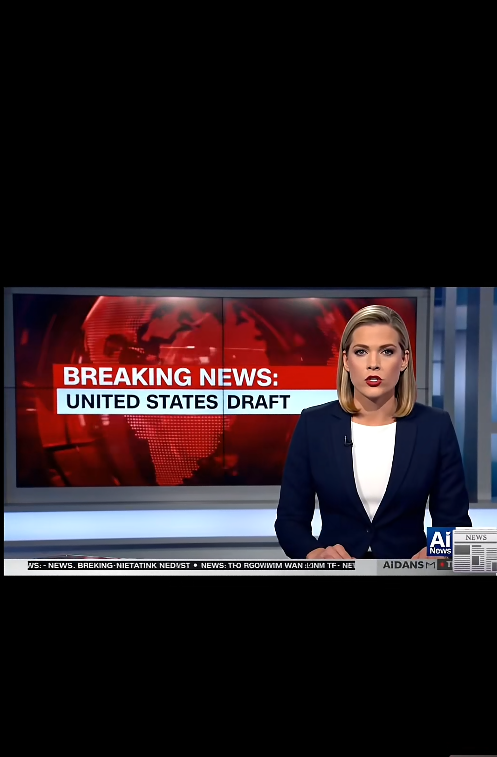
A dramatic “BREAKING NEWS” headline appearing in a short news-style video has sparked attention around one of the most sensitive subjects in the United States: the possibility of a military draft. The video features a female news anchor in a television-style studio, with large text appearing across the screen that reads, “BREAKING NEWS: UNITED STATES DRAFT.” The presentation immediately creates a sense of urgency and leaves viewers with one major question: Is the United States actually preparing to bring back the military draft?
The subject alone is enough to make people stop scrolling. For generations, the idea of being called into military service has carried enormous emotional and political weight in the United States. For some Americans, military service represents duty, sacrifice and responsibility toward the country. For others, the idea of being required to serve raises serious questions about personal freedom and whether the government should have the authority to determine when citizens must enter military service. Because of that history, even a short video containing the words “United States Draft” can quickly generate strong reactions online.
However, there is an important distinction between a dramatic social-media headline and a confirmed government announcement. A video can be designed to look exactly like a breaking-news broadcast without necessarily providing enough evidence to establish that a major policy has actually been approved or implemented. That distinction becomes especially important when the subject involves something as serious as military service.
The idea of a military draft is not new to the United States. Throughout American history, the country has used systems of compulsory military service during periods of major national conflict. One of the most remembered examples is the Vietnam War, when the draft became one of the most controversial issues in American society. Protests against the draft became widespread, and the issue contributed to a much larger national debate about war, government power and individual rights.
For younger Americans who have grown up during an era in which the military has primarily relied on volunteers, the possibility of compulsory service can seem almost unimaginable. Many people have never personally experienced a draft or known someone who was suddenly required to enter the military. As a result, seeing a headline suggesting that the draft could return can create immediate uncertainty and even fear.
But seeing the word “draft” on a screen does not automatically mean that Americans are being ordered to report for military service. The United States already maintains the Selective Service System, which is associated with registration for potential military conscription. Registration, however, is not the same thing as an active military draft. The existence of a registration system does not mean that a draft has been activated or that people are currently being selected for military service.
This distinction is extremely important because social-media posts can sometimes remove the context surrounding a real government system and present it as something much more immediate. A viewer may see a reference to Selective Service, military preparedness or a political discussion about conscription and then encounter a dramatic headline claiming that the United States is bringing back the draft. The underlying information may be real, but the conclusion presented by the video may be much broader than what has actually been confirmed.
If the United States were to activate a military draft, the process would be far more complicated than a headline appearing on a television screen. There would be major legal and governmental procedures involved, along with detailed rules concerning eligibility, selection and military requirements. Americans would want to know who could be called, what ages would be affected, what exemptions might exist and how the process would actually work.
Millions of people would immediately begin asking questions about their personal circumstances. Students would want to know whether they could continue their education. Employees would wonder what would happen to their jobs. Parents would ask how military service could affect their families. People with medical conditions would want to know how eligibility would be determined. Others would have questions about religious objections, personal beliefs and other circumstances that could potentially affect their obligations.
The question of who would actually be selected would also be extremely important. A military draft would not necessarily mean that every eligible person would immediately be sent into the armed forces. Any system of compulsory service would have specific rules determining who could be selected and under what circumstances. The details would depend on the laws and policies established at the time.
This is one reason why dramatic headlines can be misleading when they provide no additional context. A phrase such as “United States Draft” can make it sound as though millions of people have suddenly received orders to report for military service. In reality, discussions about a possible draft can involve many different things, including political proposals, hypothetical scenarios, military planning or debates about national preparedness.
The difference between those situations is enormous. A proposal is not the same as a law. A discussion is not the same as a decision. Registration is not the same as conscription. And a hypothetical scenario is not the same as a government announcement.
Social media has made these distinctions more difficult for ordinary viewers to recognize. In the past, most people received major breaking-news stories from established television networks, newspapers and radio stations. Today, a major story can appear on someone’s phone in the form of a ten-second video. The video may contain a professional-looking presenter, dramatic graphics, urgent music and a large “BREAKING NEWS” banner. To someone scrolling quickly, it can look almost identical to an authentic television broadcast.
That creates a new challenge for audiences. A professional appearance does not necessarily mean that the information is verified. Modern editing tools and artificial intelligence can make it possible to create realistic news-style videos without the footage actually coming from a real newsroom. Digital presenters, realistic backgrounds, voice generation and television graphics can all be produced with technology that was difficult or impossible for ordinary users to access only a few years ago.
This means viewers have to become more careful about what they see online. A serious-looking news anchor does not automatically prove that the information is genuine. A “BREAKING NEWS” graphic does not prove that a government agency made the announcement. Even a video with thousands of views does not necessarily mean that the information has been independently verified.
This is particularly important when the subject involves war, military service or national security. These topics can generate intense emotions, and emotional reactions can cause information to spread extremely quickly. Someone who sees a headline suggesting that the draft is returning may immediately send the video to a friend, family member or young relative. Others may share it because they believe it is important to warn people. Within hours, a claim that began with a single video can potentially reach a huge audience.
Fear is one of the strongest drivers of social-media engagement. People naturally pay attention when they believe something could directly affect their lives or the lives of their families. A headline about a new military draft immediately raises personal questions. Someone might wonder whether their son could be called. Another person might think about their daughter. A college student might worry about their education. A parent might wonder whether their child could suddenly be required to serve.
Those emotional reactions are understandable, but they are also exactly why people should pause before accepting a dramatic claim as fact.
The best response to a video like this is not necessarily panic or immediate dismissal. Instead, viewers should ask where the information came from and whether the claim can be independently confirmed. Is there an official announcement? Is there a specific law or government action being referenced? Are major reputable news organizations reporting the same development? Does the original source explain exactly what has happened, or does the video simply display a dramatic headline?
These questions can make a major difference.
Another important factor is the date of the information. Social-media platforms frequently resurface older stories and present them to users as though they are new. A video or article that originally appeared months or years ago can suddenly become popular again, especially if it is connected to a current political or military event. Without checking the date, viewers may assume that an old discussion represents a new government decision.
The same problem can happen with videos that were originally created as satire or commentary. A creator may produce a fictional news broadcast to discuss what could happen in a hypothetical situation. If someone later removes the original context and shares the clip as though it were genuine breaking news, viewers may interpret the video completely differently.
Artificial intelligence has made this issue even more complicated. AI-generated presenters and news environments can look surprisingly realistic. A person watching a short clip may not immediately realize that the presenter is digitally generated or that the entire broadcast was created for entertainment or commentary. That does not necessarily make the content harmful, but it makes clear labeling increasingly important.
The discussion surrounding a possible military draft also reflects broader questions about America’s future military needs. The United States maintains one of the world’s largest and most powerful armed forces, but military readiness depends on many factors, including recruitment, retention, technology, training and international circumstances. Whenever national security concerns increase, discussions about military manpower can become more prominent.
That does not mean every discussion about military readiness should be interpreted as preparation for a draft. Governments routinely consider different scenarios, and military planners regularly evaluate what could happen under changing circumstances. Planning for a possibility is not the same as deciding that the possibility will happen.
This distinction is often lost in viral content because complicated subjects are difficult to explain in a few seconds. A long policy discussion can be reduced to one dramatic sentence. A complicated proposal can become a shocking headline. A hypothetical question can become an apparent announcement.
The result is content that may be highly effective at attracting attention while providing very little context.
The possibility of a draft would also raise significant questions about fairness. Americans would likely debate whether compulsory military service should apply equally across society and how individuals should be selected. There would be discussions about age requirements, medical eligibility, education, employment, family responsibilities and other circumstances. People would also debate whether military service should be required at all.
These debates have existed throughout American history. The country has repeatedly faced difficult questions about the balance between individual rights and national security. During times of war or heightened international tension, those debates can become particularly intense.
For some Americans, the argument for compulsory service would focus on national responsibility. They could argue that when a country faces a serious threat, citizens may have a responsibility to contribute to its defense. Others would strongly disagree and argue that military service should remain voluntary because individuals should have control over decisions involving their own lives and physical safety.
Both perspectives have deep roots in American political history, which is another reason the word “draft” carries such a powerful emotional meaning.
The viral video therefore touches on something much larger than a simple news headline. It raises questions about America’s military, the government’s responsibilities, individual freedom and the way information is distributed in the digital age.
At the same time, viewers should be careful not to confuse an eye-catching presentation with confirmation of a major government policy. A video can be interesting, dramatic and highly shareable while still requiring additional verification.
If an actual military draft were announced, it would be an enormous national story. Government agencies would need to provide detailed information. Politicians would be responding publicly. Major news organizations would be covering the development extensively. Legal experts would be discussing the implications. Families and communities would be trying to understand what the new rules meant for them.
There would be far more information available than a few seconds of video.
That is why the short clip should be viewed as a reason to investigate rather than a reason to panic. The headline is certainly designed to capture attention, but the real story depends on what is happening behind the headline.
For anyone encountering the video online, the smartest approach is simple: stop, check and verify. Look for the original source. Check official government information. Compare the claim with reporting from multiple reputable news organizations. Look at the date. Determine whether the video is presenting a confirmed announcement, a proposal, a prediction or fictional content.
In today’s social-media environment, those few extra steps can prevent a huge amount of confusion.
The “United States Draft” headline is powerful because it speaks directly to one of the most sensitive questions Americans could imagine: could ordinary citizens once again be required to serve in the military? It is the kind of question that can instantly attract attention, generate discussion and encourage people to share a video with everyone they know.
But the seriousness of the subject makes accuracy even more important.
A military draft would not be a minor policy change. It would affect families, students, workers and communities across the country. It would generate political debate and public discussion on an enormous scale. Such a development would require clear explanations and reliable sources rather than relying on a dramatic social-media clip.
The rise of AI-generated content makes that responsibility even more important. As technology continues to make realistic videos easier to create, viewers will increasingly need to distinguish between authentic reporting, commentary, satire and fabricated news-style content.
The lesson is not that every viral video should automatically be ignored. It is that viral content should be treated as the beginning of a search for information rather than the final answer.
The dramatic headline may be what gets someone’s attention, but the facts are what determine what the story actually means.
For now, anyone seeing a video claiming that the United States is facing a new military draft should take a moment before sharing it. Ask where the claim came from, look for confirmation and pay attention to the exact language being used. A few seconds of verification can make the difference between understanding an important national issue and accidentally spreading information that has been taken out of context.
The conversation surrounding military service is too important to be reduced to a sensational headline. Whether the subject is national security, government policy or the possibility of compulsory service, Americans deserve accurate information and clear explanations.
The video may have only a few seconds to grab the viewer’s attention, but the questions it raises are much bigger. What exactly does “draft” mean? Who could be affected? What would have to happen before a draft could actually begin? And most importantly, is the dramatic claim being shared online supported by confirmed information?
Those are the questions worth asking.
In an age where almost anyone can create a convincing news-style video, viewers have more power than ever to decide what they believe and what they share. The responsibility is simple: check the source, check the date, check the facts and look beyond the headline.
Because when the subject is something as serious as military service, attention may bring people to the story, but only reliable information can tell them what the story really is.
Another reason this subject continues to attract attention is the uncertainty surrounding what a major change in military policy could mean for ordinary Americans. When people hear the word “draft,” they often imagine an immediate situation in which young people are suddenly called away from their homes and families. In reality, any major change involving compulsory military service would involve a long and complicated process, with laws, regulations and government decisions shaping how such a system would operate. Understanding that process is important because it prevents people from assuming that a dramatic headline automatically means an immediate change to everyday life.
For many families, the conversation would also go beyond the person who could potentially be called to serve. Parents could begin thinking about their children’s plans, while young adults could reconsider decisions about college, work and travel. Someone who had recently started a new career might suddenly wonder whether military obligations could interrupt their plans. Families with several children might have completely different concerns from those of individuals living alone. The uncertainty itself could become a major source of public discussion, even before any actual policy was implemented.
The economic effects would also be something Americans would closely watch. A large-scale change in military recruitment could potentially affect workplaces, universities and local communities. Employers would have questions about employees who might be required to serve, while educational institutions would need to consider how students could be affected. Businesses located near military installations could also experience changes depending on the size and nature of military activity. These are the kinds of secondary effects that are rarely visible in a short social-media video but could become important parts of a much larger national conversation.
There would also likely be a significant debate about fairness. Americans would want to understand exactly how people were selected and whether the rules applied equally. Questions about income, education, medical circumstances, family responsibilities and other factors would quickly become part of the discussion. People would want to know whether individuals from different backgrounds would face the same obligations and whether there would be meaningful opportunities to challenge a decision. These questions would not have simple answers, which is another reason why a short headline cannot explain the full reality of such a major policy.
The political reaction would almost certainly be intense as well. Supporters and opponents would likely have very different views about whether compulsory service was necessary. Some could argue that strengthening military manpower was essential during a period of heightened national security concerns. Others could argue that the government should not have the power to require citizens to serve against their wishes. Members of Congress, military officials, legal experts and advocacy organizations would all likely become involved in the discussion, creating a national debate that could continue for months.
For ordinary social-media users, however, the most important issue remains the difference between a discussion about a draft and an actual draft. That difference can easily disappear when information is condensed into a few seconds of video. A creator may take a complicated political development and turn it into a dramatic headline because a dramatic headline attracts more attention. Once that headline begins spreading, people may repeat it without checking the original information, causing the claim to become increasingly disconnected from its original context.
This is why viewers should be especially cautious when a video appears designed to create an immediate emotional reaction. Urgent graphics, dramatic music and phrases such as “breaking news” are powerful communication tools, but they are not evidence. The most reliable information is usually found in the details: who made the announcement, what exactly was announced, when it happened and what official documents or statements support the claim.
The growing popularity of AI-generated media makes this even more important. A digitally created news anchor can look convincing enough that viewers may assume they are watching a real television broadcast. In some cases, even experienced viewers can have difficulty identifying manipulated or artificially generated footage when the clip is short. This means that checking the source has become more important than simply judging whether something “looks real.”
Ultimately, the debate surrounding the possibility of a U.S. military draft is much bigger than one viral video. It touches on national security, government authority, individual freedom, military readiness and the responsibilities citizens may have toward their country. Those are serious questions that deserve careful discussion and reliable information.
The viral clip may be designed to make viewers stop and watch, but the real responsibility comes afterward. Instead of immediately accepting the headline, viewers can use it as a starting point to investigate what is actually happening. They can search for official information, compare different reports and determine whether the claim is confirmed or simply being presented as a possibility. In a world where information can spread around the globe within minutes, that small step can make a significant difference.
The strongest stories are not necessarily the ones with the loudest headlines. They are the ones that give people enough information to understand what is really happening. A headline can create curiosity, but context creates understanding. And when the subject involves something as serious as military service, understanding the difference between a confirmed development and a viral claim is more important than ever.