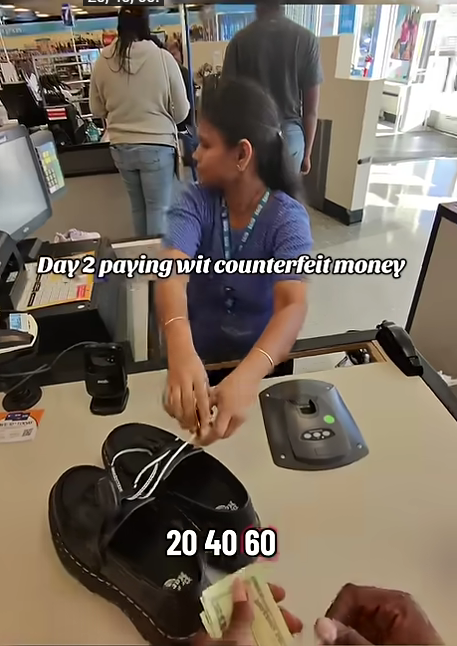
The video captures a tense yet oddly humorous retail encounter involving a customer attempting to pay for merchandise at a Ross store using fake movie-prop cash, creating a situation that quickly escalates from an awkward transaction into a full store security interaction. What begins as a seemingly routine purchase at the checkout counter slowly transforms into a bizarre moment involving counterfeit-detection technology, employee intervention, and eventually a stop by loss prevention staff before the customer is allowed to leave the store.
The incident begins inside a busy Ross retail location where a customer approaches the register carrying a pair of shoes he intends to purchase. At first glance, everything about the interaction appears completely normal. Retail employees process thousands of transactions every day, and cash payments are still common in many stores despite the widespread use of digital payment methods. The cashier likely expects the transaction to be simple and routine as the customer places the merchandise on the counter.
However, the situation changes the moment the customer hands over several twenty-dollar bills as payment. The cash itself immediately stands out because these are not real bills at all—they are movie-prop bills clearly marked with bright blue text reading “FOR MOTION PICTURE USE ONLY.” While prop money is commonly used in films, music videos, social media content, and training exercises, it is not legal currency and cannot be used in actual retail transactions. The fake bills are designed to resemble real cash from a distance while still containing markings intended to prevent them from being mistaken for legitimate money.
Whether the customer expected the cashier not to notice the markings or whether the situation was intended as some type of prank or social experiment remains unclear. What is obvious, however, is that the cashier immediately follows standard store procedure rather than simply accepting the bills without question. Like many modern retailers, Ross uses counterfeit detection systems at registers to verify larger cash transactions and identify suspicious bills before they are accepted.
The cashier feeds the fake twenty-dollar bills into the store’s bill-validator machine, likely expecting either confirmation that the money is authentic or an alert if something is wrong. Almost instantly, the machine rejects the bills. Instead of approving the cash, the detector flags it as invalid, making it clear that the bills are not legitimate currency.
This moment becomes one of the most awkward parts of the interaction because the rejection happens publicly and immediately. The customer can no longer rely on the possibility that the fake bills might pass unnoticed. The technology itself has already identified the problem before any debate even begins. For the cashier, the situation likely shifts from an ordinary transaction to a potentially serious security issue within seconds.
Rather than panicking or accusing the customer aggressively, the cashier remains professional and decides to verify the situation further by calling over another employee. This step reflects how many retail workers are trained to handle suspicious transactions calmly and carefully, especially in situations involving counterfeit money. Employees are often instructed not to escalate emotionally but instead involve supervisors or coworkers when questionable payments appear.
A second employee arrives at the register and examines the bills personally. After looking at them, the employee quickly confirms what the machine already indicated: the money is fake and cannot be accepted for payment. The bright “FOR MOTION PICTURE USE ONLY” markings make the issue difficult to dispute because the bills openly identify themselves as props rather than real currency.
The customer’s reaction at this stage becomes particularly interesting because instead of arguing aggressively, acting shocked, or attempting to force the issue further, he pivots almost instantly. Maintaining a calm and casual attitude, he retrieves the fake bills and smoothly switches payment methods, deciding to use a credit card instead.
This sudden transition dramatically changes the tone of the encounter. The customer acts almost as though the fake cash incident is a minor inconvenience rather than a potentially serious situation. His calm response creates an unusual atmosphere because viewers naturally expect more tension after counterfeit money is discovered. Instead, the interaction temporarily returns to something resembling a normal retail purchase once the legitimate card payment is processed.
For the employees, however, the situation likely remains suspicious despite the successful card transaction. Attempting to use fake money—even if the customer later pays properly—is not something stores treat lightly. Retail workers and security staff are trained to remain alert whenever counterfeit bills appear because fake currency attempts are often associated with theft, scams, or other fraudulent behavior.
Once the payment is completed, the customer collects the shoes and begins walking toward the store exit as though the situation is finished. From his perspective, switching to a credit card may have resolved the issue entirely. However, the earlier use of fake cash has already drawn attention from another part of the store’s security system: Loss Prevention.
Before the customer can fully leave, he is approached by a Loss Prevention officer identified as Pedro. Loss Prevention employees play a major role in retail environments, especially in large stores where theft, scams, and fraudulent transactions occur regularly. Their responsibilities often include monitoring suspicious behavior, verifying purchases, reviewing receipts, and investigating incidents involving counterfeit money or attempted fraud.
Pedro stops the customer near the exit and asks to inspect the receipt to confirm that the shoes were properly purchased before allowing him to leave. On the surface, this may seem like a simple receipt check, but the context makes it clear that the earlier counterfeit money incident is the real reason for the intervention. The store now wants to ensure the transaction was completed legitimately and that no unpaid merchandise is leaving the building.
The interaction with Loss Prevention adds another layer of tension because it reinforces the seriousness of attempting to use fake currency, even if the customer later paid correctly. Retail stores cannot simply ignore counterfeit-related situations because fake bills represent not only financial loss but also potential criminal activity. Even though the customer ultimately used a valid payment method, the earlier attempt naturally raised concerns among employees and security staff.
One reason the video resonates strongly online is because it captures the uncomfortable moment when modern retail technology instantly exposes a scam or prank attempt. In previous decades, counterfeit detection often depended entirely on employees manually inspecting bills. Today, however, many stores use sophisticated machines capable of identifying fake currency almost immediately. Watching the machine reject the prop money creates a satisfying sense of instant accountability because the technology leaves little room for deception.
The video also highlights the professionalism of the employees involved. Neither cashier reacts dramatically or aggressively despite the suspicious circumstances. Instead, they calmly follow procedure: verifying the bills, consulting another employee, refusing the fake cash, and allowing the customer to complete the purchase using legitimate payment. Their composed handling of the situation prevents unnecessary escalation while still protecting the store.
At the same time, the customer’s behavior contributes heavily to the strange humor of the clip. His casual attitude after being caught using clearly fake movie money creates an awkward contrast with the seriousness of the situation. Rather than appearing embarrassed or nervous, he smoothly adapts by switching to a credit card as though nothing unusual happened.
The role of Loss Prevention also becomes especially interesting because it demonstrates how layered retail security systems have become. Even after the register issue appears resolved, another level of oversight remains active. Pedro’s receipt check serves as a reminder that suspicious behavior in stores rarely goes unnoticed once it enters the attention of security staff.
The incident also sparks broader conversations about the use of prop money and the legal risks associated with attempting to use it in real businesses. Movie-prop currency is legally required to contain markings distinguishing it from actual money precisely to avoid confusion and fraud. Attempting to spend it in real-world transactions can potentially create serious legal consequences depending on the intent behind the action.
At the same time, many viewers interpret the clip more as a prank or social experiment than a deliberate criminal scheme because of how obvious the fake bills are. The large blue markings make the money difficult to mistake for real currency during close inspection. Still, the situation demonstrates how even “joke” attempts involving fake money can quickly trigger real security responses in retail settings.
Another reason the clip feels engaging is because it combines tension, awkwardness, and humor all within a relatively ordinary environment. Most people have experienced routine shopping trips, making the sudden appearance of fake movie money in a retail checkout line feel bizarre and memorable. The progression—from the rejected bills to the calm payment switch and final Loss Prevention stop—creates a mini story arc that keeps viewers invested throughout the interaction.
In the end, the video becomes more than just a failed fake-cash attempt. It serves as a glimpse into how modern retail stores handle suspicious transactions, how employees respond professionally under pressure, and how quickly unusual situations can escalate once security concerns arise. The counterfeit detector exposes the fake bills instantly, the staff follows procedure carefully, and Loss Prevention ensures the purchase is legitimate before the customer leaves. Together, those moments transform a simple shoe purchase into a strangely entertaining lesson about retail security, accountability, and the risks of trying to use fake money in the real world.
The incident also highlights how much retail environments have evolved over the years when it comes to fraud prevention and transaction security. In the past, cashiers often had to rely entirely on their own judgment to determine whether money was legitimate. Employees would hold bills up to the light, feel the texture of the paper, or look for watermarks and security strips manually. Today, however, many stores have integrated automated counterfeit-detection technology directly into the checkout process, dramatically reducing the chances of fake bills slipping through unnoticed.
In this case, the counterfeit detector machine becomes one of the most important characters in the entire interaction. The moment the fake bills are inserted, the system immediately rejects them, removing uncertainty from the situation. The machine does not hesitate, debate, or second-guess itself—it simply identifies the bills as invalid. That instant rejection changes the atmosphere at the register because the problem is now undeniable. The customer can no longer pretend the bills were accepted accidentally or hope the cashier might overlook the obvious markings.
The use of movie-prop money specifically also adds an unusual twist to the story. Prop bills are designed for entertainment purposes and are commonly used during film shoots, YouTube skits, music videos, photography sessions, and social media content. To comply with legal regulations, these bills typically contain visible markings or altered designs to prevent confusion with actual currency. The bright blue “FOR MOTION PICTURE USE ONLY” text printed across the bills in this video makes them especially obvious once closely inspected.
That detail leads many viewers to question the customer’s intentions. Some people watching the video may believe the incident was a harmless prank designed to create an awkward but funny reaction from store employees. Others may interpret it as a reckless attempt to see whether fake money could successfully pass through the checkout system. Regardless of the motive, the interaction demonstrates how quickly something intended as a joke can become a legitimate security concern inside a retail environment.
The cashier’s professionalism throughout the encounter is another major reason the video stands out. Retail employees frequently deal with difficult customers, attempted scams, suspicious returns, and fraudulent transactions. Because of that, many stores train workers carefully on how to handle unusual payment situations without escalating tension unnecessarily. The cashier in this video follows those procedures calmly and methodically.
Instead of accusing the customer of criminal behavior immediately, the cashier simply runs the bills through the detector and, after the rejection, requests a second opinion from another employee. This approach protects both the store and the workers themselves. In many businesses, employees are specifically instructed not to directly confront suspected counterfeit users aggressively because situations involving fraud can sometimes escalate unpredictably.
The second employee’s involvement also reflects how seriously stores treat counterfeit-related incidents. By having another staff member verify the fake bills, the store ensures the decision is supported by multiple employees rather than relying on a single cashier’s judgment. This process helps avoid misunderstandings and strengthens store procedures if management or law enforcement later become involved.
The customer’s reaction after being caught is one of the most fascinating aspects of the video because it contrasts sharply with what many viewers expect. Often in viral confrontation videos, people become defensive, argumentative, or angry when challenged publicly. Here, however, the customer appears remarkably calm. Instead of causing a scene, he casually retrieves the prop bills and pivots to using a credit card almost immediately.
That smooth transition creates an odd mix of tension and humor. On one hand, the situation involves fake currency and potential fraud. On the other hand, the customer behaves almost as though he simply chose the wrong payment method accidentally. His relaxed demeanor adds an awkward comedic tone to the interaction because it clashes so heavily with the seriousness of using counterfeit money.
At the same time, the employees likely remain highly suspicious despite the successful card payment. From a security standpoint, someone attempting to use fake cash—even obvious prop money—raises immediate concerns about intent. Retail stores cannot simply assume the incident was harmless once legitimate payment is provided. Employees must still consider whether the person intentionally attempted fraud or was testing store procedures in some way.
This lingering suspicion is likely why Loss Prevention becomes involved before the customer leaves the building. In large retail stores, Loss Prevention officers serve as an internal security force responsible for preventing theft, fraud, and financial loss. Unlike cashiers or floor employees, Loss Prevention staff are specifically trained to monitor suspicious behavior and investigate unusual incidents.
Pedro’s appearance near the exit dramatically shifts the tone again because it signals that the incident has moved beyond an awkward checkout moment into something officially flagged by store security. Even though the customer paid successfully with a card, the earlier counterfeit attempt has already drawn enough attention for Loss Prevention to intervene.
Receipt checks themselves are relatively common in many retail environments, especially when stores want to verify that merchandise leaving the building has been properly purchased. However, within the context of this situation, Pedro’s request clearly carries additional meaning. The store wants confirmation that the customer is leaving with legitimately paid merchandise after the suspicious cash incident at the register.
Pedro’s calm approach also reflects professional retail security practices. Rather than aggressively accusing the customer of wrongdoing, he simply asks to review the receipt. This measured approach allows security staff to maintain control of the situation without escalating tension unnecessarily. It also helps protect the store legally by avoiding overly confrontational behavior unless clear criminal intent is established.
The video also sparks discussion about how easily people underestimate modern store surveillance and security systems. Many customers do not realize how interconnected retail security has become. Cameras monitor registers, transactions are logged digitally, counterfeit detectors flag suspicious bills instantly, and communication between employees and Loss Prevention happens rapidly behind the scenes. Even relatively small suspicious actions can quickly trigger attention from multiple layers of store security.
Another reason the video feels compelling is because it unfolds in a very ordinary setting. Ross stores are familiar retail spaces where people expect routine shopping experiences, not counterfeit money confrontations. The contrast between the everyday environment and the bizarre fake-cash incident makes the situation feel especially memorable. It transforms a normal shopping trip into something tense, awkward, and strangely entertaining.
The interaction also reveals how social media culture has blurred the line between pranks and real-world consequences. In the age of viral content, some individuals perform risky or questionable public stunts specifically to capture reactions on camera. What may seem funny online, however, often creates real stress for employees who must respond seriously because they do not know whether the situation is a prank or an actual criminal attempt.
Retail workers especially face this challenge frequently. Employees dealing with fake money, suspicious returns, or staged pranks cannot safely assume the interaction is harmless because stores lose billions annually to theft and fraud. As a result, workers must treat even bizarre situations professionally until proven otherwise.
The fake bills themselves also highlight an ongoing issue with prop money circulation. While legitimate prop bills are clearly marked, some versions sold online have become increasingly realistic over time, occasionally causing confusion or misuse. Law enforcement agencies have repeatedly warned about people attempting to pass prop money in real transactions, especially when markings are hidden, folded, or partially obscured.
In this video, however, the bold markings make the attempt particularly strange because the bills openly identify themselves as fake. That visibility contributes to the comedic aspect of the interaction while also making the customer’s decision harder to understand. Viewers are left wondering whether he genuinely expected the transaction to succeed or whether the entire situation was intended purely as a social experiment.
The employees’ ability to remain calm under pressure also deserves attention because retail work often requires emotional patience during uncomfortable situations. Cashiers must frequently handle frustrated customers, technical problems, suspicious activity, and unexpected confrontations while still maintaining professionalism. The workers in this video never appear hostile or overly emotional despite the awkward circumstances unfolding directly in front of them.
The incident further demonstrates how quickly suspicious behavior can follow customers throughout a store once security becomes aware of them. Even after the transaction is technically resolved, Loss Prevention continues monitoring the situation until the customer exits successfully. This layered oversight reflects how seriously retailers treat anything involving counterfeit currency or attempted fraud.
The overall pacing of the interaction also contributes to its entertainment value. Each stage introduces a new development: the fake cash appears, the machine rejects it, another employee verifies the issue, the customer casually switches payment methods, and finally Loss Prevention steps in near the exit. The progression creates a natural escalation that keeps viewers engaged because the situation continually evolves instead of ending immediately.
At its core, the video works because it combines realism with absurdity. The fake money is obviously fraudulent, yet the customer behaves casually. The employees remain calm but clearly suspicious. The store security response feels serious even though the situation itself borders on ridiculous because of the clearly marked movie-prop bills. That unusual balance between tension and awkward humor is what makes the clip so memorable online.
In the end, the incident becomes a surprisingly detailed look at how modern retail environments handle suspicious transactions in real time. From automated counterfeit detection systems to employee verification procedures and Loss Prevention oversight, every stage of the interaction reveals another layer of security designed to protect businesses from fraud. At the same time, the bizarre nature of the fake movie money and the customer’s relaxed reaction turn what could have been a routine security issue into a strange and entertaining public moment that viewers continue discussing long after the transaction ends.