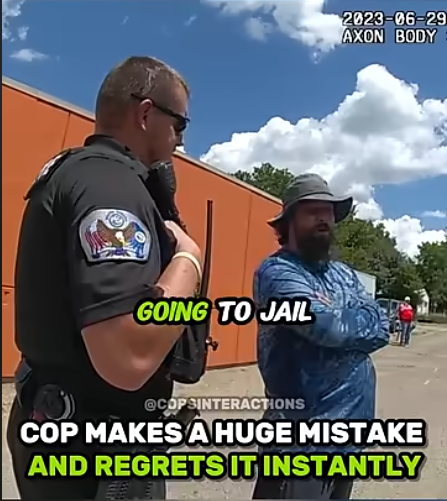
A Minor Accident, a Major Confrontation: Police Authority, Personal Rights, and the Breakdown of Cooperation
Introduction
A minor traffic accident is usually expected to be a routine matter. Two drivers stop, assess the damage, exchange information, contact insurance companies if necessary, and move on. In many cases, the situation is inconvenient but not dramatic. However, when questions of police authority, personal rights, government power, and individual resistance enter the picture, even a small roadside incident can become a tense public confrontation.
The video described shows exactly that kind of encounter. What begins as a police officer’s attempt to obtain identification from a driver after a minor accident quickly becomes a heated dispute about legal authority and personal freedom. The officer appears to believe that, because the driver was involved in an accident, he is required to provide identification. The driver refuses, repeatedly demanding to know what crime he has committed and insisting that the officer has no right to detain him or require his documents.
The interaction is not simply about a driver’s license or a traffic report. It becomes a symbolic conflict between two competing views of authority. On one side is the police officer, representing the state and attempting to manage a traffic incident according to official procedure. On the other side is the driver, who sees the officer’s involvement as unnecessary, unlawful, and threatening. The driver argues that he and the other party have already resolved the matter privately and that no “third-party interloper” is needed.
As the conversation continues, the driver’s language becomes increasingly confrontational. He calls the officer a “tyrant” and a “road pirate.” He accuses the officer of attempted kidnapping and extortion. He mocks the officer, claims the officer is shaking, and threatens to file charges if the officer continues to detain him or attempts to force him against the car.
This article examines the confrontation as a broader example of what can happen when communication breaks down between police and citizens. It explores the key issues raised by the video: refusal to identify, distrust of government authority, private resolution of disputes, escalation, and the role of law enforcement after even minor accidents. The article does not attempt to determine the exact legal outcome of the incident, since laws vary by location and the full context of the video is not available. Instead, it focuses on the themes, tensions, and lessons visible from the encounter as described.
The Roadside Setting
Traffic stops and accident scenes are among the most common points of contact between ordinary citizens and police officers. Unlike serious criminal investigations, these encounters often involve people who were simply driving to work, going home, running errands, or traveling with family. The average person may not expect a routine accident to become a legal confrontation.
In this case, the situation appears to begin with a minor traffic accident. There is no indication from the description that the accident caused serious injury or major damage. The driver claims that he has already spoken with the other person involved and agreed to compensate them for the damage. From his point of view, the matter has already been handled privately. He does not see a need for police intervention.
For the officer, however, the presence of an accident changes the situation. A police officer responding to an accident may be expected to identify the parties involved, determine whether a report is needed, verify insurance or registration, and ensure that the scene is safe. In many jurisdictions, drivers involved in accidents may be required to provide information to other parties and, in some circumstances, to law enforcement.
This difference in perspective is central to the conflict. The driver sees the accident as a private civil matter between two individuals. The officer appears to view it as an official traffic incident requiring documentation. Neither side seems willing to accept the other’s framework. As a result, the simple act of asking for identification becomes the central point of resistance.
The roadside environment also adds pressure. Encounters near traffic can be dangerous, unpredictable, and stressful. Officers may be trained to control scenes quickly for safety reasons. Drivers, meanwhile, may feel exposed, embarrassed, or threatened when confronted by uniformed authority in public. These pressures can turn a disagreement into a power struggle very quickly.
Refusal to Identify
The driver’s refusal to provide identification is the main issue that drives the confrontation. According to the description, the officer asks for the driver’s ID because he was involved in an accident. The driver repeatedly refuses, asking what crime he committed and arguing that the officer has no right to demand his identification.
This response reflects a common argument made in encounters between citizens and police: the belief that a person should not have to identify themselves unless they are suspected of a specific crime. The driver frames the officer’s request as illegitimate because, in his view, no crime has occurred. He wants the officer to state a criminal accusation before he complies.
The officer, however, appears to be operating from a different understanding. He is not necessarily claiming that the driver committed a crime in the traditional sense. He may simply be attempting to complete an accident investigation or traffic report. From the officer’s point of view, the driver’s involvement in the accident may be enough to require identification.
This is where legal misunderstanding or disagreement can become dangerous. The driver’s position may be based on a belief about constitutional rights, personal liberty, or limits on state power. The officer’s position may be based on traffic codes, accident reporting rules, or department policy. If neither side explains the basis of their position clearly, the encounter can quickly become a contest of will rather than a discussion of law.
The question “What crime did I commit?” becomes more than a request for information. It becomes a challenge to the officer’s authority. The driver is not merely asking for clarification; he is refusing to recognize the officer’s power unless the officer can justify it in the driver’s chosen terms. The officer, in turn, may interpret the refusal as obstruction, noncompliance, or resistance.
The Demand for Legal Justification
One of the most important themes in the video is the driver’s demand for legal justification. He repeatedly asks why he must identify himself and what legal authority the officer has. This kind of demand is not unusual in modern police encounters, especially when citizens record interactions and challenge officers in real time.
At its best, asking for legal justification can be a legitimate act of civic awareness. Citizens have rights, and police officers are not above the law. It is reasonable for a person to want to know why they are being detained, what law they are accused of violating, and whether they are free to leave. A society that values liberty should allow citizens to ask questions of government officials.
However, the way such questions are asked matters. In the described encounter, the driver’s demands appear to be mixed with insults, accusations, and threats. Instead of calmly asking, “Officer, can you explain the legal basis for requiring my identification?” the driver reportedly calls the officer a tyrant and a road pirate. This changes the tone of the interaction.
When a person challenges an officer’s authority aggressively, the officer may become more defensive. Instead of creating clarity, the exchange may create hostility. The officer may focus less on explaining the law and more on gaining compliance. The driver may interpret that as further proof of abuse. Each side’s reaction confirms the other side’s fears.
The demand for legal justification is therefore complicated. It can be a healthy check on government power, but it can also become a confrontational tactic that increases tension. The difference often lies in tone, patience, and willingness to listen.
The Driver’s View of Government Intervention
The driver’s broader argument is that government involvement is unnecessary. He claims that he and the other party involved in the accident have already handled the matter privately. He argues that two men can solve their own problems without interference from “third-party interlopers.”
This view reflects a strong belief in personal responsibility and private resolution. From this perspective, if one person damages another person’s property and agrees to pay for it, the matter should be settled. There is no need for police, paperwork, fines, or state involvement. The driver sees the officer not as a helper but as an intruder.
There is a certain intuitive appeal to this argument. Many minor disputes are resolved privately every day. People apologize, exchange money, repair property, or make informal agreements. Not every problem requires government action. In fact, many people would prefer to avoid official involvement when a matter can be handled respectfully and directly.
However, traffic accidents can involve more than the immediate agreement between two people. There may be insurance requirements, reporting laws, hidden injuries, disputes about fault, damage that becomes more serious later, or public safety concerns. A private agreement at the scene may not always protect both parties. One person may later deny responsibility, refuse payment, or change their story. A police report can create an official record.
The driver’s objection, therefore, raises an important philosophical question: when should private citizens be allowed to resolve matters alone, and when does the state have a legitimate role? The answer depends on law, context, and public policy. The video shows what happens when one person’s belief in private settlement directly conflicts with the officer’s understanding of official duty.
The Officer’s Role After an Accident
Police officers responding to accidents are often expected to do more than simply determine whether a crime occurred. They may help secure the scene, prevent further accidents, check for injuries, document the parties involved, gather statements, and determine whether any traffic violations contributed to the incident. Even a minor accident may require some level of official attention.
From the officer’s perspective, asking for identification may be a basic step. Without identifying the driver, the officer cannot easily complete a report, confirm that the driver is licensed, or verify that the person involved is who they claim to be. The officer may also need to ensure that the driver is not wanted on outstanding warrants or operating without a valid license.
The driver’s refusal disrupts that process. What might have been a brief exchange becomes a standoff. The officer’s authority is challenged, and the officer must decide whether to continue demanding compliance, explain further, call for backup, issue a citation, make an arrest, or disengage. Every option carries risk.
If the officer backs down, it may appear that citizens can simply refuse lawful requests. If the officer escalates, it may appear that the officer is abusing power over a minor accident. The difficulty of the officer’s position is that he must balance procedure, safety, authority, and public perception in real time.
The video, as described, does not show a calm explanation from either side. Instead, it shows the officer attempting to obtain identification and the driver refusing while making accusations. In such an environment, the officer’s role becomes harder because the original purpose of the encounter is overshadowed by the argument itself.
Accusations of Tyranny and Abuse
The driver’s language is one of the most striking parts of the confrontation. He calls the officer a “tyrant” and a “road pirate.” These words are not neutral. They are meant to delegitimize the officer’s authority and portray him as someone using state power for personal or unlawful purposes.
Calling an officer a tyrant suggests that the officer is not merely mistaken but oppressive. Calling him a road pirate suggests that traffic enforcement is a form of theft or extortion. These accusations place the driver’s argument within a larger anti-government or anti-police narrative: the idea that officers use traffic laws to control people, extract money, and violate rights.
Such language can be emotionally powerful. It appeals to people who feel that government has become too intrusive or that police often exceed their authority. For viewers who already distrust law enforcement, the driver’s words may sound courageous. He appears to be standing up to power and refusing to be intimidated.
For others, the same language may sound reckless and disrespectful. They may see the officer as simply doing his job after an accident. From that viewpoint, the driver’s insults are unnecessary and counterproductive. Instead of resolving the matter, he creates a conflict that could have been avoided.
The accusations also affect the emotional temperature of the scene. Once the driver labels the officer as a tyrant or criminal actor, compromise becomes harder. The officer is no longer treated as a public servant carrying out a duty; he is treated as an enemy. This framing makes cooperation almost impossible.
Claims of Kidnapping and Extortion
The driver reportedly accuses the officer of attempted kidnapping and extortion. These are serious accusations. Kidnapping normally refers to unlawfully taking or detaining a person against their will. Extortion usually refers to obtaining something through threats or coercion. By using these words, the driver is claiming that the officer’s attempt to detain him or obtain identification is not lawful authority but criminal conduct.
This kind of language is common in certain anti-government arguments, where routine police actions are reframed as crimes committed under color of law. A traffic ticket may be described as extortion. A detention may be described as kidnapping. An order to exit a vehicle may be described as assault or unlawful seizure.
The rhetorical purpose is clear: the driver wants to reverse the moral roles. Instead of being the person under investigation or subject to police commands, he wants to position himself as the victim of a crime. The officer becomes the wrongdoer. The driver becomes the injured party defending himself.
However, using extreme legal terms in a tense roadside encounter can create confusion and escalation. If the officer believes he has lawful authority to detain the driver, he is unlikely to accept the accusation that he is committing kidnapping. Instead, he may see the driver’s statements as irrational, hostile, or intentionally obstructive.
The driver’s threats to file charges also intensify the confrontation. Rather than asking for a supervisor, requesting clarification, or stating that he does not consent, he appears to warn the officer that continued detention will result in legal consequences. This may be intended to intimidate the officer into backing down. But it may also make the officer more determined to assert control.
Mockery and Psychological Pressure
Another key detail is that the driver allegedly mocks the officer by saying he can see the officer shaking. This is a psychological tactic. The driver is not only challenging the officer’s legal authority; he is challenging his confidence, courage, and emotional control.
Mockery can be a powerful tool in confrontations because it shifts attention from the issue to the person. Instead of discussing whether the officer has authority to request identification, the driver focuses on the officer’s physical reaction. He implies that the officer is nervous, afraid, or uncertain. This may be intended to make the officer feel embarrassed, especially if the encounter is being recorded.
In the age of viral videos, public embarrassment has become a major part of police-citizen encounters. People know that a video can be posted online and judged by thousands or millions of viewers. A driver who mocks an officer on camera may be trying to create a narrative in which the officer appears weak or exposed.
For the officer, this kind of mockery can be difficult to ignore. Police officers are trained to maintain control, but they are still human beings. Being insulted, accused, and mocked can create frustration. If the officer reacts emotionally, the driver may use that reaction as further evidence of misconduct.
This dynamic is dangerous because it turns the encounter into a performance. The goal is no longer simply to solve the accident issue. It becomes about winning the argument, humiliating the other person, and controlling how the video will be perceived by viewers later.
Private Resolution Versus Public Law
The driver’s argument that the accident had already been privately resolved is central to the philosophical conflict. He believes that because he and the other person reached an agreement, the officer has no further role. This raises an important question: when does private agreement end the matter, and when does public law still apply?
In many areas of life, private settlement is encouraged. Civil disputes are often resolved through negotiation, mediation, or payment. If someone breaks a neighbor’s fence and agrees to repair it, police may not need to be involved. If two people have a minor disagreement and settle it peacefully, that can be a positive outcome.
Traffic accidents, however, occur in a regulated public space. Roads are governed by traffic laws because unsafe driving can endanger not only the parties involved but also other drivers, pedestrians, and the public. Even if two individuals agree on payment, the state may still have an interest in whether a law was violated, whether the drivers were licensed, whether insurance requirements were met, or whether a report is required.
The driver appears to reject this broader public interest. He frames the matter as strictly personal: one man damaged another man’s property and agreed to pay. The officer likely sees the matter as both personal and public: an accident occurred on the road, and the state has rules for documenting and regulating such incidents.
Neither perspective is entirely meaningless. The driver’s desire for private responsibility speaks to a legitimate frustration with bureaucracy. The officer’s involvement speaks to the practical need for records, accountability, and public safety. The confrontation happens because both perspectives are treated as mutually exclusive.
The Language of Sovereignty and Resistance
Although the description does not label the driver as belonging to any particular movement, his language resembles arguments often used by people who strongly reject government authority in traffic and identification contexts. Phrases about “third-party interlopers,” accusations of extortion, and demands to know what crime was committed often appear in confrontations where individuals deny or challenge the legitimacy of state power.
The important point is not to attach a label to the driver, but to understand the pattern. He appears to believe that unless he has harmed someone in a way that constitutes a specific crime, the officer has no authority over him. He also appears to believe that private agreement overrides official procedure. This worldview treats government authority as something that must constantly prove itself and, when it cannot do so to the individual’s satisfaction, may be ignored.
This form of resistance can be appealing to people who feel powerless in modern bureaucratic systems. Traffic laws, fines, licensing requirements, registration fees, insurance mandates, and police stops can feel like endless layers of control. A person may begin to see every official demand as part of a larger system of coercion.
However, a society based entirely on individual interpretation of law would be difficult to manage. If every driver could decide for themselves whether police had authority after an accident, routine enforcement would become chaotic. The challenge is to protect individual rights while also maintaining a workable system of public order.
The video illustrates the tension between personal sovereignty and collective regulation. The driver claims the right to decide whether the officer’s involvement is legitimate. The officer represents a system in which individual drivers do not get the final word on whether traffic laws apply.
The Escalation of the Encounter
Escalation is one of the most important aspects of the video. The incident could have remained a brief exchange about identification. Instead, it becomes a heated confrontation involving accusations, threats, mockery, and warnings of legal action.
Escalation often happens in stages. First, there is a request: the officer asks for ID. Second, there is refusal: the driver says no and demands justification. Third, there is a repeated command or explanation from the officer. Fourth, the driver interprets the repeated demand as unlawful pressure. Fifth, insults and accusations enter the conversation. Finally, threats of force or legal consequences become part of the exchange.
At each stage, both sides have opportunities to reduce tension. The officer might calmly explain the specific law or policy requiring identification after an accident. The driver might state his objection respectfully while avoiding insults. Either person might pause, lower their voice, or request a supervisor. But once the interaction becomes personal, those opportunities become harder to take.
The driver’s warning that he will file charges for assault and kidnapping if the officer continues to detain him or attempts to force him against the car shows that the confrontation is approaching a physical boundary. The issue is no longer only verbal. The driver is anticipating that the officer may use force, and he is trying to create a legal warning before that happens.
This kind of moment is especially dangerous. If the officer moves to physically detain the driver, the driver may resist because he believes the detention is unlawful. The officer may then interpret the resistance as justification for greater force. A minor accident can quickly become an arrest, injury, or criminal case.
Communication Failure
At the heart of the incident is a failure of communication. The officer and the driver are speaking, but they do not appear to be communicating in a productive way. Each side hears the other as a threat.
The officer’s request for ID is heard by the driver as an unlawful demand. The driver’s refusal is heard by the officer as noncompliance. The officer’s continued insistence is heard by the driver as tyranny. The driver’s accusations are heard by the officer as hostility. The cycle repeats, with each response making the next one worse.
Good communication in police encounters requires clarity and restraint. Officers should explain the reason for their requests when possible. Citizens should be able to ask questions without being punished for asking. At the same time, citizens who disagree with an officer should understand that roadside arguments are rarely the best place to fully litigate legal theories. Courts, supervisors, complaints, and attorneys are usually better forums for resolving disputes about authority.
The driver in the video appears to want the officer to debate him in real time. The officer appears to want immediate compliance. These goals are incompatible. The driver wants justification before action. The officer wants action before further debate. Without a shared process for resolving that disagreement, the encounter becomes a power struggle.
This communication failure is not unique to this incident. Many police-citizen conflicts follow a similar pattern. A command is given, a citizen questions it, the officer repeats it, the citizen resists, and both sides become increasingly convinced that the other is acting in bad faith.