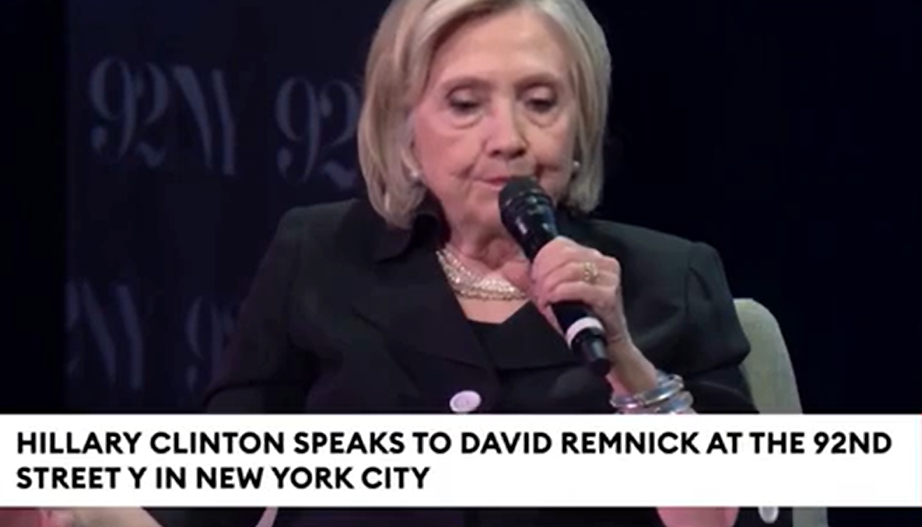
Hillary Clinton has surprised many Democrats and political observers by offering rare praise for President Donald Trump’s approach to Gaza, describing his 20-point proposal as the “only game in town.” The statement stood out not only because Clinton has been one of Trump’s most prominent political opponents for more than a decade, but also because it placed her at odds with critics on the Democratic left who have rejected the administration’s plan as unfair, unrealistic or too closely aligned with the priorities of the Israeli government.
Clinton made the remarks during a public conversation in New York with journalist David Remnick. The discussion covered American politics, the Middle East, the future of the Democratic Party and the continuing consequences of the wars involving Israel, Hamas and Iran. When the conversation turned to the possibility of a two-state solution, Remnick questioned whether the idea remained realistic after years of failed negotiations, growing distrust and political changes on both sides.
Clinton acknowledged that the outlook was extremely difficult. Israeli politics had moved further away from support for a Palestinian state, while Palestinian political institutions remained deeply divided and weakened. Gaza had been devastated, Hamas remained an armed force, and the Palestinian Authority lacked the confidence and support needed to take control of the territory easily. Despite those obstacles, Clinton argued that Trump’s proposal at least created a framework around which serious diplomacy could take place.
Her praise was carefully limited. She did not endorse Trump’s broader foreign policy, his leadership style or his political movement. She also did not claim that the plan was perfect. Instead, she said it represented a possible path toward Israeli security, reconstruction in Gaza and eventual Palestinian self-determination. In her view, the absence of a stronger alternative made it necessary to examine the proposal on its merits rather than reject it simply because it came from Trump.
That position was striking because Clinton and Trump have one of the most bitter political rivalries in modern American history. They faced each other in the 2016 presidential election, and Clinton has repeatedly warned that Trump poses a danger to democratic institutions and American leadership. Trump, in turn, has spent years attacking Clinton, questioning her character and using her as a symbol of the political establishment he claims to oppose.
For Clinton to offer any praise of a Trump initiative was therefore certain to attract attention. Her remark suggested that the Gaza crisis had reached a point where traditional partisan loyalties should not determine whether a diplomatic proposal receives consideration.
Clinton’s argument rested on a practical calculation. Gaza requires enormous reconstruction after years of warfare, displacement and destruction. Israel continues to demand guarantees that Hamas will not rebuild its military capabilities. Palestinians need a political future that offers more than indefinite military control, humanitarian dependency or repeated cycles of conflict. Regional governments want stability, but they are reluctant to accept responsibility for Gaza without a credible international structure.
Trump’s plan attempts to address those competing demands through a series of connected steps. The framework reportedly includes the disarmament of Hamas, the release of remaining hostages, reconstruction of Gaza, the creation of a new governing arrangement and a security structure intended to prevent armed groups from regaining control.
It also contains controversial ideas about economic redevelopment and international supervision. Supporters argue that Gaza cannot recover without outside investment, security guarantees and a government that is not controlled by Hamas. Critics fear that economic development could be used as a substitute for Palestinian political rights or that powerful outside actors could reshape the territory without meaningful consent from Palestinians.
Clinton’s support appeared to depend on the entire framework being applied rather than only the provisions favored by Israel or the Trump administration. She warned against reducing the proposal to Hamas’s disarmament followed by selective commercial reconstruction. For the plan to provide a genuine path forward, she argued, it would need to include the political and humanitarian elements related to Palestinian governance, rebuilding and self-determination.
That distinction is important. Many Palestinians and their supporters fear that disarmament demands could be enforced while promises about statehood, freedom of movement or political rights are delayed indefinitely. They point to earlier peace processes in which temporary arrangements remained in place for years while settlement expansion, military restrictions and political fragmentation continued.
Clinton appeared to recognize that danger. Her argument was not that Palestinians should accept security demands without receiving anything in return. Rather, she suggested that a complete agreement would have to connect Israeli security with Palestinian reconstruction and a credible political future.
The statement nevertheless placed her in conflict with parts of the Democratic coalition. Progressive lawmakers, activists and human rights organizations have strongly criticized Trump’s policies toward Gaza. Many accuse his administration of treating Palestinian lives and political rights as secondary to Israeli and American strategic interests.
Some Democratic critics have also objected to proposals that involve moving Palestinians, changing Gaza’s demographic character or placing the territory under long-term foreign management. They argue that reconstruction must be led by Palestinians and that residents must not be pressured to leave their homes.
Trump’s earlier language about transforming Gaza into a prosperous coastal destination caused particular outrage. Critics said it made the territory sound like a real-estate opportunity rather than the homeland of more than two million Palestinians who had experienced war and displacement.
Clinton indirectly acknowledged that concern when she distinguished serious reconstruction from simply building hotels or resorts along the coast. Her comments suggested that economic projects alone would not create lasting peace. Without legitimate government, security and political rights, new buildings would not solve the deeper conflict.
Her position reflects the approach of a former secretary of state who spent years dealing with Middle Eastern diplomacy. Clinton has long supported Israel’s security while also endorsing a negotiated two-state solution. She has frequently argued that Hamas’s military power and rejection of Israel make peaceful progress more difficult.
At the same time, she has supported the principle that Palestinians should have the opportunity to govern themselves. Her willingness to consider Trump’s plan is consistent with a more traditional foreign-policy view that imperfect agreements may be preferable to continued war when no better framework is available.
The phrase “only game in town” did not mean that Clinton believed every element of the proposal was good. It meant that the plan had the support, attention and resources necessary to influence events. Diplomatic proposals have little value if they are not backed by governments capable of pressuring the parties and financing reconstruction.
The United States remains the country with the greatest ability to influence Israel. Washington provides military support, diplomatic protection and political backing. It also has relationships with Arab governments that could contribute money, security personnel or political support to a postwar arrangement.
A plan supported by an American administration therefore has a practical advantage over proposals produced by outside groups without enforcement power. Clinton’s argument was that critics must offer a workable alternative if they want the Trump framework abandoned.
That challenge is difficult because the central problems remain unresolved. Hamas would have to agree to disarm or be prevented from operating as an armed organization. Israel would have to accept limits on its military role and support the transfer of authority to another governing body. Palestinians would need confidence that the new system was not simply a form of permanent occupation under a different name.
Arab states would also have to decide how much responsibility they were willing to assume. Egypt, Jordan, Saudi Arabia, Qatar and the United Arab Emirates have different interests and different relationships with Israel, Hamas, the Palestinian Authority and the United States.
Some regional governments may be willing to finance reconstruction but reluctant to deploy forces. Others may demand a firm commitment to Palestinian statehood before joining the effort. None wants to become responsible for controlling Gaza while Israel retains the ability to intervene militarily.
The political future of Gaza is therefore inseparable from the larger Israeli-Palestinian conflict. A temporary administrative arrangement might reduce violence, but it would not answer questions about borders, settlements, Jerusalem, refugees or sovereignty.
Clinton’s comments suggested that the Trump plan could create a beginning rather than a final settlement. She described a small possibility of movement at a time when the traditional peace process appears close to collapse.
Her willingness to say something positive about Trump may also reflect frustration with automatic partisan opposition. American politics often encourages Democrats and Republicans to reject each other’s proposals before examining the details.
Clinton argued that some people oppose the Gaza plan mainly because Trump created it. That accusation will anger Democrats who believe their objections are based on human rights and international law rather than personal dislike of the president.
Still, her warning raises an important question. If a political opponent presents an idea that could reduce suffering or create diplomatic progress, should it be rejected because of its source?
Clinton’s answer was clearly no. She believes the plan should be judged according to whether it can produce security, reconstruction and political progress.
Republicans quickly welcomed her remarks because they could present them as validation from one of Trump’s greatest enemies. Supporters of the president argued that Clinton’s statement proved his foreign policy had gained respect beyond the Republican Party.
They also used her words to criticize Democrats who had dismissed the proposal. In their view, Clinton’s support showed that opposition within her party was motivated more by hostility toward Trump than by concern about the Middle East.
However, Clinton’s comments should not be confused with full support for Trump’s conduct. She continued to criticize him sharply on other subjects during the same conversation. Her praise was narrow and conditional.
She made clear that the plan would have to be applied in full and that a limited version focused only on Israeli security would not be sufficient. Trump’s allies may emphasize the “only game in town” phrase while ignoring those conditions.
The reaction among Democrats is likely to be divided. Centrist and pro-Israel Democrats may welcome Clinton’s comments as a realistic acknowledgment that Hamas cannot continue governing Gaza with an armed wing.
Progressive Democrats may argue that the plan gives too much authority to the United States and Israel while failing to guarantee full Palestinian sovereignty. They may also question whether Trump can be trusted to carry out the political promises included in the framework.
Trust is one of the greatest obstacles. Palestinians have heard many promises of future statehood while watching conditions on the ground move in the opposite direction. Israelis have experienced attacks, hostage-taking and repeated rocket fire after earlier withdrawals and ceasefires.
Each side therefore sees compromise as a possible trap. Israelis fear that a Palestinian state could become a base for future attacks. Palestinians fear that temporary security arrangements will become permanent restrictions.
The October 7, 2023 Hamas assault on Israel and the war that followed deepened those fears. Israeli communities suffered killings and abductions, while Gaza experienced massive destruction and civilian loss. Families on both sides were traumatized, making political compromise more difficult.
Clinton noted the depth of that trauma. Even a technically strong diplomatic plan may fail if leaders cannot persuade their people to accept painful concessions.
Hamas’s disarmament is perhaps the most difficult immediate requirement. The organization has treated armed resistance as central to its identity and political legitimacy. Agreeing to surrender weapons would amount to a historic change.
Some Hamas members could be offered amnesty if they accepted a peaceful role. Others might refuse and continue operating underground. Enforcing disarmament could require outside security forces, intelligence cooperation and the control of weapons entering Gaza.
Israel would want strong guarantees before reducing its military presence. Yet a long-term Israeli security role would make Palestinians less willing to accept the new system.
The governing arrangement would face similar problems. The Palestinian Authority is internationally recognized but unpopular among many Palestinians. Critics view it as corrupt, ineffective and too dependent on cooperation with Israel.
Installing the authority in Gaza without elections or major reforms could create a legitimacy crisis. Local administrators, independent Palestinian figures and Arab governments might need to participate in a transitional structure.
Clinton’s support for the plan does not resolve any of these questions. It does, however, signal that some experienced Democratic foreign-policy leaders believe the framework deserves serious engagement.
Her comments may influence international observers who are uncertain about joining Trump’s initiative. Governments that distrust him may be more willing to examine the proposal if a well-known Democratic figure also sees potential in it.
Clinton’s history gives her remarks weight. As secretary of state under President Barack Obama, she dealt closely with Israeli leaders, Palestinian officials and Arab governments. She understands the long record of failed negotiations and the political risks involved.
That experience may also make her more skeptical of perfect solutions. Diplomacy often requires working with plans that satisfy no one completely. The choice may not be between a good agreement and a bad one, but between an imperfect agreement and continued war.
Critics will argue that calling a plan the only available option can create pressure to accept serious flaws. They may say that policymakers should develop better alternatives rather than treating the Trump framework as unavoidable.
Possible alternatives include an internationally led ceasefire, direct United Nations administration, renewed Palestinian elections or a regional peace conference. Each idea faces its own political and practical barriers.
The United Nations has humanitarian expertise but limited enforcement power. Palestinian elections would be difficult to organize during displacement and destruction. A regional conference could produce broad principles without securing agreement from Israel or Hamas.
This is why Clinton emphasized political reality. A plan requires more than moral appeal. It needs money, security arrangements, diplomatic support and leverage over the parties.
Trump’s plan has those advantages because it is backed by the American presidency. Whether it uses that power responsibly is a separate question.
The president’s unpredictable style remains a concern for allies and opponents. Major diplomatic agreements require consistent attention over many years. Reconstruction and political transition in Gaza would take far longer than a single announcement or summit.
Governments involved in the plan would need confidence that the United States would not suddenly change its conditions or abandon the process.
Clinton’s endorsement may be intended partly to build bipartisan support so that the framework survives future political changes. Middle Eastern leaders often hesitate to make difficult commitments when American policy changes after each election.
A plan supported by figures from both major parties could appear more durable. That would encourage regional governments to invest money and political capital.
Bipartisan support, however, would require the administration to include Democratic concerns. That might involve stronger guarantees against forced displacement, independent humanitarian oversight and clearer commitments to Palestinian political rights.
It would also require transparency about who would govern Gaza, who would control reconstruction funds and how security forces would be held accountable.
Corruption is a serious risk during reconstruction. Billions of dollars could be needed to rebuild homes, hospitals, schools, roads, water systems and energy infrastructure. Without strong oversight, money could be stolen, redirected or used to strengthen political factions.
Aid must also reach civilians without becoming a tool of control. During the war, arguments over food distribution and humanitarian access became central political issues. A postwar system would need reliable mechanisms for delivering assistance fairly.
Clinton’s comments focused attention on the difference between rebuilding Gaza and transforming it without the consent of its people. Reconstruction should allow residents to return to normal life, not simply create profitable opportunities for foreign investors.
Palestinians would need a meaningful voice in deciding what is built, who owns land and how communities are organized. Otherwise, economic development could deepen resentment rather than create stability.
The plan’s promise of self-determination is therefore critical. Clinton described the idea cautiously, recognizing that its exact meaning remained uncertain.
For Palestinians, self-determination generally means an independent state and control over borders, resources and government. Israeli leaders may define it more narrowly, allowing local administration while retaining security control.
If the plan avoids resolving that difference, it may provide only temporary relief. Clinton appears to believe that even limited progress could create conditions for later negotiations.
Her critics may see that as repeating the failures of earlier peace efforts. Temporary arrangements have often lasted far beyond their intended duration.
The Oslo process of the 1990s created Palestinian self-government in parts of the West Bank and Gaza but did not produce a final agreement. Violence, settlement expansion, political assassinations and mutual distrust gradually weakened the process.
Clinton’s generation of Democratic policymakers invested heavily in that model. Her support for Trump’s plan may reflect a belief that the old approach can no longer be restored in its previous form.
The political environment has changed dramatically. Israeli society is more skeptical of territorial withdrawal. Palestinian politics is divided between rival authorities. Regional governments are increasingly focused on economic development and security competition with Iran.
Any new plan must respond to those realities.
Trump’s supporters believe his willingness to break with traditional diplomacy gives him an advantage. They argue that earlier presidents repeated formulas that no longer worked.
His critics fear that his approach favors pressure, commercial deals and personal relationships over international law and durable institutions.
Clinton’s statement occupies a middle position. She remains critical of Trump but accepts that his administration has produced the proposal with the greatest chance of being implemented.
That willingness to separate the policy from the politician is unusual in a highly polarized era. It may also create political risks for Clinton.
Some Democratic activists already view her foreign policy as too supportive of military power and too close to the Israeli government. Her praise for Trump will reinforce those concerns.
Others will respect the decision to acknowledge a potentially useful idea from a political enemy. They may see it as an example of the seriousness expected from a former secretary of state.
Clinton is no longer running for office, giving her more freedom to take an unpopular position. She does not need to satisfy a Democratic primary electorate or defend herself in a campaign.
Her remarks may therefore reflect her genuine assessment more than a political calculation.
They also show that debate over Gaza does not always follow simple party lines. Democrats disagree with one another about Israel, Hamas, Palestinian statehood and American military support. Republicans also contain divisions between traditional supporters of Israel and isolationists who want less American involvement abroad.
Trump’s plan will be judged not only according to party loyalty but also according to its results.
If it secures the release of hostages, reduces violence and allows reconstruction to begin, Clinton’s support may appear justified. If it fails to protect Palestinian civilians or becomes a cover for indefinite control, critics will say her praise was misplaced.
The plan’s success depends on implementation, not speeches. Each step must be connected to clear responsibilities and consequences.
Who will disarm Hamas? Who will protect civilians? Who will govern Gaza? Who will pay for reconstruction? How will disputes be resolved? What happens if Israel or Palestinian groups violate the agreement?
Without clear answers, the framework may remain more of a political statement than an operational plan.
Clinton’s comments are therefore best understood as conditional optimism. She sees a small opening in a situation filled with suffering and failed alternatives.
Her phrase “only game in town” expresses urgency as much as approval. It suggests that rejecting the proposal without creating another workable option could leave Gaza trapped in devastation and Israel trapped in continuing conflict.
That argument will not satisfy people who believe the plan is fundamentally unjust. They will say that desperation should not force Palestinians to accept arrangements created without adequate representation.
Supporters will respond that continued delay also carries a terrible cost. Every month without a political settlement can mean more displacement, hunger, insecurity and radicalization.
The moral challenge is to avoid treating urgency as an excuse for injustice while also avoiding the search for a perfect agreement that never arrives.
Clinton’s intervention adds an experienced Democratic voice to that debate. She is asking critics to engage with the plan rather than dismiss it because of Trump.
That does not require silence about its weaknesses. In fact, serious engagement may involve demanding changes, protections and clearer commitments.
The most productive response to her remarks would be a detailed discussion of the plan’s provisions rather than another partisan argument about whether Trump deserves praise.
Democrats who reject the proposal should explain what alternative they support and how it would be implemented. Republicans who celebrate Clinton’s endorsement should also acknowledge her warning that all parts of the plan must be honored.
Selective implementation would destroy the balance she believes makes the framework valuable. Disarming Hamas without creating Palestinian political rights would not fulfill her vision. Rebuilding coastal areas without restoring communities would not fulfill it either.
Israeli security, Palestinian freedom and Gaza’s reconstruction must be treated as connected goals.
That is an extremely demanding standard. It requires leaders who are willing to resist pressure from their own supporters and accept compromise.
The Israeli government would need to recognize that military control cannot provide permanent peace. Palestinian leaders would need to reject armed attacks and build trustworthy institutions. Arab states would need to invest not only money but political authority.
The United States would need to apply pressure consistently, including when allies resist.
Whether the Trump administration is prepared to meet that standard remains uncertain. Clinton’s praise does not answer the question, but it increases attention on the administration’s responsibility to deliver.
Trump may welcome the support as a political victory. Yet Clinton’s conditions create expectations that could later be used to judge him.
If the plan becomes centered on commercial redevelopment while Palestinian self-determination disappears, her endorsement could turn into criticism.
The rare moment of agreement between Clinton and Trump therefore should not be mistaken for a broader political reconciliation. Their differences remain deep.