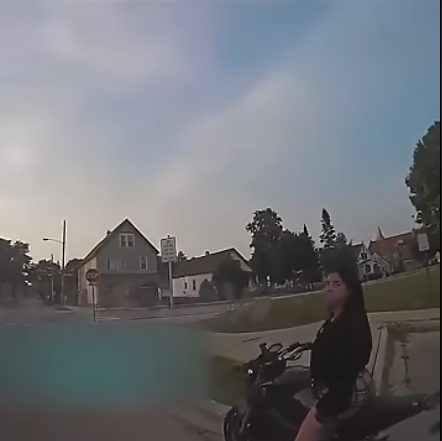
Confrontation on the Street: A Police Encounter That Quickly Escalated
The video shows a tense and rapidly escalating confrontation between a police officer and several individuals gathered around a motorcycle. What begins as a seemingly routine interaction between the officer and a woman seated on a motorcycle quickly develops into a chaotic scene involving raised voices, physical resistance, crowd interference, and the eventual detention of a man who becomes the central focus of the encounter.
The footage centers on the officer’s attempt to gain control of the situation while multiple people nearby question his actions, move around him, and appear unwilling to comply with repeated commands to step back. The officer’s attention is first directed toward the woman on the motorcycle, but the situation changes when others in the group become more involved. Among them is a man wearing a black “Thrasher” shirt, who is later detained after a physical struggle with the officer.
Throughout the video, the officer repeatedly attempts to establish control by giving direct verbal commands. He tells the woman to turn off the motorcycle, asks her to step away from it, and later commands the surrounding individuals to back off and show their hands. The group’s reactions, combined with the officer’s escalating concern for safety, create an atmosphere of disorder and tension.
By the end of the video, additional officers arrive at the scene. Their arrival appears to help stabilize the confrontation after the original officer calls for backup and continues trying to restrain the man while keeping the surrounding crowd at a distance. The incident highlights how quickly a police interaction can become volatile when bystanders interfere, emotions rise, and commands are ignored.
The Beginning of the Encounter
The video begins with a police officer approaching a woman who is on a motorcycle. At this early stage, the officer appears focused on separating the woman from the motorcycle and gaining basic control of the situation. He asks her to turn the motorcycle off and step away from it. These commands suggest that the officer is attempting to reduce any immediate risk connected to the vehicle, such as the possibility of the motorcycle being driven away or used to flee.
The woman does not immediately comply in a straightforward manner. At first, she claims that she does not speak English. However, shortly afterward, she responds to the officer by asking, “Why?” This response becomes an important moment in the encounter because it suggests confusion, hesitation, or possible resistance to the officer’s instructions. Whether the woman truly does not understand everything the officer says or is attempting to avoid answering is not fully clear from the description, but her response contributes to the delay in compliance.
The officer also asks about identification, and the woman states that she does not have an ID on her. This adds another layer to the situation. In many police encounters, identification can play an important role in allowing officers to determine who they are speaking with and whether any further action is required. The lack of identification may have increased the officer’s need to continue questioning her and maintain control of the scene.
At this stage, the confrontation is tense but not yet physically violent. The officer’s commands are direct, and the woman’s responses are hesitant. The scene appears manageable, but the presence of other people nearby begins to change the nature of the encounter. Instead of remaining a direct interaction between the officer and the woman on the motorcycle, the situation begins to involve a group.
The Role of the Motorcycle
The motorcycle is an important element in the opening moments of the video. The officer’s first instruction is for the woman to turn it off and step away. This indicates that the motorcycle is not merely a background object but a point of concern. A running motorcycle can create uncertainty during a police stop or street encounter. It can allow someone to leave quickly, make noise that interferes with communication, or create safety concerns for both the officer and others nearby.
When the officer asks the woman to move away from the motorcycle, he appears to be attempting to create physical separation between her and the vehicle. This can be a common safety tactic in tense situations. By moving a person away from a vehicle, an officer may reduce the possibility that the person can access something hidden, restart the vehicle, or suddenly move away from the scene.
The woman’s reluctance or hesitation to step away contributes to the officer’s concern. Even if she is confused or does not understand every command, the officer appears to interpret the lack of immediate compliance as a problem that must be addressed. In a police encounter, delays in following commands can increase suspicion and tension, especially when other people begin to gather or interfere.
The motorcycle also becomes symbolic of the larger issue in the video: control. The officer is trying to control the immediate environment, while the woman and nearby individuals appear to challenge or question that control. The longer the motorcycle remains part of the scene, the more the officer seems to insist on separating the woman from it.
Communication Breaks Down
One of the most noticeable parts of the video is the breakdown in communication between the officer and the people involved. The woman initially says that she does not speak English, but then responds in English by asking why she needs to step away from the motorcycle. This creates uncertainty about whether the issue is a language barrier, unwillingness to comply, confusion, or a combination of all three.
The officer’s commands are repeated and firm. He does not appear to engage in a long explanation during the tense moments. Instead, he focuses on immediate instructions: turn off the motorcycle, step away, back off, show hands. These commands are short because the officer is trying to manage safety in real time. However, to the people being addressed, the commands may seem abrupt or unexplained.
This type of communication gap can easily escalate a situation. When one side expects immediate compliance and the other side expects an explanation, tension builds quickly. The officer may see hesitation as resistance, while the individuals involved may see the officer’s commands as aggressive or unfair. Once emotions rise, it becomes more difficult for anyone to calmly explain themselves.
The woman’s question, “Why?” becomes a key moment because it reflects the conflict between authority and explanation. The officer appears to prioritize control first, while the woman wants a reason before complying. In a calmer situation, that question might be answered more fully. In this scene, however, the presence of a growing crowd and the officer’s safety concerns make calm communication increasingly difficult.
The Crowd Begins to Interfere
As the officer continues dealing with the woman, several people nearby become more involved. The group includes a man in a black “Thrasher” shirt, who later becomes the main person detained. The group’s involvement changes the encounter from a one-on-one interaction into a larger confrontation.
The officer repeatedly tells the group to “back off.” This suggests that they are moving too close to him or the scene. From the officer’s perspective, a crowd standing nearby during a police encounter can create serious safety concerns. The officer has to divide his attention between the original subject, the motorcycle, and the surrounding individuals. If people are yelling, moving close, or refusing to show their hands, the officer may feel increasingly vulnerable.
The group’s behavior appears to intensify the situation. Instead of calming the scene, they question or challenge the officer while he is trying to issue commands. Even if they believe they are defending the woman or objecting to the officer’s actions, their presence and interference make the officer’s job more difficult. In moments like this, the difference between observing and interfering becomes important.
The officer’s repeated command to see their hands is also significant. Officers often issue this command when they are concerned about possible weapons or sudden movements. Whether or not anyone in the crowd has a weapon is not indicated in the description, but the officer’s command shows that he is thinking about safety and potential threats.
Rising Tension and Loss of Control
The situation escalates as more people appear to become emotionally involved. Voices rise, the officer becomes more forceful in his commands, and the crowd seems less willing to keep distance. The encounter begins to move beyond verbal disagreement and toward physical confrontation.
At this stage, the officer is trying to manage several things at once. He is still dealing with the woman and the motorcycle, but he is also trying to control the group around him. The man in the black “Thrasher” shirt becomes increasingly important to the scene. His actions appear to draw the officer’s attention away from the woman and toward him.
The officer’s repeated commands show that he is struggling to maintain authority over the environment. When people do not follow instructions to back away, the officer has fewer options. He can continue repeating commands, attempt to physically move or detain someone, or call for additional help. In the video, the situation eventually reaches the point where the officer attempts to detain the man.
The crowd’s reaction makes the situation more unstable. Instead of stepping back once the officer begins dealing with the man, the woman and others continue yelling. The officer appears to perceive the crowd as aggressive or unsafe. This is one reason he calls for backup. A single officer facing a group of agitated individuals may quickly feel outnumbered.
The Man in the Black “Thrasher” Shirt
The man wearing the black “Thrasher” shirt becomes the central figure in the physical part of the confrontation. While the video begins with the woman on the motorcycle, the officer’s attention eventually shifts to this man. The exact reason for the attempted detention is not fully described, but the situation escalates when the officer tries to take control of him.
The man resists the officer’s attempt to detain him. This resistance leads to a struggle between the two. The officer attempts to bring the man under control, and the struggle moves to the ground. Once the confrontation becomes physical, the danger level increases significantly for everyone involved.
A physical struggle between an officer and a subject is unpredictable. The officer must focus on controlling the person, protecting himself, and preventing the crowd from interfering further. The person being detained may be trying to avoid arrest or may be reacting emotionally to the force being used. Meanwhile, bystanders may become more upset when they see someone they know being taken to the ground.
The man’s resistance appears to be a turning point in the video. Before this moment, the confrontation is mainly verbal. After this moment, the officer must physically restrain someone while still managing a hostile or upset crowd. This makes the arrival of backup even more important.
Physical Struggle on the Ground
When the officer attempts to detain the man, the situation turns into a physical altercation. The man resists, and both he and the officer end up struggling on the ground. This is one of the most intense moments in the video because the officer is no longer standing in a position of control. He is physically engaged with one person while several others remain close by.
Ground struggles are especially dangerous in police encounters. An officer on the ground may have limited mobility and reduced awareness of the surrounding area. If other individuals move in, the officer may not be able to defend himself or maintain control of the detained person. This helps explain why the officer repeatedly commands the crowd to stay back.
The woman and others continue yelling during the struggle. Their shouting adds to the chaos and may make it harder for the officer to hear, think, or communicate clearly. The officer’s commands become urgent because he is trying to prevent the situation from becoming even more violent.
The description also states that the officer continues telling the crowd to stop hitting him. This suggests that at least some people may have made physical contact with the officer during the struggle. Whether the contact is deliberate, accidental, or part of the chaos is not fully clear from the summary, but the officer’s command shows that he believes he is being physically interfered with.
The Officer Calls for Backup
As the confrontation grows more dangerous, the officer calls for backup. This is a critical moment because it shows that the officer recognizes he may not be able to safely control the situation alone. A single officer dealing with one resisting person and several shouting or interfering bystanders is in a vulnerable position.
Calling for backup is not only about gaining physical assistance. It is also about stabilizing the scene. Additional officers can separate people, control the crowd, assist with handcuffing, and reduce the burden on the original officer. Their presence can also discourage further interference by making it clear that the situation is now being handled by multiple law enforcement personnel.
The officer’s decision to call for backup reflects the seriousness of the confrontation. What may have begun as a simple command to turn off a motorcycle has now developed into a physical struggle involving resistance and crowd interference. At this stage, the officer’s priority appears to be survival, control, and preventing the confrontation from spreading.
The call for backup also marks a shift in the video’s tone. Before backup is called, the incident feels like it could still possibly calm down if the group steps back. After backup is requested, the scene has clearly crossed into a more serious police response.
Crowd Behavior During the Arrest
The behavior of the crowd is one of the most important factors in the escalation. The people nearby do not simply watch quietly. They yell, move around, and appear to challenge the officer’s commands. Their actions contribute to the officer’s sense that the scene is unsafe.
Crowds can influence police encounters in powerful ways. When several people gather around an officer, even if they are unarmed, their presence can create pressure and uncertainty. The officer must watch hands, movements, facial expressions, and distance. If people are shouting, the officer may have difficulty determining who is a threat and who is only upset.
In this video, the officer repeatedly tells the group to back off. The repetition suggests that the group either does not comply or does not stay back for long. The crowd’s refusal to create space makes it harder for the officer to focus on the person being detained. It also increases the possibility that someone could step in and interfere physically.
The woman on the motorcycle also remains emotionally involved. She and others continue yelling as the man is restrained. Their reaction may come from fear, anger, confusion, or concern for the man. However, from the officer’s perspective, the yelling and movement likely add to the danger of the moment.
Commands to Show Hands
The officer’s repeated request to see people’s hands is another important detail. In tense police encounters, hands are often considered one of the main safety concerns because hands can hold weapons, grab an officer, or interfere with an arrest. When the officer asks to see hands, he is trying to reduce uncertainty.
The command also shows that the officer is not only concerned about the person he is detaining. He is concerned about the people around him. A crowd can become dangerous when individuals move close while keeping their hands hidden or making sudden movements. Even if no one intends serious harm, an officer may interpret unclear hand movements as a possible threat.
The crowd may not understand why the officer is so focused on hands. To them, the command may seem excessive or aggressive. But in the context of a physical struggle, the officer is likely trying to make sure he is not surprised by someone approaching him or striking him.
This disconnect between the officer’s safety mindset and the crowd’s emotional reaction contributes to the escalation. The officer wants clear, immediate compliance. The crowd appears focused on objecting to what is happening. These two priorities collide in a highly charged environment.
Arrival of Additional Officers
The arrival of additional officers helps bring the situation closer to control. Once backup arrives, the original officer is no longer alone in managing the crowd and the detained man. The presence of other officers allows responsibilities to be divided. One officer can focus on the detained person, while others can address the crowd and secure the area.
The original officer manages to handcuff the man. This is a major turning point because once the man is handcuffed, the immediate physical struggle is reduced. However, even after the handcuffing, the officer continues to command the surrounding crowd to stay back and stop hitting him. This suggests that the scene remains tense even after the man is restrained.
Additional officers likely make it easier to create distance between the detained man and the crowd. Their arrival may also discourage further physical interference. In many police encounters, the arrival of backup can either calm a scene or increase tension, depending on how people react. In this case, the arrival appears necessary because the original officer is dealing with too many moving parts at once.
The end of the video does not fully explain what happens after the man is handcuffed. It is not clear whether the woman on the motorcycle is detained, cited, questioned further, or released. The main conclusion shown is that the man is handcuffed and the scene becomes more controlled after other officers arrive.
A Routine Stop Turns Chaotic
One of the main themes of the video is how quickly a routine police interaction can become chaotic. At first, the officer appears to be dealing with a woman on a motorcycle. The commands are basic: turn it off, step away, provide identification. These are not unusual elements of a police encounter.
However, the situation changes when the woman does not immediately comply and nearby individuals begin to interfere. The presence of the group shifts the encounter from a controlled interaction to a crowd-management problem. The officer must now manage not only the original issue but also the reactions of several people.
This type of escalation often happens in stages. First, there is hesitation or disagreement. Then others become involved. Then commands are repeated. Then emotions rise. Finally, physical contact occurs. Once the officer attempts to detain the man and the man resists, the encounter becomes much more serious.
The video demonstrates that escalation is rarely caused by one single moment. Instead, it builds through a series of actions and reactions. The woman’s hesitation, the crowd’s interference, the officer’s repeated commands, the man’s resistance, and the physical struggle all contribute to the outcome.
The Importance of Distance
Distance is a key issue throughout the confrontation. The officer repeatedly tells people to back off because distance gives him space to work and reduces immediate threats. When individuals stand too close during an arrest or detention, the officer may feel surrounded or vulnerable.
Maintaining distance can prevent misunderstandings and reduce the chance of physical conflict. If the crowd had stepped back and remained at a safe distance, the officer may have been able to focus on the woman and the motorcycle without the situation escalating as quickly. Instead, the crowd’s closeness appears to make the officer more forceful in his commands.
For bystanders, stepping back does not necessarily mean giving up the right to observe. People can still record, watch, and question later from a safe distance. The problem arises when bystanders move close enough to interfere with an officer’s actions or create a safety concern.
The video shows how failure to maintain distance can transform a tense interaction into a physical confrontation. The officer’s repeated warnings suggest that he sees the crowd’s proximity as one of the main threats in the scene.