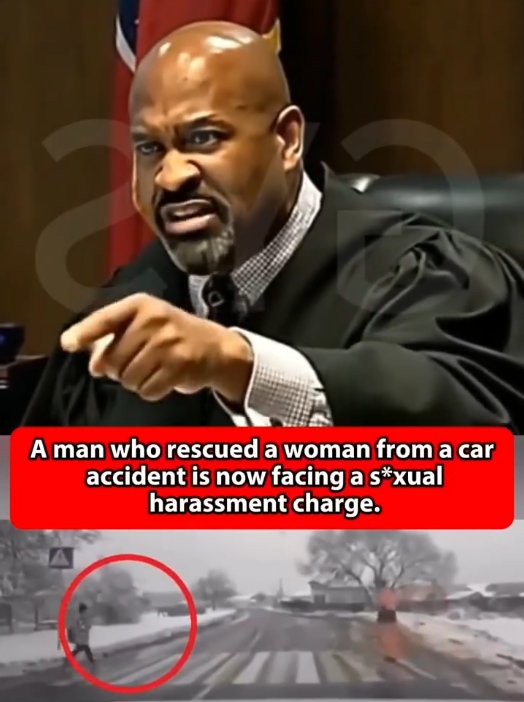
In a world that often feels increasingly disconnected, the instinct to help a stranger is one of our most noble traits. The video captures a moment of pure, unhesitating heroism: a man sees a woman in the path of a vehicle and acts. There is no time for a cost-benefit analysis, no time to weigh legal risks, and certainly no time to ask for consent. There is only the momentum of saving a life.
However, the courtroom footage that follows serves as a sobering cold shower. The transition from the grainy dashcam footage of a rescue to the high-stakes tension of a legal hearing highlights a terrifying new reality: in the modern age, even a life-saving act can be viewed through a litigious lens.
The Legal Paradox: Good Samaritan Laws vs. Personal Liability
Most people assume that “Good Samaritan” laws provide a blanket of absolute protection for anyone who helps in an emergency. In reality, these laws vary significantly by jurisdiction and often come with “reasonableness” standards.
-
The Scope of Protection: Usually, these laws protect rescuers from civil liability for unintentional injury—for example, breaking a rib while performing CPR.
-
The “Sexual Harassment” Complication: When a charge shifts from physical injury to sexual harassment, the legal ground becomes incredibly murky. Allegations of inappropriate touch, even during a frantic rescue, can bypass traditional Good Samaritan protections because they move the argument from “accidental harm” to “intentional misconduct.”
-
The Burden of Proof: Even if the charges are eventually dropped, the “process is the punishment.” The rescuer often faces public scrutiny, legal fees, and the psychological toll of being labeled a predator while believing they were a hero.
The Courtroom Climax: A Judge’s Viral Rebuke
One of the most striking elements of the video is the judge’s visceral reaction. His outburst—questioning the plaintiff’s lack of gratitude—resonates because it mirrors the collective frustration of the public. When the legal system is used to penalize those who uphold the “social contract,” it creates a chilling effect.
The judge’s role here is more than just a legal arbiter; he becomes a voice for common sense. His incredulity highlights the perceived absurdity of the situation: that a woman whose life was arguably preserved by this man’s intervention is now the architect of his potential ruin.
The “Chilling Effect” on Public Safety
What happens the next time a bystander sees someone in danger? This is the most dangerous consequence of such cases. If society begins to believe that saving a life leads to a courtroom battle, the “Bystander Effect” will only intensify.
-
Risk Aversion: People may hesitate for a crucial five seconds to consider the legal implications, which in an emergency, is the difference between life and death.
-
The Gender Gap in Rescue: There is an increasing documented hesitancy among men to assist women in medical distress (like cardiac arrest) due to fears of being accused of inappropriate touching. This case validates those fears in the most public way possible.
Beyond the Viral Clip: Media Literacy and Context
In the age of short-form video, it is vital to remember that these clips are often “de-contextualized” for maximum emotional impact. While the judge’s anger is satisfying to watch, the full legal story often involves nuances—depositions, witness statements, and specific details of the interaction—that a 60-second video cannot capture.
However, regardless of the granular details of this specific case, the narrative remains a powerful cultural touchstone. It represents the fear that our best intentions can be weaponized against us.
Restoring the Social Contract
To prevent these situations from eroding our willingness to help one another, we need a two-pronged approach:
-
Legal Strengthening: Legislators must ensure that Good Samaritan protections are robust enough to cover the chaotic, physical nature of emergency rescues, protecting rescuers from frivolous or opportunistic litigation.
-
Cultural Gratitude: We must reinforce the idea that in an emergency, “perfection” is not the standard—preservation of life is.
The man in the video saved a life, but he nearly lost his own peace, reputation, and freedom in exchange. As this case continues to circulate, it serves as a powerful reminder that our legal systems must be careful not to punish the very empathy that keeps a society human. If we lose the “Heroic Impulse,” we lose one of the last lines of defense we have for each other.
Institutional Skepticism and the Erosion of Civic Trust
Continuing from the growing rift in our judicial system, we have to look at the collateral damage of a lawsuit like this. When the public sees a judge having to scream for common sense to prevail, it sends a clear signal: the system is no longer a filter for truth, but a playground for technicalities.
This creates a brand of institutional skepticism that is hard to cure. If the average person believes that a courtroom is a place where a life-saving act can be rebranded as a crime, they stop looking at the law as a protector and start looking at it as a predator. We are entering an era where “doing the right thing” is no longer a binary choice between action and inaction; it’s a high-stakes gamble with your entire future.
The Commercialization of Victimhood
We have to talk about the “Litigation Industrial Complex.” In many modern legal frameworks, there is a massive financial incentive to find a grievance in every interaction. We’ve moved from a society of “accidents happen” to a society of “someone must pay.”
In this specific case, the shift from gratitude to accusation suggests a calculated move. When a victim realizes that their rescue involved physical contact, a specific type of opportunistic legal mind sees a “cause of action.” By framing a rescue as harassment, the plaintiff moves the case out of the “Good Samaritan” realm—which usually only covers physical injury—and into the realm of “intentional torts” or civil rights violations.
This isn’t just about one woman suing one man. It’s about a legal culture that rewards the search for offense. When we monetize the discomfort inherent in a rescue, we ensure that fewer people will ever risk the contact required to save a life. The “Hero’s Tax” becomes too high for the average citizen to pay.
The Rescuer’s PTSD: Life After the Accusation
While the viral clip focuses on the courtroom drama, it rarely follows the hero home. For the man in the video, the damage was likely done the moment the accusation was filed.
The Psychological Toll: Imagine the mental whiplash of going from the “high” of saving a life to the “low” of being processed as a criminal. Rescuers often suffer from a form of secondary trauma already; adding a sexual harassment charge creates a toxic cocktail of shame and betrayal. It leads to a “moral injury”—the soul-crushing realization that your most noble impulse was used to destroy you.
The Social Death Sentence: In the age of the internet, an accusation is often as damaging as a conviction. Even if the judge dismisses the case with prejudice, that man’s name is now forever linked to the words “sexual harassment” in search engine caches. Background checks for jobs, volunteer positions, or even dating apps will flag his name. He is a “hero” in a 60-second clip, but a “red flag” in a database.
Duty to Rescue vs. The Right to Refuse
This case forces us to confront a terrifying philosophical question: Does a person have the right to refuse a life-saving rescue if it involves contact they haven’t authorized?
In most European countries, there is a “Duty to Rescue” law. If you see someone in danger and can help without risking yourself, you are legally required to act. In the United States, however, we prioritize individual autonomy. This creates a bizarre legal loophole where a victim can theoretically argue that they would have preferred the risk of the car crash over the “unauthorized touch” of the rescuer.
When a court even entertains the idea that a life-saving pull is a form of harassment, it is essentially saying that bodily autonomy in a state of emergency is more valuable than life itself. It’s a radical, almost nihilistic interpretation of consent that ignores the physical reality of a crisis.
The Digital Panopticon: Trial by TikTok
The video we are discussing is a product of our “always-on” surveillance culture. Dashcams, ring cameras, and smartphones have turned the world into a 24/7 courtroom. But this is a double-edged sword.
On one hand, the dashcam footage is the man’s only saving grace. Without it, it would be his word against hers. In a “He Said, She Said” harassment case, the rescuer is often at a massive disadvantage. The video provides the “objective truth” that the judge used to fuel his outrage.
On the other hand, the “Viralization” of the case creates a circus. We see the judge yelling, we see the man’s face, and we see the woman’s reaction. We judge them in the comments section. This “Trial by Social Media” bypasses the nuances of the law and turns human tragedy into content. It discourages people from getting involved in public incidents because they don’t want to become the next main character of a viral controversy.
The Legislative Paper Shield: Why Current Laws Fail
We often hear that “Good Samaritan Laws” protect you. But as this case proves, those laws are often paper-thin. Most were written in the 1950s and 60s to protect doctors who stopped at car accidents. They were never designed to handle the complexities of modern social politics or the weaponization of harassment claims.
What a Real “Shield Law” Should Look Like:
-
Immunity from Intentional Tort Claims: If a rescue is captured on film or witnessed by third parties, there should be an immediate, “anti-SLAPP” style dismissal of harassment claims unless “clear and convincing” evidence of malice is provided.
-
Fee Shifting: If a person sues their rescuer and loses, they should be legally mandated to pay 100% of the rescuer’s legal fees and a “damages for stress” penalty.
-
Anonymity for the Accused: In cases where a rescue is the undisputed context, the rescuer’s name should be suppressed until a conviction is reached to prevent “reputational murder.”
The Evolution of the Social Contract: From “We” to “Me”
This video is a tombstone for a specific kind of community trust. For centuries, the “Social Contract” was built on the idea that we are all, to some extent, our brother’s keeper. If you fall, I pick you up. If you are drowning, I jump in.
We are now moving toward a “Contractual Society.” In this new world, every interaction—even a life-saving one—is seen as a transaction that requires terms and conditions. We are teaching children that it is safer to be a “silent witness” than an “active participant.”
When we allow cases like this to move forward, we are effectively training the hero out of the human. We are creating a world of “polite observers” who will watch a tragedy unfold on their phone screens, not because they are heartless, but because they are terrified of the legal consequences of caring.
Restoring the Balance: A Call for Common Sense
The judge in the video was right to be angry. His anger is the only appropriate response to a situation that defies the basic logic of human survival. But anger isn’t enough. We need a systemic return to “Common Sense Jurisprudence.”
We have to accept that emergencies are messy. They are loud, they are physical, and they are imperfect. If we demand that a hero be “perfect” in their execution—that they never touch a certain area, that they never use too much force, that they always use the correct pronouns while dragging someone out of a fire—then we will simply run out of heroes.
The man who rescued the woman in the car crash did more than just save a life; he upheld the highest ideal of our species. The fact that he had to defend that act in a court of law is a stain on our legal system.
As this video continues to rack up millions of views, let it serve as a warning. Not a warning to stop helping, but a warning to start demanding better from our laws and our neighbors. If we don’t protect the people who protect us, we will eventually find ourselves standing on the sidewalk, watching the car approach, and realizing—too late—that everyone is too afraid to reach out and pull us to safety.
The price of a life should never be a lawsuit. The price of a rescue should be a “thank you,” and nothing more. Anything else isn’t just a legal failure; it’s a civilizational one.
The Weaponization of Consent: When “Me Too” Meets the Emergency Room
The core of the legal argument in cases like the one shown in the video often hinges on a radical and arguably dangerous reinterpretation of consent. In a standard social or professional setting, the boundaries of physical touch are clearly defined and strictly enforced—as they should be. However, the courtroom drama highlights a terrifying attempt to export those same rigid boundaries into the chaos of a life-or-death struggle.
In traditional law, there is a doctrine known as implied consent. This is the common-sense principle that if a person is unconscious, incapacitated, or in immediate, life-threatening peril, the law assumes they would consent to whatever physical contact is necessary to preserve their life. If you are choking in a restaurant, the person performing the Heimlich maneuver isn’t “assaulting” your midsection; they are operating under the umbrella of implied consent.
The lawsuit we see in the video attempts to shred this doctrine. By framing a rescue as harassment, the plaintiff is essentially arguing that their subjective comfort outweighs their objective survival. This is a philosophical “black hole.” If we allow the victim of a disaster to retroactively withdraw consent for the physical contact that saved them, we make the act of helping a stranger legally impossible. We are essentially saying that a hero must first conduct a deposition before they reach for a hand.
The Scripted Reality: Rage-Bait and the Distortion of Truth
To truly understand the impact of this video, we have to look at the medium itself. It is important to note that many viral “courtroom” clips that circulate on social media are actually scripted dramatizations or “social experiments” designed to trigger high-intensity emotional reactions—specifically outrage.
While the feelings the video evokes are very real, the scenario is often curated to act as “rage-bait.” These videos are engineered to feed into our deepest cultural anxieties: the fear of being falsely accused, the frustration with “litigious” culture, and the sense that “common sense” is dying.
However, even if a specific video is a dramatization, its impact on the collective psyche is genuine. These stories become cultural parables. Much like the ancient myths told around a fire, these viral clips teach us how to navigate the world. If the parable tells us that “He who saves a life gets sued,” then the lesson learned by the millions of viewers is one of isolation and apathy. The “fake” nature of a video doesn’t stop it from having “real” consequences on how people behave at a car crash next Tuesday.
The “Perfect Victim” vs. The “Perfect Hero”
The lawsuit depicted in the video relies on the impossible standard of the “Perfect Hero.” This is the idea that a rescuer should be able to perform under extreme physiological stress with the precision of a surgeon and the etiquette of a diplomat.
When the plaintiff’s legal team deconstructs the rescue, they are looking for deviations from perfection.
-
“Why did you grab her waist instead of her shoulder?”
-
“Why was your hand there for four seconds instead of two?”
-
“Why did you pull her so hard that you bruised her skin?”
This line of questioning is a form of intellectual gaslighting. It ignores the reality of physics—that moving a human body quickly requires leverage, and leverage often requires grabbing whatever part of the anatomy is available. By holding the hero to a standard of “perfect touch,” the legal system effectively bans anyone who isn’t a trained professional from ever intervening. It turns the act of being a “good neighbor” into a professional liability.
The Economic Toll: The Rising Cost of Being a Human
Beyond the emotional and social damage, there is a hard economic reality to this legal trend. When lawsuits against Good Samaritans become common (or even just perceived as common), the costs ripple through society:
-
Insurance Premiums: If “rescue liability” becomes a standard legal risk, insurance companies will begin to factor it into personal liability and homeowner policies.
-
Public Health Burden: If bystanders stop helping, the entire burden of life-saving falls on professional First Responders (EMT, Police, Fire). In many urban areas, response times are already stretched thin. Those first 180 seconds—the “Golden Window”—are usually when a bystander is the only one present. If that bystander is too afraid to act, the survival rate for accidents and cardiac events will plummet, leading to a massive increase in preventable deaths and long-term disability costs.
-
The “Pre-Litigation” Lifestyle: We are already seeing people record “consent videos” or seeking verbal confirmation before helping someone in distress. This consumes precious seconds. In a car crash or a fire, time is the only currency that matters. A society that spends its time on “liability management” is a society that is effectively choosing to let people die.
Practical Survival: How to be a Hero in a Litigious Age
Given the reality shown in the video, how should a modern citizen respond? While we shouldn’t let fear turn us into cowards, we do have to be legally literate. If you find yourself in a position to help, there are three “invisible shields” you can use:
-
Vocalize Your Intent: If the person is conscious, shout your intent. “I’m going to pull you out now!” or “I’m here to help!” This creates a verbal record for any witnesses or nearby cameras that your physical contact is a functional necessity, not a social choice.
-
Seek “Active” Witnesses: If there are other people around, point to them and give them a job. “You, call 911! You, watch me pull her out!” By involving others, you turn a private interaction into a public, witnessed event, making it much harder for a plaintiff to later mischaracterize your actions in the dark.
-
The “Minimal Necessary Contact” Rule: While it’s hard to think in a crisis, aiming for the “center of mass” or large limbs is generally safer from a legal standpoint than contact near the torso or hips, if physics allows.
It is a tragedy that we even have to think about these things while someone is bleeding out, but this is the “Hero’s Tax” of the 2020s.
Reclaiming the Moral High Ground
The judge’s outburst in the video was a moment of moral clarity. It reminded us that the law was meant to be a tool for justice, not a weapon for the opportunistic. To prevent the “Death of the Good Samaritan,” we need a cultural shift.
We need to stop rewarding “victimhood” when it comes at the expense of a lifesaver. We need to publicly celebrate the people who get their hands dirty, even if they aren’t “perfect” in their execution. And most importantly, we need to protect the freedom to be brave.
If we continue down the path suggested by the lawsuit in that courtroom, we will eventually reach a point of “Social Entropy.” We will be a collection of 8 billion individuals, all standing in our own little legal bubbles, watching each other drown because we’re afraid of the paperwork.
The man in that video didn’t just save a woman; he gave us a chance to decide what kind of world we want to live in. Do we want a world of “Safe Observers” or “Scared Heroes”? The judge made his choice clear. Now, through our laws and our social reactions, we have to make ours.
The ultimate takeaway from this viral clip isn’t just “be careful.” It’s “be human, but be ready to fight for the right to be human.” Because if we lose the instinct to reach out a hand in a crisis, we’ve lost the very thing that makes society worth living in. We must ensure that the next time a hero steps into the road, the only thing they have to worry about is the oncoming car—not the oncoming lawsuit.