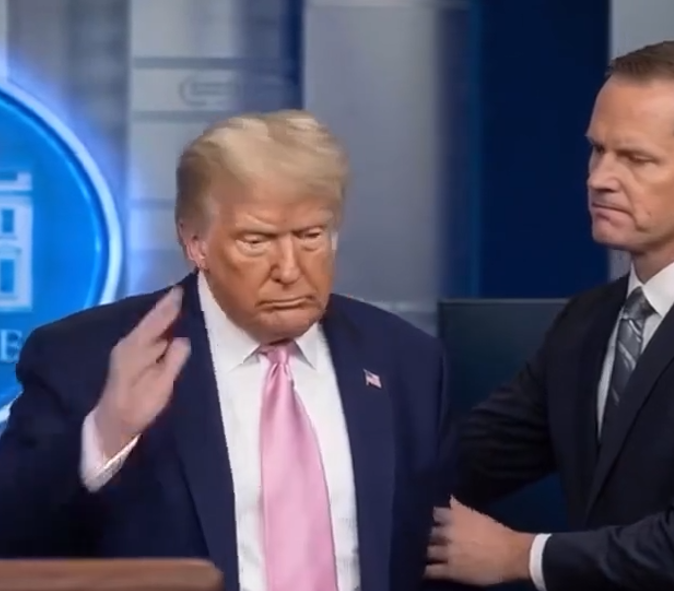
A dramatic headline claiming that ABC News had suddenly interrupted live programming to deliver “huge Trump news” has circulated alongside a much broader story about President Donald Trump’s federal intervention in Washington, D.C. The wording makes the development sound like a single unexpected announcement that stunned viewers in real time. The underlying story, however, is more substantial and complicated than the viral framing suggests. ABC News has extensively covered Trump’s intervention in Washington, including his August 2025 decision to temporarily place the Metropolitan Police Department under federal control and deploy National Guard personnel, but I could not verify a specific recent ABC broadcast in which the network “stopped a live show” and announced the quoted “We’ve just been informed” development. The verifiable story concerns the administration’s continuing use of federal resources in the nation’s capital and the political, constitutional and public-safety debate that has followed. ABC News
The intervention began as Trump argued that Washington required extraordinary federal action to address violent crime and disorder. On August 11, 2025, he announced that his administration would take temporary control of the Metropolitan Police Department and deploy National Guard personnel. Trump characterized the situation in exceptionally severe terms, promising to restore order and describing his action as necessary to rescue the capital from crime. ABC News noted at the time that the president’s description came despite city statistics showing that crime had already been declining over the preceding two years. ABC News
That distinction became central to the controversy almost immediately. The administration argued that conditions in the nation’s capital justified stronger federal intervention. Critics countered that Washington’s existing crime trends did not support the picture of an unprecedented emergency presented by Trump. Both questions became intertwined: Was the federal intervention producing greater safety, and was an extraordinary federal takeover necessary in the first place?
The administration’s approach went far beyond simply adding several federal agents to existing patrols. Federal law enforcement agencies began working alongside local police, while National Guard personnel became a visible presence in parts of Washington. The operation brought together federal, state and local resources in what the U.S. Marshals Service later described as the largest and most aggressive law-enforcement collaboration assembled to confront crime in a major American city. Federal officials say the operation ultimately produced more than 16,000 arrests during its first year, including arrests of homicide suspects and alleged gang members. U.S. Marshals Service
For supporters of the initiative, those figures represent evidence that the administration was willing to take action where previous approaches had not gone far enough. They argue that Washington is not an ordinary municipality. It is the capital of the United States, home to the White House, Congress, the Supreme Court, major federal agencies, foreign embassies and monuments visited by millions of people. Ensuring that residents, federal workers and visitors can move through the city safely is therefore both a local and national concern.
Supporters also emphasize the psychological impact of visible enforcement. Public safety is not experienced only through statistical reports. A resident deciding whether to walk home after dark, a business owner deciding whether to remain open late, or a parent worrying about a child traveling through a neighborhood responds partly to whether the environment feels secure. More visible patrols can provide reassurance even when the precise deterrent effect is difficult to quantify.
Some Washington residents have indeed welcomed a stronger law-enforcement presence. Their argument is relatively straightforward: if additional officers prevent robberies, remove illegal weapons, arrest violent suspects or discourage criminal activity, political arguments about which level of government deserves credit are secondary to the immediate benefit of safer streets.
Yet critics see the operation very differently.
For them, the issue is not whether violent criminals should be arrested. Few serious participants in the debate dispute that. The concern is how far presidential power should extend when Washington already has an elected mayor, city council and local police department.
Washington’s constitutional status makes that question unusually complicated.
Unlike the 50 states, the District of Columbia exists under authority granted to Congress by the Constitution. Congress later provided Washington with a substantial degree of local self-government through the Home Rule Act, allowing residents to elect a mayor and council. Yet Congress retained powers over the District that it does not possess over ordinary state governments.
That arrangement has produced political conflict for decades.
Washington residents pay federal taxes and participate in presidential elections, yet the District does not possess the same representation and sovereignty as a state. Congress can intervene in local policy, and federal institutions occupy an enormous portion of the city’s political and physical landscape.
Trump’s intervention reopened those longstanding tensions in dramatic fashion.
To the administration, Washington’s special status strengthens the federal government’s responsibility to ensure public order in the national capital.
To home-rule advocates, the same constitutional arrangement leaves Washington uniquely vulnerable to presidential and congressional interference in decisions that residents believe should belong to their elected local government.
The dispute therefore became about considerably more than patrol cars and arrest totals.
It became a debate over democratic authority.
How much control should Washington residents possess over their own police department?
When does a public-safety emergency justify federal intervention?
Who determines when such an emergency exists?
And once extraordinary federal authority has been exercised, how quickly should ordinary local control return?
These questions became especially significant because Trump indicated almost immediately that he wanted a longer-term arrangement. ABC News reported on August 14, 2025, that Trump planned to seek more permanent federal control of the Metropolitan Police Department after the initial period of emergency authority expired. Continuing such control beyond the statutory window would require congressional involvement. ABC News
That transformed the intervention from a short-term emergency measure into a potential restructuring of the relationship between Washington and the federal government.
Opposition grew.
In September 2025, Washington residents traveled to Capitol Hill urging lawmakers to end the federal law-enforcement surge. Demonstrators associated with the advocacy group Free DC described the intervention as an occupation and asked members of Congress to restore local authority. Their campaign coincided with an extension of National Guard orders in the capital. ABC News
The language used by opponents demonstrates the depth of the disagreement.
Supporters talk about restoring order.
Opponents talk about occupation.
Supporters see federal officers providing necessary reinforcement.
Opponents see federal power overriding democratic local government.
The same personnel walking the same streets can therefore symbolize completely different things depending on the observer.
That divide becomes particularly important when evaluating claims about whether the intervention worked.
The Trump administration has repeatedly cited large arrest totals and falling crime figures as evidence of success. But independent analyses have found that attributing Washington’s crime trends entirely to the federal surge is difficult.
A Washington Post analysis published in August 2026 examined more than 16,000 arrest reports and found federal partners mentioned in roughly three out of every ten reports during the first year of the intervention. The newspaper concluded that Trump’s sweeping claims about the effect of the federal operation oversimplified the available evidence. The Washington Post
Crime statistics themselves also require careful interpretation.
FactCheck.org examined Metropolitan Police Department data in August 2026 and found overall crime down approximately 20 percent compared with the same period in 2025. Homicides were down substantially and robberies had declined. But the picture was not uniformly positive: assaults with a dangerous weapon had risen sharply, and overall violent crime was up slightly during the period FactCheck examined, while property crime had fallen significantly. FactCheck.org
This is why statements such as “crime fell” or “violent crime increased” can both appear in discussions of the same city without necessarily contradicting each other.
Crime consists of multiple categories.
Homicide can decline while another violent offense rises.
Property crime can fall enough to reduce overall crime even while certain violent offenses increase.
The dates selected for comparison also matter.
Perhaps most importantly, Washington’s crime trends were already improving before Trump launched the federal operation. ABC News explicitly noted this when reporting on the original August 2025 intervention. ABC News
That does not prove the federal operation had no effect after it began.
It means causation is more difficult to establish than a political slogan suggests.
If homicides were already declining and continued declining after federal intervention, analysts must determine how much of the later improvement resulted from the new policy and how much reflected a trend already underway.
Political leaders rarely emphasize such uncertainty.
Administrations naturally want credit for positive outcomes.
Opponents naturally emphasize evidence suggesting those outcomes would have occurred anyway.
The public is left trying to separate statistical reality from political interpretation.
That challenge becomes even greater when viral headlines transform complicated policy developments into sudden “breaking news.”
A phrase such as “ABC News Stops Live Show, Breaks HUGE Trump News” creates an impression that a single dramatic event changed everything at once.
Government policy rarely works that way.
The Washington intervention developed over months.
Federal agencies coordinated operations.
National Guard orders were extended.
Local residents organized opposition.
Crime statistics evolved.
Courts considered disputes involving federal power.
Political leaders debated the operation.
The significance lies in that continuing process rather than one unspecified television announcement.
Civil-liberties organizations have focused heavily on what increased federal enforcement means for people who already distrust government authorities.
Immigrant communities are one important example.
The Trump administration has simultaneously conducted a much broader immigration enforcement campaign across the United States. That means an encounter with federal personnel can carry different implications for an undocumented resident than an encounter involving ordinary local services.
Critics worry that immigrants may become reluctant to report crimes, speak with investigators or seek assistance if they fear that contact with authorities could expose themselves or family members to immigration consequences.
This presents law enforcement with a genuine dilemma.
Police agencies depend on public cooperation.
A witness who refuses to speak can make a violent crime more difficult to solve.
A domestic-violence victim afraid to contact authorities may remain in danger.
A community convinced that officers are primarily interested in immigration status may become less willing to provide information about unrelated criminal activity.
Supporters of Trump’s immigration policies respond that federal immigration law still has to be enforced and that concerns about community cooperation cannot create a blanket exemption from enforcement.
The policy challenge is therefore balancing two legitimate government interests: enforcing federal law while maintaining enough community trust for people to cooperate with authorities.
Oversight becomes another major issue when numerous agencies operate simultaneously.
A Washington resident may encounter Metropolitan Police officers, federal agents, Park Police, National Guard personnel or members of other participating organizations.
Those agencies do not necessarily operate under identical rules.
They have different chains of command.
Different complaint procedures.
Different jurisdictions.
Different policies governing public information.
For residents, the distinctions can become confusing.
If an encounter goes wrong, who is responsible?
Where should a complaint be submitted?
Which agency retains the relevant records?
Who investigates alleged misconduct?
Which officials can be held politically accountable?
Those questions matter because effective enforcement requires more than raw power.
Legitimacy depends on knowing who exercises authority and how that authority can be challenged when mistakes occur.
The administration argues that interagency coordination is precisely one of the operation’s strengths.
Criminal networks do not respect bureaucratic boundaries. A firearm can cross state lines. A suspect can move between Washington, Maryland and Virginia. Federal offenses can overlap with local crimes. Information held by one agency may help another identify a suspect.
From this perspective, pooling federal and local capabilities allows law enforcement to act more efficiently.
Critics do not necessarily reject coordination itself.
Their concern is whether coordination becomes a mechanism through which local authority is effectively absorbed into federal priorities.
That distinction will remain important long after the current operation ends.
Presidential precedents do not disappear when presidents leave office.
A power exercised by Trump can potentially be invoked by a future Democratic president.
That reality should matter to both political parties.
Supporters of broad federal authority under Trump must consider whether they would support the same power being used by a president whose law-enforcement priorities they oppose.
Critics must consider what level of federal intervention they would accept if local authorities genuinely lost control of a severe security situation.
Constitutional systems are strongest when rules are evaluated independently of the individual currently benefiting from them.
The Washington intervention tests that principle because Trump remains such a polarizing political figure.
For supporters, skepticism about the operation can look like partisan unwillingness to acknowledge improvements in public safety.
For critics, support for the intervention can look like willingness to expand presidential power simply because they approve of the president exercising it.
Both interpretations can prevent serious discussion of the underlying questions.
There are also practical consequences for the National Guard personnel themselves.
The deployment is not merely symbolic.
Thousands of service members have spent extended periods participating in the Washington mission. Their presence creates costs, affects military scheduling and places troops in circumstances different from traditional overseas or disaster-response assignments.
An incident in August 2026 illustrated the complications. A Georgia National Guard member assigned to the D.C. crime task force was arrested after allegedly pointing a firearm at another Guard member during a dispute. The allegation involved an internal disagreement rather than an encounter with a civilian, but it nevertheless added to scrutiny surrounding the long-running deployment. AP News
One incident does not establish that an entire deployment is dysfunctional.
But it demonstrates that extending military assignments in civilian environments creates its own management and disciplinary challenges.
The larger question is what role the National Guard should play in ordinary public safety.
The Guard has historically responded to natural disasters, major emergencies, civil disturbances and other extraordinary situations. Using troops as a sustained visible component of urban law enforcement raises different questions.
Military personnel and police officers are trained for overlapping but distinct missions.
Police work requires daily interaction with civilians, evidence gathering, arrests, constitutional procedures and community relationships.
Military organizations are built primarily around defense and combat readiness, even though Guard personnel also perform extensive domestic missions.
Supporters argue that Guard members can provide manpower and logistical support while freeing trained police officers for direct enforcement.
Critics worry that long-term military visibility can normalize a level of federal force that should remain exceptional.
Again, Washington’s special legal status makes the issue unusually complicated.
The same deployment in a state could involve different legal authorities and relationships with a governor.
This is why D.C. frequently becomes a testing ground for broader questions about federal power.
The political consequences extend beyond Washington.
Trump has repeatedly presented his intervention in the capital as evidence that stronger enforcement can change urban conditions.
If the administration successfully convinces voters that Washington became safer because of federal action, the operation can become part of a national law-and-order message.
Republicans could argue that Democratic-led cities need more aggressive enforcement.
Democrats could respond that local conditions differ dramatically and that federal intervention threatens constitutional federalism.
The argument would then move from one city to a national debate about who should control American policing.
That possibility helps explain why civil-rights groups are watching Washington so closely.
A policy confined to one unusual federal district is one thing.
A model intended for broader replication is another.
Courts would likely become increasingly important if federal authorities attempted comparable interventions elsewhere.
States possess constitutional status and powers that Washington does not.
Governors control their National Guard forces under ordinary circumstances.
Federal statutes limit military involvement in domestic law enforcement.
Any administration attempting to reproduce the D.C. model nationwide would therefore confront legal questions not present in exactly the same form in the capital.
The public debate would also be different.
Residents of a state can argue that federal intervention violates state sovereignty.
Washington residents instead confront the unusual reality that Congress ultimately possesses substantial authority over their city.
That is why calls for D.C. statehood have become intertwined with the controversy.
Statehood supporters argue that the federal intervention demonstrates the vulnerability created by Washington’s current status.
Opponents of statehood emphasize the constitutional rationale for maintaining a federal district independent of any state.
Trump’s crime initiative did not create that debate.
It gave it renewed urgency.
Community trust may ultimately become one of the most important measures of the operation’s success.
Crime statistics matter enormously.
A reduction in homicide represents real people who remain alive.
A reduction in robbery means fewer victims.
Removing illegal firearms can prevent future violence.
Arresting dangerous offenders protects communities.
Those outcomes should not be minimized simply because they become politically useful to an administration.
But enforcement cannot be evaluated only through arrest totals.
A system that generates thousands of arrests while losing public confidence may create longer-term difficulties.
People must be willing to testify.
Witnesses must trust investigators.
Residents must believe complaints will be taken seriously.
Young people must be able to see law enforcement as something other than an occupying force.
Officers themselves benefit when communities cooperate.
This is why successful policing has always involved both enforcement and legitimacy.
Too little enforcement allows dangerous individuals to operate freely.
Enforcement without accountability can produce fear and resentment.
The challenge is maintaining both authority and trust.
Trump’s Washington experiment has pushed that challenge into unusually sharp focus.
The administration believes visible force, coordinated federal resources and aggressive prosecution have helped restore order.
Opponents believe some improvements were already underway and worry that the administration is using crime as justification for expanding federal power.
Independent evidence provides ammunition for both arguments but fully resolves neither.
Crime has fallen significantly in several categories.
Federal agencies have participated in thousands of operations and arrests.
At the same time, Washington was already experiencing improvement before the intervention, and analyses caution against attributing every decline directly to Trump’s policies. The Washington Post
This uncertainty is normal in public policy.
Governments rarely conduct controlled experiments.
Washington cannot be divided into identical cities, with federal intervention applied to one and withheld from another.
Researchers therefore have to compare trends, neighborhoods, arrest patterns and historical data.
Political messaging moves much faster than that research.
The administration can announce success immediately.
Critics can announce failure immediately.
Reliable evaluation takes longer.
That is another reason sensational online headlines can distort understanding.
The viral ABC framing promises a dramatic revelation.
The real story demands patience.
It requires looking at what Trump actually ordered, what authority he invoked, how federal agencies participated, what crime data show, how residents responded and what constitutional questions remain unresolved.
Those details may be less explosive than “We’ve just been informed,” but they are far more consequential.
There is also a broader media lesson.
Breaking-news graphics create urgency because television networks use them when information changes quickly.
Social-media publishers have learned to imitate that language even when the underlying story is old, gradual or poorly sourced.
“Breaking.”
“Just in.”
“Minutes ago.”
“We’ve just been informed.”
These phrases create the feeling that readers must click immediately or risk missing an historic development.
Sometimes the urgency is genuine.
Sometimes it is simply a marketing technique.
In this case, the verified ABC reporting I found documents Trump’s federal intervention and the subsequent opposition to it, but does not support presenting the supplied viral wording as a verified quotation from a specific new ABC interruption.
That distinction matters because credibility accumulates slowly and disappears quickly.
A publisher may gain a click through an exaggerated headline.
But if readers repeatedly discover that the promised revelation does not exist, they eventually stop trusting the source.
The underlying Washington story does not need artificial drama.
It involves a president exercising extraordinary authority in the capital.
National Guard troops.
Federal agents.
Thousands of arrests.
Falling crime in some categories.
Rising crime in others.
Residents protesting on