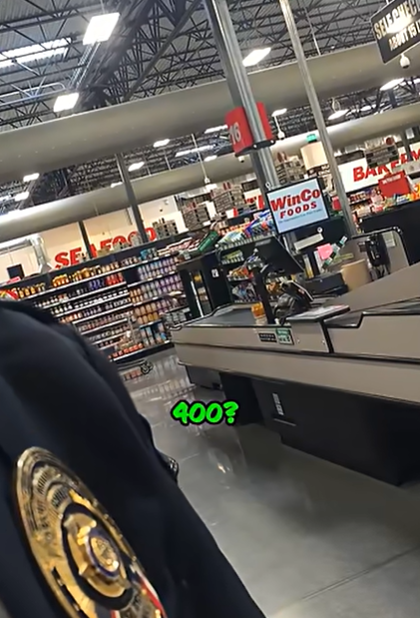
A humorous grocery store moment turned into an unexpected lesson about phone scams after a police officer received a call from a scammer who claimed there was a warrant out for his arrest. The scammer, completely unaware that he was speaking to an actual law enforcement officer, attempted to pressure him into paying a supposed fee to avoid being taken to jail. Instead of ending the call immediately, the officer decided to play along, turning the attempted scam into a memorable and ironic interaction.
The video takes place inside a grocery store checkout area, where the officer appears to be standing in line when the call comes through. The setting makes the situation even more amusing because it is so ordinary. Around him are checkout counters, store signs, and everyday shoppers, while on the phone a scammer is trying to create a fake emergency. The contrast between the calm grocery store environment and the scammer’s dramatic claims makes the moment feel almost absurd.
The scammer tells the officer that there is a warrant out for his arrest. This is a common scare tactic used in phone scams, where the caller pretends to represent law enforcement, a government agency, or a court office. The goal is usually to frighten the person into acting quickly without thinking clearly. By claiming that the officer is about to be arrested, the scammer tries to create panic and urgency.
But in this case, the scammer has chosen the wrong target. The person on the other end of the call is not a frightened citizen unfamiliar with the legal system. He is a police officer. He understands how real warrants work, how law enforcement communicates, and how unlikely it is that someone could simply pay a random fee over the phone to cancel an arrest warrant. Rather than becoming afraid, he seems amused by the situation.
The officer begins playing along with the scam. He acts as though he believes the caller and even jokes that he must be a “criminal.” By responding this way, he allows the scammer to continue with the script. The officer’s tone appears calm and entertained, while the scammer continues trying to sound serious and official. The humor comes from the fact that the scammer thinks he is manipulating someone, when in reality, he is the one being quietly exposed.
The scammer then tells the officer that he will be behind bars within 6 to 12 hours unless he pays a $400 “cancellation fee” for the arrest warrant. This claim is clearly designed to make the victim feel trapped. The caller presents two options: pay now or face arrest soon. The amount, $400, is framed as the cost of making the problem go away. But the entire idea is false. Real warrants are not canceled by paying a fee to an unknown caller.
The officer continues pretending to be worried and asks how much he needs to pay to resolve the issue. His reaction encourages the scammer to keep going. The scammer likely believes he has found a cooperative target, someone willing to listen and possibly hand over money. What he does not realize is that the officer is fully aware of what is happening and is letting the conversation unfold for the irony of the moment.
The on-screen text highlights the humor of the situation, pointing out that the scammer is trying to extort a police officer. That is what makes the video so entertaining for viewers. The scammer’s entire plan depends on convincing someone that law enforcement is after them, yet he is unknowingly speaking to someone who works in law enforcement. The scammer’s false authority is being tested against real authority, and he has no idea.
The officer’s decision to play along also shows how predictable these scams can be. The caller uses fear, urgency, and a demand for payment. He claims there is a serious legal threat, gives a short time frame, and presents payment as the only way out. These are classic warning signs. The officer likely recognizes them immediately, which is why he is able to respond with humor instead of panic.
For ordinary people, however, these calls can be frightening. A person who does not know how warrants work might believe the scammer, especially if the caller sounds confident or uses official-sounding language. Scammers often rely on pressure and confusion. They do not want the victim to pause, verify the claim, or contact real authorities. They want immediate payment before the victim has time to think.
That is why the video is funny, but also useful. It exposes the scammer’s tactics in a way that is easy to understand. The fake warrant, the threat of jail, the short deadline, and the payment demand are all red flags. By hearing the scammer try these tactics on a police officer, viewers can see how ridiculous the scam is when removed from the fear it is meant to create.
The grocery store setting adds another layer to the moment. The officer is not sitting in a police station or conducting an official investigation. He is simply standing in a checkout line, going about his day, when the scammer calls. That ordinary setting makes the call feel even more random and shows how scammers can reach anyone at any time. They do not know who will answer. They simply call and hope the person on the other end is scared enough to comply.
The scammer’s confidence is also part of what makes the video stand out. He speaks as though he has authority and control, claiming the officer will soon be behind bars unless he pays. But because the officer knows the claim is fake, the caller’s confidence becomes almost comical. Every serious threat sounds more absurd because the audience knows the officer is not fooled.
The officer’s playful response helps keep the situation entertaining. By admitting to being a “criminal” and asking about the payment, he gives the scammer enough rope to reveal the full scam. He does not need to argue or immediately expose himself as an officer. He simply lets the caller continue, showing how the scam works in real time. The result is both funny and educational.
The $400 “cancellation fee” is one of the clearest signs that the call is fraudulent. Legal systems do not operate this way. A real arrest warrant cannot be erased by paying a fee to someone on the phone. Police do not call people and offer a quick payment option to avoid jail. Courts and law enforcement agencies use formal processes, not random phone threats demanding immediate money.
The scammer’s timeline of “6 to 12 hours” is another pressure tactic. By giving the officer a narrow window before supposed arrest, the caller tries to create panic. Scammers know that fear can make people act quickly. If a victim believes police may arrive soon, they may pay without verifying the information. The officer, however, recognizes the tactic and continues playing along calmly.
The video also shows how scammers depend on impersonation. They pretend to be connected to official systems, hoping the target will respect or fear that authority. In this case, the scammer’s fake authority collapses because he is unknowingly speaking to someone who understands the real system. The officer knows the caller has no power to issue, cancel, or enforce a warrant.
For viewers, the best part of the video may be imagining the scammer’s reaction if he ever discovered who he was speaking to. He likely believed he was pressuring a nervous person in a grocery store. Instead, he was being humored by someone trained to recognize exactly this kind of deception. That hidden reversal is what gives the clip its comedic edge.
Still, the situation points to a serious issue. Phone scams can cause real financial harm. Many victims lose hundreds or even thousands of dollars because they are frightened into paying. Some are elderly, isolated, or unfamiliar with how official agencies communicate. Others may be busy, stressed, or caught off guard. A scammer does not need every call to work. They only need a small number of people to believe them.
The officer’s interaction can help spread awareness. When people see how the scam is presented, they may be more prepared if they receive a similar call. They can remember that real law enforcement does not demand payment over the phone to cancel warrants. They can pause, hang up, and contact official numbers directly if they are worried. The most important step is not to let the caller control the pace of the conversation.
The scammer’s mistake was assuming that fear would work on everyone. He followed his script, made threats, demanded money, and expected compliance. But the officer’s calm reaction showed that knowledge is the best defense. Once a person understands the pattern, the scam loses much of its power. The caller’s threats become empty words.
The interaction also reveals how scammers often do not know anything meaningful about the person they call. They may use generic claims, vague legal language, and broad threats. They may not know the person’s job, location, or circumstances. In this case, that lack of knowledge led to the perfect irony: the scammer accused a police officer of having a warrant and demanded money to keep him out of jail.
The officer’s humor does not take away from the seriousness of the scam. Instead, it makes the lesson easier to remember. A dry warning about phone scams might be ignored, but a video of a scammer unknowingly trying to fool a police officer is memorable. The humor helps the message spread.
The clip also shows why people should be cautious when receiving unexpected calls involving legal threats. Scammers often use official-sounding words to make the situation feel real. They may mention warrants, courts, fines, fees, law enforcement, or urgent deadlines. But a real legal issue should always be verified through official channels, not handled through a random caller demanding immediate payment.
In the end, the officer never appears truly afraid. He plays along because he understands the scam from the start. The scammer, meanwhile, continues believing he is in control. That contrast creates the heart of the video. One person is pretending to be an authority figure, while the real authority figure is standing in a grocery store checkout line, calmly letting the fake story unfold.
What makes the video especially satisfying is that the scammer’s own script exposes him. The fake warrant, the threat of jail, the strange “cancellation fee,” and the demand for quick payment all reveal the scam for what it is. The officer does not need to do much beyond ask questions and pretend to cooperate. The caller’s words do the rest.
The moment is funny because of the irony, but it also serves as a warning. Anyone can receive a scam call, and scammers will often sound confident, aggressive, or official. But confidence does not make a claim true. A real warrant is not resolved with a $400 phone payment, and a real officer or court official will not threaten someone into paying over the phone.
By the end of the call, the scammer’s attempt to intimidate the officer becomes a joke at the scammer’s expense. He thought he was pressuring a victim, but he was actually demonstrating his own fraud to someone who knew better. The video turns a common scam into a public lesson, showing viewers how these calls work and why they should never let fear push them into sending money.
The grocery store officer’s calm reaction, playful answers, and willingness to let the scammer continue made the clip both entertaining and informative. It captured the absurdity of a scammer threatening a police officer with arrest and demanding a fake fee to cancel a fake warrant. More importantly, it reminded viewers that when a caller uses fear, urgency, and payment demands, the safest response is to stop, question, and verify before doing anything.
The officer’s calm reaction also shows why education is one of the strongest tools against scams. The scammer’s words only have power if the person receiving the call believes them. Once the target understands that real law enforcement does not operate this way, the entire threat falls apart. The officer knew from the beginning that the caller had no authority, no real warrant, and no legal way to demand a payment over the phone. Because of that knowledge, he could treat the call as entertainment rather than a crisis.
For many people, however, a call like this can feel terrifying. A person who hears the word “warrant” may immediately imagine police arriving at their home, losing their job, being publicly embarrassed, or being separated from their family. Scammers count on that emotional reaction. They do not want the target to calmly analyze the claim. They want panic to take over before logic has a chance to respond.
That is why the scammer added a short timeline. By saying the officer would be behind bars within 6 to 12 hours, he was trying to create urgency. The message was clear: act now or face immediate consequences. This is one of the most common scam techniques. The shorter the deadline, the less likely a frightened person is to verify the information. The scammer wants the victim to feel that there is no time to call a real police department, speak to a family member, or search for official information.
The officer’s playful agreement to continue with the payment exposed how scripted the caller likely was. The scammer did not seem to question why the officer was so willing to pay or why he was responding in such an unusual way. He simply continued pushing toward the money. That shows the mechanical nature of many scams. The caller follows a pattern: scare the person, offer a fake solution, demand payment, and keep pressure on until the person gives in.
The fake “cancellation fee” is also a clever phrase because it sounds official enough to confuse someone under stress. Scammers often choose words that feel bureaucratic or legal. They may say “processing fee,” “bond fee,” “warrant clearance,” “case cancellation,” or something similar. The goal is to make the payment sound like part of a formal process. But in reality, the phrase means nothing. A warrant cannot be canceled by paying a random caller. Legal problems are handled through courts, attorneys, official notices, and verified agencies, not through sudden phone demands.
The grocery store setting makes the video even more effective because it shows how scams interrupt ordinary life. The officer was not expecting a scam call while standing near checkout counters. He was simply going about his day. That is how these calls usually arrive: during work, shopping, cooking, driving, or relaxing at home. The randomness is part of the scammer’s advantage. They catch people off guard, then try to overwhelm them with fear before they can regain control.
The officer, however, did not allow the caller to control the pace. He slowed the interaction down by asking questions and pretending to be confused or worried. This gave him control over the conversation while making the scammer reveal more of the scheme. Instead of hanging up immediately, he let the scammer expose the fake process step by step. For viewers, that makes the scam easier to recognize in the future.
The irony of the scammer calling a police officer is what makes the clip entertaining, but the deeper message is that anyone can be targeted. Scammers do not carefully choose every victim. They often call large numbers of people, hoping a few will respond. They may not know whether the person is young or elderly, wealthy or struggling, a civilian or an officer. They simply rely on fear and repetition. In this case, that random approach backfired in the funniest possible way.
The officer’s badge and uniform, visible in the grocery store, make the caller’s claims even more ridiculous to the audience. The scammer is pretending to have law enforcement power while speaking to someone who actually represents law enforcement. The caller’s confidence becomes part of the comedy because viewers can see what he cannot. He thinks he is threatening a potential victim, but he is actually performing his scam in front of someone who understands every false claim.
This kind of video can be more powerful than a standard warning because humor makes the lesson memorable. People may forget a list of scam prevention tips, but they may remember the image of a scammer trying to convince a police officer that he needs to pay $400 to avoid arrest. That absurdity sticks in the mind. Later, if they receive a similar call, they may recognize the pattern and remember not to panic.
The scammer’s attempt to sound official also reveals how much these schemes depend on performance. He likely uses a serious tone, confident wording, and threats to create the illusion of authority. But authority is not created by confidence alone. A real official process can be verified. A real warrant has records. A real court matter has documentation. A random caller demanding money has none of that. The officer knew this, which is why the threats had no effect.
The video also reminds viewers that fear-based calls should be treated with suspicion. If someone calls unexpectedly and says there is an urgent legal problem, the safest response is to pause. Do not provide personal information. Do not send money. Do not follow instructions to buy gift cards, transfer funds, use cryptocurrency, or pay a “fee” to avoid arrest. Hang up and contact the real agency directly using a verified number.
In many scams, callers try to keep victims on the phone the entire time. They may tell them not to speak to anyone, not to hang up, and not to contact local authorities. That isolation is intentional. The scammer knows that once the victim talks to someone else, the lie may collapse. A family member, bank employee, police officer, or friend might immediately recognize the scam. That is why scammers work so hard to keep the target emotionally trapped.
The officer’s response breaks that pattern completely. He is not isolated, and he is not afraid. He is standing in public, surrounded by everyday activity, calmly letting the scammer talk. The caller has no control over him. That reversal makes the scammer look powerless, even though he is trying to sound threatening.
The interaction also shows that scammers often use legal language because it creates instant anxiety. Most people do not want trouble with police, courts, or government agencies. Even a person who has done nothing wrong may feel nervous when someone claims there is a warrant or case against them. Scammers exploit that fear. They know that legal language can make people feel small, confused, and desperate to make the problem disappear.