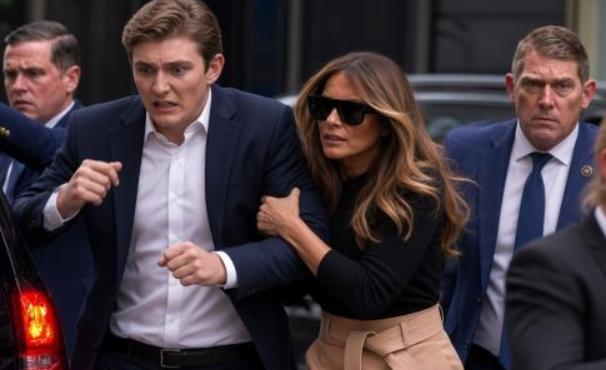
A disturbing piece of Iranian-linked propaganda targeting First Lady Melania Trump and President Donald Trump’s youngest son, Barron Trump, has intensified concerns surrounding threats against America’s first family at a moment of already heightened tension between Washington and Tehran. The video, circulated by the Tasnim News Agency, an Iranian outlet associated with the Islamic Revolutionary Guard Corps, presented threatening material involving Melania Trump before ending with an ominous warning directed toward her 20-year-old son. The U.S. Secret Service subsequently confirmed that it was aware of the video and was treating the material seriously as part of its responsibility to investigate potential threats against people under its protection.
The approximately two-minute production reportedly carried the title “Where to Kill Melania?!” and incorporated imagery associated with the first lady’s movements and public activities. Reporting on the video said it highlighted locations in New York associated with Melania and attempted to portray aspects of her routine as potential vulnerabilities. The production went considerably beyond ordinary political criticism, however, by encouraging violence and discussing possible attacks. For security reasons, the specific operational suggestions contained in the propaganda should not be amplified, but their inclusion is a major reason the video generated such concern.
The final portion of the video broadened the threat beyond Melania.
Barron Trump was specifically named.
The closing message warned him that what had been shown was “just the beginning” and told him to “wait for us,” according to several reports that reviewed the footage.
That ending transformed what was already a disturbing propaganda production into a direct threat involving two members of the president’s immediate family. Barron has maintained a considerably lower public profile than his father and older siblings, making the decision to target him especially notable. Unlike Donald Trump Jr., Eric Trump and Ivanka Trump, Barron has not established himself as a regular political surrogate or high-profile public advocate for his father’s administration.
He is the president’s son.
Yet the propaganda explicitly placed him inside the escalating confrontation.
The Secret Service responded cautiously, as would be expected from an agency that generally avoids publicly discussing specific protective arrangements. A spokesperson confirmed that the agency was aware of the threatening material and investigates communications that could represent threats against people it protects. The agency declined to disclose operational security details.
That limited public response should not be interpreted as indifference.
Protective agencies deliberately avoid revealing exactly how they react to particular threats because discussing security changes could provide useful information to hostile actors. When a threat emerges, protective measures can be adjusted without public notification. Routes can change. Schedules can be altered. Intelligence resources can be redirected. Additional coordination can occur between federal agencies and local law enforcement.
The public may never learn the full extent of those changes.
That secrecy is part of the protection itself.
Melania Trump and Barron Trump are already protected by the Secret Service because of their relationship to the sitting president. Consequently, Iranian propaganda does not suddenly create protection where none existed. What it can do is influence threat assessments and potentially require security officials to examine whether new precautions are necessary.
Threat assessment involves considerably more than simply determining whether a video contains violent language.
Investigators want to know who produced the material.
Who authorized it?
Was it intended primarily as propaganda?
Did the creators possess genuine intelligence?
Are individuals connected to the production communicating with people inside the United States?
Are there indications that someone intends to act on the rhetoric?
Does the material correspond with other intelligence indicating an operational threat?
Those questions help distinguish propaganda designed primarily to intimidate from credible preparations for violence.
The distinction is crucial, but propaganda cannot simply be dismissed because it may be theatrical.
Political violence can emerge from environments in which threatening rhetoric becomes increasingly normalized.
Repeatedly presenting political opponents as legitimate targets can encourage individuals outside formal government structures to interpret violent language as permission to act.
That is one reason security agencies take threatening communications seriously even when the probability of an actual attack is uncertain.
The Tasnim video is also significant because of the outlet responsible for circulating it. Tasnim is widely described as being closely associated with Iran’s Islamic Revolutionary Guard Corps. That relationship gives its content greater geopolitical significance than a threatening post created by an anonymous individual with no apparent institutional connection.
At the same time, it is important to distinguish between media propaganda, official government policy and an operational assassination plan.
The existence of a threatening video does not by itself prove that an assassination operation has been authorized.
That conclusion would require additional evidence.
But the involvement of a prominent Iran-linked outlet inevitably raises questions about why the material was produced, what audience it was intended to reach and whether officials approved or encouraged its publication.
The timing also matters.
Relations between Washington and Tehran have deteriorated dramatically, creating an atmosphere in which threats against political leaders and their families carry additional weight.
Donald Trump has himself faced Iranian threats for years, particularly following his decision during his first presidency to authorize the January 2020 U.S. strike that killed Qasem Soleimani, the powerful commander of Iran’s Quds Force.
Soleimani’s death became a lasting source of anger within Iran’s political and military establishment.
Iranian officials and affiliated figures repeatedly vowed revenge.
American authorities subsequently investigated alleged Iranian plots against former Trump administration officials and Trump himself.
Those concerns were not merely theoretical.
In November 2024, the U.S. Justice Department announced charges involving an alleged Iranian plot to kill Donald Trump before that year’s presidential election. Prosecutors alleged that an Iranian official had directed an operative to develop a plan targeting Trump.
That history fundamentally changes the way contemporary threats are interpreted.
A threatening propaganda video does not exist in isolation.
It enters an environment where U.S. authorities have previously accused Iranian-linked individuals of participating in genuine assassination planning.
That background is likely to make American security officials particularly cautious when evaluating any new threat involving the Trump family.
The latest propaganda has also expanded beyond Donald Trump himself.
That is an important development.
Political leaders accept a certain level of security risk when they enter public life. Their children and spouses, however, occupy a different position.
Melania is first lady and therefore has an official public role, but Barron remains primarily a private citizen whose fame derives from his parents.
Targeting family members can serve a psychological purpose.
The objective may not simply be physical intimidation.
Threatening someone’s spouse or child can create emotional pressure that threats against the individual alone cannot achieve.
It sends the message that the confrontation extends beyond government offices and military institutions.
Family becomes part of the battlefield of intimidation.
That possibility helps explain why the video has generated outrage.
Political disagreement between governments is normal.
Even severe diplomatic confrontation is not unusual.
Governments impose sanctions.
They expel diplomats.
They issue condemnations.
They engage in military deterrence.
They conduct intelligence operations.
But propaganda encouraging violence against family members represents a very different form of escalation.
It personalizes geopolitical conflict.
Melania Trump has generally maintained a more selective public schedule during her husband’s second presidency than many previous first ladies.
Her relative privacy inevitably complicates the task of those attempting to turn her into a political target.
The Iranian-linked video appears to have attempted to overcome that limitation by focusing on publicly associated elements of her life.
That is precisely why security experts warn about the aggregation of publicly available information.
One individual piece of information may appear harmless.
A photograph.
A public appearance.
A store someone has visited.
A restaurant.
An event schedule.
A social-media post.
But when multiple pieces are assembled together, they can create a more detailed picture of someone’s habits.
For ordinary people, that creates privacy concerns.
For individuals facing potential state-backed threats, the consequences can become significantly more serious.
Modern protective security therefore extends beyond physical bodyguards.
Digital information matters.
Social-media exposure matters.
Metadata matters.
Public schedules matter.
Family members’ online activities matter.
Security teams must think not simply about protecting someone at a particular location but about controlling how predictable their movements become.
Barron Trump’s position presents an especially difficult challenge.
At 20 years old, he is attempting to live the life of a young adult while simultaneously being the son of a sitting president facing serious security threats.
Those two realities are difficult to reconcile.
Most university students can walk through a city, meet friends or attend events without federal protection.
Barron cannot approach public life in exactly the same way.
The more recognizable he becomes, the more complicated ordinary activities can become.
Recent Iranian propaganda has made that challenge even more obvious.
In late August, Iranian state media reportedly escalated its focus on Barron with additional threatening content centered specifically on him. The Secret Service again confirmed that it was aware of the material and investigating it.
That later development suggests that the warning attached to the Melania video was not simply forgotten after publication.
Barron became a continuing subject of threatening propaganda.
Again, the operational details of that material should not be repeated unnecessarily.
The important point is that Iranian-linked media continued producing content portraying the president’s son as a target.
For Melania Trump, those threats create a uniquely personal burden.
A threat against herself is one matter.
Seeing a child targeted is another.
Melania has spent much of Barron’s life attempting to protect his privacy.
During Donald Trump’s first presidency, she frequently sought to keep him away from unnecessary political exposure.
As he became an adult, that protective approach remained evident in his comparatively limited number of public appearances.
But privacy has limits when someone’s father is president.
Barron’s height and distinctive appearance make him easily recognizable.
His rare appearances attract enormous media attention.
Photographs circulate internationally within minutes.
The internet preserves information indefinitely.
Protective security therefore becomes a permanent balancing act.
Too much visibility can create vulnerabilities.
Complete isolation would prevent a normal life.
The Secret Service must work between those extremes.
The Iranian propaganda campaign also illustrates how psychological warfare has changed in the social-media era.
Governments no longer need traditional television broadcasts to reach foreign populations.
A video released through an affiliated outlet can be translated, clipped, reposted and discussed around the world within hours.
People who would never intentionally watch Iranian state media may encounter the propaganda through American news coverage or social platforms.
That dramatically increases its potential audience.
This creates a dilemma for journalists.
Ignoring threatening propaganda entirely can prevent the public from understanding a significant geopolitical development.
Reporting every disturbing detail, however, can inadvertently provide the propaganda producers with exactly the amplification they wanted.
Responsible coverage therefore requires restraint.
The existence and significance of the threat can be reported without republishing operational attack suggestions.
That distinction becomes particularly important when propaganda includes information supposedly intended to help attackers.
The public can understand that a serious threat was made without being provided with a blueprint.
The broader geopolitical context is equally important.
Iranian hostility toward Donald Trump did not begin with the latest confrontation.
The 2020 killing of Soleimani created a long-running desire for retaliation among Iranian hardliners.
Soleimani was not simply another military officer.
As commander of the Quds Force, he was one of Iran’s most influential security figures and played a central role in the country’s regional strategy.
Trump’s decision to authorize the strike made him personally associated with Soleimani’s death.
Iran subsequently issued repeated threats against Trump and other officials connected to the operation.
American authorities responded by providing or maintaining protection for certain former officials believed to face Iranian threats.
That history demonstrates that the security concern extends beyond political rhetoric.
U.S. investigators have alleged actual plots.
In 2024, federal prosecutors accused individuals connected to Iran of attempting to organize assassinations inside the United States.
Those allegations reinforced concerns that Tehran could potentially use intermediaries rather than conventional military forces.
Such operations offer governments a degree of deniability.
A state does not need to send uniformed soldiers into another country.
It can allegedly rely on intelligence operatives, criminal networks, proxies or recruited individuals.
That possibility makes domestic counterintelligence essential.
The FBI, Secret Service, intelligence agencies and local law enforcement may all become involved depending on the nature of a threat.
Information sharing becomes critical.
A suspicious individual observed by local police may mean little until federal investigators connect that person to a broader intelligence picture.
Likewise, intelligence collected overseas may become relevant to protective operations inside the United States.
This is why high-level political protection is considerably more sophisticated than the agents visible standing near a president or first lady.
The visible protective detail represents only one layer.
Behind it are intelligence analysts.
Investigators.
Counter-surveillance teams.
Explosive specialists.
Communications personnel.
Local police.
Emergency medical planning.
Transportation security.
Cybersecurity.
Advance teams.
And other resources the public rarely sees.
Threats involving foreign states can activate even more layers.
Diplomatic consequences are another consideration.
If American officials conclude that threatening propaganda is being actively encouraged by Iranian state institutions, Washington could respond through sanctions, diplomatic measures, cyber operations or other mechanisms.
The appropriate response would depend on intelligence that is unlikely to become fully public.
The challenge for policymakers is preventing intimidation while avoiding unnecessary escalation.
A threat against a president’s family naturally generates anger.
Political leaders may feel pressure to respond aggressively.
But decisions involving two hostile states must consider consequences extending far beyond the individuals immediately involved.
Retaliation can produce retaliation.
Escalation can become self-sustaining.
That does not mean threats should be ignored.
It means governments must distinguish between protecting their citizens, imposing consequences and allowing emotion to determine strategy.
Donald Trump’s own rhetoric toward Iran has frequently emphasized overwhelming retaliation.
He has publicly warned that attacks against him would produce severe consequences for Iran.
Such statements are designed partly as deterrence.
The message is that any attempted assassination would impose costs so enormous that Iranian leaders should prevent it from happening.
Deterrence, however, depends on credibility and communication.
The adversary must understand both the warning and the circumstances that would trigger the response.
Too much ambiguity can create uncertainty.
Too much specificity can restrict a government’s options.
Presidents therefore often use deliberately forceful but flexible language.
The threats against Melania and Barron introduce an additional question.
Would an attack against a president’s family be treated as an attack against the United States itself?
There is no simple automatic answer.
The response would depend on attribution, circumstances, evidence of state involvement and the severity of the incident.
But an attack conclusively linked to a foreign government would unquestionably create an extraordinary national-security crisis.
That is precisely why preventing such an event is so important.
Protection is preferable to retaliation.
Intelligence is preferable to funerals.
Diplomacy backed by credible deterrence is preferable to discovering how two countries react after an irreversible event.
The Iranian-linked video therefore matters even if no attacker ever acts upon it.
It represents another deterioration in the rhetorical environment surrounding U.S.-Iran relations.
When propaganda moves from criticizing political decisions to depicting spouses and children as targets, the boundaries surrounding political conflict become increasingly dangerous.
There is also a broader ethical question.
Should families of political leaders ever become targets of state propaganda?
International political traditions generally distinguish political leaders from their relatives, particularly relatives without government authority.
Barron Trump does not determine American policy toward Iran.
He does not command the U.S. military.
He does not impose sanctions.
He does not negotiate treaties.
Whatever anger Iranian officials or their supporters feel toward Donald Trump’s policies, transferring that hostility onto his son cannot be justified by Barron’s political authority because he possesses none.
That makes the threat particularly disturbing.
Melania’s situation is somewhat different because the first lady occupies an official public position, although she does not exercise presidential authority either.
She represents the United States ceremonially and participates in public initiatives.
But she does not command American military operations.
Threatening her as a method of pressuring her husband similarly shifts conflict from state policy toward family intimidation.
That tactic has a long and troubling history.
Authoritarian governments, criminal organizations and terrorist groups have all used threats against relatives to pressure political opponents.
The psychological logic is straightforward.
People may accept danger to themselves more readily than danger to their children.
The tactic attempts to exploit love as a vulnerability.
That is precisely why democratic governments must respond carefully.
Protect the family.
Investigate the threat.
Disrupt credible plots.
But avoid allowing propaganda to dictate national strategy.
Otherwise, the intimidation succeeds even without an attack.
The video has also generated debate about whether social-media platforms should permit such material to circulate.
Platforms generally prohibit credible threats and content encouraging violence.
Yet news organizations may need to display limited portions when reporting on the controversy.
Context therefore matters.
A propaganda account distributing assassination encouragement is different from a journalist showing a censored screenshot while explaining that authorities are investigating.
Moderation systems frequently struggle with that distinction.
Artificial intelligence adds further complications.
Threatening propaganda can increasingly be produced using synthetic imagery, manipulated photographs and AI-generated narration.
A video can appear highly sophisticated without requiring a major production operation.
That reduces the cost of psychological warfare.
Governments and affiliated groups can generate large quantities of threatening or misleading content rapidly.
The objective may be to frighten an adversary, overwhelm information systems or provoke an emotional response.
For security agencies, the challenge is determining which threats represent noise and which indicate genuine operational intent.
They cannot assume every online threat will become an attack.
There are too many.
They also cannot dismiss them all.
Threat assessment therefore depends on context.
Source.
Capability.
Intent.
Specificity.
History.
Access.
Connections.
And intelligence unavailable to the general public.
The Iranian-linked nature of the Melania video increases its significance under several of those criteria.
The wider history of alleged Iranian assassination plotting increases it further.
That does not establish that an attack is imminent.
It explains why authorities are paying attention.
The episode also highlights the strange reality confronting modern presidential families.
The White House may be one of the most heavily protected residences in the world, yet the people living within it cannot remain there permanently.
They travel.
They attend events.
They visit family.
They work.
They study.
They shop.
They vacation.
Every movement creates a security operation.
For Melania, even an apparently ordinary public outing can involve substantial planning.
For Barron, university life creates its own challenges.
Protective teams must preserve security without completely destroying the individual’s ability to function normally.
That balance becomes harder when hostile propaganda specifically focuses on ordinary routines.
Security may become more visible.
Schedules may become less predictable.
Public appearances may become rarer.
Routes may change.
Those changes can create inconvenience, but unpredictability is one of the fundamental tools of protective security.
Potential attackers benefit from patterns.
Protection seeks to disrupt them.
This is why responsible reporting should avoid publishing unnecessary details about protectees’ current movements or security arrangements.
Public curiosity does not outweigh safety.
The Iranian video itself demonstrates why.
Information that appears harmless in isolation can be weaponized when combined with hostile intent.
The threats also arrive within a broader atmosphere of political violence affecting the United States.
Donald Trump survived an assassination attempt during the 2024 presidential campaign.
That event permanently changed the security environment surrounding him.
Additional threats and alleged plots have reinforced the reality that presidential protection cannot be treated as ceremonial.
Political violence is not theoretical when bullets have already been fired at a candidate who later returned to the presidency.
For Melania and Barron, witnessing that danger involving a husband and father would naturally make subsequent threats more difficult to dismiss emotionally.
The public sees headlines.
Families experience fear.
That distinction can easily be forgotten during geopolitical debate.
Behind the titles “president,” “first lady” and “first son” are human relationships.
A threatening propaganda video is not merely another diplomatic message when it names someone’s spouse and child.
It reaches into private life.
Perhaps that is exactly the purpose.
Iranian hardliners may hope that threatening Trump’s family demonstrates that American power cannot provide complete security.
The United States, in turn, has an interest in demonstrating the opposite.
Not necessarily through dramatic public announcements.
Through protection.
Investigation.
Intelligence.
And deterrence.
The Secret Service’s restrained statement therefore carries more significance than its brevity suggests.
The agency knows about the material.
It investigates threats against protectees.
Operational details will remain private.
That is essentially everything the public needs to know about the immediate protective response.
Revealing more could help the people creating the threats.
Meanwhile, the political implications will continue unfolding.
Members of Congress may demand briefings.
Administration officials may raise the issue publicly.
Intelligence agencies will continue assessing Iranian intentions.
Diplomats will consider how threatening propaganda fits into the broader confrontation.
And security personnel will continue doing work largely invisible to the public.
The greatest uncertainty concerns what comes next.
Will Iranian-linked media continue targeting members of the Trump family?
Recent reporting involving Barron suggests the propaganda campaign has already continued beyond the original Melania video.
Will the rhetoric escalate further?
Will Iranian authorities distance themselves from the material?
Will American officials impose additional consequences?
Or will the videos remain part of an intimidation campaign that produces frightening headlines but no operational attack?
Those questions cannot yet be answered.
What can be established is serious enough.
A media outlet associated with Iran’s Revolutionary Guard circulated material encouraging violence against the first lady.
The production included threatening material involving Melania Trump.
It concluded by naming Barron Trump.
The Secret Service confirmed awareness of the threat.
And subsequent Iranian media material has reportedly focused directly on Barron as well.
Those facts do not require exaggeration.
They are disturbing on their own.
The most important response now will occur largely outside public view.
Threat intelligence will be evaluated.
Potential connections will be investigated.
Protective measures will be reviewed.
Information will be shared among agencies.
And officials will attempt to determine whether the propaganda represents primarily psychological warfare or something connected to a more concrete threat.
The public may never know everything they discover.
That is appropriate.
Successful protective security is often invisible.
When nothing happens, outsiders may conclude the danger was exaggerated.
But sometimes nothing happens precisely because people working behind the scenes prevented it.
For Melania Trump and Barron Trump, that work has acquired renewed urgency.
The threatening propaganda has turned an already hostile international confrontation into something deeply personal for the president’s family.
Iran and the United States can disagree over sanctions.
They can confront one another over military operations.
They can compete for influence.
Their leaders can exchange harsh political rhetoric.
But encouraging violence against family members crosses into a far more dangerous territory.
And once political conflict enters that territory, the possibility of miscalculation grows.
A lone individual could interpret propaganda as authorization.
A hostile network could attempt to exploit publicly available information.
A government could misinterpret another country’s response.
An attack could produce retaliation far beyond what the original perpetrator anticipated.
This is how apparently isolated acts can become international crises.
Preventing that chain of events is now the responsibility of security professionals and political leaders on multiple sides.
For the Secret Service, the immediate responsibility is straightforward: protect Melania and Barron.
For American intelligence agencies, the task is determining the seriousness and origin of the threat.
For policymakers, the challenge is responding strongly enough to deter violence without allowing hostile propaganda to control American decision-making.
And for journalists and the public, the responsibility is to recognize the seriousness of the threat without amplifying the operational instructions embedded within it.
The video was designed to attract attention.
It succeeded.
But attention does not have to become assistance.
The essential story is not the mechanics proposed by the propaganda.
It is that a prominent Iran-linked outlet publicly circulated violent threats against the family of the American president at a moment of profound tension between the two countries.
That alone represents a serious escalation in rhetoric.
Barron Trump’s inclusion makes the episode particularly striking because he remains largely outside his father’s political operation.
At only 20 years old, his life is already shaped by extraordinary security circumstances he did not choose.
Melania, meanwhile, faces the unsettling reality of seeing both herself and her son turned into subjects of foreign propaganda.
For Donald Trump, the threat intersects with years of Iranian hostility directed personally toward him.
For the Secret Service, it becomes another threat requiring assessment.
For Washington and Tehran, it is another indication of just how personal and dangerous their confrontation has become.
The hope now is that the story ends where it currently stands: with propaganda being investigated rather than violence being carried out.
Because the alternative would not merely be a tragedy for one family.
An attack on the immediate family of a sitting American president, particularly one linked convincingly to a hostile foreign power, could trigger consequences extending far beyond Washington.
That possibility is precisely why the threats cannot simply be dismissed as another ugly piece of online rhetoric.
But it is also why they must be handled carefully rather than sensationally.
The objective should be prevention.
The objective should be protection.
And ultimately, despite the increasingly hostile rhetoric surrounding the Trump family, the objective of national leadership should remain preventing threats and intimidation from escalating into an irreversible international crisis.