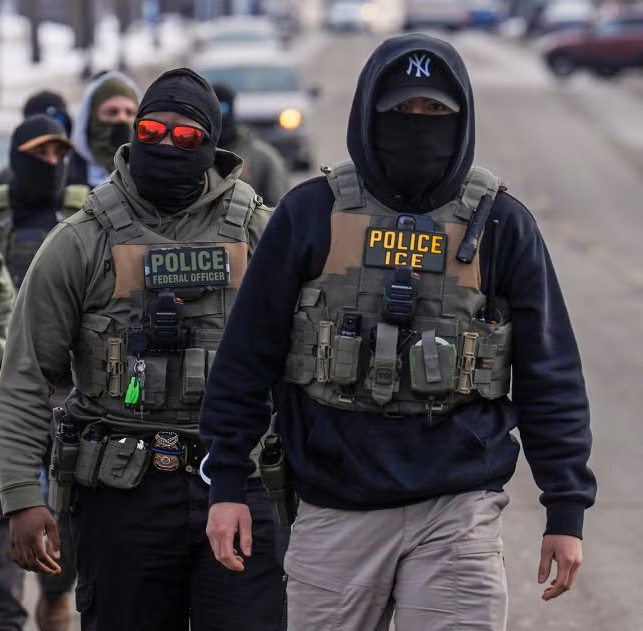
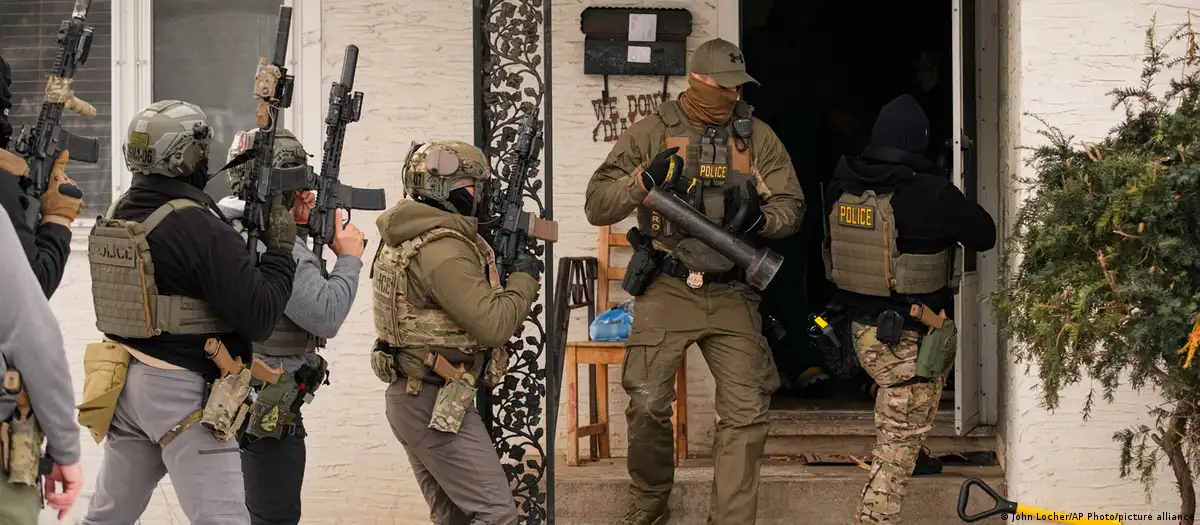
US immigration enforcement agency ICE has awarded a $16.7 million (€14.33 million) contract to buy 6,000 pairs of gloves that can deliver electric shocks.
Since the Department of Homeland Security (DHS) earlier this month announced its plans to use the gloves, there has been strong criticism by human rights groups and the Democrat opposition.
ICE is already facing intense criticism for its aggressive raids and tactics.
Since US President Donald Trump‘s crackdown on immigration began, several people have been killed in encounters between ICE officers and immigrants and people protesting against the agency.
How do the gloves work?
The controversial devices look like normal patrol gloves. But officers can activate an electric mode with the press of a button.
If they do so, the gloves will deliver a painful electric shock to whoever the officers touch with the gloves.
They are already in use in some prisons and police departments in the United States.
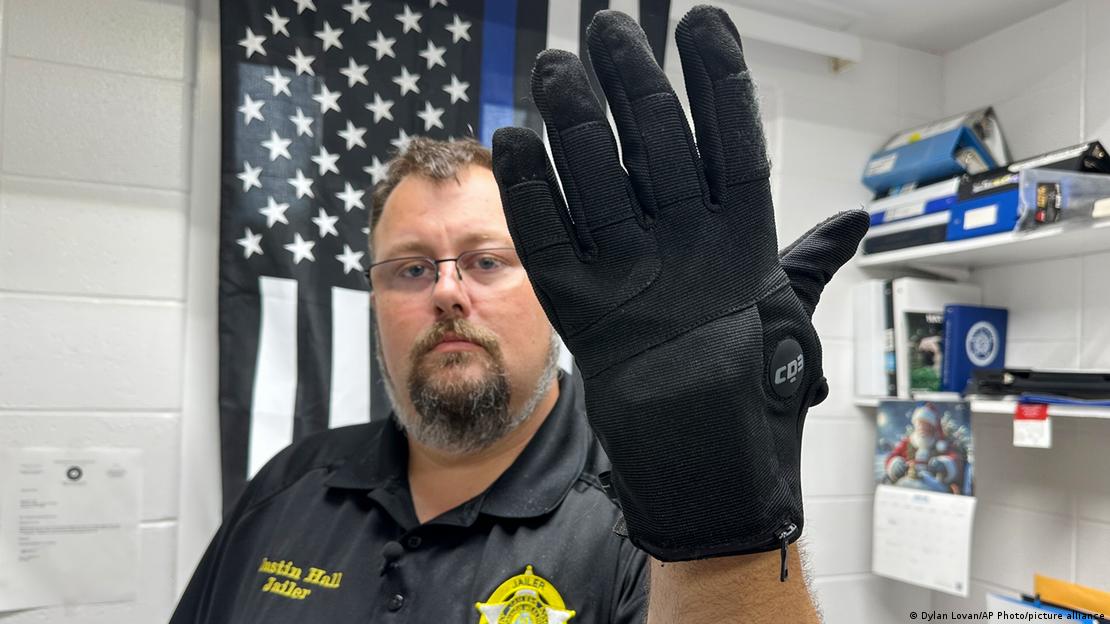
The ICE notice said officers would use them in “high-tension environments,” such as arrests, transporting detainees and responding to civil disturbances outside of detention facilities.
“It will be used when a subject is actively or passively resisting and an officer needs to gain control quickly to prevent injuries to both parties,” the document said.
Skepticism over ICE’s ‘professional capability’
The notice about the purchase contract was published on Thursday just hours after a group of US senators called for the plans to use the gloves to be abandoned.
In a letter to ICE’s acting director, a group led by Democrat Catherine Cortez Masto of Nevada said that the “blatant and tragic misuse of force in Los Angeles, Chicago, Minneapolis, Houston, Maine, and other locations around the country raises significant skepticism about the agency’s professional capability to safely deploy a new tool that could be used to harm Americans without cause.”
When the DHS earlier this month announced its plans for ICE officers to use the gloves, it said called the shock gloves “a Conductive Distraction and De-escalation Device which will be issued to Homeland Security Investigations and Enforcement Removal Operations officers and agents.”
While President Donald Trump says his crackdown on illegal immigration will boost domestic security, there have been several fatal shootings during ICE raids and more than 50 people have died in ICE custody, according to Reuters news agency and US media reports.
A controversial new purchase by U.S. Immigration and Customs Enforcement has opened another major front in the national debate over immigration enforcement, police powers, civil liberties and the use of force under President Donald Trump’s administration. ICE has awarded a $16.7 million contract to purchase approximately 6,000 pairs of gloves capable of delivering painful electric shocks through direct physical contact, according to reporting by Reuters and the Associated Press. The devices are intended to give federal immigration officers another tool for controlling people during arrests, detainee transportation and other high-tension encounters, but critics argue that putting electrically charged gloves directly onto the hands of agents creates significant risks of misuse.
The purchase comes at an especially sensitive moment for ICE. Immigration enforcement has expanded significantly during Trump’s second administration, while the agency has simultaneously faced protests, lawsuits, congressional scrutiny and accusations of excessive force. Against that backdrop, the prospect of thousands of federal officers being equipped with gloves capable of delivering electric shocks has generated questions extending far beyond the technology itself. Critics want to know when officers will be permitted to activate the gloves, what medical restrictions will apply, what level of resistance will justify their use, how officers will be trained, how each deployment will be documented and what consequences will follow if the devices are used improperly.
Supporters of the technology see the issue differently. ICE has characterized the devices as another less-lethal option that could allow officers to gain control of resistant individuals without immediately escalating to more dangerous methods. According to the AP, ICE says use of the devices will be governed by policy, training and accountability requirements. The Department of Homeland Security has defended the procurement amid political criticism, presenting officer safety as an important consideration in determining what equipment agents should have available during potentially dangerous encounters.
The devices themselves are unusual because they incorporate an electrical control mechanism directly into a glove worn by an officer. Rather than requiring the officer to reach for a separate device, the technology allows an electrical shock to be delivered through physical contact. According to congressional descriptions of the planned equipment, DHS identified the product as the CTG-5 G.L.O.V.E. and described it as a “Conductive Distraction and De-escalation Device.” Other congressional materials identify G.L.O.V.E. as an acronym for Generated Low Output Voltage Emitters.
From the government’s perspective, that design could theoretically provide an officer with a rapid method of gaining control during a struggle. From the perspective of critics, however, the same characteristic creates the central danger. Because the device is worn directly on an officer’s hand, an electrical shock could potentially become part of an ordinary physical interaction between an agent and someone being arrested or detained. That raises difficult questions about how clearly the boundary between routine physical control and electrical force will be defined.
ICE’s planning documents indicated that the gloves could be used in “high-tension environments,” including arrests, transportation of detainees and responses to disturbances around detention facilities. The agency’s explanation suggested that the device could be employed when someone is actively or passively resisting and an officer believes rapid control is necessary to prevent injuries. That reference to passive resistance has become particularly significant for opponents, because passive resistance can involve behavior very different from physically attacking an officer.
A person might refuse to move.
A protester might sit down.
A detainee might resist being placed into a vehicle without attempting to strike anyone.
Exactly where electrical force becomes appropriate in those circumstances is one of the questions critics say must be answered before thousands of devices are deployed.
The controversy began intensifying before the final contract was even awarded. On August 10, DHS published a notice concerning the planned acquisition, estimating that the purchase could ultimately be worth between $10 million and $20 million. Democratic lawmakers quickly began demanding explanations. On August 27, Senator Catherine Cortez Masto of Nevada and 15 Senate colleagues formally urged the administration to abandon the plan. The same day, ICE moved forward with the $16.7 million contract.
The timing became part of the controversy. According to Senator Adam Schiff’s office, ICE proceeded with the no-bid contract without first providing Congress answers to the questions lawmakers had raised about training, medical safety, oversight and authorized uses. Those lawmakers were not merely asking whether electrical gloves could work. They were questioning whether ICE had demonstrated that the devices were necessary and whether the agency had established safeguards strong enough to prevent abuse.
Cortez Masto and her colleagues submitted more than 30 questions and requests for documentation. Their concerns covered necessity, procurement, alternatives, medical safety, appropriate use, training and accountability. One of the most basic questions was why ICE needs electrically charged gloves when officers already have access to other defensive tactics and less-lethal tools. The senators specifically asked what operational capability the gloves provide that pepper spray, Tasers, batons and established restraint techniques do not.
That question goes to the heart of the dispute.
If the gloves allow officers to resolve dangerous confrontations while reducing injuries, supporters could argue that they represent a useful addition to the agency’s equipment.
If they merely provide another way to inflict pain during encounters that could have been resolved using existing techniques, critics could argue that they unnecessarily expand the government’s coercive power.
The difference depends heavily on policy and practice.
Technology itself does not determine how force is used.
Officers do.
Training does.
Supervision does.
Accountability does.
And the circumstances surrounding each encounter do.
The senators therefore asked whether ICE had consulted other law-enforcement agencies already using the technology to determine whether there had been injuries, complaints or instances of misuse. They also wanted to know what alternatives ICE considered before selecting the gloves and why the purchase was being handled through a noncompetitive procurement process.
The no-bid nature of the contract has become a separate source of criticism. The AP reported that the $16.7 million award went to Compliant Technologies LLC without competitive bidding. Democratic lawmakers have questioned why a purchase involving millions of taxpayer dollars and a controversial use-of-force device did not go through a normal competitive process.
Senators Cory Booker, Alex Padilla and Richard Blumenthal separately demanded that DHS and ICE halt the purchase and provide additional information. Their letter asked about the operational justification, the legal and factual basis for selecting a sole-source contract, medical and safety reviews and other aspects of the procurement. They also requested information concerning ICE’s use-of-force record since January 20, 2025.
These questions have become more politically powerful because they are being asked amid a wider argument about ICE’s conduct.
Democratic senators opposing the purchase pointed to incidents involving force in Los Angeles, Chicago, Minneapolis, Houston, Maine and other locations. In their letter, they argued that these incidents create serious doubts about whether ICE can responsibly deploy an additional device capable of inflicting pain through electrical current. That assessment represents the senators’ position rather than a neutral finding that every disputed incident involved unlawful force, but it demonstrates the level of distrust surrounding the agency.
The Trump administration and its supporters approach the issue from almost the opposite direction.
Trump has made aggressive immigration enforcement a central element of his presidency, arguing that stronger enforcement is necessary to secure the country and remove people who are unlawfully present. ICE officers operating under that agenda can encounter unpredictable and sometimes dangerous situations. From the administration’s perspective, agents should have equipment capable of protecting themselves while carrying out federal law.
That argument cannot simply be dismissed.
Law-enforcement officers can face genuine threats.
Arrests can become violent.
People can attempt to escape.
Crowds can surround officers.
Detainee transportation can involve unpredictable situations.
The real disagreement is therefore not whether officers should be able to protect themselves. It is what level of force is proportionate, when it should be authorized, and whether sufficient safeguards exist to prevent a tool intended for dangerous encounters from becoming routine.
ICE has presented the gloves as a potential alternative to more severe force. That concept is important because law enforcement agencies frequently use a force continuum in which officers select among different responses depending on the threat they encounter. A device that allows an officer to control someone without using a firearm could, under certain circumstances, reduce the risk of death.
But describing something as less lethal does not mean it is harmless.
Pain-compliance devices are intentionally designed to cause discomfort severe enough to change someone’s behavior. That is their purpose. The debate therefore involves not only whether the technology can reduce reliance on deadly force but whether electrical pain will be used only when necessary.
Civil-rights concerns become particularly significant during immigration enforcement because many ICE encounters are civil immigration matters rather than arrests for violent crimes. Someone may be taken into custody because of their immigration status, not because officers believe the person has just committed a violent offense.
Critics therefore argue that introducing electrical force into those encounters demands especially strict limits.
The concern becomes even more pronounced when protests are involved.
Immigration raids have generated demonstrations in cities around the country. Protesters sometimes attempt to block vehicles, surround officers, record operations or otherwise interfere with enforcement activity. Federal officers may view some of those actions as dangerous or obstructive, while protesters may view them as constitutionally protected political expression.
The possibility that electrically charged gloves could be used during “civil disturbances” consequently raises First Amendment concerns.
Lawmakers opposing the purchase want to know how ICE will distinguish between an individual presenting an immediate physical threat and someone participating in nonviolent protest activity.
That distinction is essential.
A government committed to protecting both public safety and constitutional rights must be able to separate violence from dissent.
A protester shouting at an officer is different from a person attacking one.
A person recording an arrest is different from someone attempting to seize an officer’s weapon.
A detainee asking questions is different from a detainee physically assaulting personnel.
A workable use-of-force policy must recognize those differences.
The glove controversy is therefore becoming a debate about much more than one piece of equipment.
It is becoming a test of public trust.
And trust in ICE is already deeply divided.
Supporters see agents carrying out federal laws that elected officials have a responsibility to enforce.
Opponents see an agency whose expanded operations have created fear within immigrant communities and whose tactics require greater oversight.
The same pair of gloves therefore represents two completely different things depending on the observer.
To supporters, they may represent another way to keep officers safe.
To opponents, they represent the potential normalization of electrical pain during civil immigration enforcement.
That divide is unlikely to disappear simply because the contract has been signed.
Another factor intensifying the controversy is the growing number of deaths in ICE custody during Trump’s second term. Reuters reported in early August that more than 50 people had died in ICE custody since January 2025. In one case, the family of Salvadoran detainee Edwin Lopez-Cornejo alleged that he did not receive adequate medical care before his death at a New Jersey detention facility. ICE disputed allegations of improper treatment, saying he received appropriate care and that personnel responded when he suffered a medical emergency.
Those deaths are not the same issue as the shock-glove purchase, and it would be misleading to suggest that electrical gloves caused them. The gloves have not yet been implicated in those cases. But the custody deaths contribute to the broader atmosphere of concern in which the procurement is occurring.
Critics argue that an agency already facing questions about detention conditions and force should not receive additional coercive technology without unusually strong safeguards.
The administration can counter that controversies elsewhere in the agency do not establish that a particular tool will be misused.
Both points explain why oversight is becoming central to the dispute.
If the gloves are deployed, documentation could determine whether the public ever receives a clear picture of how they are actually being used.
Will every activation automatically be recorded?
Will officers have to file use-of-force reports?
Will supervisors review those reports?
Will data be released publicly?
Will the agency track injuries?
Will demographic information be recorded?
Will complaints trigger independent investigations?
Will body cameras capture the circumstances leading to activation?
Will the device itself electronically record when electrical mode is switched on?
These questions may sound technical, but they could ultimately determine whether meaningful accountability is possible.
Without reliable records, allegations of misuse can become one person’s word against another.
With comprehensive records, investigators can examine patterns.
Suppose one officer activates the gloves twice in a year while another activates them dozens of times.
That difference could warrant review.
Suppose one detention facility records dramatically more uses than comparable facilities.
That could reveal a training or supervision problem.
Suppose the devices consistently reduce injuries compared with previous control techniques.
That evidence could support ICE’s argument that the gloves improve safety.
Good oversight can therefore protect both detainees and officers.
It can expose abuse when it occurs while also providing evidence when officers act appropriately.
Medical safety represents another unresolved area.
Any device delivering electrical current naturally raises questions about vulnerable individuals. Officers may encounter elderly people, pregnant women, people with heart conditions, individuals using implanted medical devices, people experiencing mental-health crises or people under the influence of substances.
An officer making an arrest may not know someone’s complete medical history.
That creates a practical challenge.
A device could theoretically be considered safe under controlled testing while producing different risks in unpredictable real-world circumstances.
The senators therefore asked for documentation concerning medical safety and the conditions under which use would be prohibited. Their letter explicitly identified medical safety as one of the major unresolved questions surrounding the procurement.
Training will consequently be crucial.
Giving an officer a new device is relatively easy.
Teaching thousands of officers when not to use it is much harder.
Effective training would need to cover not only operation of the glove but decision-making under pressure.
Agents would need to understand when electrical force is legally justified, how long contact should last, what areas of the body should be avoided, what medical vulnerabilities matter, what to do immediately afterward and when emergency medical assistance should be requested.
They would also need scenario-based training.
A compliant detainee.
A person pulling away.
A person refusing to stand.
Someone attempting to flee.
A protester blocking a vehicle.
A person striking an officer.
Someone holding a weapon.
Each scenario involves different legal and tactical considerations.
Simply teaching officers how to activate the glove would not answer the most important question: when should they activate it?
The controversy surrounding passive resistance makes that issue particularly urgent.
If ICE policy allows electrical shocks against someone who is not attacking an officer but is simply refusing to comply with commands, civil-liberties advocates are likely to challenge the policy aggressively.
The government’s argument would presumably be that officers sometimes need to gain control quickly before a situation escalates.
Critics would respond that intentionally inflicting electrical pain on a nonviolent person could be disproportionate.
Courts may eventually become involved if lawsuits arise.
Use-of-force cases frequently depend on highly specific facts.
What did the officer know?
What threat existed?
Was the individual resisting?
How serious was that resistance?
Were less intrusive alternatives available?
How long was force used?
Did the officer continue after control had been achieved?
The answers can determine whether a particular action was lawful.
An electrically charged glove could introduce new factual questions into those cases.
Because the technology is worn on the hand, distinguishing an ordinary physical restraint from an intentional electrical activation may require strong recording systems.
That makes transparency especially important.
Civil-rights organizations are likely to seek information through litigation and public-records requests.
Congress may hold hearings.
Inspectors general could examine procurement and deployment.
Journalists will attempt to obtain incident reports.
The contract therefore may be only the beginning of a much longer controversy.
The financial aspect is also attracting attention.
At $16.7 million for 6,000 pairs, the contract represents a significant federal expenditure. A simple division would imply roughly $2,783 per pair if the entire contract value were attributable solely to the gloves, although contract totals can include training, accessories, support, replacement components or other services, so that calculation should not be treated as the confirmed per-unit purchase price.
Lawmakers specifically asked ICE to disclose the projected per-unit cost and explain how many personnel would receive the equipment.
Critics of the purchase argue that taxpayers deserve to know why this technology is worth the investment.
Supporters can reasonably respond that cost should be evaluated against effectiveness. If a device reduces serious injuries, prevents shootings or protects agents and detainees, its value cannot be measured solely by purchase price.
But that argument requires evidence.
How effective are the gloves?
How often have other agencies used them?
Have injuries decreased?
How many complaints have resulted?
How frequently are they activated unnecessarily?
Those are measurable questions.
The senators have asked whether ICE consulted agencies already using the devices to obtain precisely that kind of information.
The political conflict surrounding the purchase is unlikely to remain limited to the Senate.
Immigration has become one of the defining political battles of Trump’s second administration. His supporters elected him partly because of promises to dramatically increase enforcement and deportations. From that perspective, criticism of ICE equipment can be portrayed as another attempt to weaken officers responsible for carrying out policies voters endorsed.
Democrats and civil-rights advocates reject that framing.
They argue that supporting immigration enforcement does not require accepting every tactic, every procurement decision or every use of force without scrutiny.
Government power, they contend, must remain constrained even when officials are pursuing legitimate enforcement objectives.
That disagreement reflects an old democratic tension.
How much power should the government possess in order to enforce the law?
And what safeguards are necessary to ensure that power is not abused?
Electric shock gloves simply provide a new technological setting for that much older argument.
The Trump administration will likely continue emphasizing officer safety and enforcement effectiveness.
Opponents will continue emphasizing proportionality, constitutional protections and accountability.
The actual experience of the first officers equipped with the gloves could eventually provide evidence supporting one side or the other.
If deployment results in fewer injuries and few substantiated complaints, ICE will have a stronger argument that the technology works as intended.
If videos emerge showing agents shocking nonviolent detainees or protesters, political opposition could intensify dramatically.
That is why early implementation will matter so much.
The first widely publicized incident involving the gloves could shape public perception for years.
A successful intervention preventing a dangerous confrontation might become evidence for supporters.
An apparent misuse captured clearly on video could become a defining image for critics.
In the smartphone era, either scenario could reach millions of people within hours.
ICE leadership therefore faces a challenge extending beyond procurement.
It must establish legitimacy for the tool.
That requires convincing not only officers but courts, lawmakers and the public that there are clear boundaries around its use.
Policies buried in internal manuals may not be enough.
Public confidence may require transparency.
What level of resistance justifies electrical force?
Can the gloves be used on handcuffed people?
Can they be used on minors?
Can they be used on pregnant women?
Can they be used on elderly detainees?
Can they be used during peaceful protests?
Can an officer activate them repeatedly?
What medical evaluation follows use?
Who investigates complaints?
Those are the kinds of questions that will define the controversy.
The dispute also demonstrates how rapidly immigration enforcement technology is evolving.
Border and immigration agencies already rely on surveillance cameras, biometric systems, license-plate readers, drones, databases and other technologies. The shock gloves represent a different category because they directly affect physical encounters between officers and individuals.
That makes their consequences immediate.
A database can raise privacy concerns.
A surveillance system can raise questions about monitoring.
An electrical control device raises questions about pain, injury and bodily autonomy.
Those issues inevitably trigger strong emotional responses.
For immigrant communities already fearful of enforcement operations, the image of agents wearing electrically charged gloves may deepen anxiety regardless of how frequently the devices are actually used.
That perception matters.
Effective law enforcement depends partly on community cooperation.
Witnesses need to report crimes.
Victims need to seek help.
People need to trust that contacting authorities will not automatically expose them or their relatives to unrelated consequences.
When communities become afraid of federal agents, cooperation can decline.
Supporters of strict immigration enforcement may argue that individuals without lawful status should expect enforcement.
But the effects of fear can extend to U.S. citizens, lawful residents and mixed-status families.
The Senate critics specifically warned that the gloves could potentially be used to harm Americans without cause, reflecting concern that immigration operations increasingly involve encounters with citizens and protesters as well as undocumented immigrants.
This is one reason the political debate has moved beyond immigration status itself.
The question is increasingly about federal law-enforcement power in public spaces.
When ICE conducts a raid, bystanders may record.
Protesters may arrive.
Local officials may object.
Family members may intervene.
Journalists may attempt to document what is happening.
Each additional participant creates potential confrontation.
Equipping officers with another pain-compliance device changes the tactical possibilities within those encounters.
Whether that change improves safety or increases abuse will depend on how the technology is governed.
There is also an important distinction between criticism and established wrongdoing.
Democratic senators have made serious allegations concerning ICE’s record, but their political statements should be identified as their claims and assessments rather than treated automatically as judicial findings.
Likewise, ICE’s description of the gloves as a de-escalation device represents the agency’s intended purpose, not proof that every future use will actually de-escalate a confrontation.
Both sides are making predictions.
The real evidence will come from deployment.
That is why data collection should matter even to people who have already formed strong opinions.
If the gloves are genuinely safer, transparent data can demonstrate that.
If they are routinely misused, transparent data can reveal that too.
Without transparency, the debate risks becoming permanently ideological.
For now, one thing is clear.
ICE has moved beyond merely considering the technology.
The $16.7 million contract has been awarded.
Six thousand pairs are planned.
The political opposition is organized.
Sixteen senators have demanded extensive answers, while another group of Judiciary Committee Democrats has separately pushed DHS and ICE to halt the purchase and explain its justification.
The controversy therefore is unlikely to disappear.
Instead, attention will now shift toward implementation.
When will the gloves reach officers?
Which units will receive them first?
What training will occur?
Will the agency release its detailed use policy?
Will Congress receive the documents it requested?
Will medical experts review the devices?
Will ICE publicly report each activation?
And perhaps most importantly, what will happen the first time an officer uses one during a real immigration operation?
Those questions remain unresolved.
The shock-glove controversy arrives at a moment when American immigration policy is already deeply polarized. To some voters, Trump’s enforcement campaign represents a long-overdue effort to restore control of the immigration system. To others, the tactics being used represent an unacceptable expansion of federal power.
The gloves have now become a physical symbol of that disagreement.
One side sees another less-lethal tool.
The other sees another mechanism of coercion.
Both sides claim safety as part of their argument.
ICE says officers need options that can quickly control dangerous encounters and potentially prevent more serious injuries.
Critics say the public needs protection from unnecessary force and that electrically shocking people during civil immigration operations could itself create injuries and escalation.
Ultimately, the question will not be resolved by the name attached to the device.
Calling it a “Conductive Distraction and De-escalation Device” does not guarantee de-escalation.
Calling it a “shock glove” does not establish that every use will constitute abuse.
What matters is what officers actually do with it.
If the devices are deployed, the country will eventually have evidence.
There will be incident reports.
There may be body-camera footage.
There may be medical records.
There may be complaints.
There may be lawsuits.
There may be congressional hearings.
And there will almost certainly be videos circulating online.
At that point, Americans will be able to judge whether the technology functioned primarily as a safer alternative during genuinely dangerous encounters or whether the warnings about misuse proved justified.
Until then, the $16.7 million contract represents both an operational decision and a political gamble.
The administration is betting that ICE can introduce a controversial new force option while convincing the public that its benefits outweigh its risks.
Opponents are betting that the agency’s existing record demonstrates why such trust should not be granted without extensive safeguards.
Between those positions stand thousands of officers, detainees, protesters, families and ordinary members of the public who may eventually encounter the technology directly.
Their experiences will matter more than any press release.
Because the most important question surrounding ICE’s electric gloves is not whether they can deliver a shock.
That has already been established.
The question is whether a federal agency operating at the center of one of America’s most divisive political battles can use that power proportionately, transparently and responsibly.
And with thousands of pairs potentially headed into the field, the answer may soon move from political argument to real-world test.