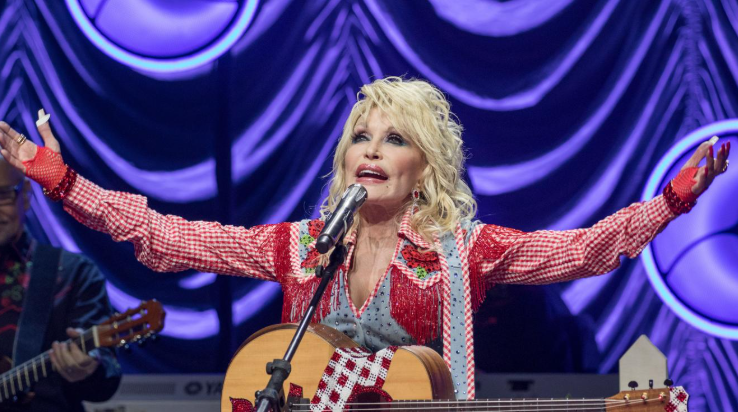
The world of music has lost one of its most recognizable, beloved and influential voices. Dolly Parton, the country music legend whose songs, personality, generosity and unmistakable sense of humor made her a cultural institution far beyond Nashville, has died at the age of 80.
Parton died on August 25, 2026, in Nashville, Tennessee. Her death was initially announced by her nephew Brian Seaver in a message shared through her official social media presence. Her representatives subsequently confirmed that she had been facing a brief battle with cancer and died at Vanderbilt-Ingram Cancer Center surrounded by loved ones. The precise type of cancer was not disclosed.
The announcement brought an immediate wave of grief across the entertainment world.
For millions of people, Dolly Parton was never simply a country singer.

She was a songwriter whose words crossed genres and generations. She was an actress who could command a movie screen with the same ease with which she commanded a concert stage. She was a businesswoman who turned her connection to Tennessee into an entertainment empire. She was a philanthropist whose literacy programs put books into the hands of children around the world.
And perhaps most remarkably, she remained unmistakably herself through all of it.
The rhinestones, enormous hair, instantly recognizable Tennessee accent and self-deprecating jokes became part of the image, but underneath the carefully constructed glamour was an artist whose songwriting could be painfully honest.
That combination helped make Dolly Parton difficult to categorize.
She could make audiences laugh and then, only moments later, make them cry.
She could write about poverty because she understood it personally.
She could sing about heartbreak without making vulnerability sound like weakness.
She could walk into an industry dominated by powerful men, play by her own rules and eventually become powerful enough that the industry had little choice but to respect them.
Her journey began far away from the wealth and international recognition that would later define her public life.
Dolly Rebecca Parton was born on January 19, 1946, in Tennessee and grew up in a large family with limited financial resources. Those early experiences never disappeared from her songwriting or public identity.
Rather than hiding her origins after becoming successful, she transformed them into part of her artistic foundation.
The mountains, churches, family relationships, hardships and characters she encountered during childhood became material that would influence songs throughout her career.
Long before she became an international celebrity, music represented possibility.
She began performing while still young and eventually headed toward Nashville with ambitions far greater than her circumstances might have suggested were realistic.
But Dolly Parton possessed something that cannot easily be manufactured.
She understood stories.
More importantly, she understood how to compress complicated emotions into songs ordinary people could recognize immediately.
Love.
Jealousy.
Poverty.
Ambition.
Sacrifice.
Heartbreak.
Family.
Faith.
Those subjects appeared repeatedly throughout her work, but rarely felt artificial because Parton had an unusual ability to write with directness.
She didn’t need elaborate language to make a listener feel something.
Sometimes a simple melody and a few carefully chosen lines were enough.
As her career developed, that gift became increasingly obvious.
Her songwriting helped establish her long before the enormous celebrity image became inseparable from her name.
Eventually came the songs that would turn Dolly Parton from a successful country performer into an American institution.
“Jolene” became one of the most famous songs in country music history.
Its premise was remarkably simple: a woman pleading with another woman not to take the man she loves.
Yet Parton’s delivery transformed that vulnerability into something hypnotic.
The song crossed generations, genres and cultural boundaries. Artists from vastly different musical backgrounds would eventually reinterpret it, demonstrating just how adaptable Parton’s writing could be.
Then there was “I Will Always Love You.”
The song eventually became internationally associated with Whitney Houston’s extraordinary recording, but its origins remained deeply connected to Parton’s own career.
It demonstrated one of her defining strengths as a songwriter: she understood that love and separation did not have to be opposites.
Sometimes loving someone meant leaving.
Sometimes gratitude could exist alongside sadness.
Sometimes goodbye could be an act of affection rather than anger.
Houston’s later version would introduce the composition to an enormous global audience, but the songwriting underneath remained unmistakably Dolly.
Then came “9 to 5,” a song that captured workplace frustration with humor, rhythm and accessibility.
The track accompanied Parton’s successful move into film and became another cultural landmark.
Her performance in the 1980 movie 9 to 5, alongside Jane Fonda and Lily Tomlin, showed audiences who knew her primarily as a singer that her charisma translated naturally to acting.
She wasn’t simply playing “Dolly Parton.”
She had comic timing.
She understood the camera.
And she could hold her own beside established Hollywood performers.
The movie and song became lasting parts of popular culture, particularly because their themes surrounding workplace inequality remained recognizable long after their release.
Parton’s ability to move between music, film, television and business became increasingly important to understanding her career.
She refused to remain confined to one identity.
Country music may have been home, but Dolly Parton continually expanded the definition of what a country star could become.
She appeared in movies.
She wrote books.
She developed television projects.
She created businesses.
She built Dollywood.
She collaborated with younger generations of musicians.
She embraced rock music later in her career.
She became a celebrity whose fame extended far beyond audiences who regularly listened to country radio.
That crossover success could have created distance between Parton and the communities from which she emerged.
Instead, she repeatedly returned to Tennessee.
Dollywood became perhaps the clearest physical representation of that relationship.
The theme park developed into a major tourist attraction and economic force, but it also reflected Parton’s continued identification with the region that shaped her.
She understood that fame could be used not simply to leave somewhere behind, but to bring opportunity back to it.
That philosophy also became central to her philanthropy.
Among Parton’s most consequential projects was the Imagination Library, her children’s literacy initiative.
The idea was straightforward: give young children books.
But simple ideas can become extraordinary when pursued consistently.
What began locally expanded dramatically, eventually reaching families far beyond Tennessee and the United States.
Her representatives highlighted that literacy work when announcing her death, describing the enormous number of books distributed through the program as one of the clearest examples of her generosity.
The program represented something fundamental about Parton’s approach to charity.
She understood what access could mean.
A child growing up without money might not control the circumstances of their birth.
But a book could open a door.
It could create curiosity.
It could encourage imagination.
It could provide an escape.
And perhaps, for one child somewhere, it could create the same sense of possibility that music had created for Dolly Parton decades earlier.
Her philanthropy extended beyond literacy.
Parton also contributed financially to medical research, including research connected to the development of a COVID-19 vaccine.
Her representatives specifically referenced that contribution while remembering the broader humanitarian impact of her life.
Yet Parton often resisted presenting generosity as something extraordinary.
That attitude contributed to her unusual public appeal.
She was enormously wealthy and internationally famous, but she rarely presented herself as morally superior because of her charitable work.
Humor remained one of her most effective tools.
Parton understood her public image better than almost anyone.
She knew people talked about her hair.
She knew people talked about her clothes.
She knew people talked about cosmetic surgery.
And instead of behaving defensively, she frequently got to the joke first.
That self-awareness made it difficult for others to use those subjects against her.
The glamour was not accidental.
It was performance.
It was branding.
It was fun.
And Dolly was in control of the joke.
Behind that exaggerated exterior, however, was an exceptionally disciplined professional.
A career lasting approximately seven decades does not happen through personality alone.
Parton continued writing, recording, performing and developing projects at an age when many entertainers would have comfortably retired.
She remained curious about younger artists and changing musical styles rather than treating new generations as competitors.
That willingness to evolve helped preserve her relevance.
A teenager discovering Dolly Parton through a contemporary collaboration could eventually arrive at “Jolene.”
Someone hearing Whitney Houston sing “I Will Always Love You” could discover the songwriter behind it.
A movie fan could find the albums.
A visitor to Dollywood could learn about the woman whose name appeared on the entrance.
The different pieces of her career constantly introduced audiences to one another.
Her personal life, meanwhile, contained an unusual degree of privacy considering the magnitude of her fame.
Parton’s marriage to Carl Dean lasted nearly six decades before his death in March 2025.
Dean famously avoided the spotlight that surrounded his wife.
While Dolly became one of the most photographed women in entertainment, he largely remained outside the celebrity world.
That contrast fascinated audiences for decades.
Parton frequently spoke affectionately about their relationship while simultaneously protecting much of it from public consumption.
His death in 2025 represented an enormous personal loss.
The two had built a marriage capable of surviving a level of fame that destroys many relationships.
When Parton’s own death was announced the following year, her nephew’s family message referenced the belief that she had been reunited with Carl and other loved ones who had died before her.
That thought resonated strongly with fans because Carl had occupied such a distinctive place in the Dolly Parton story.
He was simultaneously central and almost invisible.
He was the husband of one of the most famous women in America while maintaining a life largely beyond the cameras.
Dolly appeared to respect that boundary throughout their marriage.
Their relationship also reflected another characteristic that defined her public persona: Dolly Parton could reveal enormous amounts about herself while still keeping important pieces private.
Audiences felt as though they knew her.
Yet she retained control over what they actually knew.
That balance became increasingly rare as celebrity culture changed.
Social media eventually transformed fame into a nearly continuous performance.
Parton belonged to an earlier generation, but she adapted without surrendering the mystery that had always surrounded certain parts of her life.
That ability to remain recognizable while changing with the times helped explain her extraordinary longevity.
Her influence stretched far beyond country music.
Pop stars admired her.
Rock musicians admired her.
Actors admired her.
Songwriters studied her.
Young performers who had not been born when some of her biggest songs were released still recognized her as an important creative figure.
When news of her death spread, tributes arrived rapidly from across entertainment and public life. Fellow country performers and artists from other genres remembered not only the superstar but also the person they had encountered behind the scenes.
That response demonstrated the breadth of Parton’s cultural reach.
Very few entertainers remain relevant for seven decades.
Even fewer remain genuinely beloved.
Celebrity usually creates division.
Success invites backlash.
Longevity can turn admiration into indifference.
Dolly somehow resisted much of that cycle.
Not universally, of course. No public figure is universally admired.
But she occupied an unusual cultural space.
People who disagreed about politics could enjoy Dolly Parton.
People who didn’t listen to country music knew Dolly Parton.
People who had never visited Tennessee knew Dolly Parton.
Her personality crossed boundaries that often seemed immovable elsewhere in American culture.
Part of that came from her refusal to treat kindness as weakness.
Dolly could be warm without seeming naive.
She could be funny without being cruel.
She could be glamorous without apologizing for it.
She could discuss faith without making every conversation a political argument.
And she could express pride in where she came from while still connecting with people whose lives looked nothing like hers.
That combination made her remarkably difficult to imitate.
Many performers borrowed pieces of the Dolly formula.
The rhinestones.
The big personality.
The Southern humor.
The crossover ambition.
But Dolly Parton worked because those pieces appeared authentic to her.
They weren’t a marketing strategy invented after fame arrived.
They were extensions of the person she had already decided to become.
Her death therefore represents more than the loss of another famous musician.
It closes one of the longest and most remarkable chapters in modern American entertainment.
Parton witnessed enormous changes in the music industry.
She began in an era dominated by radio, records and television variety programs.
She lived through cassette tapes.
Music videos.
Compact discs.
Digital downloads.
Streaming.
Social media.
And algorithm-driven music discovery.
Through every technological transition, the songs survived.
That is perhaps the clearest measure of songwriting.
Production styles age.
Fashion changes.
Technology disappears.
But a great song can continue working with nothing more than a voice and an instrument.
Dolly Parton wrote those kinds of songs.
That is why future generations who never experienced the height of her celebrity may still discover her.
They may encounter “Jolene” without understanding how famous its writer became.
They may hear “I Will Always Love You” and trace the composition backward.
They may watch 9 to 5 because its themes continue to resonate.
They may receive a childhood book through the Imagination Library without fully understanding the woman responsible for the program.
That is what legacy looks like when it becomes larger than celebrity.
Parton’s final years also demonstrated her refusal to behave as though creativity belonged only to the young.
She continued discussing future projects and ambitions.
Even as health issues increasingly became part of the public conversation, she remained focused on work.
Her representatives’ confirmation that she died following a brief battle with cancer gave the public more clarity about the circumstances surrounding her death, but the specific cancer was not disclosed, and it would be inappropriate to speculate beyond what her family and representatives have confirmed.
The announcement made the suddenness of the loss especially difficult for admirers.
Dolly Parton had seemed permanent.
That is what happens with entertainers whose careers span multiple generations.
Grandparents remember their early work.
Parents grow up hearing their songs.
Children discover them through movies, collaborations, memes or social media.
Eventually the artist stops belonging to a particular era.
They simply become part of the culture.
Dolly had reached that point long ago.
Her death does not remove her from that culture.
If anything, the days and years ahead will probably reveal just how deeply embedded she had become within it.
Radio stations will replay the classics.
Musicians will perform tributes.
Old interviews will circulate again.
Fans will return to favorite albums.
Parents will tell children about seeing her perform.
Songwriters will explain how she influenced them.
Visitors will continue arriving at Dollywood.
And books will continue reaching children through the Imagination Library.
The machinery of Dolly Parton’s legacy was built to continue without her.
That may ultimately be one of her greatest accomplishments.
She created institutions, songs and opportunities capable of outliving the person whose name made them possible.
The Broadway musical based on her life is also expected to continue. Producers said after her death that the production would proceed in accordance with her wishes, with Broadway previews scheduled for December 2026 and an opening planned for January 19, 2027—the date that would have marked her 81st birthday.
There is something fitting about that.
Even after Dolly Parton’s death, another curtain is preparing to rise.
Another audience will hear the songs.
Another generation will encounter the story.
And another version of the young girl from Tennessee who dreamed of something bigger will walk onto a stage.
That is the paradox of losing an artist whose work becomes timeless.
The person is gone.
The voice remains.
Dolly Parton died at 80 after a life almost unimaginably full of music, achievement and reinvention. She rose from poverty to become one of the defining songwriters and entertainers of her era. She crossed from country music into pop culture without abandoning the identity that made her distinctive. She transformed celebrity into business success and then repeatedly redirected portions of that success toward other people.
She gave children books.
She supported medical research.
She created jobs.
She created songs people played at weddings, funerals, breakups, celebrations and ordinary afternoons.
She made people laugh at her jokes.
She made them cry with her lyrics.
And through all the transformations of American entertainment, she remained Dolly.
There will be discussions about record sales, awards, chart positions and career milestones.
Those numbers matter because they demonstrate the extraordinary scale of her success.
But they cannot fully explain why the reaction to her death has been so emotional.
People do not mourn statistics.
They mourn memories.
A song playing in a parent’s kitchen.
A movie watched with someone who is no longer here.
A childhood trip to Tennessee.
A book arriving in the mail.
A concert remembered decades later.
A lyric that suddenly meant something during a difficult moment.
Dolly Parton became attached to millions of those memories.
That is why her death feels personal to people who never met her.
Her greatest achievement may ultimately have been the emotional relationship she created with audiences.
She spent decades appearing larger than life while somehow making people feel that the person beneath the rhinestones remained approachable.
She became extraordinarily famous without becoming completely unreachable.
And she turned an image that could easily have become caricature into something much more enduring.
It represented confidence.
Individuality.
Humor.
Ambition.
And the refusal to allow other people to define what a woman from rural Tennessee was supposed to become.
Now, after eight decades of life and roughly seven decades connected to entertainment, the performances have finally ended.
But the songs haven’t.
The stories haven’t.
The books haven’t.
The businesses haven’t.
The influence hasn’t.
And the millions of lives touched by her work and philanthropy remain.
Dolly Parton spent a lifetime creating reasons for people to remember her.
She probably never needed to worry.
The world will.

