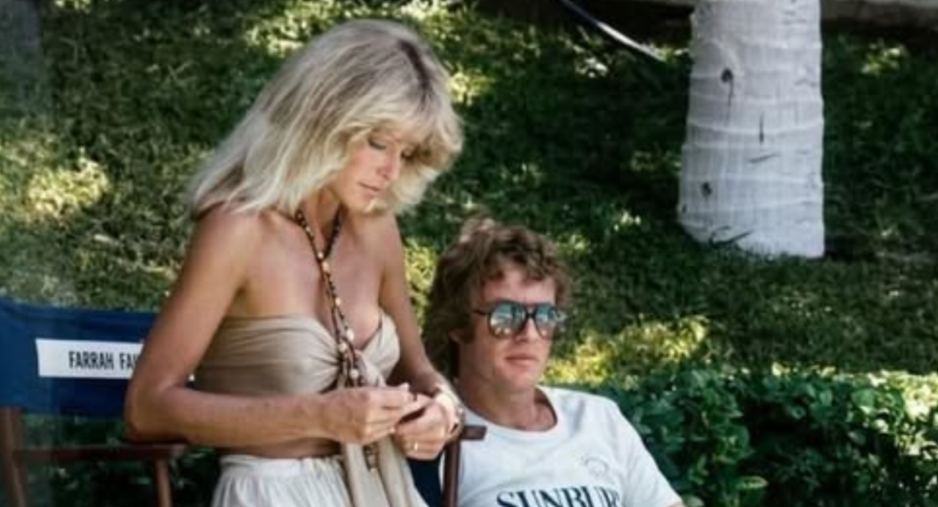
In the glittering mythology of 1970s Hollywood, few couples captured the imagination of the public quite like Farrah Fawcett and Lee Majors. They seemed to embody a particular kind of television royalty that was almost impossible to reproduce: glamorous without appearing unreachable, enormously successful while still carrying an unmistakable sense of ordinary humanity. At a time when television was creating a new generation of celebrities whose faces could become familiar in millions of homes every week, Farrah and Lee occupied a rare position at the center of that transformation. He was already a celebrated leading man, known around the world as Steve Austin in The Six Million Dollar Man, while she was on the verge of becoming one of the defining female stars of the decade through Charlie’s Angels. Together, they represented the meeting of two extraordinary careers, two Southern personalities, and two people whose relationship would eventually prove far more complicated—and far more enduring—than the glamorous photographs of their early years suggested.
Before the fame became overwhelming, both Farrah Fawcett and Lee Majors had built their identities through determination and a distinctly grounded upbringing. Neither arrived in Hollywood as an overnight sensation. Their paths were shaped by ambition, persistence, and the understanding that success could disappear as quickly as it arrived. Lee Majors, born Harvey Lee Yeary in Wyandotte, Michigan, and raised in Kentucky, had worked his way toward an acting career after an early interest in athletics. His physical presence, rugged appearance, and natural screen charisma eventually made him an ideal leading man. By the time he became Steve Austin, the bionic hero of television, Majors had already established himself as an actor capable of carrying a major series. His performance gave The Six Million Dollar Man a combination of action, humor, confidence, and vulnerability that helped turn the program into a cultural phenomenon.
Farrah Fawcett, meanwhile, was developing a different kind of presence. Born in Corpus Christi, Texas, she had initially gained attention as a model and actress before Hollywood began recognizing her potential. Her beauty was immediately apparent, but it was only one part of what eventually made her famous. Farrah possessed an expressive face, a distinctive smile, and a natural screen presence that allowed her to stand out even when surrounded by other performers. Her early career involved guest appearances and supporting roles, and like many aspiring actors of the era, she spent years working toward the opportunity that could change everything. That opportunity arrived with extraordinary force.
The middle of the 1970s became the moment when both careers reached another level. Lee was already playing Steve Austin, the astronaut transformed into a technologically enhanced government operative after a devastating accident. The character became one of television’s most recognizable heroes. The series was adventurous and futuristic, but Majors gave Austin a human quality that audiences could connect with. He was not simply a superhero. He was a man adjusting to an extraordinary new existence, and that combination of strength and humanity helped make the show enormously popular.
Then came Farrah’s breakthrough. In 1976, Charlie’s Angels premiered, introducing audiences to a trio of women who would become icons of 1970s television. Farrah played Jill Munroe, bringing an energetic combination of confidence, warmth, athleticism, and glamour to the character. The show itself quickly became a sensation, but Farrah’s image transcended the series. Her famous red swimsuit poster became one of the most recognizable pieces of popular culture of the decade, selling millions of copies and transforming her into a phenomenon almost overnight.
The timing was remarkable. Lee Majors was already one of television’s most recognizable stars, and Farrah was suddenly becoming one of the most recognizable women in the world. Their marriage placed them at the intersection of two enormous cultural forces. They were not simply husband and wife; they were a television supercouple during an era when television stars could become larger-than-life figures. Photographers followed them, magazines featured them, and audiences were fascinated by the possibility that the glamorous people they saw on television actually had a private life behind the scenes.
Yet the public image of Farrah and Lee was always more polished than the reality of their relationship. That distinction is important when looking back at celebrity culture from the perspective of 2026. The 1970s entertainment industry had an enormous appetite for photographs, interviews, and stories about famous couples, but the public often received only a carefully constructed version of their lives. Behind the glamorous images were two ambitious performers dealing with demanding careers, long working hours, travel, expectations, and the pressure that came from being constantly observed.
Their relationship began in 1973, and they married in 1973. At that point, neither could have predicted just how dramatically their professional lives would change over the following few years. Lee was moving deeper into television stardom, while Farrah was building toward the breakthrough that would redefine her public identity. Their early marriage therefore unfolded alongside a rapidly accelerating professional world.
The couple’s Southern roots were often part of the public image surrounding them. Farrah’s Texas background and Lee’s upbringing in Kentucky contributed to an impression of two Hollywood stars who had not completely lost touch with where they came from. There was something particularly appealing about that contrast. Hollywood was famous for excess, reinvention, and artificiality, yet Farrah and Lee could still be presented as people whose personalities were influenced by a more traditional, grounded culture. That quality helped make them attractive to audiences who admired their success without necessarily viewing them as completely detached from ordinary life.
Their fame, however, came with an enormous cost. The greater the attention surrounding them, the less privacy they had. Farrah’s poster became a symbol of the decade, but it also created an image that she would spend years attempting to move beyond. She did not want her identity to remain limited to beauty and glamour. Like many actors who experience sudden fame because of a particular role or image, she wanted to demonstrate that she could do more. She wanted serious dramatic work. She wanted challenging characters. She wanted audiences to recognize her as an actress rather than simply as the woman from the famous poster.
That desire became increasingly important as the 1970s progressed. Farrah’s decision to leave Charlie’s Angels after its first season was controversial because the series had become such a success. From a purely commercial perspective, remaining with the show might have seemed like the safest choice. Yet Farrah understood that remaining associated exclusively with Jill Munroe could restrict her future. She wanted to explore other opportunities and establish herself on her own terms.
Her departure also demonstrated a larger truth about the relationship between celebrity and personal independence. Farrah had become famous very quickly, but she did not want fame to dictate the entirety of her career. The decision required courage because Hollywood often rewards performers for repeating whatever made them successful in the first place. Choosing a different direction can be risky. Farrah accepted that risk.
For Lee, the situation was different but equally demanding. The Six Million Dollar Man continued to make him one of television’s biggest stars, and the responsibilities of carrying such a successful production were considerable. His career was built around a central character whose identity was closely tied to his own public image. As Steve Austin, he represented strength, technology, adventure, and reliability. Off-screen, however, he was a husband navigating a relationship with someone whose own fame was exploding at an extraordinary speed.
The contrast between their careers inevitably placed pressure on the marriage. Two people can love each other deeply while discovering that their professional ambitions and personal schedules are pulling them in different directions. The entertainment industry is particularly difficult in that respect because success often demands availability at precisely the moments when a personal relationship needs time and attention. Long shoots, promotional obligations, travel, public appearances, and professional commitments can gradually create distance.
By the end of the 1970s, Farrah and Lee’s marriage was under serious strain, and they separated in 1979. Their separation represented a painful transition, but it did not erase the importance of what they had shared. In later years, both would continue developing their careers in different directions. Farrah increasingly pursued dramatic acting, appearing in television movies and films that allowed her to demonstrate a range far removed from the glamorous image that had initially made her famous.
One of the most significant transformations in Farrah’s career came through her dramatic work. Her performances in projects such as The Burning Bed demonstrated that she was capable of tackling difficult, emotionally demanding material. The role earned her widespread critical recognition and helped change the way audiences viewed her. The woman once primarily associated with a red swimsuit and feathered hairstyle had become a serious dramatic performer willing to take risks.
That evolution is central to understanding Farrah’s legacy. Her beauty was never irrelevant to her fame, but reducing her career to her appearance overlooks one of the most interesting aspects of her story. She spent decades challenging the limitations created by her own extraordinary image. The more famous she became for being beautiful, the more determined she could become to prove that beauty was not the boundary of her talent.
Lee Majors also continued to work extensively, building a career that extended well beyond his years as Steve Austin. His screen persona changed as he grew older, and he appeared in television series, films, guest roles, and other projects. The cultural impact of The Six Million Dollar Man, however, remained a defining part of his career. Steve Austin became one of the archetypal television heroes of the 1970s, and the character’s influence could still be seen in popular culture decades later.
Despite their separation, Farrah and Lee did not become permanent enemies in the way Hollywood narratives sometimes suggest. Their relationship evolved. The intensity of their marriage gave way to distance, maturity, and eventually a form of mutual respect. This later chapter is perhaps one of the most meaningful parts of their story because it challenges the simplistic idea that relationships have only two possible endings: lasting marriage or complete estrangement.
People change. Careers change. Priorities change. Sometimes the most honest ending to one chapter is not the destruction of everything that came before it, but the acceptance that two people have grown in different directions. Farrah and Lee’s story illustrates that possibility. Whatever difficulties existed between them during their marriage, there remained an underlying connection formed during an extraordinary period of both their lives.
Years after their separation, Lee spoke about Farrah with affection and admiration. He reportedly described them as the “Brad and Angelina” of their era, a comparison that captures just how enormous their cultural visibility had been. Before celebrity couples became an industry of its own, Farrah and Lee had already experienced what it meant for audiences to be fascinated by a famous relationship as though it were part of the entertainment itself.
The comparison also highlights how much celebrity culture changed between the 1970s and the modern era. Today, famous couples can be followed continuously through social media, interviews, photographs, podcasts, and online commentary. In Farrah and Lee’s time, the mechanisms were different. Television, magazines, newspapers, posters, and paparazzi photographs carried the story. The volume of information was smaller, but the mystique could be greater. A photograph of a celebrity couple leaving a restaurant or attending an event could generate enormous public interest because there were fewer competing images available.
Their fame therefore existed in a kind of mythic haze. The public saw selected moments, while the majority of their lives remained inaccessible. That distance created room for fantasy. Farrah and Lee could be imagined as the perfect Hollywood couple precisely because audiences did not see every argument, disappointment, uncertainty, or ordinary day. The polished photographs became symbols of an idealized era.
But the truth of their story is more compelling than the myth. They were two ambitious people trying to build meaningful lives inside an industry that constantly demanded more from them. Their marriage did not survive, but their careers did. Their individual identities continued to evolve, and the respect they eventually found for each other suggested that the end of a marriage did not have to mean the end of affection.
Farrah’s later life was marked by both extraordinary professional achievements and profound personal challenges. Her determination remained visible even as she confronted difficult circumstances. She continued working, documenting aspects of her life, and maintaining the same willingness to face uncomfortable realities that had characterized her most ambitious dramatic performances.
In the years before her death in 2009, she had become something much larger than the image that initially made her famous. She was remembered not only as Jill Munroe or the woman in the red swimsuit, but as an actress who had spent decades trying to define herself beyond the expectations placed upon her. Her career became a story about reinvention. She had started as a young woman whose appearance made her famous and ultimately became an established performer whose dramatic work commanded respect.
One of the most poignant elements of her final years was the renewed connection she shared with Lee. Their relationship had traveled through marriage, separation, independent careers, and decades of change. By the time they reconnected, they were no longer the young Hollywood couple who had once dominated magazine covers. They were older, experienced, and able to look at their shared past with a perspective that had been impossible when they were living through it.
The reported forty-minute conversation between them before Farrah’s death has often been remembered as a deeply emotional moment. Whatever private words were exchanged belong to them, but the significance of the reconnection is clear. After decades of separate lives, they were able to communicate again with warmth and honesty. It was not a return to their marriage, nor did it need to be. It was something different: an acknowledgment of the bond they had once shared and the history that could never be erased.
That kind of reconciliation can be more meaningful than a dramatic Hollywood reunion. It does not rewrite the past or pretend that difficult years never happened. Instead, it recognizes that people can reach a place where resentment no longer has to define their memories. Farrah and Lee had built careers, experienced successes and failures, and grown older. Their renewed friendship suggested that time had softened the sharpest edges of their story.
Farrah died on June 25, 2009, at the age of 62. Her death brought renewed attention to the remarkable path she had traveled. For many people, the first image that came to mind was still the iconic poster. For others, it was Jill Munroe running through an action sequence on Charlie’s Angels. But those images represented only the beginning. Her legacy also included serious dramatic performances, difficult personal choices, artistic ambition, and a determination to be taken seriously on her own terms.
Lee Majors continued living and working long after the end of their marriage, and his connection to Farrah remained part of the story of both their lives. His career, meanwhile, continued to carry the imprint of Steve Austin and the extraordinary television era that had made him famous. Even decades later, the image of the Bionic Man remains inseparable from the popular culture of the 1970s.
Looking back from 2026, Farrah Fawcett and Lee Majors represent something more interesting than a simple celebrity love story. Their relationship offers a window into a period when television was becoming one of the most powerful forces in American popular culture. It was a time when actors could become household names through weekly television series and when a single photograph could become a cultural phenomenon.
Their story also reflects the changing role of women in entertainment. Farrah’s rise demonstrated the enormous commercial power of female celebrity, but her later career demonstrated the desire to control what that celebrity meant. She refused to remain permanently trapped inside the image that had made her famous. Her dramatic performances were evidence of a performer trying to reclaim her identity from the machinery of celebrity.
Lee’s story reflects another side of the same phenomenon. He became famous by embodying a powerful television hero, yet his career also required him to adapt as tastes changed. The cultural landscape that had created Steve Austin did not remain frozen. Television evolved, audiences changed, and actors had to find new ways to remain relevant.
Together, their careers form a kind of parallel history of American television. The Bionic Man and the Angel were symbols of an era, but the people behind those symbols were far more complicated. They experienced fame, pressure, ambition, disappointment, reinvention, and ultimately a form of peace.
Perhaps that is why their story continues to attract attention. It is easy to remember the glamour. It is easy to remember the photographs, the television shows, the famous characters, and the extraordinary success. What is harder—and more meaningful—is remembering the humanity underneath all of it.
Farrah and Lee were not simply a perfect Hollywood couple. They were two people who happened to become famous at an extraordinary moment. Their relationship existed under pressures that most couples never experience. Their successes were magnified by the media, their difficulties were magnified by public attention, and their private decisions were often interpreted through the lens of celebrity culture. Yet behind the headlines were ordinary human emotions: love, ambition, disappointment, hope, forgiveness, and memory.
The passage of time has changed the way their relationship is understood. In the 1970s, they could be seen as the ultimate glamorous television couple. In the decades that followed, their separation became part of the story. But from the distance of 2026, another interpretation emerges. Their most enduring connection may not have been the marriage itself, but the respect that survived after the marriage ended.
There is something deeply human about that. Not every important relationship lasts in its original form. Some relationships transform. Some become friendships. Some become memories that can eventually be held without bitterness. Farrah and Lee’s later connection suggests that the value of a relationship cannot always be measured by whether it survives exactly as it began.
Their shared history also reminds us that celebrity does not protect people from the ordinary difficulties of life. Fame can provide opportunities, wealth, recognition, and influence, but it cannot guarantee emotional simplicity. In fact, extraordinary professional success can sometimes make personal relationships more complicated. The more people expect from a star, the more difficult it can become for that person to simply be a private human being.
Farrah and Lee experienced that contradiction at the height of their fame. The world wanted them to remain the glamorous couple captured in photographs, while their real lives were inevitably more complicated. Their eventual separation demonstrated that even the most photographed relationships are still relationships between individuals with separate needs, ambitions, and dreams.
Their legacy, therefore, should not be reduced to nostalgia. It should be understood as a story of evolution. Lee Majors became one of television’s defining action stars. Farrah Fawcett transformed herself from a pop-culture sensation into a respected dramatic actress. Their marriage became a chapter in both stories, but it did not define either person completely.