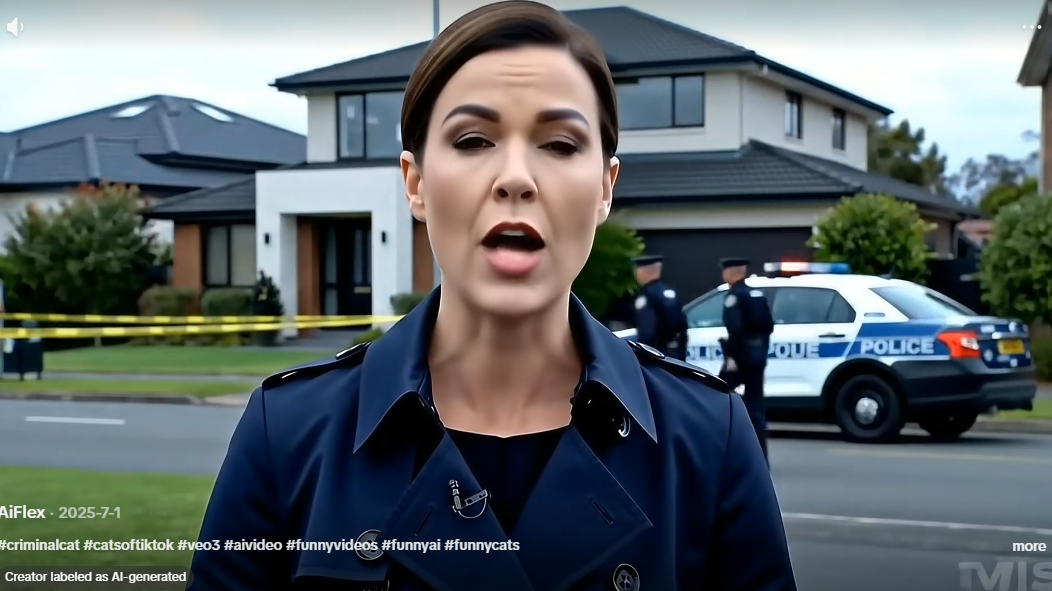
What initially looks like a serious breaking-news report quickly turns into one of the strangest and most entertaining scenes imaginable. The video shows what appears to be a police investigation taking place outside a large residential property. Police vehicles are nearby, yellow crime-scene tape surrounds part of the area, officers are moving around, and a group of photographers and journalists appears to be waiting for something important to happen. A female reporter stands in front of the camera, speaking with the serious expression and professional presentation normally associated with television news. Everything about the opening suggests that viewers are about to hear about an important incident.
Then the camera reveals the unexpected star of the story: an orange cat wearing dark sunglasses.
The moment completely changes the atmosphere. Instead of a serious suspect, witness, official or celebrity appearing in front of the gathered media, a police officer is seen carrying the cat in his arms. The animal looks remarkably calm despite all the attention surrounding it. The cat is wearing sunglasses and appears to have a harness or collar, making it look less like an ordinary household pet and more like a character arriving at a major public event. Photographers point their cameras toward the animal, while other people watch from behind the police barriers. What should be a serious police scene suddenly becomes a bizarre comedy.
The video appears to be created as fictional or AI-style entertainment rather than genuine news footage. Some of the text visible on the screen looks distorted or difficult to read, and the exaggerated situation itself makes it clear that viewers should not automatically interpret the scene as a real police incident. Instead, the clip seems designed to imitate the visual style of a television news report while placing an intentionally ridiculous subject at the center of the story. The result is a short piece of content that uses realism, surprise and humor to capture attention.
At the beginning of the video, the reporter creates an atmosphere of importance. She is positioned outside the property while police activity continues behind her. The camera angle is familiar to anyone who has watched television news. A reporter stands in front of the location where something supposedly happened, explains the situation to viewers and provides a visual connection to the scene. Police tape in the background reinforces the impression that authorities have restricted access to the area. It is the kind of setting that immediately makes people wonder what happened and why so many people have gathered.
The visual details are important because they establish expectations before the unusual moment arrives. If the video had started immediately with a cat wearing sunglasses, viewers would understand that it was intended as a joke. Instead, the creator first establishes a serious environment. The police vehicles, officers, reporter and cameras all communicate one message: something significant is happening here. That makes the appearance of the cat much more surprising.
As the camera moves toward the gathering, the viewer can see several people with professional-looking cameras. They appear to be focused on the same subject. Their behavior resembles the reaction of journalists covering an important public event. Cameras are raised, people are watching closely and the scene has the energy of a media gathering. But instead of waiting for an important person to emerge from the property, the photographers are focused on an orange cat.
The officer holding the animal appears completely calm. He carries the cat carefully while the cameras continue to capture the moment. The cat itself seems almost completely uninterested in the attention. Its dark sunglasses make it look especially confident, creating the impression that it somehow knows exactly why everyone is there. The contrast between the serious-looking officer and the ridiculous-looking cat creates much of the humor in the scene.
The sunglasses are perhaps the most memorable detail. Cats are already popular internet characters, but putting sunglasses on an orange cat immediately gives it a completely different personality. Instead of looking like a normal pet, the animal suddenly resembles a celebrity, detective or fictional action hero. The cat’s calm posture only adds to the effect. It does not look frightened or confused. It looks as though being surrounded by police officers and photographers is simply another ordinary day.
The situation becomes even more amusing when a microphone is brought toward the cat. A reporter appears to be attempting to interview the animal as if it were a human witness or public figure. The image is intentionally absurd. In a real news report, journalists might interview a police spokesperson, witness or investigator. Here, however, the microphone is directed toward a cat that is wearing sunglasses and being carried by an officer.
That single moment captures the entire idea behind the video. The creator has taken the familiar structure of a serious news report and replaced the expected subject with something completely unexpected. Instead of asking viewers to focus on a major event, the video asks them to imagine that an ordinary cat has somehow become the most important figure at the scene.
This type of humor works because it relies on contrast. The environment is serious, while the central character is ridiculous. The people surrounding the cat behave as though something important is happening, while the cat itself simply sits there. The officer appears professional, the photographers appear focused and the reporter appears serious. Only the subject makes the situation impossible to take seriously.
The clip also demonstrates why unexpected visual combinations can be so effective on social media. People scroll through enormous amounts of content every day, and most videos need to create curiosity almost immediately. A police scene is familiar. A reporter standing outside a property is familiar. A group of photographers is familiar. But a police officer carrying an orange cat wearing sunglasses is not something most viewers expect to see. That unusual combination creates an immediate reason to keep watching.
Viewers may initially wonder what the police are investigating. They may assume the video is going to reveal a serious event. But once the cat appears, the question changes. Instead of wondering what happened at the property, viewers start wondering why the cat is being treated like a celebrity. Why are all these photographers taking pictures? Why is a reporter holding a microphone toward the animal? Why does the cat look so calm? The unanswered questions become part of the entertainment.
The video is also an example of how fictional content can imitate the visual language of traditional journalism. Modern audiences are familiar with the appearance of breaking-news broadcasts. A reporter standing outside a location, police vehicles in the background, yellow tape across the area and a news banner at the bottom of the screen are all visual signals that tell viewers they are watching something important. When those signals are combined with an impossible or exaggerated story, the result becomes parody.
This is particularly relevant in the age of AI-generated content. Technology now allows creators to produce highly realistic fictional scenes involving people, locations and events that never actually happened. A video can look convincing while still being completely imaginary. Sometimes the easiest clues are small details such as distorted writing, strange objects, unnatural movements or an overall situation that seems too bizarre to be true.
In this case, the concept itself is a major clue. A police investigation involving an orange cat wearing sunglasses and receiving attention from a group of photographers is clearly presented for entertainment. There is no reason to treat the clip as evidence of a real criminal investigation. Instead, it is better understood as a fictional scenario designed to make people laugh and stop scrolling.
That distinction is important when sharing content online. A funny fictional video can become misleading if viewers remove its context and repost it as genuine news. The safest way to describe a video like this is to focus on what can actually be seen. The footage shows a reporter, police officers, a residential setting, photographers and an orange cat being carried by an officer. Beyond those visible details, viewers should avoid inventing claims about real crimes, real suspects or real police activity unless there is reliable evidence supporting them.
The humor does not depend on the situation being real. In fact, the absurdity is what makes it work. The cat does not need to have actually been involved in an investigation for the video to be entertaining. The entire joke comes from pretending that the animal is important enough to attract a full media gathering.
There is almost a celebrity quality to the way the cat is presented. The photographers appear eager to capture the perfect picture. The officer escorts the animal as though it were an important figure. A microphone is placed nearby as if the cat is expected to make a statement. Meanwhile, the cat remains silent and calm, wearing its sunglasses as though it has been dealing with media attention for years.
That imagined personality makes the scene even funnier. The cat almost looks like a celebrity who has arrived at an event without saying a word. The sunglasses make it appear confident and mysterious. If this were a fictional movie, the cat could easily be presented as a secretive character who somehow knows more about the situation than everyone else.
The orange color of the cat also makes it visually stand out against the darker uniforms and serious surroundings. The animal becomes the focal point of the scene almost immediately. Once viewers notice it, it is difficult to focus on anything else. The entire police setting becomes a backdrop for the cat.
Cats have always had a special place in internet culture. Their unpredictable behavior and expressive faces have made them a constant source of memes, jokes and viral videos. An ordinary cat doing something unexpected can attract millions of views because audiences already enjoy seeing animals placed in unusual situations. This video takes that idea further by turning the cat into the central figure of an imaginary news event.
The sunglasses are especially effective because they give the cat an instantly recognizable character. Without them, the animal might simply look like a normal orange cat being carried by an officer. With them, it looks like someone important. The sunglasses create a personality without the animal needing to do anything.
The cat’s calm behavior also adds to the joke. A normal animal might appear frightened by police vehicles, crowds and cameras. This cat seems completely comfortable. It is almost as though it expected the media to be there. The animal does not appear to understand that the situation is unusual, which makes the humans around it look even more ridiculous.
The reporter’s serious presentation creates another layer of comedy. Her job in the scene is to convince the viewer that the situation deserves attention. She speaks with the tone associated with breaking news, while the visuals slowly reveal that the central subject is a cat. The greater the seriousness of the presentation, the funnier the contrast becomes.
This is a common technique in comedy. A ridiculous subject becomes funnier when everyone around it behaves as though it is completely normal. If the officer were laughing or the photographers were obviously joking, the scene would lose some of its effect. Instead, the characters appear serious, allowing the viewer to recognize the absurdity for themselves.
The video also shows how a simple visual idea can create a story without needing extensive dialogue. There is no complicated explanation required. The audience can understand the basic joke simply by looking at the screen. Police officers are present. Media members are present. A cat is being carried. The cat is wearing sunglasses. A microphone appears. That is enough.
This makes the clip particularly suitable for short-form social media. The story is easy to understand even if someone watches it without sound. The visual details provide the context, while the unexpected appearance of the cat supplies the payoff.
The scene can almost be imagined as a fictional headline: authorities have arrived, journalists are waiting and an unexpected figure has emerged from the property. But instead of a politician or celebrity, the figure is a cat. That simple reversal is enough to create curiosity.
The video also plays with the idea of importance. In real life, the number of photographers surrounding a person often signals that the person is famous or that the event is significant. Here, the same visual signal is used to make the cat appear important. The more cameras that point toward the animal, the more ridiculous the situation becomes.
The cat effectively becomes the most famous creature on the street.
The police officer carrying it adds another layer of seriousness. Police officers are normally associated with law enforcement, investigations and public safety. Seeing an officer carefully carrying a cat makes the viewer wonder what could possibly have happened. The fact that the animal is wearing sunglasses makes the mystery even more entertaining.
There are countless imaginary explanations that could be created around the scene. Perhaps the cat is supposedly a witness. Perhaps it was rescued from the property. Perhaps it somehow became connected to the fictional investigation. Maybe the sunglasses are part of its disguise. Maybe the cat is actually the owner of the house and the humans are simply trying to get answers.
Of course, none of those explanations should be treated as factual. They are simply examples of how the video encourages viewers to create their own story around an unexplained image. That is one of the reasons absurd content can be so engaging. The audience becomes part of the joke by imagining what could possibly explain the situation.
The clip also reflects a broader change in online entertainment. Traditional media once controlled most of the tools needed to create realistic video scenes. Producing a convincing television-style report required cameras, actors, locations, equipment and editing. Today, creators can produce fictional scenes much more easily, and AI tools can help generate visuals that resemble real footage.
That creates exciting possibilities for comedy and storytelling, but it also means viewers need to be more careful about what they assume is genuine. A realistic-looking video is not automatically evidence of a real event. The visual appearance alone cannot establish authenticity.
In this case, viewers can enjoy the creativity while recognizing that the scene appears fictional. There is no need to attach a real person’s name, accuse anyone of wrongdoing or describe the event as an actual police case. The entertainment comes from the fictional scenario itself.
The strongest part of the video remains the moment when the cat becomes the center of attention. Everything before that moment prepares the audience for something serious. Everything after it becomes increasingly ridiculous. The transition is what makes the clip memorable.
It is easy to imagine a viewer watching the opening and thinking, “What happened here?” Then the cat appears, and the viewer’s reaction becomes something closer to, “Wait, is that a cat wearing sunglasses?” That change in expectation is exactly what short-form content creators want.
The video demonstrates the value of surprise. People are naturally attracted to things that do not fit their expectations. A cat belongs in a home, garden or perhaps a pet carrier. A police investigation belongs in a serious news report. Putting the two together creates a combination that is difficult to ignore.
The story also has a playful quality because the cat is not portrayed as dangerous. It is not attacking anyone, running from police or causing chaos. It simply exists at the center of an unnecessarily dramatic situation. That makes the humor light rather than frightening.
The animal almost seems to be receiving an absurd level of respect. The officer holds it carefully. The photographers wait for pictures. The reporter approaches with a microphone. The cat simply sits there. The imbalance between the attention being given and the importance of the subject is the heart of the joke.
Another reason the scene works is because viewers can immediately identify with the cat. Anyone who has ever seen a pet behave as though it owns the house can understand the personality being suggested. Cats are often humorously portrayed as confident, independent and completely unimpressed by human behavior. The sunglasses amplify that familiar image.
The cat does not need to say anything.
Its appearance says enough.
The video therefore becomes less about the supposed police investigation and more about the character created around the animal. The orange cat becomes a fictional personality — confident, mysterious, unbothered and apparently important enough to attract the press.
That is why the image is likely to stay in the viewer’s memory longer than the reporter or the police vehicles. People may forget the details of the fictional property, but they are unlikely to forget the sunglasses-wearing cat being carried through a media crowd.
Ultimately, the video is a clever example of how an ordinary subject can become extraordinary through presentation. A cat is normally just a pet. Add sunglasses, place it in the arms of a police officer and surround it with journalists, and suddenly the animal becomes the center of a fictional public spectacle.
The scene begins with the visual language of serious journalism but ends as something much closer to comedy. That unexpected transformation is the main reason the clip works. It catches attention, creates curiosity and delivers an image that is so unusual that viewers naturally want to keep watching.
At the same time, the clip serves as a reminder to think critically about videos that imitate real news. Modern technology makes it increasingly easy to create realistic-looking fictional scenes. Distorted text, unusual visual details and exaggerated circumstances can all provide clues that a video is intended as entertainment rather than documentation.
There is nothing wrong with enjoying that kind of content. In fact, fictional AI-style videos can be creative and genuinely funny when viewers understand what they are seeing. The important thing is simply to avoid presenting fictional scenes as confirmed real events.
In the end, the real star of this strange story is unmistakable. It is not the reporter, the police officer or the photographers. It is the orange cat sitting calmly behind dark sunglasses while an entire group of people appears determined to capture its every move.
The cat has no obvious reason to be the center of attention, yet everyone around it behaves as though it is the most important figure in the entire investigation. That contradiction is what makes the scene so entertaining. The more serious the people appear, the more ridiculous the situation becomes.
For a few moments, the normal rules of a news report disappear. A police scene becomes a stage, the photographers become an audience, the microphone becomes a symbol of importance and an ordinary household cat becomes a celebrity.
It is a simple idea, but it is an effective one. In an online world filled with predictable videos, unexpected moments are often the ones that people remember. A reporter can be forgotten. A generic police scene can be forgotten. But a sunglasses-wearing orange cat being carried by a police officer while photographers rush to take pictures is difficult to forget.
And perhaps that is the entire point of the video. It does not need to tell a real crime story. It does not need a complicated mystery or a dramatic conclusion. It simply needs to make viewers stop, look twice and wonder what on earth they are watching.
In that respect, the video succeeds perfectly. What begins as an apparently serious news report becomes an absurd and humorous spectacle centered around one very confident-looking cat. The fictional scene turns an ordinary animal into an unlikely celebrity, and the contrast between the seriousness of the setting and the ridiculousness of the subject creates the kind of visual surprise that social media audiences naturally enjoy.
So while the scene should be viewed as fictional entertainment rather than verified news, it still delivers exactly what a viral short video needs: an immediate hook, an unexpected twist, a memorable character and a moment that makes people want to share it with someone else.
After all, how often do you see an entire media crowd waiting outside a police scene only to discover that the person receiving all the attention is an orange cat wearing sunglasses?
Probably not very often.
And that is precisely why this strange little scene is so difficult to ignore.