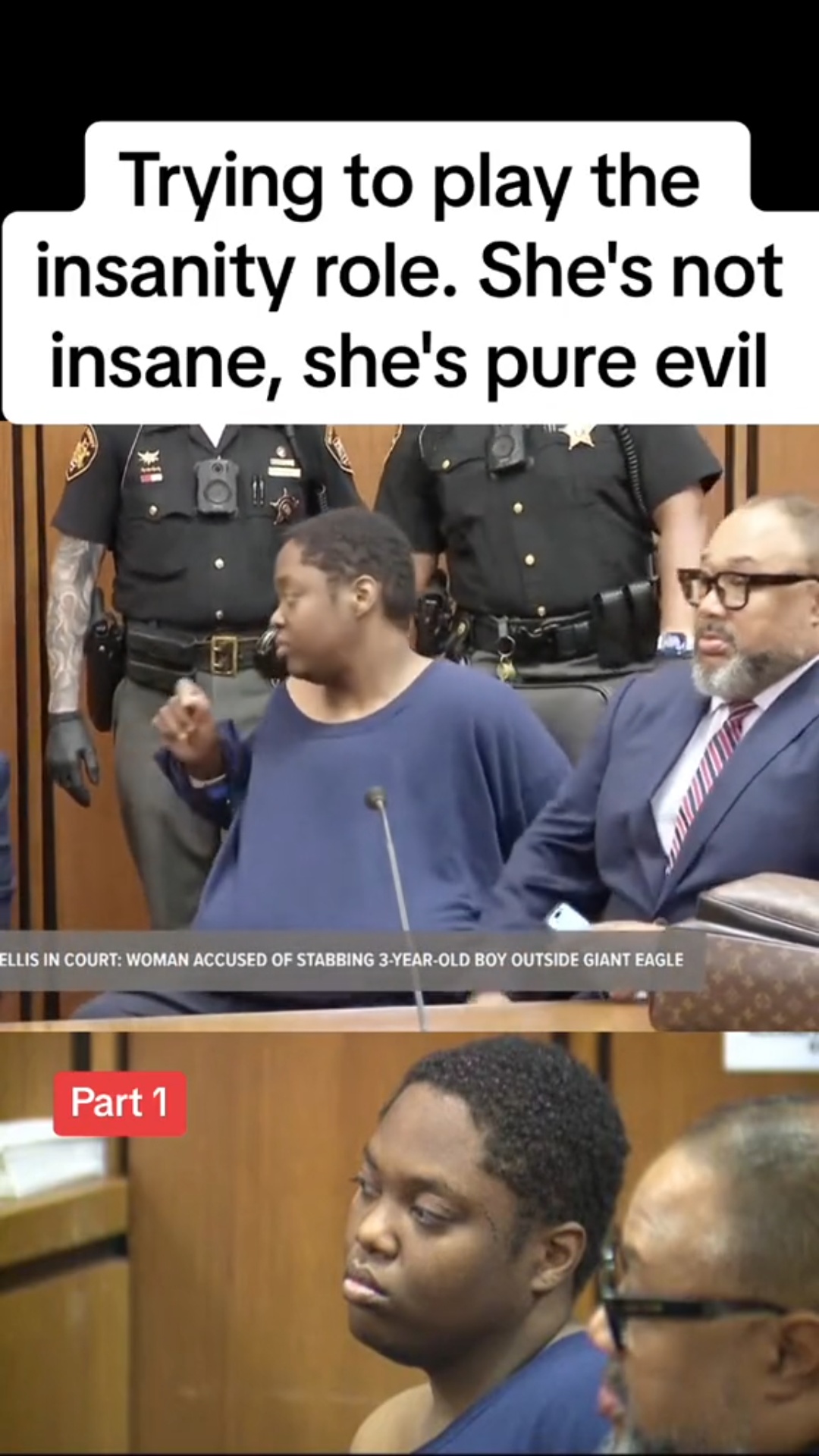
A deeply disturbing Ohio murder case became the subject of intense online debate after a woman accused of killing a young child entered a plea of not guilty by reason of insanity. Viral posts quickly described the defense as an act, claimed she was attempting to deceive the court and attached emotionally charged labels to her behavior. The actual legal proceedings, however, presented a more complicated question than the sensational headlines suggested: Bionca Ellis had a documented history of severe mental illness, but jurors still had to decide whether that illness met Ohio’s narrow legal definition of insanity at the precise time of the offense.
The case arose from a random attack outside a Giant Eagle supermarket in North Olmsted, a suburb of Cleveland, on June 3, 2024. Prosecutors said Ellis followed 3-year-old Julian Wood and his mother, Margot Wood, from the store into the parking area after taking knives from a neighboring thrift store. Julian was fatally injured, while his mother survived an injury sustained as she attempted to protect him. Ellis was arrested nearby, and investigators said there was no known connection between her and the Wood family.
The apparent randomness of the crime made it particularly difficult for the community to understand. There was no reported argument between Ellis and the family, no personal relationship and no obvious dispute that might explain why they were targeted. The absence of a conventional motive naturally led people to ask whether severe mental illness had played a role.
Ellis’s behavior during her early court appearances increased public speculation. Videos showed her smiling or appearing disconnected during proceedings in which she faced extremely serious charges. To viewers watching short clips without medical or legal context, those reactions appeared cold, mocking or deliberately theatrical. Social-media commenters frequently described them as proof of cruelty.
Courtroom behavior, however, cannot by itself establish what a person understood during an earlier crime. Inappropriate smiling, limited emotional expression, confused speech or apparent detachment may have many explanations. They can reflect stress, psychiatric symptoms, medication, neurological conditions, deliberate conduct or an individual’s unusual way of responding to an overwhelming situation. Judges and juries are therefore expected to consider expert evaluations and the complete evidentiary record rather than diagnose a defendant from a brief viral video.
The court initially found Ellis incompetent to stand trial in September 2024. Competency concerns a defendant’s condition during the legal proceedings: whether the person understands the charges, can communicate meaningfully with attorneys and can participate in preparing a defense. Ellis underwent inpatient treatment and received court-ordered medication. After approximately five months, doctors determined that her condition had improved sufficiently for the criminal case to proceed.
This finding was significant but did not answer the question later placed before the jury. Competency to stand trial and legal insanity at the time of an offense are separate issues. A defendant may be unable to participate in court shortly after an arrest but later regain competency through treatment. Conversely, someone may be competent during trial while arguing that a severe disease prevented them from understanding the wrongfulness of their actions when the crime occurred.
Ohio law sets a demanding standard for an insanity defense. A defendant must prove that, because of a severe mental disease or defect, the person did not know the wrongfulness of the conduct charged. Merely showing that someone had impaired judgment, difficulty controlling behavior or a psychiatric diagnosis is not enough. The legal question is not simply whether the person was mentally ill, but whether the illness prevented recognition that the act was wrong.
Ellis’s attorneys did not dispute that she committed the physical acts. Their case focused on her mental state. They argued that her actions occurred during a severe psychotic episode and that her conduct before and after the attack showed a profound break from reality rather than a rational effort to commit a planned crime and escape responsibility.
The defense presented extensive information about Ellis’s psychiatric history. Trial reporting showed that she had been diagnosed with schizophrenia, experienced previous hospitalizations and had shown recurring delusions and disorganized thinking. Witnesses described significant improvement when she received medication and deterioration during periods when she did not consistently follow treatment.
Forensic psychiatrist Dr. Sara West testified for the defense after evaluating Ellis on more than one occasion. West had previously helped determine that Ellis was not competent to stand trial. During the insanity evaluation, she reviewed Ellis’s records, history and reported experiences around the time of the offense.
West told the jury that Ellis had been experiencing serious symptoms of schizophrenia, including paranoid fear, irrational thoughts, disorganization and reported auditory hallucinations. In West’s professional opinion, those symptoms prevented Ellis from understanding that her conduct was wrong when the attack occurred.
That testimony directly supported the insanity defense. It did not merely say that Ellis was mentally ill. It connected the illness to the specific legal requirement, asserting that schizophrenia impaired her ability to recognize the wrongfulness of her actions at that moment.
The prosecution did not deny that Ellis had schizophrenia. Instead, it argued that having schizophrenia did not automatically make every action a product of psychosis or satisfy the legal insanity standard. The state’s position was that Ellis remained capable of understanding right from wrong and that anger or rage, rather than a delusion compelling her to believe the attack was acceptable, explained her conduct.
Forensic psychiatrist Dr. Stephen Noffsinger testified as a rebuttal witness for the prosecution. He interviewed Ellis, reviewed her medical, criminal and social history and examined recordings and other evidence. He agreed that she suffered from schizophrenia but concluded that the condition had not prevented her from knowing her actions were wrong.
Noffsinger questioned whether some of Ellis’s reported hallucinations were corroborated. He also emphasized that mental illness does not account for every decision made by someone with a diagnosis. People with schizophrenia, he explained, may still act because of emotions and motives common to people without schizophrenia, including anger and loss of temper.
The competing testimony placed the jury in a difficult position. Both experts recognized the existence of serious mental illness, but they disagreed about its legal effect at the time of the crime. One believed Ellis’s psychiatric symptoms had made her unable to appreciate wrongfulness. The other believed she remained aware that attacking someone was wrong despite her illness.
This distinction is often misunderstood in public discussions of criminal trials. Mental illness is a medical concept, while legal insanity is a specific rule concerning criminal responsibility. A person can have a genuine and severe disorder yet fail to qualify for an insanity acquittal. The law does not ask only whether a diagnosis exists; it asks how that diagnosis affected particular mental abilities during the offense.
The defense highlighted conduct that it believed appeared irrational. Ellis had reportedly left a wheelchair and luggage at a police station earlier that day, openly carried stolen knives rather than concealing them and made no serious attempt to escape after the attack. Her attorneys argued that the lack of concealment, apparent absence of a motive and unusual behavior supported the conclusion that she was disconnected from reality.
Prosecutors interpreted the same sequence differently. They focused on surveillance evidence showing Ellis examining and selecting knives before following the Wood family. The state argued that those choices demonstrated organization, decision-making and awareness rather than complete psychiatric disorganization.
The disagreement demonstrates how evidence does not always speak for itself. Walking away calmly could be interpreted as evidence of psychosis and emotional disconnection, or it could be viewed as indifference. Selecting an object could indicate organized planning, or it could occur during a confused mental state. Jurors had to decide which interpretation best fit the entire record and whether the defense met its legal burden.
Online audiences often reached conclusions more quickly. Short clips of Ellis’s facial expressions or behavior were circulated with captions asserting that she was pretending to be insane. Commenters described her as manipulative and claimed her lack of visible remorse established that the defense was fraudulent.
Those conclusions went beyond what the clips could prove. Determining whether someone is malingering—deliberately exaggerating or fabricating psychiatric symptoms—normally requires careful professional assessment. Evaluators review medical records, prior diagnoses, consistency across interviews, observed behavior and information from independent sources. A viewer cannot reliably perform that assessment from an edited courtroom clip.
The established record also makes it inaccurate to imply that Ellis suddenly invented mental illness after being charged. Evidence at trial included a lengthy history of psychiatric treatment and hospitalization predating the killing. She was found incompetent by the court and later restored through treatment. Multiple experts agreed that she had schizophrenia, although they disagreed about whether she was legally insane during the offense.
The central dispute was therefore not whether Ellis had any mental illness. It was whether the illness prevented her from understanding wrongfulness under Ohio law. Describing the case only as a woman “faking insanity” removes this essential distinction and inaccurately portrays the psychiatric evidence as nonexistent.
The title of the viral article introduced another problem by claiming that the judge called Ellis “pure evil.” The page quoted a supposed judicial statement that the behavior was not madness but evil. However, it supplied no hearing date, transcript, full video or official court record supporting the quotation. The page was dated September 24, 2025, several weeks before Ellis’s trial began and before the jury reached its verdict in October. Nevertheless, it claimed that prosecutors had defeated the insanity case and that a jury had rejected the plea.
That timeline makes the page unreliable as an account of the completed trial. It appears to combine a pretrial courtroom clip with later-sounding claims or generalized language about an insanity defense. The phrase “pure evil” was also present in the caption of the embedded social-media content, making it possible that the wording originated with a video publisher or commenter rather than Judge John Russo.
Verified accounts of Ellis’s sentencing reported that Judge Russo imposed life imprisonment without the possibility of parole. They described him as acknowledging the devastating effects on both families and stating that mental illness did not excuse the crime. Reliable reports did not attribute the viral “pure evil” quotation to him.
This difference matters because judges occupy positions of legal authority. Placing an invented or unverified quotation in a judge’s mouth can give an emotional internet opinion the appearance of an official judicial conclusion. A judge’s actual decision must be distinguished from language added by a headline writer or social-media account.
After more than eight hours of deliberations over two days, the jury rejected the insanity defense and found Ellis guilty of the charges submitted for its decision. The convictions included aggravated murder, murder-related offenses, felonious assault, child endangering and theft-related charges.
The verdict meant jurors concluded that the prosecution had proved the charged offenses and that Ellis had not established the legal insanity defense under Ohio’s standard. It did not mean the jury found that schizophrenia was fabricated, nor did it erase the earlier incompetency finding or the evidence of psychiatric hospitalization.
At sentencing on October 27, 2025, the court heard emotional victim-impact statements from Julian’s parents. They described the loss of a joyful young child and the lasting effect the crime had imposed on their family. Ellis briefly apologized for what she had done. Her lawyers requested a sentence that would eventually allow parole consideration, citing her severe mental illness, while prosecutors sought the maximum punishment.
Judge Russo sentenced Ellis to life without the possibility of parole for aggravated murder, with concurrent sentences on the remaining counts. The decision ensured that she would remain imprisoned permanently unless the conviction or sentence were later changed through the appeals process. Her attorneys said they planned to appeal.
The punishment reflected the extraordinary seriousness of the crime, the vulnerability of the victim and the court’s judgment that permanent incarceration was appropriate. It also showed that recognition of mental illness does not necessarily result in reduced legal accountability. A sentencing judge may consider psychiatric history while still concluding that public safety and the gravity of the offense require the maximum sentence.
The case left the community with painful questions about the interaction between mental-health systems and criminal justice. Ellis reportedly had repeated hospitalizations and a history of inconsistent medication use. She had also been involved in an earlier legal matter and was released shortly before the fatal attack. The tragedy prompted public scrutiny of whether warning signs had been missed and whether more effective intervention might have prevented the loss of life.
It is tempting after a terrible crime to assume that someone in the system must have had enough information to predict it. In reality, assessing future violence is difficult. Most people with schizophrenia are not violent, and a diagnosis alone does not establish that an individual will harm someone. Treating every person with psychosis as dangerous would be both inaccurate and deeply stigmatizing.
At the same time, untreated symptoms, repeated crises and inability to maintain care can create serious risks for some individuals. Effective prevention requires accessible treatment, communication among agencies, careful assessment and legal options that balance civil liberties with genuine safety concerns.
The Ellis case should not be used to portray mental illness as synonymous with evil. Schizophrenia is a serious disorder that can affect thought, perception and functioning, but millions of people living with psychiatric conditions never commit violent crimes. Sensational descriptions can increase fear and discourage people from seeking help.
Nor should mental illness be used to minimize the suffering of victims. Julian Wood’s death was an irreversible tragedy, and his family’s grief remains at the center of the case. Acknowledging the defendant’s diagnosis does not diminish the child’s life or the severity of what occurred.
The justice system is asked to hold both truths at once: a defendant may have a genuine disease, and the person may still be legally responsible for devastating harm. The insanity defense exists for the unusual circumstances in which illness destroys the mental capacity required for criminal responsibility. It is not a general exemption for everyone diagnosed with a disorder.
Contrary to common belief, a successful insanity defense does not usually mean that a defendant simply goes home. In Ohio, a person found not guilty by reason of insanity can be committed to a secure psychiatric institution and remain under court supervision while considered a danger. The result differs from a prison conviction, but it can still involve lengthy confinement and mandatory treatment.
Public anger toward the defense is understandable in a case involving the death of a child. The phrase “not guilty” can sound as though the legal system is declaring that nothing happened or that the victim did not matter. Legally, however, an insanity acquittal does not deny that the person committed the act. It means the law has determined that severe mental disease removed the level of moral and criminal responsibility ordinarily required for punishment.
In Ellis’s case, the jury was not persuaded that this threshold had been met. The verdict was based on evidence presented in open court, including psychiatric testimony from both sides, surveillance material, witness accounts and Ellis’s own recorded statements. That is a much stronger basis for judgment than an online clip of a defendant smiling or looking away.
The case also illustrates the harm caused when crime reporting turns legal proceedings into a simple contest between “insane” and “evil.” Human behavior does not always fit those categories neatly. A person may be severely ill, capable of cruelty and legally responsible at the same time. A jury can reject an insanity defense without concluding that the diagnosis was fraudulent.
Labeling someone “pure evil” may express outrage, but it does not explain the medical evidence, the legal standard or the institutional failures that may have preceded a crime. It closes discussion at the exact point where deeper examination could help prevent future tragedies.
Responsible reporting should accurately distinguish allegations, expert opinions, jury findings and judicial statements. It should not claim that a judge delivered a dramatic quotation without a transcript or authenticated recording. It should not announce a jury’s decision before the trial has occurred. It should also avoid describing a documented psychiatric condition as an obvious performance unless credible evidence establishes malingering.
An accurate headline might say that an Ohio jury rejected a schizophrenia-based insanity defense in the fatal attack on a child. That wording is less emotionally explosive, but it reflects what actually occurred. It recognizes the existence of mental illness while accurately stating that jurors found the legal defense insufficient.
The legal process did not resolve every moral or medical question. Experts can disagree honestly, particularly when attempting to reconstruct a person’s mental state during a brief event long after it occurred. Psychiatry cannot replay the mind with perfect certainty, and jurors must ultimately decide which explanation is more convincing.
The verdict did resolve criminal responsibility in the trial court. Ellis was convicted, and Judge Russo imposed the strongest available life sentence. The Wood family received a formal judgment holding her accountable, although no sentence could restore the life that was taken.
The public discussion should remember Julian as more than the victim in a viral courtroom video. His parents described him as energetic, outgoing and full of affection. The magnitude of the loss cannot be captured by sensational language directed at the defendant.
The discussion should also remain truthful. Justice is not strengthened by fabricated quotations or distorted timelines. A case this serious does not need exaggeration. The verified facts, the competing psychiatric opinions, the jury’s decision and the family’s loss are powerful enough without invented drama.
Bionca Ellis did rely on an insanity defense, and the jury rejected it. She had a documented diagnosis of schizophrenia, but the jurors concluded that the evidence did not prove she was unable to understand the wrongfulness of her actions. She was sentenced to life without parole.
What the verified record does not establish is that she merely invented her illness, that the judge publicly called her “pure evil,” or that the dramatic exchange described by the viral page occurred as presented.
The most responsible conclusion is therefore more careful than the headline. This was not a simple story of a defendant pretending to be mentally ill and being exposed by an angry judge. It was a tragic murder case involving a genuinely ill defendant, opposing expert conclusions, a narrow legal standard and a jury that ultimately found her criminally responsible.
Understanding that complexity does not excuse the crime. It protects the truth—and truth is essential to justice.