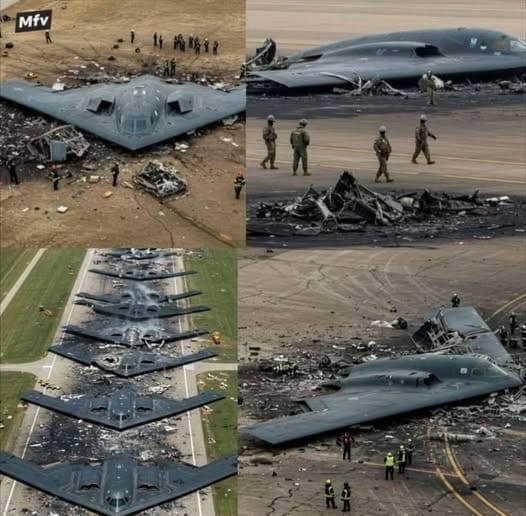
A dramatic warning began moving through social media under a headline declaring that Iran had attacked “our fleet.” The words were written to sound immediate and personal, as though American ships had just come under fire and the public needed to learn what happened without delay. “Breaking news” appeared at the beginning, giving the claim the urgency of a live military emergency. The use of “our fleet” encouraged readers to feel directly connected to the supposed targets, even though the post did not identify which country’s fleet it meant, which ships were involved, where the incident happened or when the attack allegedly occurred. The headline promised details beyond the link, but opening the page produced an entirely different subject. Instead of a report about Iranian missiles, drones, naval vessels or American casualties, readers found a general article about the B-2 Spirit stealth bomber and the demands of long-distance aviation missions. The fleet attack announced above the article was never explained because the article did not report one.
The mismatch is not a minor editorial error. A military attack involving Iran and an American fleet would be a major international event with immediate consequences for service members, regional security, energy markets and diplomatic relations. Such a report would require precise details. It would identify the ships or military formation involved, explain the type of weapons used, state whether the attack was intercepted and quote officials responsible for confirming the incident. The linked page does none of those things.
Its article begins by discussing an extended-duration B-2 mission. It describes the stealth bomber’s ability to fly across long distances, receive fuel in the air and operate with only two crew members. It discusses navigation, maintenance, fatigue, communication and mission planning. Those subjects may be interesting, but they do not establish that Iran attacked a fleet.
The B-2 Spirit is also an aircraft rather than a naval fleet. A story about bomber endurance cannot be quietly substituted for a claim about warships coming under attack. The two topics could theoretically be connected within a broader military operation, but a reliable article would clearly explain that connection. It would not place one alarming claim in the headline and then abandon it completely.
The page appears to rely on the fact that many readers will never examine the body carefully. Social-media users frequently react to a headline, image or introductory caption without opening the link. Some may share the post immediately because they believe an attack is underway. Others may open it briefly, scan a few references to American military power and assume the promised details appeared somewhere farther down.
A long article can make a false headline feel supported even when the text is unrelated. The length gives the impression that substantial reporting has taken place. Technical terms such as stealth capability, aerial refuelling, mission planning and global power projection can sound authoritative. A reader moving quickly may mistake military vocabulary for evidence about the specific claim.
Yet authority comes from sourcing, not from tone.
A genuine breaking-news report would tell readers who confirmed the event. It might cite the Pentagon, U.S. Central Command, the Navy, Iranian authorities, regional governments or reporters near the location. If accounts conflicted, the article would state those disagreements openly. One side might claim its missiles struck a ship while another said the weapons were intercepted. Readers would be told what remained uncertain.
The linked page provides none of that structure. It contains no quotation from Iran announcing a fleet attack. It contains no American denial or confirmation. It offers no satellite imagery, video analysis, ship-tracking information or witness account. It does not name a carrier, destroyer, amphibious vessel or support ship. It gives no casualty number because it never establishes that a specific attack happened.
The absence of a date is particularly revealing. “Breaking news” means that an event is new or developing. Readers need to know whether the claim refers to something that occurred minutes earlier, that morning or weeks in the past. Without a date, old military footage or recycled rumors can be presented as a new emergency.
The page was published on April 11, 2026, but the publication date alone does not identify when the supposed attack occurred. The article never states that Iran attacked a fleet on April 11. It does not describe an event on any other date either. The date merely shows when the webpage appeared.
This distinction matters because genuine confrontations between Iran and American forces have occurred during periods of high tension. When real fighting exists, misleading pages become harder to identify. A fabricated or unsupported headline may resemble current events closely enough to sound believable.
Iran has missiles, attack drones, fast boats and other military systems capable of threatening ships in and around the Persian Gulf and Strait of Hormuz. The United States maintains a major naval presence in the region through its Fifth Fleet and other forces. Years of hostility, maritime seizures, proxy conflict, sanctions and military warnings have created an environment in which a sudden confrontation is possible.
That background, however, cannot prove one specific headline.
A claim does not become accurate simply because it describes something that could happen. The event itself must be verified.
This is one of the central challenges of misinformation during an international crisis. False stories do not always describe impossible events. They often imitate plausible developments and attach themselves to genuine tension. A rumor that Iran attacked American ships may spread more easily during a period when Iran and the United States are already exchanging threats or fire.
Readers may remember seeing another report about drones near the Strait of Hormuz and assume that the new headline refers to the same event. They may combine separate incidents in their minds: an attack on a commercial tanker, an intercepted missile, a naval blockade and a B-2 mission. The result becomes a larger, more dramatic story that no individual source actually reported.
Precise language is therefore essential.
A commercial cargo ship is not an American naval vessel merely because it operates near U.S. forces. A drone flying near the Strait is not proof that an aircraft carrier was struck. Iranian state media claiming damage is not the same as independently confirmed damage. An attack directed at a ship is not identical to a successful hit. An interception does not mean the threat was imaginary, but it does change the outcome.
The phrase “attacked our fleet” hides all of those distinctions.
What does “fleet” mean in this context? It could refer to the U.S. Fifth Fleet headquarters in Bahrain, a carrier strike group, several destroyers travelling together or naval forces operating generally across the region. The headline gives no answer.
The possessive word “our” creates another problem. A news article should identify the country or organization involved instead of assuming every reader belongs to the same national audience. The internet crosses borders. A person in Europe, Asia, Africa or South America can encounter the same page. “Our fleet” is emotional language rather than precise reporting.
Its purpose is to convert a distant geopolitical event into a personal threat. An attack on “the U.S. Navy” can be considered and evaluated. An attack on “our fleet” feels like an attack on the reader and their community. That emotional pressure may reduce the likelihood that the person pauses to verify the claim.
The words “breaking news” intensify that pressure. They suggest that waiting could mean falling behind during a rapidly unfolding crisis. But speed is exactly when misinformation is most dangerous. Early reports are often incomplete, governments may release competing claims and videos can circulate without confirmed locations or dates.
Responsible outlets handle that uncertainty by using cautious wording. They may say Iran “claimed” an attack, U.S. officials “reported” an interception or damage “could not immediately be verified.” These phrases are not signs of weakness. They show that the report distinguishes confirmed facts from allegations.
A misleading page removes those boundaries. It declares the event in the headline and provides no supporting account in the body.
There were real naval clashes involving Iran and the United States after the page appeared. In one reported confrontation, Iranian authorities said they launched missiles and drones toward American Navy ships after U.S. forces targeted an Iranian tanker. Iranian reports claimed significant damage. The U.S. military said it intercepted the attack and stated that no American assets had been struck.
That difference is crucial. Readers should not choose whichever version aligns with their political views and present it as settled fact. They should report that the sides made conflicting claims and look for independent evidence.
Later reporting described the U.S. military as saying three Navy ships were targeted. That gives a much more specific and supportable account than “Iran attacked our fleet.” It identifies the type of targets and attributes the information to a named institution. It also preserves the distinction between being targeted and being damaged.
American officials have separately reported intercepting Iranian attack drones near the Strait of Hormuz. Again, this is a concrete description. It states what was launched, where the threat appeared and how the U.S. says its forces responded.
None of those details appears in the linked article.
A person could attempt to rewrite the webpage after the fact by attaching it to one of these later clashes, but that would be inaccurate. The page was published before the May confrontations and does not describe them. A later real event cannot retroactively verify an earlier unsupported headline.
This problem frequently appears online. A vague prediction or rumor circulates first. When something similar eventually occurs, users claim the original post was correct. But a statement so broad that it can attach itself to any future incident is not reliable reporting.
Dates prevent that type of manipulation. A proper timeline allows readers to determine whether an article reported an event, predicted it or was later misrepresented as evidence.
The page’s actual B-2 discussion may have been taken from a separate aviation article or generated as a general military essay. It praises the aircraft’s endurance and describes the difficulty of global missions. It refers broadly to a “recent” operation without identifying the mission, route, target, crew or official source.
Even as a B-2 report, it remains vague.
A credible aviation article might identify the Air Force unit, departure base, mission duration and public statement from military officials. Operational security may limit some details, but the article would still explain what had been officially released. The linked text instead reads like an overview of what long-range bomber missions generally require.
The presence of unrelated material suggests that the headline may have been selected primarily for engagement. Iran, American fleets and breaking news are likely to attract more attention than a general explanation of pilot fatigue and aerial refuelling.
The page therefore creates two layers of misdirection. The headline misrepresents the body, and the body gives the appearance of specific military reporting while remaining largely general.
This is particularly irresponsible during a conflict because false alarms can increase fear. Families of deployed service members may see the headline and worry that a relative’s ship has been attacked. They may search frantically for official information or contact loved ones who cannot respond during operations.
Financial markets can also react to perceived threats in the Strait of Hormuz. The waterway is one of the most important routes for global energy shipments. Reports of attacks, mining or closure can influence oil prices, shipping insurance and commercial decisions. A misleading viral post will not normally move global markets by itself, but thousands of similar claims create noise that makes genuine developments harder to evaluate.
Military misinformation can also encourage political escalation. People who believe American ships were struck may demand immediate retaliation. Others may spread exaggerated claims about casualties or sinking vessels. These reactions can create public pressure before the facts are established.
Governments themselves use information strategically during conflict. A country may emphasize successful interceptions to demonstrate strength, while its opponent claims direct hits to show effectiveness. Images may be delayed, cropped or released without context. Anonymous accounts may present old explosions as new footage.
For this reason, readers should seek several types of confirmation.
Official military statements are important because the armed forces involved have direct access to operational information. They are not automatically neutral, however, and may protect sensitive details or present events in a way favourable to their government. Independent news organizations can compare the claims, speak with multiple officials and examine available evidence.
Commercial satellite images, maritime security alerts and ship-tracking data may provide additional information. Witnesses and regional authorities can also help clarify where an event occurred. No single source is perfect, but agreement across several credible and independent sources increases confidence.
A random webpage containing an unrelated essay does not meet that standard.
The website’s surrounding content should also influence how carefully readers approach it. Sensational pages often publish incomplete titles, celebrity rumors, health claims and emotionally charged stories across unrelated subjects. Their business model may depend more on attracting clicks than establishing an editorial reputation.
A polished layout does not guarantee professional reporting. Website templates are inexpensive and can make a small anonymous operation resemble a news publication. The presence of advertisements, categories and an author name does not prove that editors reviewed the material.
Readers should look for a corrections policy, staff page, physical contact information, editorial standards and a history of original reporting. They should examine whether articles link to primary documents and whether authors have identifiable expertise.
In the case of major military news, the absence of sourcing should outweigh the confidence of the headline.
Social-media platforms amplify the problem by displaying headlines separately from articles. A user may see only the dramatic title, a photograph and the reactions of friends. The body text remains hidden unless they click.
Publishers know this and can design titles to function as independent viral claims. Even when the linked article contradicts or fails to support the headline, the false impression has already spread through screenshots and reposts.
Corrections face a disadvantage because they require more words. “Iran attacked our fleet” is immediate and emotionally clear. “The linked article discusses a B-2 mission and provides no evidence supporting the fleet-attack headline” takes longer to read.
Yet that longer explanation is what accuracy requires.
Users can reduce the spread of such claims through a simple process. First, open the article and check whether the body answers the headline. This single step would expose the problem here immediately. Second, identify the date and location of the alleged event. Third, look for named ships, officials or agencies. Fourth, search the central claim through established news organizations and official sources.
The wording of the search matters. Instead of copying the entire clickbait headline, use neutral terms such as “Iran U.S. Navy ships attack,” followed by the date or region. This makes it easier to locate factual reporting rather than pages repeating the same viral phrase.
Readers should also verify images and video. Military footage is regularly reused across conflicts. A ship launching defensive weapons during an exercise can be presented as footage from an attack. An explosion from years earlier can be described as a new strike. Video-game footage and computer-generated scenes have also been misrepresented as genuine combat.
Clues such as weather, ship numbers, coastlines, uniforms and watermarks can help specialists identify a clip, but ordinary users should avoid making confident conclusions based on appearance. The most reliable approach is finding the original upload from a known source.
The language used in captions deserves equal attention. “Iran claims it struck a U.S. destroyer” accurately identifies the source of an allegation. “Iran destroys American warship” presents the outcome as fact. The difference between those sentences can disappear as content is reposted.
Uncertainty should travel with the information.
When evidence changes, reporting should change too. A missile may initially be reported as intercepted before damage is discovered. A government may deny a strike and later release a different account. Good journalism updates the story and explains what changed.
Misleading pages rarely provide that transparency. They move quickly to the next emotional headline.
The real geopolitical environment surrounding Iran and the United States remains serious enough without exaggeration. Naval forces operate close to Iranian territory and important commercial routes. Missiles and drones can travel quickly, leaving commanders little time to respond. A mistake, misunderstanding or deliberate attack could widen a confrontation.
Commercial crews are also placed at risk. Maritime conflict does not affect only warships. Tankers, container ships and other civilian vessels can be struck, boarded, diverted or trapped. Their crews may come from countries with no direct role in the dispute.
The Strait of Hormuz gives these events global importance. A substantial portion of internationally traded oil and gas normally passes through or near the waterway. Disruption can affect fuel prices, manufacturing, transportation and household costs far beyond the Middle East.
Those realities deserve detailed, sober reporting.
They should not become background material for a headline that fails to tell readers what happened.
The phrase “our fleet” also oversimplifies the actual organization of American naval forces. The Fifth Fleet is headquartered in Bahrain and operates across the Persian Gulf, Gulf of Oman, Arabian Sea and nearby waters. Individual ships may be attached to carrier groups, amphibious groups or independent missions. A strike against one destroyer would be serious but would not necessarily mean an entire fleet had been attacked.
Accurate terminology helps the public understand scale. “Iran launched drones toward three U.S. Navy ships” communicates the event more precisely than “Iran attacked our fleet.” It leaves room to explain whether the weapons reached their targets, how the ships responded and what followed.
Precision does not reduce the seriousness of an event. It prevents seriousness from becoming distortion.
The linked page could have published a legitimate analysis of B-2 endurance. It might have explained why long-range bombers matter during tensions with Iran and how aerial refuelling allows aircraft to operate from distant bases. That would still require sourcing, but at least the headline and article would share a subject.
Instead, it uses fear of a naval attack to lead readers into a bomber essay.
The most likely outcome is not that readers gain a sophisticated understanding of military aviation. It is that they remember seeing a report that Iran struck an American fleet. The unsupported headline becomes the lasting message, while the unrelated body is forgotten.