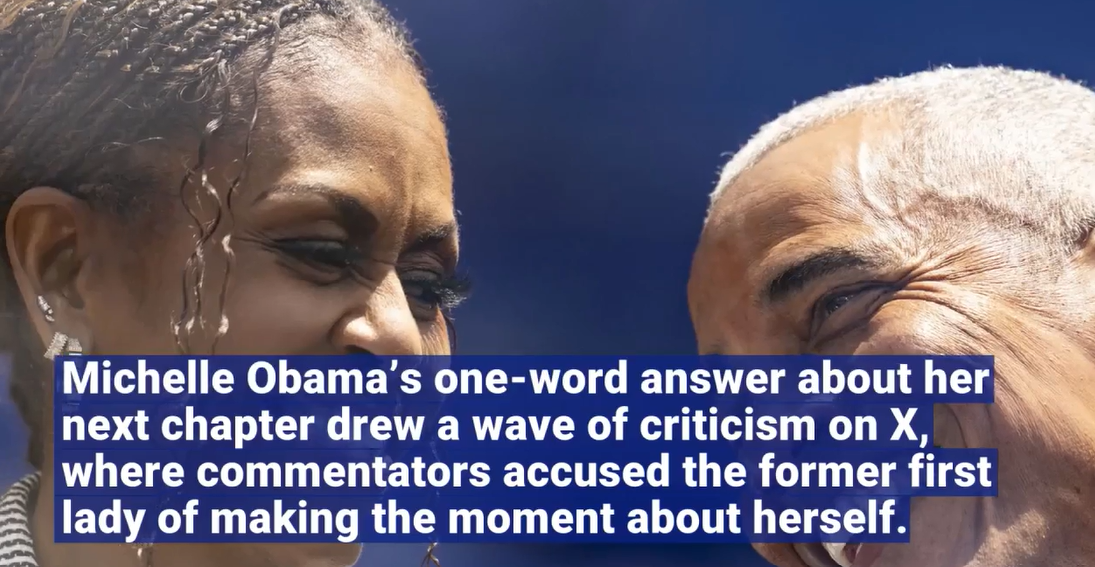
Former first lady Michelle Obama has become the subject of a heated social media debate after answering a lighthearted question about the next stage of her life with a single word: “Me.” The response came during a joint television interview with her husband, former President Barack Obama, as the couple reflected on their lives, their years in the White House, and the opening of the Obama Presidential Center in Chicago.
During the conversation, “Good Morning America” co-anchor Robin Roberts asked Barack and Michelle Obama to describe their next chapter using only one word. Barack Obama answered first, choosing the word “fun.” Michelle Obama then offered a different response. Without a long explanation, she simply said, “Me.”
Roberts appeared to enjoy the answer and described it as a “drop the mic” moment. Barack Obama also responded playfully, joking that the interviewer seemed to be grading Michelle’s answers more favorably than his. Inside the interview, the exchange appeared relaxed and humorous. It was presented as a brief glimpse into the personalities and future plans of a couple who have spent decades in public life.
Once the clip reached social media, however, it was separated from much of the surrounding conversation and interpreted far more seriously. Conservative commentators and political accounts accused Michelle Obama of being self-centered, entitled, and dismissive of her marriage. Some suggested that her answer revealed unhappiness with her husband, while others portrayed it as evidence that she thinks primarily about herself.
One commentator argued that the answer showed an inability to think about the wider world. Another wrote that Michelle Obama appeared to dislike her husband. Similar messages spread across X and other social media platforms as users debated whether the single word was empowering, humorous, revealing, or offensive.
The backlash demonstrates how even the smallest remarks made by famous political figures can become part of a much larger cultural conflict. A word spoken during a casual television segment can be clipped, reposted, and assigned a meaning that may be very different from the original tone of the conversation.
To critics, “me” sounded selfish. To supporters, it sounded like a woman finally claiming space for herself after spending much of her adult life serving the needs of her family, her husband’s political career, and the country. Those contrasting interpretations reveal more about modern political divisions than the word itself.
Michelle Obama’s answer did not appear unexpectedly. For more than a year, she has spoken openly about entering a deeply personal stage of life. Her daughters, Malia and Sasha, are adults, and she is no longer responsible for their daily care. Her husband is no longer president, and she does not carry the official obligations of being first lady.
She has described this period as one in which she can make decisions without first considering what is required by a campaign, an administration, a national audience, or young children. After decades of responsibilities, she has said she is asking what she wants for herself.
In previous interviews, Michelle Obama explained that she had returned to therapy while transitioning into this new chapter. She described therapy as a way to examine old habits, relationships, responsibilities, and emotional patterns as she adjusted to greater personal freedom.
She noted that for much of her life, her decisions had been connected to other people. As a mother, she made choices based on her daughters’ well-being. As the wife of an ambitious politician, she considered the demands of Barack Obama’s campaigns and career. As first lady, nearly every action was observed, analyzed, and judged by the public.
Seen in that broader context, “me” did not necessarily mean that she planned to ignore everyone around her. It could instead mean that she no longer wished to define herself entirely through service to other people.
This distinction matters because focusing on oneself is not always the same as being selfish. A person can prioritize personal health, growth, happiness, and independence while continuing to care about a spouse, children, friends, community, and society.
Michelle Obama’s supporters argue that women are often expected to sacrifice themselves for others and are criticized when they openly express personal desires. A man who says he wants to enjoy retirement or pursue his own interests may be viewed as successful and independent. A woman who says she wants to focus on herself may be called selfish.
That difference in interpretation is especially relevant to Michelle Obama’s story. Before Barack Obama became a national political figure, she had built her own demanding career. She graduated from Princeton University and Harvard Law School, worked as an attorney, and later held positions in public service, nonprofit work, and hospital administration.
As her husband’s political career expanded, the family’s life increasingly revolved around campaigns, elections, public appearances, security demands, and official responsibilities. Michelle Obama continued working for a period while raising their daughters, but her public identity eventually became closely connected to her husband’s career.
During Barack Obama’s presidency, she created major initiatives involving childhood health, military families, education, and opportunities for young people. Still, the role of first lady is not an elected office. It traditionally asks the president’s spouse to perform public service without having independent political authority.
Every first lady faces expectations about clothing, behavior, causes, family life, public warmth, and political involvement. Michelle Obama faced those expectations while also dealing with intense criticism tied to race, gender, appearance, and political opposition.
Her clothes, facial expressions, vacations, speeches, parenting, body, and personal choices were regularly discussed in the media. At different times she was described as too angry, too involved, not involved enough, too fashionable, too expensive, too outspoken, or insufficiently patriotic.
She has repeatedly discussed the emotional weight of being the first Black first lady of the United States. She and her family understood that mistakes could be judged not only as personal failures but as statements about Black families more broadly.
Her answer about the next chapter may therefore reflect a desire to step away from constant performance. For many years, her public actions were not allowed to be simply personal. They were examined as political symbols.
Some critics reject this explanation. They argue that Michelle Obama has enjoyed extraordinary privilege, wealth, influence, travel, and professional opportunities. From their perspective, speaking as though she has spent her entire life sacrificing herself ignores the benefits connected to her position.
The Obamas became globally famous, gained financial security, signed major publishing and media agreements, and entered elite cultural circles. Critics say that someone with those advantages may sound out of touch when presenting personal independence as a struggle.
It is possible, however, for privilege and pressure to exist at the same time. A person can have wealth, status, and opportunity while also experiencing stress, public scrutiny, family strain, and loss of privacy. Recognizing one reality does not require denying the other.
Michelle Obama’s marriage has also become part of the reaction. For years, political opponents and entertainment outlets have speculated about the Obamas’ relationship. These rumors became especially intense when Michelle chose not to attend certain major public events with her husband.
She did not accompany Barack Obama to former President Jimmy Carter’s funeral, and she did not attend Donald Trump’s second presidential inauguration in January 2025. Her absences produced claims that the couple might be separating, despite the lack of confirmed evidence.
Michelle Obama later addressed such speculation, saying that people struggled to accept that she was making decisions for herself. According to her explanation, some observers found it easier to assume a marital crisis than to believe she had simply chosen not to attend events she did not wish to attend.
Her “me” answer quickly became connected to those older rumors. Some social media users interpreted it as a rejection of Barack Obama, especially because his own answer, “fun,” sounded lighter and less personal.
That reading may place far more significance on a playful exchange than it was intended to carry. The couple laughed during the segment, and Barack Obama’s response suggested friendly teasing rather than discomfort or anger.
During events surrounding the opening of the Obama Presidential Center, Michelle also publicly praised her husband. She spoke about his character, achievements, and the effect he had on her life. Those remarks complicate the claim that one word proves deep resentment within their marriage.
Long relationships are rarely captured accurately by a few seconds of television. Couples can love one another while experiencing frustration, disagreement, sacrifice, and periods of personal change. They can also choose different goals for the future without rejecting the relationship itself.
The Obamas married in 1992, long before the presidency. Their marriage has included career changes, parenthood, electoral campaigns, political attacks, the White House, and life after public office. Both have acknowledged that Barack Obama’s political ambitions created pressure within the family.
Michelle Obama has written and spoken about times when she felt alone with parenting responsibilities while her husband traveled or worked long hours. Barack Obama has also acknowledged that his choices placed a burden on his wife and daughters.
Those admissions have sometimes been treated as signs of failure. Yet discussing strain honestly can also demonstrate that a marriage has survived challenges rather than avoided them.
The debate over “me” reflects a broader disagreement about identity within marriage. Some people believe spouses should describe the future primarily in terms of “we.” To them, marriage represents a shared journey, and publicly emphasizing oneself may seem cold or disrespectful.
Others believe a healthy marriage allows each person to maintain an independent identity. They argue that spouses do not stop being individuals and that personal development can strengthen rather than threaten a relationship.
Michelle Obama’s answer may resonate particularly with people who have spent many years as caregivers. Parents often organize their schedules, careers, finances, and emotions around their children. When those children grow up and leave home, parents may struggle to understand who they are outside the daily caregiving role.
This transition is often called the empty-nest period. For some parents, it produces sadness and loneliness. For others, it creates freedom. Many experience both emotions at once.
Women may feel this transition especially strongly when society has encouraged them to build their identity around motherhood. After years of being needed every day, they may need to rediscover personal interests, friendships, professional goals, and routines.
Michelle Obama is now in her early sixties. Her answer can be understood as part of a common life-stage question: After completing many of the responsibilities that defined earlier decades, what should come next?
Her choice of “me” suggests that the answer will not be another campaign, official role, or period of adjusting her life entirely around someone else’s ambitions. It signals that she wants the freedom to choose how she spends her time.
That may include writing, podcasting, public speaking, travel, family time, advocacy, business projects, or simply declining invitations. Her current work includes the “IMO” podcast, which she hosts with her brother Craig Robinson and uses to explore relationships, family experiences, aging, friendship, and personal growth.
The title “IMO,” meaning “in my opinion,” itself reflects a more conversational and personal phase. Rather than speaking only through carefully controlled official events, Michelle Obama discusses ordinary problems and emotional questions.
Critics may see the podcast and repeated discussions of personal choice as another example of celebrity self-absorption. Supporters see them as an effort to have honest conversations about experiences that many adults face.
Social media platforms encourage the most extreme interpretation of public comments. Nuance rarely travels as quickly as anger. A short clip produces more engagement when it appears to confirm what audiences already believe.
People who dislike Michelle Obama were likely to view “me” as evidence of arrogance. People who admire her were likely to view it as a statement of independence. Few reactions required viewers to consider the full interview or her previous explanations.
This pattern is common in political media. A brief comment becomes a symbol, and the individual is asked to represent an entire cultural debate. The argument is no longer only about Michelle Obama. It becomes an argument about marriage, feminism, motherhood, celebrity, privilege, race, and self-care.
The phrase “social media backlash” can also exaggerate the scale of public outrage. A small number of highly active accounts can make criticism appear universal. News stories may collect several negative posts and present them as a widespread response even when millions of people have expressed no opinion at all.
The comments cited in reports largely came from conservative media personalities and accounts already critical of the Obamas. Their reactions are real, but they do not necessarily represent a broad or politically neutral sample of public opinion.
At the same time, the criticism should not be dismissed merely because it came from political opponents. Public figures invite interpretation when they speak on national television. Some viewers may sincerely believe the answer sounded insensitive or self-important.
The fairest approach is to examine both the words and their context. Michelle Obama did say “me.” She did not say “family,” “service,” “community,” or “together.” It is understandable that some people interpreted the word as strongly individualistic.
However, she was answering a question that specifically asked for only one word. A one-word answer cannot explain an entire philosophy or future plan. The format encouraged a simple, memorable response rather than a detailed discussion.
Her previous comments supply much of the missing explanation. She has repeatedly said that she is entering a phase in which her daughters are grown, official duties have ended, and her choices are no longer controlled by the same responsibilities.
Her answer was therefore consistent with an idea she had already expressed at length. It was not necessarily an unexpected attack on her husband or declaration that no one else mattered.
The controversy also raises questions about how society defines selfishness. People are generally encouraged to care for their mental health, establish boundaries, and avoid exhausting themselves to satisfy everyone around them. Yet when a public figure directly says that a chapter of life will be about herself, those same ideas can suddenly appear less admirable.
There is a difference between self-care and self-centeredness. Self-care involves recognizing personal needs while respecting the needs of others. Self-centeredness involves treating other people as unimportant or useful only when they serve one’s interests.
Nothing in the brief interview proves that Michelle Obama intends to abandon her relationships or public concerns. Her answer more reasonably suggests a change in emphasis.
The response also fits the language commonly used in retirement. After decades of work, people often say it is finally time to travel, relax, pursue hobbies, or put themselves first. Such statements are generally understood as a reward for years of responsibility.
Michelle Obama has not completely retired from public life, but she has completed several demanding chapters. She supported two presidential campaigns, spent eight years as first lady, raised two daughters under Secret Service protection, and remained a major political and cultural figure afterward.
Her desire for greater control over her time is therefore not unusual. What is unusual is the level of attention given to that desire because of who she is.
Race and gender inevitably influence the reaction, even though not every critic is motivated by prejudice. Michelle Obama has spent years confronting the “angry Black woman” stereotype, in which confidence, frustration, or directness can be interpreted more negatively when expressed by a Black woman.
A white male politician describing his next chapter as being about himself might receive criticism, but he may also be praised for honesty or independence. Michelle Obama’s supporters argue that her words are more quickly used to portray her as ungrateful, bitter, or difficult.
Critics respond that raising race or gender can become a way to avoid legitimate disagreement. They maintain that any famous political spouse could face criticism for giving such an answer beside a partner.
Both factors may be involved. Some people may object to the statement based on genuine beliefs about marriage and service, while others may interpret it through long-standing hostility toward Michelle Obama.
The timing of the interview also shaped the reaction. It occurred at the Obama Presidential Center, a project intended to preserve and present Barack Obama’s legacy. Against that setting, Michelle’s choice of “me” created a sharp contrast that made the clip especially memorable.
The center itself represents the former president’s public life, political rise, and historical significance. It is located on Chicago’s South Side, where Michelle Obama grew up and where Barack Obama began much of his community and political work.
The joint interview gave the couple an opportunity to reflect on that history while looking toward the future. Barack Obama’s “fun” suggested a lighter stage after years of responsibility. Michelle Obama’s “me” suggested autonomy.
The answers are not necessarily opposites. Personal freedom can be fun, and fun can include time devoted to oneself, family, friends, and community.
Barack Obama’s joke about Roberts favoring Michelle’s answer also showed that he did not publicly treat the response as an insult. Viewers cannot know everything about a private marriage, but the visible exchange did not support the most dramatic interpretations circulating online.
Public reaction may also be influenced by Michelle Obama’s decision not to run for office. For years, Democrats and political commentators have imagined her as a possible presidential candidate because of her popularity. She has repeatedly rejected the idea.
Her focus on herself may frustrate people who believe she has an obligation to use her fame for electoral politics. Some supporters want her to rescue or lead the Democratic Party, while critics suspect she secretly desires power.
Michelle Obama’s repeated refusal suggests that she does not want another period in which her life is controlled by campaigning and public office. The word “me” may be a direct rejection of expectations that she must continue giving herself to national politics.
Famous women are often told that influence creates a duty to remain publicly available. When they withdraw or establish limits, the decision can be interpreted as arrogance. Michelle Obama appears increasingly willing to accept criticism rather than perform obligations she no longer wants.
This was evident in her decision to skip Donald Trump’s inauguration. She explained that she was making choices for herself instead of attending simply because tradition or public expectation demanded it.
Supporters viewed that decision as an honest boundary. Critics saw it as disrespectful to the peaceful transfer of power and the responsibilities associated with being a former first lady.