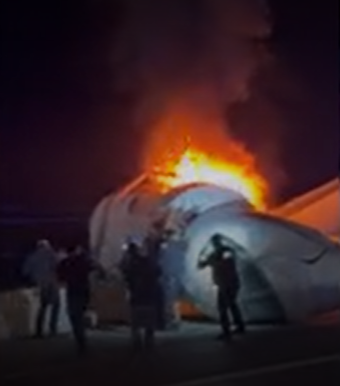
A deadly plane crash on a Texas highway turned an ordinary Tuesday night into a scene of panic, courage and heartbreak, after a private business jet came down near Laredo and burst into flames as drivers, police officers, firefighters and bystanders rushed toward the wreckage to help the people trapped inside. The crash, which happened on Loop 20 near the Texas-Mexico border, killed one person and injured several others, while also leaving behind powerful images of strangers working together in the middle of smoke, fire and confusion to save lives before the situation grew even worse.
The aircraft, a Cessna Citation Latitude operated by NetJets, had been traveling from San José del Cabo, Mexico, to Austin, Texas, when it experienced trouble and was diverted toward Laredo International Airport. The plane never made it safely to the runway. Instead, it crashed onto the highway shortly after 10 p.m., striking the ground near moving traffic and creating a dangerous emergency in a place where no one expected to see an aircraft coming down. For drivers on the road, the moment was shocking. One second, the highway was just another stretch of pavement under the night sky. The next, a plane had crashed, flames were visible, debris was scattered, and people were running toward danger because others were trapped and needed help.
Six people were on board the aircraft. Authorities said one person died, while the five others survived and were taken to hospitals for treatment. A person in a vehicle on the highway was also injured after the crash affected traffic on the ground. Several police officers who helped at the scene were treated for smoke inhalation, showing just how dangerous the rescue effort became. Even before the full investigation could explain why the crash happened, the first moments after impact revealed something clear: the actions of bystanders and first responders helped prevent the tragedy from becoming even larger.
Witnesses described a chaotic and frightening scene. The plane had come down on the highway and caught fire, creating heavy smoke and intense urgency. People nearby did not simply stand back and watch. Some left their cars and moved toward the wreckage, trying to reach the passengers before flames and smoke made rescue impossible. Civilians, police officers and firefighters worked in the same dangerous space, trying to open parts of the aircraft and get people out. Some used tools, including a sledgehammer and shovel, in an attempt to break through sections of the plane. Others used fire extinguishers or helped pull survivors away from the wreckage once openings were made.
The rescue was difficult because aircraft are built to be strong. Cockpit windows and doors are not easy to break, especially under pressure, at night, surrounded by smoke, heat and fear. But those at the scene kept trying. Video from the crash site showed people gathered around the aircraft, moving quickly and urgently as they attempted to free those inside. Their actions were risky, but they also showed the instinct that often appears in disasters: when people hear cries for help or see others trapped, many act before they have time to think about themselves.
First responders arrived to find not only a crash, but a rescue already underway. Police officers and civilians had already moved toward the plane. Firefighters then joined the effort, working to control the fire, reach the survivors and secure the scene. Emergency crews had to act quickly while also protecting themselves from the dangers around them. A plane crash on a highway brings many risks at once: fire, fuel, smoke, damaged metal, traffic, possible secondary explosions and the uncertainty of how badly the aircraft has been damaged. Despite those dangers, rescuers focused on getting the trapped passengers out.
The crash also created danger for people on the ground. Highways are built for vehicles, not emergency landings, and even a small aircraft can become a major hazard when it falls near traffic. In this case, a vehicle was struck or affected during the crash, and its driver was injured. The fact that more people on the highway were not killed or seriously hurt may be one of the most remarkable parts of the incident. At that time of night, Loop 20 still had traffic, and a falling aircraft could have caused a much wider disaster. Authorities shut down the highway in the area as crews worked through the night and investigators began the careful process of examining the crash site.
For the survivors, the moments after impact must have been terrifying. They were inside a damaged aircraft, surrounded by smoke and confusion, while people outside fought to reach them. Some were able to get out with help. Others needed rescuers to break through or open parts of the plane. In those first minutes, time mattered more than anything. A delay of even a few moments could have changed the outcome. That is why officials later praised the civilians who stopped and helped, calling attention to the role ordinary people played before emergency crews had fully taken control of the scene.
The victim who died was later identified in reports as Joshua Baer, a well-known figure in Austin’s technology community and the founder of Capital Factory. His death added another layer of sorrow to the crash, especially for people in Austin who knew him as an entrepreneur, mentor and supporter of startups. Friends, colleagues and community leaders remembered his influence and the work he had done to help build Austin’s technology scene. But beyond his public role, his death was also a personal tragedy for his family and loved ones, who now face the pain of losing someone suddenly in a violent and unexpected accident.
At the same time, the survival of the five others on board became a powerful reminder of how much rescue efforts can matter. Plane crashes are often thought of as events where survival depends only on what happens during impact. But in many crashes, what happens afterward is just as important. The speed of the rescue, the decisions of the first people on scene, and the ability to move survivors away from fire and smoke can be the difference between life and death. In Laredo, bystanders and first responders appear to have played that crucial role.
The crash also raised questions about what happened before the plane came down. Officials said the aircraft had reported mechanical difficulties and was trying to divert to Laredo. That detail is now central to the investigation. The National Transportation Safety Board and Federal Aviation Administration are expected to examine the aircraft, flight data, maintenance records, communications with air traffic control, weather conditions and the final moments of the flight. Investigators will look at whether mechanical failure, pilot decision-making, environmental conditions or another factor contributed to the crash. These investigations can take time because aviation accidents require careful analysis, not guesses.
For now, authorities have not given a final cause. That is important because early reports after aviation accidents can change as more information becomes available. What is known is that the aircraft was in distress, diverted from its planned route, and came down short of a safe landing. Investigators will try to reconstruct the flight step by step, from takeoff in Mexico to the attempted approach into Laredo. They will study the wreckage and speak with survivors if they are able to provide information. They may also use recordings and flight tracking data to understand what the pilots were facing in the minutes before the crash.
The location of the crash added to the complexity. Loop 20, also known as Bob Bullock Loop, is a major roadway in Laredo. A crash there affects not only the people involved but also the city’s transportation system, nearby businesses, emergency services and airport operations. After the crash, parts of the highway were closed while investigators and cleanup crews worked. Drivers were diverted, and officials urged people to avoid the area. The crash site had to be preserved for investigators, which meant crews could not simply clear everything away immediately. Every piece of debris could potentially help explain what went wrong.
The response from local officials focused heavily on the bravery of those who helped. Police and fire leaders praised the Good Samaritans who moved toward the burning aircraft instead of away from it. Some of those civilians left their own vehicles behind and joined the rescue effort with whatever tools they had available. Their courage was especially striking because they were not trained for that specific kind of emergency. They did not arrive with protective equipment or a full understanding of the risks. They simply saw people trapped and chose to help.
That kind of response can define a community after a disaster. Laredo officials said they wanted to identify and thank the civilians who assisted. In moments like this, recognition matters. It reminds the public that heroism is not always planned. Sometimes it comes from ordinary people making a decision in a few seconds. A tow truck driver, a passerby, a person who happened to be near the crash at the right moment—any of them can become part of a rescue when they choose to act.
The police officers who responded also faced serious risk. Several were treated for smoke inhalation after working close to the burning aircraft. Smoke can overcome rescuers quickly, especially when materials inside a vehicle or aircraft are burning. Officers often arrive before firefighters, which means they may be forced to make urgent decisions without all the equipment needed for a fire rescue. In this case, they helped get people out while also dealing with a dangerous and unstable crash scene. Their injuries show the cost of that response, even though they were later reported to be recovering.
Firefighters, too, had to manage a scene that could change rapidly. Aircraft fires are especially dangerous because of fuel and the materials involved. Fire crews had to suppress flames, help with extraction and make sure the area was safe enough for medical teams to treat victims. Emergency medical personnel then had to evaluate survivors, move them away from the crash and transport them to hospitals. The coordination required in those moments is intense. Police, firefighters, paramedics and civilians all had different roles, but their actions had to come together quickly.
The images and videos from the crash spread rapidly online, drawing national attention. Viewers saw people trying to break into the plane and rescue those inside. The footage was dramatic, but behind every clip was a human emergency. It was not just a viral moment. It was a life-and-death rescue happening in real time. The videos helped show the bravery at the scene, but they also reminded people of the shock and helplessness that can come with witnessing a disaster up close.
For people who travel often, the crash may feel unsettling. Private jets and business aircraft are often associated with safety, comfort and control. But aviation, like all forms of transportation, still carries risks. Most flights land safely every day, and aviation remains one of the most closely regulated industries. Still, when something goes wrong, it can happen quickly. That is why investigations are so important. They are not only about assigning responsibility; they are about learning what happened so future accidents can be prevented.
NetJets confirmed that the aircraft was part of its operation and expressed condolences after the crash. Companies involved in aviation accidents usually activate support teams for survivors, families and employees while cooperating with investigators. The company’s response will likely continue as the investigation moves forward. Families of those involved will want answers, and the public will want to know whether anything could have been done differently. Those answers may not come immediately.
The crash also placed emotional weight on the city of Laredo. Local residents saw one of their highways become the site of a deadly aviation accident. Some witnessed the crash directly. Others saw the emergency response, the road closures and the aftermath. For the people who stopped to help, the memories may remain for a long time. Rescuers often carry the emotional impact of what they saw, even when their actions saved lives. The same is true for bystanders who recorded video or watched from nearby vehicles. A sudden disaster can leave people replaying the scene long after the smoke clears.
Families of the passengers now face different kinds of pain. One family is mourning a death. Others are supporting survivors as they recover physically and emotionally. Even those who survive a crash can be deeply affected by it. They may face injuries, shock and memories of the moments inside the aircraft and the rescue that followed. Recovery may take time, and it may involve more than medical treatment. Surviving a crash often changes how people see ordinary life, travel and the fragility of safety.
The driver injured on the highway is also part of the story. That person was not on the plane and had no connection to the flight, yet suddenly became involved in the disaster simply by being on the road at that moment. Highway crashes involving aircraft show how aviation emergencies can spread beyond the passengers and crew. People on the ground can become victims too, even when they are just driving home, heading to work or passing through the area.
In the days after the crash, investigators will continue collecting evidence. They may remove pieces of the aircraft, examine the engines, review maintenance records and study communications between the pilots and air traffic controllers. They may look at whether the aircraft had a known mechanical issue, how the pilots responded, and whether the diversion to Laredo offered the best chance of landing safely. They will also examine the crash path and the point of impact to understand why the plane came down where it did.
The public often wants immediate answers after a crash, but aviation investigations move carefully because small details matter. A single warning light, sound, mechanical part, weather condition or decision can change the course of a flight. Investigators have to separate confirmed facts from assumptions. They also have to consider the possibility that several factors combined to cause the accident. Until the investigation is complete, officials are likely to avoid giving a final explanation.
What can already be said is that the crash brought together tragedy and heroism in the same place. One person died, and that loss cannot be softened by the fact that others survived. At the same time, the survival of five passengers and the injured driver shows how powerful quick action can be. The people who ran toward the aircraft did not know exactly what they would find. They did not know if the fire would spread or if the plane would become more dangerous. But they acted anyway.
That is why the rescue has become such a central part of the story. The crash itself was deadly, but the response showed the best instincts of people under pressure. In a moment filled with fear, strangers worked together. Some tried to break windows. Others helped with doors. Some used extinguishers. Police officers pushed through smoke. Firefighters took over the scene. Paramedics treated the injured. Each action became part of a chain that helped people survive.
For the families of survivors, those actions may be remembered forever. A stranger’s decision to stop on a highway may have helped save someone’s child, parent, friend or loved one. In emergencies, the people who help often disappear afterward, returning to their own lives without fully realizing the impact they made. That is why officials’ efforts to find and thank the Good Samaritans are meaningful. Their courage became part of the reason this crash did not take more lives.
The deadly crash on the Texas highway will now become part of the official record of aviation accidents, but for those who lived through it, it will never be just a report. It will be remembered as the night a plane came down near Laredo, the night fire and smoke filled a highway, the night one life was lost, and the night strangers and first responders fought to pull people from the wreckage. It will be remembered for the fear, but also for the bravery.
As the investigation continues, the focus will remain on finding out why the aircraft failed to reach the airport safely. But while investigators search for technical answers, the human story is already clear. A flight that was supposed to end in Austin ended in disaster on a Texas road. A community was shaken. A family was left grieving. Survivors were taken to hospitals. Officers and civilians risked their own safety. And in the middle of a terrifying scene, people chose to help.
That choice is what stands out most. Disasters often reveal both the danger of life and the strength of people. On Loop 20, those two truths appeared side by side. The crash showed how quickly a normal night can become tragic, but the rescue showed how quickly courage can appear. The people who ran toward the plane could not undo the crash, but they could fight for the lives still inside. And because they did, several people who might have died were able to survive.
The story of the Laredo plane crash is therefore not only about a deadly aviation accident. It is also about response, responsibility and humanity under pressure. It is about first responders doing the work they are trained to do, and civilians doing what their conscience told them to do. It is about a highway transformed into an emergency scene and a city forced to confront sudden tragedy. It is about the long process of investigation that will follow, and the even longer process of healing for those affected.
In the end, the crash left behind grief, questions and gratitude. Grief for the life that was lost. Questions about what went wrong in the air before the aircraft came down. Gratitude for the people who helped when every second mattered. The answers may take time, but the courage shown on that highway was immediate. And as Laredo moves forward from the tragedy, that courage will remain one of the most important parts of the story.