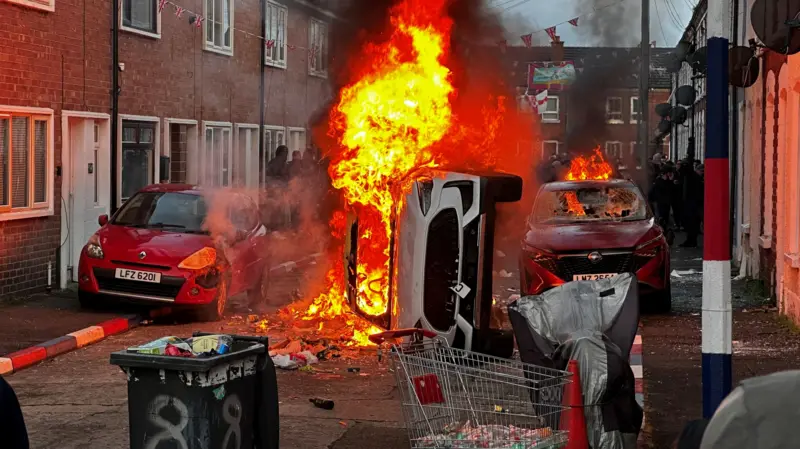
In recent years, conversations around identity, community, and belonging have become increasingly visible across different parts of the United Kingdom. While many communities continue to embrace diversity and coexist peacefully, there have also been moments where tension, fear, and division have surfaced in deeply unsettling ways. One such night in Belfast, particularly along the Lower Newtownards Road, stands as a stark reminder of how quickly order can give way to chaos when anger and hostility take hold.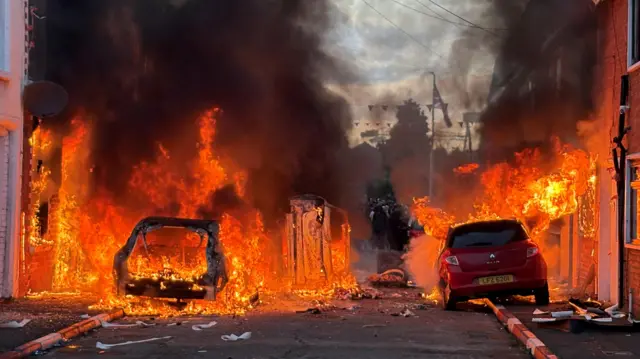
As darkness fell, what began as a gathering soon transformed into something far more alarming. Hundreds of individuals, many with their faces covered, moved through the streets in a coordinated and intimidating manner. The presence of masks alone created an atmosphere of anonymity and unease, making it difficult to identify who was involved and heightening the sense of unpredictability. As the crowd grew, so did the intensity of the situation.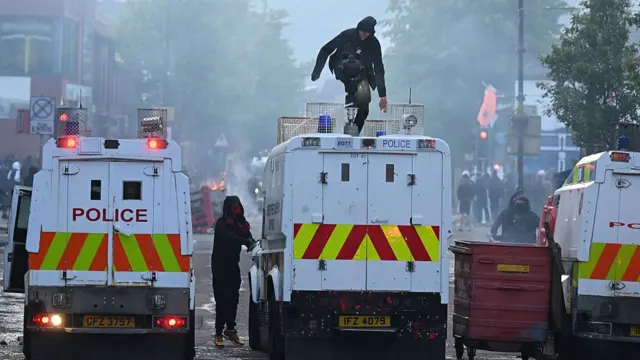
Witnesses described scenes that were both chaotic and deeply distressing. The group carried objects such as bottles, bricks, and pieces of masonry, items that would soon be used not only as tools of destruction but also as symbols of aggression. Fires began to break out as bins were set alight, casting an orange glow across the streets and sending smoke into the night sky. The crackling of flames mixed with the sound of shouting, creating an environment that felt both volatile and out of control.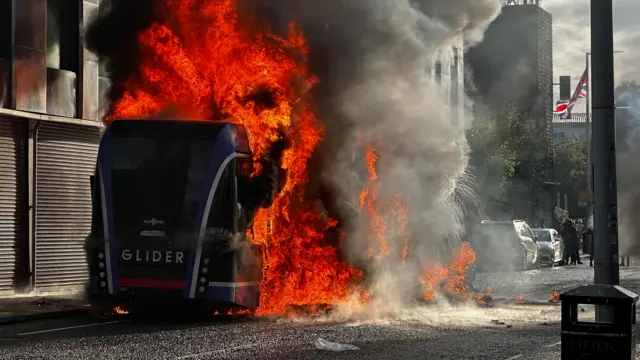
Among the most disturbing aspects of the night were the chants that echoed through the streets. Shouts of “foreigners out” rang loudly, carrying a message that was both exclusionary and threatening. These words, repeated and amplified by the crowd, transformed the event from a display of disorder into something more targeted and deeply concerning. For many residents, particularly those from immigrant backgrounds, these chants were not just words—they were a direct threat to their sense of safety and belonging.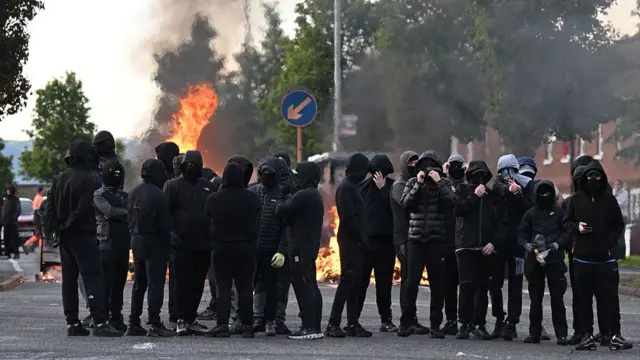
As the group moved from street to street, their actions became increasingly aggressive. Reports indicated that doors were banged on, windows were smashed, and in some cases, attempts were made to force entry into homes. The idea that a crowd could move through residential areas in this way created a sense of fear that extended far beyond those directly affected. For families inside their homes, the experience was one of uncertainty and vulnerability, unsure of whether they would become the next target.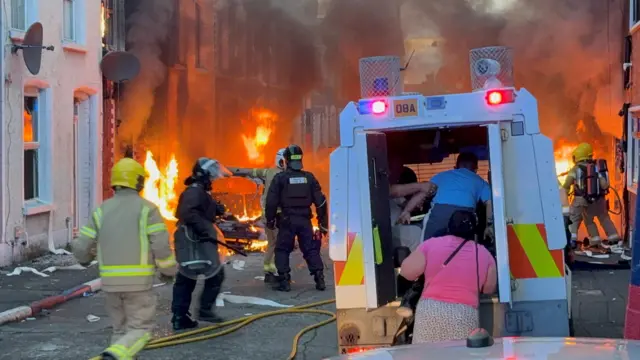
The targeting of homes added a deeply personal dimension to the events. A home is often considered a place of safety, a space where individuals and families can feel secure. When that space is threatened, the psychological impact can be profound. The act of banging on doors or attempting to break windows is not just about physical damage; it is about instilling fear and asserting dominance. For those who experienced it, the memory of that night is likely to remain long after the physical damage has been repaired.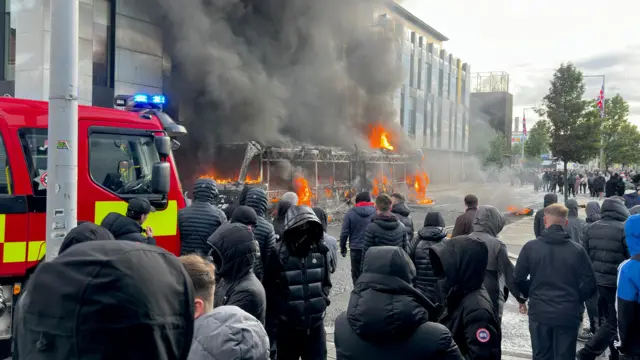
One particularly striking moment described by witnesses involved an attempt to set a car on fire. As individuals gathered around the vehicle, preparing to ignite it, the situation shifted when a woman emerged from her home. Her voice, cutting through the chaos, reportedly clarified that the car belonged to a local resident and not someone they were targeting. In that moment, the crowd’s behavior changed, and the attack on that specific vehicle was halted. This interaction, brief as it may have been, highlighted the selective nature of the aggression and the underlying motivations driving it.
The idea that such decisions could be made in real time, based on perceived identity, underscores the complexity and danger of the situation. It reveals how quickly individuals can become targets based on assumptions, and how fragile the boundary can be between safety and risk in such an environment. For many observers, this moment served as a chilling illustration of how division can manifest in tangible and immediate ways.
As the situation escalated, law enforcement became increasingly involved. Police presence in such scenarios is critical, both for restoring order and for protecting those at risk. In this case, officers were faced with the challenge of managing a large and volatile crowd while also responding to specific incidents of violence and intimidation. Their role required not only physical intervention but also strategic decision-making to prevent further escalation.
One of the most distressing outcomes of the night involved a young family who had to be removed from their home by police for their own safety. The image of a family being escorted away from their residence, potentially in the middle of the night, is one that resonates deeply. It represents a breakdown of normalcy, where everyday life is disrupted by circumstances beyond one’s control. For the family involved, the experience was likely both frightening and disorienting, leaving lasting emotional effects.
Scenes like these also have a broader impact on the community as a whole. Even those who were not directly affected may feel a heightened sense of anxiety or concern. The knowledge that such events can occur within one’s own neighborhood can alter perceptions of safety and trust. It can lead to questions about what might happen in the future and whether similar incidents could occur again.
The response to such events often involves a combination of immediate action and longer-term reflection. In the immediate aftermath, efforts are focused on ensuring safety, providing support to those affected, and assessing the extent of the damage. This may include securing properties, offering temporary accommodation, and providing reassurance to residents. These actions are essential in stabilizing the situation and beginning the process of recovery.
In the longer term, however, the focus shifts to understanding the underlying causes and preventing similar incidents from occurring. This involves examining the factors that contributed to the unrest, including social, economic, and cultural dynamics. It also requires a commitment to addressing issues of division and promoting a more inclusive and cohesive community.
Public reaction to events like these can vary, but there is often a strong sense of condemnation for acts of violence and intimidation. Community leaders, officials, and organizations may speak out against such behavior, emphasizing the importance of respect, tolerance, and unity. These statements play a role in shaping the narrative and reinforcing shared values, even in the face of difficult circumstances.
At the same time, there is often a recognition that addressing the root causes of such events is not a simple task. It requires ongoing effort, dialogue, and collaboration between different groups within the community. This may involve initiatives aimed at building understanding, reducing tensions, and creating opportunities for positive engagement.
The role of media and social platforms in covering such events is also significant. The way in which information is shared and interpreted can influence public perception and response. Accurate and responsible reporting is essential in ensuring that the focus remains on facts and context, rather than speculation or sensationalism. This helps to provide a clearer understanding of what occurred and why it matters.
For those who experienced the events firsthand, the impact is often deeply personal. The memory of that night, the sounds, the sights, and the emotions, can remain vivid long after the situation has been resolved. Support services, including counseling and community outreach, may play a role in helping individuals process these experiences and move forward.
In reflecting on such incidents, it is important to consider both the immediate and broader implications. While the events themselves may be confined to a specific time and place, their effects can extend far beyond those boundaries. They can influence how people think about their community, their relationships with others, and their sense of belonging.
Ultimately, the events on the Lower Newtownards Road serve as a reminder of the importance of maintaining a sense of unity and understanding within communities. They highlight the potential consequences of division and the need for ongoing efforts to promote inclusivity and respect. While the night itself was marked by fear and disruption, it also presents an opportunity for reflection and growth.
By learning from such experiences, communities can work toward creating environments where individuals feel safe, valued, and respected, regardless of their background. This requires a collective commitment to addressing challenges, supporting one another, and building a future that reflects shared values of dignity and coexistence.
In the aftermath of a night marked by fear and disruption, the process of understanding what led to such events becomes just as important as addressing the damage itself. Incidents like those witnessed on the Lower Newtownards Road do not emerge in isolation. They are often the result of a combination of factors that build over time, including social tension, misinformation, economic frustration, and a sense of division that can be exploited or intensified under certain conditions. Recognizing this complexity is essential for anyone seeking to understand not just what happened, but why it happened.
Belfast, like many cities, carries a layered history that continues to shape its present. While significant progress has been made over the years toward peace and stability, underlying tensions can still surface, particularly in moments of uncertainty or heightened emotion. In such environments, even small triggers can escalate quickly, drawing in individuals who may feel disconnected, frustrated, or influenced by narratives that promote division. This does not excuse the behavior witnessed, but it provides context for how such situations can develop.
The role of group dynamics in these events is also significant. When individuals gather in large numbers, especially under conditions of anonymity such as wearing masks, behavior can change. Actions that might not occur in isolation can become more likely in a group setting, where responsibility feels diffused and emotions are amplified. This phenomenon, often observed in crowd behavior, can lead to rapid escalation, particularly when there is a shared focus or target.
The use of masks, in particular, adds a layer of complexity. On one hand, they provide anonymity, making it more difficult for authorities to identify those involved. On the other hand, they can contribute to a sense of detachment, where individuals feel less accountable for their actions. This combination can create an environment where aggressive behavior becomes more likely, as the usual social and legal constraints feel less immediate.
For residents who experienced the events firsthand, the psychological impact can be lasting. Even after the fires are extinguished and the streets are cleared, the memory of what occurred remains. The sounds of shouting, the sight of flames, and the feeling of vulnerability within one’s own home can leave a deep impression. For some, this may lead to increased anxiety, difficulty sleeping, or a heightened sense of alertness. These responses are natural, reflecting the body’s way of processing and responding to stress.
Children, in particular, may be affected in unique ways. Witnessing or hearing about such events can be confusing and frightening, especially if they do not fully understand what is happening. The image of a family being escorted from their home, for example, is one that can resonate deeply, raising questions about safety and stability. Supporting children through these experiences often involves open communication, reassurance, and, when needed, professional guidance.
The response of the wider community plays a crucial role in the healing process. Acts of support, whether through direct assistance, public statements, or community gatherings, help to reinforce a sense of unity and resilience. These actions send a message that the events of that night do not define the community as a whole, and that there is a collective commitment to moving forward in a positive direction.
Local leaders and organizations often take steps to address both the immediate and underlying issues. This may include organizing meetings, facilitating dialogue between different groups, and implementing programs aimed at reducing tension and promoting understanding. While these efforts may not provide immediate solutions, they contribute to a longer-term process of building trust and cohesion.
Law enforcement agencies also face important challenges in responding to such incidents. Their role extends beyond managing the immediate situation to include investigating what occurred, identifying those responsible, and ensuring that appropriate actions are taken. This process requires careful coordination, evidence gathering, and adherence to legal procedures. It also involves balancing the need for accountability with the importance of maintaining public trust.
The investigation itself may involve reviewing footage, collecting witness statements, and analyzing the sequence of events. Each piece of information contributes to a clearer understanding of how the situation unfolded. In some cases, this process can take time, particularly when dealing with large groups and complex circumstances. Patience and thoroughness are essential in ensuring that conclusions are accurate and just.
At the same time, there is often a broader conversation about prevention. How can similar incidents be avoided in the future? What steps can be taken to address the underlying factors that contribute to such events? These questions do not have simple answers, but they are an important part of moving forward. They require input from multiple perspectives, including residents, officials, and experts, each contributing to a more comprehensive understanding.
Education and awareness are key components of this process. By promoting understanding of different cultures, backgrounds, and experiences, communities can reduce the likelihood of division and misunderstanding. This does not happen overnight, but through ongoing effort, it is possible to create environments where differences are respected and valued rather than feared.
The role of communication cannot be overstated. Clear, accurate, and timely information helps to reduce uncertainty and prevent the spread of rumors or misinformation. In the absence of reliable information, speculation can fill the gap, sometimes exacerbating tension. Ensuring that residents have access to trustworthy sources of information is therefore an important aspect of managing both the immediate aftermath and the longer-term response.
Media coverage also plays a significant role in shaping public perception. Responsible reporting can provide context, highlight the experiences of those affected, and contribute to a more informed understanding of the situation. At the same time, it is important to avoid sensationalism or narratives that may inadvertently increase fear or division. Striking this balance is essential in supporting both awareness and stability.
For those who were directly affected, the path forward may involve a combination of practical and emotional steps. This could include repairing damage to homes, seeking support from community organizations, and finding ways to process the experience. While each individual’s response will be different, the presence of support systems can make a meaningful difference in how they navigate this process.
The broader significance of the events lies in what they reveal about the importance of community values. Respect, inclusivity, and cooperation are not just ideals; they are essential components of a stable and healthy society. When these values are challenged, as they were during this incident, the response of the community becomes a reflection of its commitment to upholding them.
In reflecting on the events of that night, it is important to recognize both the severity of what occurred and the potential for growth that follows. While the scenes described were deeply troubling, they also highlight the resilience of those affected and the capacity of communities to come together in response to adversity. This resilience is not always immediately visible, but it is present in the actions of individuals and groups who work to support one another and rebuild.
As time passes, the focus will gradually shift from the immediate impact to the lessons learned. These lessons, while rooted in a difficult experience, have the potential to inform future actions and decisions. By examining what happened and why, communities can identify ways to strengthen their response, address underlying issues, and reduce the likelihood of similar events.
Ultimately, the story of that night in Belfast is one that encompasses both challenge and response. It is a reminder of the complexities that can arise within communities, but also of the importance of addressing them with care, understanding, and a commitment to positive change. Through reflection, support, and continued effort, it is possible to move forward in a way that honors those affected and contributes to a safer, more inclusive future.
In the days that follow such an incident, attention often turns toward rebuilding not only physical spaces but also the sense of trust that may have been shaken. Streets that were once familiar can feel different after experiencing unrest, even if only for a short time. Residents may find themselves more cautious, more aware of their surroundings, and more reflective about the environment they live in. This shift in perception is a natural response, but it also highlights the importance of restoring a sense of normalcy as quickly and thoughtfully as possible.
Community-led efforts can play a powerful role in this stage. Small gestures, such as neighbors checking in on one another, local groups organizing support, or volunteers helping to repair damage, contribute to rebuilding confidence. These actions may not erase what happened, but they help create a counter-narrative—one that emphasizes unity, care, and resilience over fear and division. Over time, these positive interactions can help reshape how people feel about their community and their place within it.
At the same time, there is often a need for continued dialogue. Events like this can leave questions unanswered and emotions unresolved, making it important to create spaces where people can express concerns and share perspectives. Open conversations, when handled respectfully, can reduce misunderstandings and help address the deeper issues that may have contributed to the situation. While such discussions can be challenging, they are a necessary step toward long-term stability and cohesion.
Authorities and local leaders may also look at ways to strengthen preventative measures. This could include increased community policing, better communication channels between residents and officials, and programs designed to engage individuals who may feel disconnected or marginalized. Prevention is not solely about enforcement; it is about creating conditions where tensions are less likely to escalate into harmful actions.
For many observers, the incident also raises broader questions about the role of identity and belonging in modern society. In increasingly diverse communities, the ability to coexist peacefully depends on mutual respect and understanding. When this balance is disrupted, even temporarily, it serves as a reminder of how important these values are. Reinforcing them requires ongoing effort from individuals, institutions, and communities alike.
In the longer term, the way such events are remembered can shape future responses. If they are approached as isolated moments of disorder, the opportunity for learning may be limited. But if they are seen as part of a larger context that requires attention and care, they can lead to meaningful change. This perspective encourages a more proactive approach, one that focuses not only on reacting to incidents but also on addressing the conditions that allow them to occur.
Ultimately, the path forward lies in a combination of reflection, action, and commitment. While the events on that night were deeply unsettling, they also provide an opportunity to reaffirm the principles that hold communities together. Through continued effort, support, and understanding, it is possible to rebuild not just what was damaged, but also a stronger sense of unity and shared purpose moving forward.