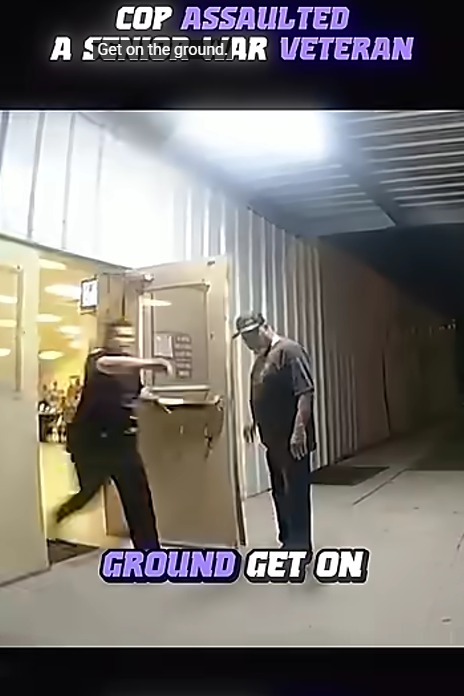
This video presents a combination of bodycam and security camera footage documenting a serious incident involving a police response that results in the wrongful arrest and use of force against a senior war veteran. The footage unfolds in several stages, beginning with the initial dispatch call and progressing through the confrontation, escalation, identification of the mistake, and the subsequent professional consequences for the officer involved. The incident is shown from multiple angles, providing viewers with a clearer understanding of how the situation developed and how miscommunication and rapid decision-making contributed to the outcome.
The video begins with a police officer responding to a call regarding a disturbance at a building. According to the information provided during dispatch, the report concerns a mentally disabled individual wearing a purple shirt who is allegedly causing disruption in the area. This description becomes the primary reference point for the officer as he approaches the location. The expectation is that the officer will locate and assess the individual matching this description and determine whether intervention is necessary.
Upon arriving at the building, the officer encounters a senior war veteran who is present at the entrance. In the footage, the veteran is seen politely holding the door open for the officer, behaving in a calm and cooperative manner. Despite this, the officer quickly engages with him in a confrontational manner. The veteran does not match the description provided in the dispatch call, as there is no indication that he is wearing a purple shirt or exhibiting the behavior originally reported.
As the interaction continues, the officer begins to question the veteran and accuses him of being involved in the disturbance. The veteran responds calmly and attempts to clarify the situation, explaining that he is the post commander at the facility and that the officer may have the wrong person. He emphasizes that he has not engaged in any aggressive behavior and suggests that there has been a misunderstanding regarding identity.
Despite the veteran’s attempts to explain his position, the situation escalates further. The veteran requests space and asks the officer to remain calm in order to de-escalate the interaction. However, the officer perceives the veteran’s responses as noncompliant behavior and continues to treat the situation as a potential threat. This difference in interpretation leads to a rapid increase in tension between the two individuals.
The escalation reaches a critical point when the officer uses force against the veteran. According to the footage, the officer deploys pepper spray, delivers a physical strike, and forces the veteran to the ground in order to place him in handcuffs. These actions occur despite the veteran’s continued statements that he is not the individual described in the dispatch report. The scene becomes increasingly chaotic as the officer proceeds with the arrest procedure.
Shortly after the use of force, a female witness who was involved in the original call intervenes. She approaches the officer and clarifies that there has been a mistake in identification. She explicitly informs the officer that the person responsible for the disturbance is wearing a purple shirt, which does not match the veteran’s appearance. This clarification directly contradicts the officer’s assumption that the veteran was the suspect.
At this stage, the footage shows that the officer begins to reassess the situation. However, instead of immediately releasing the veteran, the officer attempts to justify the actions taken by stating that the individual failed to comply with commands to “get back.” This explanation is presented in response to the witness’s correction and appears to be an attempt to rationalize the escalation that had already occurred.
Following the incident, the video transitions to information regarding an internal review of the officer’s conduct. According to the summary, an internal affairs investigation was conducted to examine the circumstances surrounding the arrest and the use of force. The investigation concluded that the actions taken were not justified based on the available information and that the veteran had been wrongly identified as the suspect.
As a result of the findings from the internal investigation, the officer was ultimately terminated from their position within the department. This outcome reflects the determination that proper procedure was not followed and that excessive force was used against an individual who did not match the description of the reported suspect. The consequences highlight the importance of accurate identification and careful assessment during law enforcement responses.
Overall, the video presents a structured sequence of events beginning with a routine dispatch call and escalating into a serious misidentification incident. The combination of bodycam and security footage allows viewers to observe how quickly assumptions, communication errors, and rapid escalation can lead to significant consequences. The involvement of the witness and the later investigative findings provide additional context that clarifies how the mistake was identified and addressed after the fact.
The incident ultimately underscores the importance of careful verification during police interactions, especially when responding to limited or potentially unclear descriptions. It also illustrates how quickly situations can escalate when communication breaks down between officers, witnesses, and individuals at the scene. The final outcome of the investigation serves as the concluding element of the video’s narrative, bringing closure to an event that began with a misunderstanding and developed into a serious case of wrongful arrest and excessive force.
To better understand how the situation escalated so quickly, it is useful to look at the broader context of how law enforcement responses often unfold when officers are dispatched to calls with limited or potentially incomplete information. In this case, the officer arrives with a specific description in mind: a mentally disabled individual wearing a purple shirt who is reportedly causing a disturbance. This description becomes the central frame through which the officer interprets everything that follows upon arrival at the scene.
When officers respond to such calls, they must make rapid judgments based on the initial dispatch information, environmental cues, and the behavior of individuals they encounter. However, this reliance on quick assessment can sometimes lead to errors in identification, especially in dynamic environments where multiple people may be present. In this video, the officer encounters a senior war veteran at the entrance of the building, which becomes the focal point of the misunderstanding.
From the perspective of the veteran, the interaction begins in a completely ordinary and even courteous manner. Holding the door open for an officer is typically a sign of respect and cooperation, not hostility or resistance. The veteran’s actions suggest that he is not only calm but also supportive of the officer’s presence at the location. This contrast between behavior and perception plays a central role in how the situation unfolds.
Despite the veteran’s calm demeanor, the officer appears to interpret his presence as potentially suspicious. This may be influenced by confirmation bias, where an individual focuses on details that seem to fit an existing expectation while discounting those that do not. In high-pressure situations, such cognitive shortcuts can significantly impact decision-making. In this case, rather than reassessing whether the individual matches the dispatch description, the officer continues to treat the veteran as a possible suspect.
As the interaction progresses, communication becomes increasingly strained. The veteran repeatedly attempts to clarify his identity and role within the facility, stating that he serves as the post commander. This detail is important because it directly contradicts the assumption that he is the individual described in the call. However, instead of de-escalating the situation and verifying this claim, the officer maintains a confrontational posture.
One of the key turning points in the footage occurs when the veteran requests space and attempts to lower the intensity of the interaction. In many policing protocols, verbal de-escalation is a critical step in preventing unnecessary escalation. However, in this instance, the officer interprets the veteran’s request not as a calming measure but as resistance to commands. This difference in interpretation becomes the catalyst for the use of force.
The deployment of pepper spray marks a significant escalation. Pepper spray is typically used in situations where an officer perceives an immediate threat or active resistance. In this case, the veteran is not shown engaging in aggressive behavior toward the officer prior to the use of force, which raises questions about proportionality. Following the pepper spray, the officer physically forces the veteran to the ground and proceeds with handcuffing. The rapid transition from verbal exchange to physical restraint underscores how quickly the situation escalated.
The use of force is particularly notable given the veteran’s identity as an older individual with military background. While age and status do not exempt anyone from lawful police action, they are often considered relevant factors when assessing threat level and physical capability. In this situation, however, those contextual factors do not appear to significantly influence the officer’s immediate response.
After the veteran is restrained, the arrival of the female witness introduces a critical correction to the unfolding narrative. Her statement that the actual suspect is wearing a purple shirt directly contradicts the officer’s assumption. This moment serves as a clear turning point because it provides external verification that the veteran does not match the original description. At this stage, the error in identification becomes apparent to everyone present.
The officer’s response to this clarification is complex. Rather than immediately releasing the veteran, the officer attempts to justify the prior actions by referencing perceived noncompliance, specifically the instruction to “get back.” This justification reflects a common post-escalation rationalization pattern, where earlier decisions are defended based on perceived resistance during the encounter. However, this explanation does not fully address the initial misidentification issue raised by the witness.
From a procedural standpoint, misidentification cases are among the most serious types of operational errors in law enforcement contexts. They not only affect the individuals directly involved but can also impact public trust in policing practices. The fact that the veteran was a senior war service member adds additional emotional weight to the incident, as viewers may perceive a heightened expectation of respect and careful treatment in such cases.
Following the incident, the internal affairs investigation becomes a key component of the overall narrative. Internal investigations are typically conducted to determine whether an officer’s actions complied with departmental policies, use-of-force guidelines, and constitutional protections. In this case, the investigation examines whether the officer had sufficient grounds to believe the veteran was the suspect described in the dispatch call, and whether the level of force used was appropriate given the circumstances.
The findings of the investigation conclude that the officer’s actions were not justified. This conclusion suggests that the decision-making process was flawed at multiple stages, beginning with identification and continuing through escalation and use of force. The determination that the veteran was wrongly arrested reinforces the importance of accurate assessment and verification before engaging in physical enforcement actions.
The termination of the officer serves as the final administrative outcome of the incident. Termination in such cases is typically reserved for situations where violations are considered serious enough to undermine public trust or violate core departmental policies. This decision reflects the severity with which the agency viewed the misidentification and subsequent escalation.
Beyond the immediate facts of the case, the incident raises broader questions about how quickly situations can escalate when communication fails. It highlights the importance of active listening, situational reassessment, and willingness to pause when new information becomes available. In this video, the arrival of the witness provided exactly the type of corrective information that could have altered the outcome if integrated earlier into the officer’s decision-making process.
It is also worth noting how bodycam and security footage contribute to public understanding of such incidents. Without visual documentation, many details of timing, tone, and behavior might remain unclear or subject to interpretation. The availability of multiple camera angles allows viewers to piece together a more comprehensive timeline of events, although interpretation of those events may still vary depending on perspective.
The video ultimately functions as a case study in how quickly assumptions can shape outcomes in high-pressure environments. It demonstrates how a mismatch between initial information and on-the-ground reality can lead to serious consequences when not corrected promptly. It also illustrates the importance of clear communication between dispatch information, responding officers, and witnesses at the scene.
In conclusion, the incident is not only about a single moment of wrongful arrest but about a chain of decisions and interpretations that unfolded in rapid succession. Each stage—from dispatch, to arrival, to confrontation, to escalation, to correction, and finally to investigation—contributes to the overall understanding of how the event occurred. The final outcome emphasizes accountability, procedural review, and the need for careful judgment in situations where mistaken identity can have immediate and significant consequences.
Another important layer to consider in this incident is how stress and time pressure can influence perception during field operations. When officers arrive at a scene where a disturbance has been reported, they often enter a heightened state of alertness. This is a natural response to uncertainty, as the officer must quickly determine whether a situation involves danger, compliance, or misunderstanding. However, this heightened state can sometimes lead to rapid conclusions being formed before all available information has been fully processed.
In this case, the officer’s attention appears to remain fixed on the original dispatch description, which described a person wearing a purple shirt. This detail becomes a mental anchor, guiding interpretation of everything observed at the scene. Even though the veteran does not match this description, the initial assumption appears to persist long enough to influence the early stages of the interaction.
The veteran’s behavior throughout the encounter remains consistent with calmness and cooperation. He does not appear to raise his voice or act in a threatening manner. Instead, he continues to attempt clarification, emphasizing his identity and position within the facility. In many real-world scenarios, such behavior would typically encourage officers to pause and reassess the situation. However, in this case, the escalation continues despite those signals.
This disconnect between behavior and interpretation highlights one of the central issues in fast-moving enforcement situations: the difference between perceived resistance and actual resistance. A person requesting space or attempting to explain themselves may be misinterpreted as noncompliant, even when their intent is cooperative. This distinction becomes especially important when physical force is introduced, as it fundamentally changes the nature of the interaction.
Once pepper spray is deployed, the situation shifts from verbal exchange to physical control. At this stage, the opportunity for de-escalation becomes significantly reduced. Physical restraint often locks both parties into a more rigid sequence of actions, making it harder to reassess or reverse decisions in real time. The veteran being forced to the ground marks a critical turning point in the incident, as it represents the point of maximum escalation based on an incorrect identification.
The arrival of the witness at this stage introduces an external correction that fundamentally alters the understanding of the event. Her identification of the actual suspect wearing a purple shirt directly contradicts the assumptions that guided the officer’s actions. This moment is significant because it provides objective clarification from someone directly connected to the original call, rather than an unrelated bystander.
From an accountability perspective, this correction highlights the importance of integrating new information immediately, even during active enforcement actions. In many procedural frameworks, officers are trained to reassess continuously as new details emerge. The witness statement represents exactly the kind of critical input that should prompt immediate reevaluation of the situation.
However, because the situation has already escalated to physical restraint, reversing course becomes more complicated. The officer’s response, which focuses on justifying prior actions through perceived noncompliance, reflects a common psychological and procedural tendency to maintain consistency in decision-making after escalation has occurred. This is sometimes referred to as post-decision rationalization, where earlier actions are defended in order to preserve perceived correctness of judgment.
The aftermath of the incident, particularly the internal affairs investigation, serves as a structured review of these decision points. Investigators typically examine not only the final actions taken but also the sequence of judgments that led to those actions. This includes reviewing dispatch information, bodycam footage, witness statements, and policy guidelines to determine whether each step aligned with expected procedures.
In this case, the conclusion that the arrest was wrongful indicates that the threshold for reasonable identification was not met. This determination is significant because it establishes that the veteran should not have been treated as the suspect based on the available evidence at the time. It also reinforces the importance of verifying identity before initiating forceful measures.
The officer’s termination represents the administrative resolution of the case, but it also serves as a broader institutional message regarding standards of conduct. Agencies often use such outcomes to reinforce expectations around accuracy, restraint, and proportionality in use-of-force situations. While individual circumstances vary, the overarching principle is that enforcement actions must be grounded in clear and accurate identification of subjects.
Beyond procedural analysis, the incident also has a social and psychological dimension. Public reactions to such videos are often shaped by emotional responses to perceived fairness, respect, and authority. The fact that the individual involved was a senior war veteran adds an additional layer of sensitivity, as military service is commonly associated with respect and honor in many communities. This aspect can intensify public reaction to the perceived mishandling of the situation.
The video also demonstrates how quickly public perception can form based on partial information. Viewers watching bodycam footage often do so without access to the full context available to responding officers at the moment. This creates a difference between real-time decision-making and retrospective analysis. While the footage allows for detailed review after the fact, the officer on scene must act within seconds based on limited and evolving information.
This gap between real-time action and post-event analysis is one of the key challenges in evaluating incidents like this. Decisions that appear clear in hindsight may have been far less obvious in the moment. At the same time, errors in judgment can still be identified and addressed through structured review processes, as seen in this case.
Ultimately, the incident illustrates how a combination of incomplete information, rapid escalation, and misinterpretation can lead to significant consequences. It also shows the importance of continuous reassessment during enforcement actions, especially when new information becomes available. The presence of the witness and the eventual internal investigation provide a complete arc from initial call to final accountability, closing the loop on a situation that began with uncertainty and ended with institutional review.